Archive for the 'Media' Category


Places I wish I could be: Cappella Romana goes to Hagia Sophia by way of Stanford

Something that I’ve been paying a good deal of attention to in the last year is the Icons of Sound project at Stanford University. Art historian Bissera Pentcheva has been involved in piecing together a working model of the aesthetic environment of Hagia Sophia, and the work has involved a recreation of the Great Church’s acoustics. Strategically placed (to say nothing of carefully negotiated with the Turkish government) balloon pops in the cathedral provided an audio sample sufficient to generate a computer model of the building’s resonance and decay, and they called in the big guns, Cappella Romana, to record some things that would demonstrate the model’s efficacy. An initial proof of concept of the project was published in the form of the stunning video found on this page.

The project has proceeded from there, and this weekend is a huge development — Cappella Romana doing a weekend residency at Stanford and presenting two concerts in the university’s new state-of-the-art Bing Hall. These concerts will involve setting up a sound system that uses the computer model of Hagia Sophia’s acoustic; the ensemble and the audience will, in theory, experience the music as though it were being sung in the Great Church itself.

I really wish I could be there, no question about it; if you live anywhere near Stanford, tickets are still available for Saturday evening’s performance. More information is at the Cappella Romana blog, and there’s also a fascinating article about the project in Stanford Live Magazine.

Since the ideal acoustic environment for churches, particularly Orthodox churches, is a topic about which I find myself constantly trying to evangelize to others, I would like to note the following excerpt from the magazine article:

“We learned that spaces have their own particular sound, created by the reverberation and patterns of the reflections that interact with the performer,” says [Jonathan Abel, a consulting professor at the Center for Computer Research in Music and Acoustics in Stanford’s Music Department]. “Singers vary tempo and even subtly vary pitch to hit resonances of the building. There’s an interaction that happens in the field of the space, to the point where it’s difficult to separate the acoustics of the space from the performance of the music. When you perform a piece of music that was written for a particular acoustic in that very same space, it conveys something unique to the listener.”

CR’s Artistic Director, Alexander Lingas, follows up on this a bit later in the piece:

“As singers,” says Lingas, “we’re used to making adjustments for specific acoustics. We can feel and hear the resonances where harmonics lock in between each other, which affects tempo and tuning. So we’re very interested in seeing how it will work when we unite all the parts together in Bing Hall.”

If you’re somebody who is going to be at one of these concerts, I’d love to hear about your experience.

CORRECTION, 8:04pm — I am told that Saturday’s concert is in Memorial Church, not Bing. Thank you for letting me know!

Another contribution elsewhere

Just FYI — Fr. Andrew Damick invited me to contribute an essay to the Orthodoxy and Heterodoxy blog considering the points raised by this piece, and my essay was published this morning. Should you be coming here from Orthodoxy and Heterodoxy, welcome. There’s a decent amount to read in the archives; oral exam prep and fatherhood have slowed my output down somewhat, but I still treat this blog as a going concern, so do please stick around.

“Do you feel in charge?”

Spoilers for The Dark Knight Rises, Skyfall, and so on below.

The UPS truck came yesterday. Thus it was that once Theodore was put down, I took a break from Cicero’s letters, and I told Flesh of My Flesh, “I’m making dinner, and then we’re watching The Dark Knight Rises.” The issue being, you see, that she hadn’t seen it yet. Skyfall was the first movie we had been able to see together in   since The Avengers, and that was just because for my birthday, some friends offered to watch Theodorus Rex while we went out by ourselves.

I very much enjoyed Skyfall, incidentally, and have seen it twice now; the transformation of Daniel Craig as the new James Bond into, effectively, the old James Bond, is complete. If one knows something about the history of actors who might have been Bond, the presence of Ralph Fiennes (as well as the reveal of him as the “new” M, who’s really the “old” M) is clever; he was one of the actors being considered back in 1994 to take over the role after Dalton declined to participate in what became GoldenEye. If I’m remembering a particular issue of Premiere sufficiently, the list before they finally circled back around to Brosnan was Mel Gibson, Liam Neeson, Ralph Fiennes, Sam Neill, and Hugh Grant. Fiennes, then, as a former field agent whom we see take a bullet and fire off some of his own shots, takes on some real-life resonance, given that part of the idea with Gareth Mallory seems to be that he’s what Bond would have been if he’d just been a bit more respectable.

I liked the approach with Skyfall of “James-Bond-as-art-film”; we get a lot of Bond fighting in silhouette, and this can get a bit trippy, particularly when he’s silhouetted against lots of moving neon lights. Sam Mendes also seems to be trying to tell you something with how he frames shots; Bond is frequently centered in the frame, as is Javier Bardem’s Silva, but then, at the very end, when Bond is looking out over the city from MI6’s roof, it starts out with him centered only to have the camera nudge just a little bit right so that Big Ben is now centered. The point seems to be that Bond has finally decided once and for all that he’s doing what he does, not out of anger for Vesper’s betrayal, not out of the repressed trauma of his parents’ death, but for queen and country.

But I’m supposed to be talking about The Dark Knight Rises.

So, four and a half years ago, The Dark Knight took up a big chunk of my summer. I saw it, I think, nine times on the big screen all told, six of those in IMAX, and really what I did during July and August of 2008 was call up my friends and say, “Hey, want to go see The Dark Knight in IMAX with me?” I didn’t have much else to do; I had a French reading knowledge class I was taking, and I was working, but so far as I knew at that point, I was definitely not going to be working on a grad program anytime soon, and my wife was in Germany, followed almost immediately by her spending close to a month in Seattle after her dad was diagnosed with cancer. The Dark Knight seemed as good a way as any to kill time.

Obviously, my life has changed a lot in the intervening years, and I have other ways my time is occupied these days, thank God. Still, I managed to see The Dark Knight Rises four times on the big screen, two of those in IMAX. So, draw whatever conclusions you will about that — such as, for example, baby or no baby, PhD program or no PhD program, I’m still an unrepentant nerd.

The Dark Knight Rises picks up eight years after the Batman took the rap for Harvey Dent’s murders rather than have Gotham lose their knight in shining armor. The storytelling reason for this seems to be so that Batman takes on some qualities of being an urban legend, almost a Spring-heeled Jack kind of figure; I suspect that the practical, real-world reason is because it had been seven years since they started shooting Batman Begins, which itself required Christian Bale to play Bruce Wayne over a seven to eight year span, and The Dark Knight was supposed to take place something like six months after Batman Begins while being made three years later. Everybody looks noticeably older than they did in 2005, in other words, and this gives them an in-story way to explain that.

In the intervening years, Bruce Wayne has become a recluse, letting the physical and mental damage he suffered as Batman settle in. He tries to become a philanthropist, but he finds out projects that can save the world also have the dark side of probably being able to destroy it, a realization which just drives him further into the shadows. Commissioner Gordon has been able to use the memory of Harvey Dent to lock up a lot of people, but the lie is eating away at him. It’s a status quo that’s, for all intents, a well-polished rotten apple.

Enter four characters who each stir up the hornet’s nest in their own way. Selina Kyle is a jewel thief who has taken a curious interest in Bruce’s fingerprints; John Blake is a young cop who sees that everybody is pretty much just going through the motions to keep everything looking nice; Miranda Tate is an investment partner of Bruce’s who wants to show him that the world is worth trusting enough to save it… and then there’s Bane, who is manipulating much of this (or is he?) specifically to force Bruce to get back into the ring as Batman.

A running theme of the movie — which goes all the way back to Batman Begins — is that of the “clean slate”. The express purpose of the League of Shadows, after all, was to “wipe the slate clean”, as it were, when cities got too big and corrupt by destroying them, which is the objective that Bane has inherited; Selina Kyle wants to wipe out her own past (there’s a MacGuffin of the “gangland myth” of a computer program that can do this, which it turns out that Bruce acquired to keep from being used; since the Joker had no traceable record in The Dark Knight, it’s possible that this is intended to be an oblique reference to him); Gordon, Bruce, and Blake are all living with accounts needing to be settled, and so on. Is a revolution how society ultimately has to pay its bill? As R’as Al Ghul suggests in Begins (and as Bane trumpets in Rises), is burning away the brush always the solution, and it’s just a question of scale? Can one man show a better way? One might not be entirely wrong to detect a Christ allegory with where Nolan and company end up with this question (albeit thankfully not in the somewhat ham-fisted way that Superman Returns did), but it seems to me that Plato’s cave is far more explicitly referenced.

Rises does a nice job of bringing things full circle back to Begins; the story keys off of R’as Al Ghul’s conviction in Begins that “Gotham must be destroyed”, and shows that just because R’as Al Ghul died, it didn’t mean the idea died. R’as Al Ghul left a legacy, and it’s a legacy Bruce has to deal with.

Incidentally, for anybody familiar with the comics, there’s only one way the character of Miranda Tate was going to make any sense at all, and if you’re paying attention, they telegraph her identity as Talia from the get-go. She talks like R’as (she has a line about “restoring balance” early on), and there are visual callbacks as well, like showing her good at building a fire, much as R’as was in Begins. A reward of repeated viewings, too, is noticing that the little girl in the prison stabs somebody in the back in one of the first flashbacks, much as the adult Talia does to Bruce.

There are other interesting references to Begins; there’s the explicit comparison of the prison to the well young Bruce falls into in Begins, but there’s also Batman walking on ice (apparently having learned to mind his surroundings after all), and the memorial statue of Batman unveiled at the end bears a striking resemblance to the nightmare Batman that Scarecrow hallucinated in Begins. Both Begins and The Dark Knight end with conversations about thanking Batman — Begins: “I never said thank you.” “And you’ll never have to.” TDK: “Thank you.” “You don’t have to thank me.” — and while Rises has its own ending, it has its own version of this conversation: “Thanks.” “Don’t thank me yet.” It’s a little grace note that seems to say a lot about where Bruce sees what he’s achieved relative to his own ideals — in Begins the story ends with his ideals having won the day, in TDK his ideals have cost him dearly, and at this point in Rises it’s unclear whether or not he will even survive his own ideals.

The point of Rises, and I suppose of Nolan’s whole trilogy, is that in this story, Bruce Wayne isn’t trying to become a superhero, he’s trying to build a myth. As R’as says in Begins, “You have to become an idea.” The idea that there might be a big unstoppable demon that comes after you if you’re a bad guy, and you’ll never know who it is, is much more powerful than there being a human being who can be taken down with a bullet. In Begins he takes on the initial trappings of the legend, in TDK he sees a human being who he thinks could become the idea without having to pretend to be somebody else, only to see that person corrupted, and in Rises he has to complete the mythmaking by, effectively, dying and coming back from the dead — both so he can just be Bruce Wayne once and for all, and so that Batman can be that much more powerful. Along these lines, Bane is presented as sort of a counter-symbol to Batman; “No one cared who I was till I put on the mask,” he says.

Do Nolan’s films constitute a “definitive” Batman? Well, what do you mean by that? “Definitive” according to whose take on the character? Frank Miller’s? Neal Adams and Denny O’Neil’s? Bob Kane’s? Paul Dini’s? Adam West’s? Just by the nature of film, where you’re basically blowing up a short story into two or three hours and only being able to do it once every few years, you’re never going to be able to bring out all the nuances that one can play with in an ongoing serial like a comic book or a TV show. Like any film adaptation, the best you’re going to be able to do is honor the spirit of the source material while doing your own thing as well as you can. Batman, by virtue of being a symbol, is open to a lot of interpretation, and I think Nolan has made three pretty great movies with his interpretation. Somebody else will probably come along and do their own interpretation in a few years, and there may very well be things I like about that one better, perhaps things I don’t like as well; who knows? The comics themselves will still be sitting on the shelf right next to these movies, as well as Tim Burton’s 1989 film. What I think one can say is that this trilogy is a long Batman story that incorporates a lot of ideas and images from the comics as well as the animated series (there’s a decent amount of Batman Beyond in Bruce’s solution), and while it’s something you could never do with Batman as he appears in the comics (unless it were an Elseworlds mini-series or something of that nature), it’s a great way, from where I sit, to encapsulate the character onscreen in a self-contained story.

OK. Back to reading some Latin.

Star Wars, geek culture, and periodization

One of my earliest memories is being in the movie theatre for the second run of Star Wars. I think. I was not quite three when it was re-released on 15 August 1979, but I have a memory of seeing the Death Star run in a theatre seat. I might have been in my dad’s lap. At any rate, it was all Star Wars all the time from that point until I was probably seven or eight; the toys were a regular appearance at my birthday and Christmas several years in a row (the AT-AT was my main Christmas present in 1980, as I recall), I had all the storybooks and novels, I read some of the comic books, and I had the kids’ cassette tape read-along versions as well. Watching the film on VHS was a regular activity when my friends and I had Friday night sleeplovers, and I also recorded it one of the times when it was broadcast on CBS. (Fun fact: John DeLancie, aka “Q” on Star Trek: The Next Generation, was in a cough syrup commercial that aired with that broadcast.)

I never did get into the Timothy Zahn novels — by the time I was in high school, if it wasn’t a movie that George Lucas was involved with, I didn’t particularly care — but I remember the “Kenneth Branagh as young Obi-Wan Kenobi” rumors starting around 1993. (I still wonder if there wasn’t something to those, particularly since it’s come out that Obi-Wan was older in the original treatment of Episode I, and that this older character was basically split into young Obi-Wan and Qui-Gon Jinn.) I also discovered the early drafts of Star Wars online around 1996 or 1997, and became fascinated by what might reappear in the prequel trilogy. Might we see Whitsun? The planet Utapau? Would Anakin Skywalker’s character be anything like Annikin Starkiller? (No, yes, and sort of, but Darth Maul attacking Qui-Gonn and co. on Tatooine in Episode I was very similar to a key moment in one of these drafts.)

I never quite understood the unhappiness of some people with the Special Editions; yes, there was some lame stuff, but I had no problem with the stated reasoning behind them (after all, I was one of the people who clamored to see the “Director’s Cut” of Blade Runner that wasn’t actually a “Director’s Cut” in 1992). I also wasn’t one of the people who looked like the sun had just fallen out of the sky coming out of Episode I: The Phantom Menace. I enjoyed the prequels — again, yes, fine, there were stupid bits, but I didn’t get the near-total turning on Lucas that the Ain’t-It-Cool-News crowd staged. Were the new films the focus of my existence the way the first three had been? No, of course not, but nor should they have — the Star Wars prequels represented ages 22-28 for me, not 3-6. By the time Revenge of the Sith completed the cycle, the Lord of the Rings films had come to represent a more sophisticated, up-to-date view of fantasy-on-film (as they should have); to some extent, so did the Harry Potter series, and then Christopher Nolan’s Batman movies represent another stage of this kind of moviemaking, at least for me.

(Somebody somewhere along the way probably expected me to write something about The Dark Knight Rises. Well, I had a 4 week old baby when it came out, so that post kinda fell by the wayside. I’ll probably write something when the Blu-Ray hits the street. In short, I’ve seen it 4 times, and I think it rewards multiple viewings; one may perhaps argue that it’s a bad Batman movie, but I would argue that even if that’s the case — and I’m not sure it is — it’s still the right way for Christopher Nolan’s story to have wrapped up.)

Still, some things started to make me scratch my head. The behind-the-scenes material on the Episode I DVD showed Lucas talking about how Jar-Jar Binks was intended to be “the funniest character ever in a Star Wars movie”, and it struck me as weird that he would shoehorn a totally unnecessary character into a story he’d supposedly had plotted out for years. It was also evident from reading Michael Kaminski’s The Secret History of Star Wars that whatever Lucas imagined the prequels (and, perhaps, sequels) might have looked like back in 1979 was a completely different beast from what we got from 1999-2005; heck, for that matter, whatever he thought they were going to look like in 1999, even that was something very different from how he finished up six years later. It was also plain that Lucas really wasn’t a good enough storyteller from a technical standpoint to not need somebody else to edit him and bounce things off of, and that what we got really amounted to him making it up as he went along from movie to movie. Did that diminish the accomplishment? No, not necessarily, but why the need to resort to revisionist history every time he made up something new so that it was always accounted for in the “original master plan” that apparently never actually existed in the first place?

Last year, I made the decision to not buy the Star Wars Blu-Ray box. I could handle Darth Vader’s “NOOOOOOOO” at the end of Revenge of the Sith; it made sense in context. But to tack it on at the end of Return of the Jedi — nope, sorry, George, I’m not giving you my money for that, and I’m tired of apologizing for you. I don’t claim to understand his reasons for revising everything and pretending that it was always the way he intended it, even when it wasn’t, but I don’t want to play the game anymore. Sorry, I really don’t.

With today’s news, we get one more bit of revisionist history:

“For the past 35 years, one of my greatest pleasures has been to see Star Wars passed from one generation to the next,” said Lucas. “It’s now time for me to pass Star Wars on to a new generation of filmmakers. I’ve always believed that Star Wars could live beyond me, and I thought it was important to set up the transition during my lifetime.”

Compare with Lucas telling Starlog and Vanity Fair in 1999 that there was no way that there would be a sequel trilogy directed by other people, and telling Total Film in 2008, “I’ve left pretty explicit instructions for there not to be any more features. There will definitely be no Episodes VII – IX” (link here).

I would like to suggest that George Lucas has been perhaps the single greatest contributor to geek culture of the last forty years. Even in the last 15 years or so — in 1996/1997, websites like Ain’t-It-Cool-News, the original incarnation of Corona Coming Attractions, Dark Horizons, and the like all started popping up, and one of the major raisons d’être for such sites was that the trilogy that we’d all been dreaming about for over a decade looked like it was finally going to get made. Such sites made geek moviedom an exciting place to be for a few years.

I would further like to suggest that he has been the single greatest contributor to making geek culture the shrill, bitter, entitled, cynical group of online jackasses that it largely is now. (Lucas, as well as the studios realizing that these websites could easily be turned into just another cheap marketing outlet. I’m looking at you, Harry Jay Knowles, and I’m a guy who remembers AICN from the http://www.bga.com/~rodan/coolnews.html days.) I don’t relate to the “George Lucas raped my childhood” people, but I can’t deny that there’s a big group of movie fans that feel like they got the biggest bait-and-switch in history, and there have been consequences. (By contrast, the guys who maybe have contributed some very serious class to this brave new world? Michael Uslan and J. Michael Straczynski, whose respective abilities to be real gentlemen and to provide an inspiring window into the projects they work on are amazing. Yes, sometimes JMS comes across as a bit full of himself, and Uslan’s non-Batman movies are hit-and-miss at best, but nonetheless, they’re both doing it right in a big way.)

So now we enter the Disney period of Star Wars. One of the things I’m trained to think about as a historian is, when trying to come up with a schema for periodization, looking at the sources to which your historical actors are looking back. The Renaissance is the Renaissance because they’re looking back to Greco-Roman antiquity. Early Modern Europe is Early Modern Europe because they’re looking back to the Renaissance. That kind of thing. In making the first Star Wars movies, Lucas was looking back to serials, to Flash Gordon, to The Hidden Fortress, to a language of filmmaking that had been largely abandoned, so all he had to do, really, was rework it with the tools he had available in 1975, and invent whatever new tools he needed to be able to make that kind of cinematic experience up-to-date for the contemporary audience. There wasn’t really an existing frame of reference for what Star Wars was doing — Planet of the Apes and Logan’s Run were what people thought of when it came to cinematic science fiction and fantasy.

The problem with the prequels, ultimately, is that they had an audience with expectations. Both Lucas and the audience had to look back to Star Wars, Lucas so he could figure out where he needed to end up, and the audience to try to second-guess him. Between 1983 and 1999, there were things like DuneHoward the Duck (ahem, George), Superman IVBatman and RobinAlien3 and Alien:ResurrectionIndependence Day… lots of ways that audiences had been shown that studios would cynically try to squeeze money out of them with inferior product. Surely George Lucas (who, as I mentioned, gave us Howard the Duck) wouldn’t do that, right?

And, as I say, I’m not convinced that he did do that with the prequels, but there are sufficient numbers of people who are convinced of that, that, really, Disney needs to be very conscious of what they look back to as they approach this new era of Star Wars. Are they going to look back to the prequels (which we might think of as the Middle Ages)? The originals (which we might think of as the Late Antique Roman Empire in full bloom)? The sources of the originals (Greco-Roman antiquity before Constantine)? Will we get a Star Wars Renaissance? Or something else? Are they going to give this to talented filmmakers who idolized the original trilogy growing up to try to reinvent and to do something as revolutionary playing in this universe as the first movie did in establishing the universe? Or are they going to give this to people who do serviceable work-for-hire and hope for a franchise that nobody needs to think too hard about, like Pirates of the Caribbean became? Will these new films be just so much big-budget fan fiction? At the same time, can’t one make the case that the prequels amounted to big-budget fan fiction that happened to be done by George Lucas? Dunno — guess we’ll see in 2015. We’ll see if this new trilogy is worth Theodore’s time the way the original trilogy was worth mine.

And meanwhile, Bryan Singer is back on X-Men, too. He’s coming back to do a sequel to a reboot/prequel/whatever — that he was supposed to direct in the first place — of a series that he got kicked off of to do a sequel to a different series, and the person who originally replaced him on the movie he got kicked off of, and who also replaced him on the reboot/prequel, is whom he’s replacing now. Got all of that? Days of future past indeed. Between this and Leia Organa now being a Disney princess, everything old is new again, and vice versa.

A contribution elsewhere

A couple of months ago, the people involved with new online Orthodox Arts Journal asked if I would be interested in contributing anything to their efforts. I’m a big fan of New Liturgical Movement, and as this is sort of an attempt to do something similar from the Orthodox side, I was thrilled to participate however I could. I suggested some things I can do, it seemed to make sense to all concerned, and as of this morning, my first post for them is up. Take a look, and peruse the rest of the site as well — they’re doing some nice stuff, and it’s an honor to be involved.

That’s my boy.

That's my boy.

Thoughts on Prometheus

When I was probably five years old at the most (c. 1981), I remember my parents getting this really amazing machine called a VCR. Well, actually, it was an array of machines; there was the VCR unit itself that the tape went into, there was a separate unit that served as the TV tuner and timer (and I remember the hours that we had to spend turning the little knobs for each channel on that thing to get them to actually come in clearly so we could record TV), and then the humongous camera that connected to the VCR (which you then had to carry around with a shoulder strap if you were recording anything).

I don’t know why I remember this particular detail, but I do; the first movie my parents watched on that VCR was Alien. Maybe part of why I remember it is because they allowed me to be in the room, but I had to have my back to the TV the whole time, which I didn’t understand.

I didn’t actually see Alien myself until probably sometime in the early 1990s, perhaps some time after the time I first watched Blade Runner, which itself was probably around 1990 or so. Now is not the time necessarily to write a full-length essay about my love of Blade Runner, but what I will say is that it was a vital step along the way in my movie geekdom. Batman (1989) had gotten me excited about a number of things when it came to film — director as auteur, production design, the importance of the score, and so on — but Blade Runner really got me thinking about the process of filmmaking and how things change, evolve, progress, and yes, sometimes get messed up in the journey from page to screen. It was the first time I was introduced to the idea that there might have been a very different movie left behind somewhere in the process, and that it might be well worthwhile to restore those other concepts. (I’m sure somebody has mused at some point about the parallels between scholarly production of editions of texts based on application of theories of textual criticism to manuscript culture and the phenomenon of multiple existing cuts of a film.) Although I missed the original theatrical run in 1982, I saw it at the Neptune Theater in Seattle once if not twice in 1991, I saw the “Director’s Cut” (that wasn’t really a director’s cut, but never mind) at the Egyptian Theater in 1992, and I was also fortunate enough to see the so-called Workprint at the same theater in 1999. Another thing I remember is that each time I saw it, the place was packed to the gills. And yes, I’ve got one of the Final Cut briefcase sets. It’s right next to the Inception set. Don’t judge me.

Since Blade Runner, I have found Ridley Scott to be always creatively ambitious in the process with the final product being somewhat hit or miss, depending on the film. I still think The Duellists is an incredibly underrated and underappreciated piece of work; Legend (of which I’ve only ever watched the director’s cut with the Jerry Goldsmith score) is a movie with some fascinating ideas and beautiful visuals but that clearly was trying to overreach in terms of what could be done at the time (and in general makes me glad that nobody seriously attempted a live-action Lord of the Rings any sooner than they did); Black Rain and Hannibal are both technically terrific, and I like both movies, but they’re clearly work-for-hire efforts; Gladiator and Kingdom of Heaven (the extended cut, anyway) are both great; I liked American Gangster and Body of Lies well enough even if neither were exactly earth-shattering; Robin Hood seemed like a fantastic idea with epic scope that somewhere along the way got scaled down to an attempt to use some leftover bits from Gladiator and Kingdom of Heaven for a younger audience, and while it had its good points, it never seemed like I was actually watching a final product anybody intended me to see, but rather something that got assembled more or less by committee.

Which brings me to Prometheus.

The idea of Ridley Scott returning to what we might call “fantastic” fiction for the first time since Legend and getting to play in the Alien universe again has been an intriguing one to me from the get-go. He’s certainly a different filmmaker than he was in 1979, and technology has perhaps caught up more to the way somebody like him thinks — so what would he do? He’s said many times in interviews over the years that he would be interested in asking the question where the big guy in the chair in the first Alien came from, so presumably that’s where he would go. How would he get there and what would he do with it? At the same time, the business of filmmaking has changed a lot since 1979, so how would that impact the movie?

I saw Prometheus last night in IMAX 3-D. I’m not really going to write a review of it, as such; I can tell you that I enjoyed it immensely, thought it had a great cast, was stunning visually, told an interesting story that I expect is really just the prologue to the movie Scott really wants to make, and that it’s really more along the lines of SF adventure that has some tense, squirmy moments, rather than being a horror movie set in an SF context the way Alien was — but writing a critical evaluation of it point-by-point isn’t what I’m interested in doing. Right now I’m really quite turned off by a certain subset of movie geekdom that seems to go out of its way to tear down to component atoms anything that dares to not be exactly the same movie they’ve already made in their head (see the comboxes on a site like Ain’t It Cool News, for example — man, that site used to be pure gold; how far the mighty have fallen), and that’s not where I want to go. I’m more interested in talking about the ideas in the film, and how they link up with other things one finds in Scott’s filmography.

I will, however, acknowledge up front the impact that present-day moviemaking economics appears to have had on Prometheus so I can get it out of the way. There was a lot of nattering over the film’s rating; would it be R, like the original Alien, or would it be PG-13? Would the business side of how movies get made today allow for an ambitious R-rated SF film? You could do it back in 1979 for a number of reasons, but with today’s emphasis on the biggest opening weekend possible, it would seem to be a harder sell. When Prometheus was finally announced as having an R rating a few weeks ago, there were some who assumed that it was a “soft” R — that is, it had been edited down as much as possible in hopes of getting a PG-13, but ultimately couldn’t get there, and by that point it was too late to say, “Okay, we’ve got an R movie, it is what it is, let’s go ahead and throw everything back in.” And yes, that in fact seems to be the case. There is a lot of, shall we say, connective tissue that is missing from certain moments in the film that I assume to have been cut out in the quest for a PG-13. There are a couple of events that I suspect are the, shall we say, irreducibly minimal R-rated bits (if you’re a pregnant woman, you’re probably not going to want to see this movie until you’re well past delivery, I’ll say that much), but aside from those, in terms of language, general level of violence, sex, nudity, etc. there’s nothing that makes this a characteristically R-rated movie in the way that, say, Watchmen is. Does it come across as creatively compromised as a result? Not exactly, but I’m very curious to see how the inevitable unrated Director’s Cut differs when it comes out on Blu-Ray.

Warning: spoilers ahead.

I had a conversation the other day with one of my fellow DO summer school students in which the seeming affinity on the part of certain Evangelical Christians for Judaism and Israel came up. My colleague said, “Well, when you’re a kid, if you don’t like what Dad tells you [i.e., Catholicism/Orthodoxy], you go and ask Grandpa [Judaism]. Makes perfect sense.”

Prometheus is a story about going and asking Dad questions, and Dad not really liking that you asked and you not really liking the answers. In this way, it’s really more of a piece with Blade Runner, which in terms of theme is all about the creation getting to ask the creator, “Why did you make me, and why did you make me flawed?” It’s a moment that also crops up in Gladiator, when Commodus demands to know from Marcus Aurelius why he’s getting passed over (which is also paralleled in Prometheus by a scene between Guy Pearce’s Weyland and Charlize Theron’s Vickers). “Your faults as a son is my failure as a father,” Marcus Aurelius tells him, which echoes Tyrell telling Roy Batty, “You were made as well as we could make you.” The consequences are the same for both Tyrell and Marcus Aurelius, with the artificial golden-eyed owl in the former case and the statue heads of the Antonines in the latter case all impersonally witnessing the patricide.

Ellie Shaw has to do the same thing to her creator, her genetic “father”, but in this case it’s because her creator is about to kill her. She has led seventeen people to a far corner of the universe in order to meet the race that she believes engineered the human race, only to find out that God does not like us very much. Why? Well, that’s a question that isn’t directly answered, but the title combined with certain details in the film suggest some intriguing possibilities. Prometheus the Titan gave mankind fire against the will of the gods, and subsequently had to endure being chained to a mountain peak and having his liver eaten by an eagle every day for the rest of eternity. Were we created without permission? Certainly the film makes a visual point of the Engineers’ ship at the very beginning being a completely different design from the ships we see in towards the end, suggesting different factions. Are the Engineers ultimately victims of their own hubris, with their propensity for meddling with natural biologies resulting in weapons they can’t control, among which they count us? Certainly that would tie the iconic image of the xenomorph chestburster (which, yes, we do see in some form) to Prometheus’ mythological fate — which, incidentally, is why I don’t think the film’s final scene is “tacked on” in any way, as some have argued. It is part and parcel of the imagery and themes invoked by the title, and hardly just thrown in to underscore the obvious.

Back to the idea of going to Grandpa when you don’t like what Dad tells you. David, the android that is participating in the mission, is one part Ash (Ian Holm’s murderous robot in Alien), one part Roy Batty, one part HAL 9000, and a bit of Lance Henriksen’s Bishop from Aliens, but Michael Fassbender makes it entirely his own thing, too. He’s not terribly impressed with his creators, but he’s fascinated and delighted by what he encounters of the Engineers. David’s actions are never entirely benign, but neither is he exactly vicious in the way that HAL and Ash are. I’m certain that he was acting under Weyland’s orders to infect Holloway and get the impregnated Shaw into cryosleep as quickly as possible, but he also acts genuinely curious to see what will happen when he carries out those orders — like Ash, he admires what they’ve found, and wants to see the end result. David isn’t all that interested in why humans made him; one gets the impression that he wants to ask the Engineers (i.e., Grandpa) why they bothered making the humans in the first place. My guess is that the Engineer knocks David’s head off because he sees David as the result of humanity’s hubris, the same hubris that seems to have resulted in whatever happened on LV-223’s installation 2,000 years ago (what I assume to be an outbreak of xenomorphs, judging by the burst chests of the Engineer corpses).

I said that I expect Prometheus to be a prologue to the story Ridley Scott really wants to tell. I say that because of the narrative problem of deciding to tell the story of “the big guy in the chair”. In order for such a story to work, it has to be told from the standpoint of a human being, an audience surrogate. This protagonist has to have a reason to seek that race out, and how do you do that in a way that makes sense when, in terms of storytelling logic and what appears to be the framework set up in Alien, there’s no way the protagonist could know they exist? Well, by the end of Prometheus, Ellie Shaw knows they exist and has a reason to seek them out on their own turf, and it’s propelling the story forward into another film.

Miscellaneous comments: Ridley Scott has a thing for closeups of eyes. Instantly-recognizable shot from Blade Runner:

And Holloway in Prometheus:


I rather liked that David’s head was leaking milk. Nice visual tie to Ash in Alien. I also noticed that Ellie is dragging his body along as well, so presumably he will be whole again in a sequel.

I assume there is more of Patrick Wilson as Ellie’s father somewhere on the cutting room floor. Otherwise, why bother casting Patrick Wilson? Seems like luxury casting for five lines. Along similar lines, I assume there was footage shot of a younger Peter Weyland, because it doesn’t make sense to me to cast Guy Pearce specifically to put him in old age makeup. I could be wrong on both counts.

In terms of narrative ties to Alien — I’m sure we’ll find out more for certain in any future film, but it seems to me that the Engineers’ rush to leave the installation 2,000 years ago (and I’m intentionally not going to discuss the implications of that date in terms of Earth history) is probably what results in the ship that crash-landed on LV-426. Their weapons stock got out of control, and David mentions that there are “other ships”, plural, so not just the one that he and Ellie are flying to the Engineers’ home planet. The one on LV-426 was perhaps the one that actually was able to take off.

However, one point that I find really intriguing is the possibility of what the star map that David was interacting with might have been. Was it keeping track of every place that the Engineers had interfered or interacted with the evolutionary process? If so, they’ve seeded a lot of worlds. What else is out there to be found in this universe besides xenomorphs?

Even in its clearly toned-down form, Shaw’s self-caesarean was pretty rough going (and I assume it was ultimately one of the barriers for a PG-13 rating). I found it very uncomfortable to watch as a man; I can’t imagine what it would be like for a woman, let alone a pregnant woman. I won’t be suggesting to my wife that she watch it until we’re well past the birth. I’ll note that it is also one of the ways the imagery of Prometheus having his liver pecked out and eaten is invoked; Shaw’s faith and optimism are ultimately used against her, and this is the price. This is maybe overthinking it a touch, but as a name, Προμηθεύς means something like “forethought”, which Shaw seems to lack — she didn’t really think her ideas through sufficiently.

Anyway — Prometheus has my recommendation. Go see it and draw your own conclusions.

“My teacher can beat up your teacher” throughout the ages

Hello from… well, not Dumbarton Oaks, not quite. I’m in Washington, DC, at the George Washington University Mount Vernon campus, where our housing is. Friday night I went to bed at 12:30am so I could wake up at 2:30am so I could leave for the airport at 3:45am to get on a 6am flight so I could get to DC by 10:30am… except that we couldn’t check in here until 3pm.  Well, my longtime e-acquaintance Ivan Plis took pity on me and hung out with me for lunch, taking me to Nando’s Peri-Peri just off of DuPont Circle, which is easily the flame-grilled Portuguese chicken I have ever had. Yes, it’s also the only flame-grilled Portuguese chicken I’ve ever had, but it was still delicious. After lunch, Ivan walked me around the area a bit, or at least as much as was possible with two suitcases, and then we parted ways. Getting the rest of the way here was a bit of an adventure; my iPhone 3GS just will not hold a charge anymore, and it died just as a bus was coming that may or may not have been the bus I wanted to get on. I got on, only to realize about fifteen minutes later that it was the wrong one. I got off to wait at the stop across the street for the bus going in the opposite direction, which theoretically should have been about a half hour away… except that it was an hour away. It finally appeared, and I was able to get off at the right stop, only to still have a half mile left to walk, with most of it uphill. I guess I got my exercise today. This morning I attended Matins and Liturgy at St. Sophia Greek Orthodox Cathedral, which is about a mile away as the crow flies (but of course it’s not that simple; it’s about 2 miles by cab) and has a new protopsaltis in residence; I spent the afternoon walking around the area, attending Choral Evensong at the National Cathedral (right next door to St. Sophia, as it happens), and had a lovely day all around until I tried to go home and took a shortcut through a park’s forest trails. Zigged when I should have zagged, I had three bags of groceries, and wound up getting stuck with an uphill route I was trying to avoid. All in all, it took me about an hour and a half to get home when it should have taken about twenty minutes. Oh well. Orientation at Dumbarton Oaks is 9am Monday; we’ll see what happens.

By the way, there is going to be a group blog for Andrew Gould‘s expanded New World Byzantine concept, sort of an Orthodox version of the New Liturgical Movement. It looks like there are some definite parallels between what the Saint John of Damascus Society has in mind and what Andrew is trying to get going for liturgical crafts across the board. Should be fascinating to see where it goes. (And incidentally, there are already some big things in the works for SJDS, things that have already started to come together much more quickly than we thought might happen. Announcements to come soon.)

A few months ago I got invited to review a book titled The Past is Always Present: The Revival of the Byzantine Musical Tradition at Mount Athos by Danish ethnomusicologist Tore Tvarnø Lind. My review will be appearing in a future issue of Logos: A Journal of Eastern Christian Studies, but since I was limited to around 2,000 words (yes, I said “limited”), there was a lot that I wanted to say that I didn’t have space for (all good stuff — the book is great). I was going to have a blog post specifically about the book, but then I had to get my paper in order for the North American Patristics Society conference, do what I could to help get the house ready for impending baby, and then pack for D.C., so that didn’t quite happen.

But then, Friday, there was an unexpected post someplace I don’t check all that often.

So, I’ve noted before, perhaps somewhat infamously, that there are ways in which the internet is a problematic venue. Every imaginable cause in the world probably has a website out there run by a person for whom the sun probably only rises and sets because that issue has his voice advocating for it properly; heck, I’m sure probably somebody thinks that about my little corner of the net. Anyway, I’m somewhat reluctant to participate in many online forums, or even to monitor them too often; I’m not sure, to name but one example, that Byzantine chant needs its own version of Facebook. But, you know, it kinda has its own version of Facebook anyway, and it has its utility as a resource. Still, there are a lot of disputes that get hashed over there that I don’t care to get involved with, and the one time that I got noticed enough to be mentioned in that forum it was bad news (although my friend Taso Nassis is somebody I would not have met without that incident, so all’s well that ends well, I suppose).

On Friday, a notice was posted by one of the more argumentative individuals on that forum about a statement released by the Ecumenical Patriarchate. The Greek is here; this is my (somewhat hurried) translation:

Bulletin from the Holy and Sacred Synod on the subject of ecclesiastical music.

The Ecumenical Patriarchate, from the decision of the Holy and Sacred Synod of 29 March 2012, upon relevant public notice of the Patriachal and Synodal commission concerning divine worship, from 23 March 2012 concerning the subject of our ecclesiastical music, because of the fault of some cantors in applying a theoretical work, at first on the one hand imperceptibly, with time on the other hand more systematic, [a work] published in 1982 under the title “Method of Greek Music: A Theoretical Treatise” [by Simon Karas] and [which] created an uneasy situation, declared that:

1. It dismisses and condemns the “Theoretical Treatise”‘s self-willed, irresponsible, showy retractions to the liability and authority of the decisions of the Mother Church, as even an attempt to disseminate something – as characterized above – outdated and abnormal to the prevailing canonical order of the theory and practice of our ecclesiastical music.

2. It denounces every work of difference, adulteration, and forgery in appearance of old musical works of composers formally recognized by the Mother Church that is unlawful and strange to the prevailing works, and

3. As a musical system it recognizes, applies, and teaches according to the theory, practice, and tradition, [the system which] was established in the years 1812-14 by the Three Teachers, Chrysanthos Metropolitan of Prousa, Gregory the Protopsaltis, and Chourmouzios the Archivist, as “The New Method of Analytic Notation of Musical Melodies,” and approved by the Mother Church.

In the Patriarchate, 28 May 2012

From the Chief Secretary of the Holy and Sacred Synod

Okay. Back up a couple centuries.

As Lind’s book lays out quite well (and he’s not Orthodox, so he doesn’t himself have any particular dog in the fight), in the early part of the nineteenth century there was a reform of the notational system we usually call “Byzantine notation” or “psaltic notation”. This reform reduced the number of signs used, and also introduced a way of being able to more accurately notate rhythm, tempo, and accidentals. Well, the problem is obvious: when you change how something is written down, you effectively fork the tradition, and that’s what happened. Cantors who were trained before the reform continued either singing from old notation or singing the new notation as though it were the old notation, thus passing on the pre-reform tradition. Cantors who were trained from books compiled after the reform without any level of pre-reform tradition learned something different. Subtly different, perhaps, but different, and this appears to have become known as “patriarchal style”, as in the style practiced at and endorsed by the Ecumenical Patriarchate. The Three Teachers didn’t really give an account of their system of reform, so were they intending to preserve what came before, only simplifying how it was represented on the page, or were they intending to turn it into something else? This is the crux of the problem, it seems. (Oh, and if I’m over-simplifying or getting things wrong, please jump in. I’m trying to give a reasonably economical account here of what I think I know, but I don’t want to misrepresent anything.)

To give but one example of the practical difference that I have seen: there is a sign in Byzantine notation called a klasma. It’s a little half oval that can appear either above or below a sign depending on the sign.

Now, the way I was taught to realize a klasma by (now-Dr.) Ioannis Arvanitis is that adds a beat to the sign, but that it also has the function of adding an ornament — a little break in the voice. This ornament is suggested by the name klasma, and according to Arvanitis, it’s a holdover from the old notation, with the ornament being what distinguishes it from simply adding a dot (which also extends the sign by one beat). A somewhat clumsy way of realizing this in staff notation might be this:

When I visited Holy Cross Seminary, I got to sit in on Byzantine chant classes with Dr. Grammenos Karanos, who I’m told is an exemplar of patriarchal style. He told his students that the klasma has the principal function of adding a beat, and only in the context of a relatively small number of specific phrases does one add the ornament. Otherwise, it’s the same the thing as an aplē (adding a dot) and is maintained separately from the aplē for orthographic purposes. That would mean the above phrase would look like this in staff notation:

There’s no shortage of other examples.

Anyway, Simon Karas was an ethnomusicologist who was interested in these differences maintained through oral tradition, as well as the relationship to Greek vernacular music, and he tried to systematize what he observed in the 1982 book referenced in the Patriarchate’s bulletin. (I translated an article about him by Lycourgos Angelopoulos last year that goes into some of this.)

One can perhaps see the divide between those who sang as though the new notation were the old notation and those following the new notation more strictly in the Patriarchate’s choice of the word “outdated” (παρωχημένος) in point one. The irony that I see is that both approaches are conservative; one is performatively conservative, the other is notationally conservative. There is almost a sola Scriptura issue here (but even patriarchal style is informed by oral tradition, so not quite).

Among other things, Lind’s book talks about how Karas’ work influences the monastery of Vatopedi on Mount Athos; students of Angelopoulos (“grandstudents” of Karas, then) work with them on manuscripts, vocal style, and so on. The monks want to preserve an authentic tradition going back before the reform, and there is concern that something is lost in how the reform has been realized. One of the things I find interesting is that the tensions surrounding these preservation efforts seem to follow the old theoretical poles of cathedral (or city) and monastery, with an additional pole of the university. Vatopedi is trying to assert a certain authority and pre-eminence regarding psaltic tradition, Constantinople is trying to do the same thing (as represented by “patriarchal style”), and Karas and his legacy represent a line of academic inquiry that influence how both sides act and react. Who “owns” the tradition? Who speaks for it? Certainly there are issues surrounding how Byzantine chant is understood as something authentically “Greek”, with Constantinople looming large for obvious historical reasons, but with Karas perhaps trying to contextualize Constantinople in a larger “Greek” picture. Constantinopolitan cantors (and those faithful to them), Athenian academics, and Athonite monks — I’m not sure I can think of any particular equivalent issue in this country that’s working itself out in precisely the same way.

The thing of it is, speaking from my previous life as an opera singer, none of this is anything new. “My teacher can beat up your teacher” is part of any musician’s game from the first day they step into the studio. I remember the first time I ever took a lesson with my first voice teacher in college, and he asked me to tell him how I was thinking of certain things. I explained it the way Dennis Kruse taught me, and I can still picture the patronizing smile on this guy’s face when he said, “Oh, that’s all wrong. We’ll fix that.” I can also still remember the way Dennis shook his head when I explained to him what the new guy was telling me, saying, “He doesn’t know what he’s talking about. Get out of his studio as soon as you can.”

Heck, just speaking in terms of the Greco-Roman world, none of this is exactly news. If you were a student of rhetoric in what we might broadly call “the ancient world”, you could count on getting hazed by students of other teachers, you could count on getting beaten up by students of other teachers, and there was even a possibility you could get kidnapped upon arrival in the city by students of other teachers and forced to study with somebody other than your intended teacher. Studying something so marinated in tradition that requires a close relationship with a teacher makes this kind of thing simply inevitable.

Still, nobody here has been declared either a heretic or anathema, there’s nothing here that says “Whatever you do, don’t sing a klasma with the ornament lest your soul be in danger”, and on the whole I can’t really imagine how anything in this notice is going to have any practical force whatsoever without something that looks a lot like an Inquisition or HUAC. “Are you now, or have you ever been, influenced by the 1982 Method of Greek Music by Simon Karas?” Nope, I just don’t see that happening. This strikes me as a sop to somebody at most, but I really don’t know enough about the inner workings of the Ecumenical Patriarchate to know to whom or by whom or why. With all due respect to the Patriarchate, this comes across as over-the-top and heavy-handed, to say the least.

In any event, Ioannis Arvanitis, however poor of a student I may have been, was my teacher (and I hope someday he will be again), he’s one of the great cantors and composers of our day, he’s one of the greatest men I’ve ever had the privilege to know or learn from, and he was a Simon Karas student. Given all of this, I’m left scratching my head at what seems to be the disconnect from reality.

Anyway, I may have more to say about Lind’s book later — perhaps when the review is published I’ll put together a “director’s cut” of it. In the meantime, consider it recommended; it’s a very readable work and should be of great interest to people interested in monasticism, Byzantine music, Greece and modernity, and so on.

And a few more…

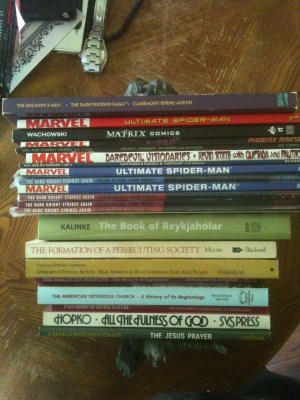
A Monk of the Eastern Church. The Jesus Prayer. “Fr. A” written on fly-leaf; otherwise clean.

Thomas Hopko. All the Fulness of God. Previous owner’s address label on fly-leaf; minor underlining.

Archimandrite Christoforos Stavropoulos. Partakers of Divine Nature, sixth printing. “12.95” written lightly in pencil on fly-leaf. Otherwise like new.

George C. Michalopulos and Herb Ham. The AMERICAN Orthodox Church: A History of its Beginnings. Some light pencil underscores.

Archimandrite Seraphim Aleksiev. The Forgotten Medicine: The Mystery of Repentance. Previous owner’s seal embossed on fly-leaf. Otherwise clean.

Stanley Samuel Harakas. Exploring Orthodox Christianity: Orthodox Christian Beliefs: Real Answers to Real Questions from Real People. Previous owner’s name and seal on the fly-leaf, otherwise clean.

R. I. Moore. The Formation of a Persecuting Society. Clean throughout.

Marianne E. Kalinke. The Book of Reykjahólar: The Last of the Great Medieval Legendaries. Like new.

Frank Miller and Lynn Varley. The Dark Knight Strikes Again. First printing. One complete set, issues 1-3. Additional copy of issue 1. Clean throughout.

Brian Michael Bendis. Ultimate Spider-Man Vol. 1: Power and Responsibility. Clean throughout.

—. Ultimate Spider-Man Vol. 2: Learning Curve. Clean throughout.

—. Ultimate Spider-Man Vol. 4: Legacy. Clean throughout.

Kevin Smith with Joe Quesada and Jimmy Palmiotti. Daredevil: Visionaries. Clean throughout.

Dan Jolley and Tony Harris. JSA: The Unholy 3, issue 1. Clean throughout.

Adisakdi Tantimedh, P. Craig Russell, and Galen Showman. JLA: Age of Wonder, issue 1. Clean throughout.

Chris Claremont, John Byrne, and Terry Austin. X-Men: The Dark Phoenix Saga. Some wear at top and bottom of spine, small tear in back cover. Interior clean.

John Byrne et alX-Men: Phoenix Rising. Like new.

Also two DVDs: The Dark Knight 2 disc Special Edition, and Blade Runner: The Director’s Cut. Both like new.

As before, I have no fixed prices in mind for any of this stuff and will entertain whatever offers come my way for individual items or for batches. E-mail at rrbarret AT indiana DOT edu.

More shameless commerce

I have these listed in my Amazon store, but I thought perhaps this might be a more direct approach. Send me an e-mail if interested: rrbarret AT indiana DOT edu. In no particular order:

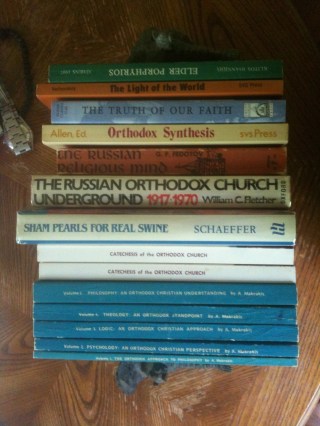
Apostolos Makrakis, The Logos and Holy Spirit in the Unity of Christian Thought, Volumes I-V. All unmarked but with labels saying “Fr. A” on the fly-leaf.

—. Catechesis of the Orthodox Church. Two copies. No underlining or maginalia in either copy; one copy has “Hanania” written in pencil on the fly-leaf. Both copies show some discoloration on the cover.

Frank Schaeffer, Sham Pearls for Real Swine. Unmarked, mylar sleeve for book cover.

William C. Fletcher, The Russian Orthodox Church Underground, 1917-1970. Unmarked, mylar sleeve for book cover.

G. P. Fedotov, The Russian Religious Mind: Kievan Christianity, the 10th to the 13th Centuries. Some underlining. Some wear on spine, binding solid.

Joseph J. Allen, ed. Orthodox Synthesis: The Unity of Theological Thought. Some underlining.

Elder Cleopa of Romania. The Truth of Our Faith. No markings; clean copy.

Serge S. Verhovsky. The Light of the World. Address label and embossed seal for previous owner on fly-leaf; some underlining and marginalia.

Klitos Ioannidis. Elder Porphyrios: Testimonies and Experiences. No markings; clean copy.

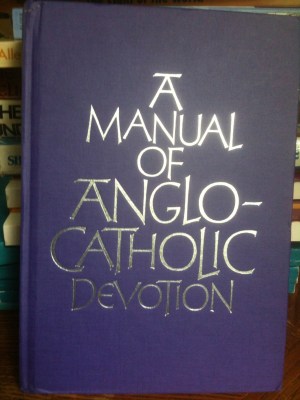
Andrew Burnham. A Manual of Anglo-Catholic Devotion. Owner’s name and purchase date written on fly-leaf; otherwise clean copy.

I have no particularly fixed prices in mind on any of these; this is mostly a last ditch effort to see if there’s a good home to be found for any of them after they’ve languished on Amazon for too long. Feel free to make offers for single items or for batches.


adventures in writing alexander lingas all saints bloomington all saints orthodox church american orthodox architecture american orthodox music american orthodoxy Antiochian Archdiocese Antiochian Orthodox Christian Archdiocese of North America Antiochians books byzantine chant cappella romana chant church architecture ecclesiastical chant ethnomusicologists ethnomusicology fellowship of ss. alban and sergius Greece Greek greek food greekness hazards of church music international travel tips ioannis arvanitis joe mckamey john michael boyer kurt sander Latin liturgical adventures liturgical architecture liturgical music liturgical texts and translation liturgy liturgy and life lycourgos angelopoulos medieval byzantine chant Metropolitan PHILIP militant americanist orthodoxy modern byzantine architecture modern greek music music as iconography my kids will latin and greek when they're newborns my kids will learn latin and greek when they're newborns orthodox architecture orthodox architecture is bloody expensive Orthodox choir schools Orthodox Ecclesiology orthodox outreach orthodox travel pascha at the singing school Patriarchate of Antioch Patriarch IGNATIUS IV Patriarch of Antioch publishing random acts of chant richard barrett in greece richard toensing rod dreher sacred music st. vlads st john of damascus society Syriac the Bishop MARK fan club the convert dilemma the dark knight The Episcopacy The Episcopate the only good language is a dead language this american church life travel we need more american saints why do we need beautiful music in churches?

Blog Stats

  • 262,835 hits

Flickr Photos