Archive for the 'General' Category


A transition

I suppose I should probably announce this, since it was announced in church this last Sunday —

Sunday 23 December will be my last day as All Saints Orthodox Church‘s cantor and choir director, and it will be my family’s last day as regular members of the parish. We will still be living in Bloomington until such time as our paths take us elsewhere, and I’m sure we will find ourselves at All Saints every so often — our godparents are there, we have godchildren there, we have many friends there, including the priest — but the next few months will probably more often than not see us visiting various other Orthodox churches in the surrounding area.

My last weekend, curiously enough, coincides with the first pastoral visit to All Saints of His Grace +ANTHONY. The transition aside, I look forward to meeting him and talking with him, and I very much hope that that weekend is only the beginning of a long and fruitful pastoral relationship between His Grace, Fr. Peter, and the parish.

Lest anybody add two and two together to get five — I and my family are all still Orthodox, and the St. John of Damascus Society will continue to be very much a going concern (with this just being the tip of the iceberg — lots of exciting stuff coming down the pike that I hope to announce very soon). The work I’m trying to do with the music of the Church is still very much on my plate, and I remain committed to helping in whatever I way I can with the Orthodox Church’s mission in Bloomington and at Indiana University.

If anybody has any questions, please feel free to ask them in the combox. My family and I crave your prayers as we make this transition.

“Do you feel in charge?”

Spoilers for The Dark Knight Rises, Skyfall, and so on below.

The UPS truck came yesterday. Thus it was that once Theodore was put down, I took a break from Cicero’s letters, and I told Flesh of My Flesh, “I’m making dinner, and then we’re watching The Dark Knight Rises.” The issue being, you see, that she hadn’t seen it yet. Skyfall was the first movie we had been able to see together in   since The Avengers, and that was just because for my birthday, some friends offered to watch Theodorus Rex while we went out by ourselves.

I very much enjoyed Skyfall, incidentally, and have seen it twice now; the transformation of Daniel Craig as the new James Bond into, effectively, the old James Bond, is complete. If one knows something about the history of actors who might have been Bond, the presence of Ralph Fiennes (as well as the reveal of him as the “new” M, who’s really the “old” M) is clever; he was one of the actors being considered back in 1994 to take over the role after Dalton declined to participate in what became GoldenEye. If I’m remembering a particular issue of Premiere sufficiently, the list before they finally circled back around to Brosnan was Mel Gibson, Liam Neeson, Ralph Fiennes, Sam Neill, and Hugh Grant. Fiennes, then, as a former field agent whom we see take a bullet and fire off some of his own shots, takes on some real-life resonance, given that part of the idea with Gareth Mallory seems to be that he’s what Bond would have been if he’d just been a bit more respectable.

I liked the approach with Skyfall of “James-Bond-as-art-film”; we get a lot of Bond fighting in silhouette, and this can get a bit trippy, particularly when he’s silhouetted against lots of moving neon lights. Sam Mendes also seems to be trying to tell you something with how he frames shots; Bond is frequently centered in the frame, as is Javier Bardem’s Silva, but then, at the very end, when Bond is looking out over the city from MI6’s roof, it starts out with him centered only to have the camera nudge just a little bit right so that Big Ben is now centered. The point seems to be that Bond has finally decided once and for all that he’s doing what he does, not out of anger for Vesper’s betrayal, not out of the repressed trauma of his parents’ death, but for queen and country.

But I’m supposed to be talking about The Dark Knight Rises.

So, four and a half years ago, The Dark Knight took up a big chunk of my summer. I saw it, I think, nine times on the big screen all told, six of those in IMAX, and really what I did during July and August of 2008 was call up my friends and say, “Hey, want to go see The Dark Knight in IMAX with me?” I didn’t have much else to do; I had a French reading knowledge class I was taking, and I was working, but so far as I knew at that point, I was definitely not going to be working on a grad program anytime soon, and my wife was in Germany, followed almost immediately by her spending close to a month in Seattle after her dad was diagnosed with cancer. The Dark Knight seemed as good a way as any to kill time.

Obviously, my life has changed a lot in the intervening years, and I have other ways my time is occupied these days, thank God. Still, I managed to see The Dark Knight Rises four times on the big screen, two of those in IMAX. So, draw whatever conclusions you will about that — such as, for example, baby or no baby, PhD program or no PhD program, I’m still an unrepentant nerd.

The Dark Knight Rises picks up eight years after the Batman took the rap for Harvey Dent’s murders rather than have Gotham lose their knight in shining armor. The storytelling reason for this seems to be so that Batman takes on some qualities of being an urban legend, almost a Spring-heeled Jack kind of figure; I suspect that the practical, real-world reason is because it had been seven years since they started shooting Batman Begins, which itself required Christian Bale to play Bruce Wayne over a seven to eight year span, and The Dark Knight was supposed to take place something like six months after Batman Begins while being made three years later. Everybody looks noticeably older than they did in 2005, in other words, and this gives them an in-story way to explain that.

In the intervening years, Bruce Wayne has become a recluse, letting the physical and mental damage he suffered as Batman settle in. He tries to become a philanthropist, but he finds out projects that can save the world also have the dark side of probably being able to destroy it, a realization which just drives him further into the shadows. Commissioner Gordon has been able to use the memory of Harvey Dent to lock up a lot of people, but the lie is eating away at him. It’s a status quo that’s, for all intents, a well-polished rotten apple.

Enter four characters who each stir up the hornet’s nest in their own way. Selina Kyle is a jewel thief who has taken a curious interest in Bruce’s fingerprints; John Blake is a young cop who sees that everybody is pretty much just going through the motions to keep everything looking nice; Miranda Tate is an investment partner of Bruce’s who wants to show him that the world is worth trusting enough to save it… and then there’s Bane, who is manipulating much of this (or is he?) specifically to force Bruce to get back into the ring as Batman.

A running theme of the movie — which goes all the way back to Batman Begins — is that of the “clean slate”. The express purpose of the League of Shadows, after all, was to “wipe the slate clean”, as it were, when cities got too big and corrupt by destroying them, which is the objective that Bane has inherited; Selina Kyle wants to wipe out her own past (there’s a MacGuffin of the “gangland myth” of a computer program that can do this, which it turns out that Bruce acquired to keep from being used; since the Joker had no traceable record in The Dark Knight, it’s possible that this is intended to be an oblique reference to him); Gordon, Bruce, and Blake are all living with accounts needing to be settled, and so on. Is a revolution how society ultimately has to pay its bill? As R’as Al Ghul suggests in Begins (and as Bane trumpets in Rises), is burning away the brush always the solution, and it’s just a question of scale? Can one man show a better way? One might not be entirely wrong to detect a Christ allegory with where Nolan and company end up with this question (albeit thankfully not in the somewhat ham-fisted way that Superman Returns did), but it seems to me that Plato’s cave is far more explicitly referenced.

Rises does a nice job of bringing things full circle back to Begins; the story keys off of R’as Al Ghul’s conviction in Begins that “Gotham must be destroyed”, and shows that just because R’as Al Ghul died, it didn’t mean the idea died. R’as Al Ghul left a legacy, and it’s a legacy Bruce has to deal with.

Incidentally, for anybody familiar with the comics, there’s only one way the character of Miranda Tate was going to make any sense at all, and if you’re paying attention, they telegraph her identity as Talia from the get-go. She talks like R’as (she has a line about “restoring balance” early on), and there are visual callbacks as well, like showing her good at building a fire, much as R’as was in Begins. A reward of repeated viewings, too, is noticing that the little girl in the prison stabs somebody in the back in one of the first flashbacks, much as the adult Talia does to Bruce.

There are other interesting references to Begins; there’s the explicit comparison of the prison to the well young Bruce falls into in Begins, but there’s also Batman walking on ice (apparently having learned to mind his surroundings after all), and the memorial statue of Batman unveiled at the end bears a striking resemblance to the nightmare Batman that Scarecrow hallucinated in Begins. Both Begins and The Dark Knight end with conversations about thanking Batman — Begins: “I never said thank you.” “And you’ll never have to.” TDK: “Thank you.” “You don’t have to thank me.” — and while Rises has its own ending, it has its own version of this conversation: “Thanks.” “Don’t thank me yet.” It’s a little grace note that seems to say a lot about where Bruce sees what he’s achieved relative to his own ideals — in Begins the story ends with his ideals having won the day, in TDK his ideals have cost him dearly, and at this point in Rises it’s unclear whether or not he will even survive his own ideals.

The point of Rises, and I suppose of Nolan’s whole trilogy, is that in this story, Bruce Wayne isn’t trying to become a superhero, he’s trying to build a myth. As R’as says in Begins, “You have to become an idea.” The idea that there might be a big unstoppable demon that comes after you if you’re a bad guy, and you’ll never know who it is, is much more powerful than there being a human being who can be taken down with a bullet. In Begins he takes on the initial trappings of the legend, in TDK he sees a human being who he thinks could become the idea without having to pretend to be somebody else, only to see that person corrupted, and in Rises he has to complete the mythmaking by, effectively, dying and coming back from the dead — both so he can just be Bruce Wayne once and for all, and so that Batman can be that much more powerful. Along these lines, Bane is presented as sort of a counter-symbol to Batman; “No one cared who I was till I put on the mask,” he says.

Do Nolan’s films constitute a “definitive” Batman? Well, what do you mean by that? “Definitive” according to whose take on the character? Frank Miller’s? Neal Adams and Denny O’Neil’s? Bob Kane’s? Paul Dini’s? Adam West’s? Just by the nature of film, where you’re basically blowing up a short story into two or three hours and only being able to do it once every few years, you’re never going to be able to bring out all the nuances that one can play with in an ongoing serial like a comic book or a TV show. Like any film adaptation, the best you’re going to be able to do is honor the spirit of the source material while doing your own thing as well as you can. Batman, by virtue of being a symbol, is open to a lot of interpretation, and I think Nolan has made three pretty great movies with his interpretation. Somebody else will probably come along and do their own interpretation in a few years, and there may very well be things I like about that one better, perhaps things I don’t like as well; who knows? The comics themselves will still be sitting on the shelf right next to these movies, as well as Tim Burton’s 1989 film. What I think one can say is that this trilogy is a long Batman story that incorporates a lot of ideas and images from the comics as well as the animated series (there’s a decent amount of Batman Beyond in Bruce’s solution), and while it’s something you could never do with Batman as he appears in the comics (unless it were an Elseworlds mini-series or something of that nature), it’s a great way, from where I sit, to encapsulate the character onscreen in a self-contained story.

OK. Back to reading some Latin.

The baptism of Theodore Harvey Barrett II

Please consider yourself invited to Theodore’s baptism. He will be baptized at 9am on 25 November 2012 at All Saints Orthodox Church in Bloomington, Indiana; his godparents will be our friends Anna Pougas and Benjamin Czarnota. If you can come, I’d love to have you there.

A couple of people have asked me about baptismal gifts. Let it be said first and foremost that nobody is under any obligation or expectation of a gift. Your prayers (and your attendance, if we’re fortunate enough to have you there) are gift enough! However, if you want to do something, there are certainly still items left on Theodore’s gift registries (on Amazon, at Target, and otherwise), and there are also some online forums that talk about appropriate Orthodox baptismal gifts. Links for all of those are below. If none of those quite speak to you, perhaps you might make a gift to All Saints’ building fund; you could also make a gift to the St. John of Damascus Society; and then there is also a restoration project for an 11th century church dedicated to Mar Tadros (St. Theodore the General) in Lebanon that perhaps you could make a gift to in Theodore’s name. More information on the project is here. I am trying to find out how individuals might give to this project; watch this space for details if that’s something that intrigues you.

In the meantime, please pray for him, over the next couple of weeks especially!

Star Wars, geek culture, and periodization

One of my earliest memories is being in the movie theatre for the second run of Star Wars. I think. I was not quite three when it was re-released on 15 August 1979, but I have a memory of seeing the Death Star run in a theatre seat. I might have been in my dad’s lap. At any rate, it was all Star Wars all the time from that point until I was probably seven or eight; the toys were a regular appearance at my birthday and Christmas several years in a row (the AT-AT was my main Christmas present in 1980, as I recall), I had all the storybooks and novels, I read some of the comic books, and I had the kids’ cassette tape read-along versions as well. Watching the film on VHS was a regular activity when my friends and I had Friday night sleeplovers, and I also recorded it one of the times when it was broadcast on CBS. (Fun fact: John DeLancie, aka “Q” on Star Trek: The Next Generation, was in a cough syrup commercial that aired with that broadcast.)

I never did get into the Timothy Zahn novels — by the time I was in high school, if it wasn’t a movie that George Lucas was involved with, I didn’t particularly care — but I remember the “Kenneth Branagh as young Obi-Wan Kenobi” rumors starting around 1993. (I still wonder if there wasn’t something to those, particularly since it’s come out that Obi-Wan was older in the original treatment of Episode I, and that this older character was basically split into young Obi-Wan and Qui-Gon Jinn.) I also discovered the early drafts of Star Wars online around 1996 or 1997, and became fascinated by what might reappear in the prequel trilogy. Might we see Whitsun? The planet Utapau? Would Anakin Skywalker’s character be anything like Annikin Starkiller? (No, yes, and sort of, but Darth Maul attacking Qui-Gonn and co. on Tatooine in Episode I was very similar to a key moment in one of these drafts.)

I never quite understood the unhappiness of some people with the Special Editions; yes, there was some lame stuff, but I had no problem with the stated reasoning behind them (after all, I was one of the people who clamored to see the “Director’s Cut” of Blade Runner that wasn’t actually a “Director’s Cut” in 1992). I also wasn’t one of the people who looked like the sun had just fallen out of the sky coming out of Episode I: The Phantom Menace. I enjoyed the prequels — again, yes, fine, there were stupid bits, but I didn’t get the near-total turning on Lucas that the Ain’t-It-Cool-News crowd staged. Were the new films the focus of my existence the way the first three had been? No, of course not, but nor should they have — the Star Wars prequels represented ages 22-28 for me, not 3-6. By the time Revenge of the Sith completed the cycle, the Lord of the Rings films had come to represent a more sophisticated, up-to-date view of fantasy-on-film (as they should have); to some extent, so did the Harry Potter series, and then Christopher Nolan’s Batman movies represent another stage of this kind of moviemaking, at least for me.

(Somebody somewhere along the way probably expected me to write something about The Dark Knight Rises. Well, I had a 4 week old baby when it came out, so that post kinda fell by the wayside. I’ll probably write something when the Blu-Ray hits the street. In short, I’ve seen it 4 times, and I think it rewards multiple viewings; one may perhaps argue that it’s a bad Batman movie, but I would argue that even if that’s the case — and I’m not sure it is — it’s still the right way for Christopher Nolan’s story to have wrapped up.)

Still, some things started to make me scratch my head. The behind-the-scenes material on the Episode I DVD showed Lucas talking about how Jar-Jar Binks was intended to be “the funniest character ever in a Star Wars movie”, and it struck me as weird that he would shoehorn a totally unnecessary character into a story he’d supposedly had plotted out for years. It was also evident from reading Michael Kaminski’s The Secret History of Star Wars that whatever Lucas imagined the prequels (and, perhaps, sequels) might have looked like back in 1979 was a completely different beast from what we got from 1999-2005; heck, for that matter, whatever he thought they were going to look like in 1999, even that was something very different from how he finished up six years later. It was also plain that Lucas really wasn’t a good enough storyteller from a technical standpoint to not need somebody else to edit him and bounce things off of, and that what we got really amounted to him making it up as he went along from movie to movie. Did that diminish the accomplishment? No, not necessarily, but why the need to resort to revisionist history every time he made up something new so that it was always accounted for in the “original master plan” that apparently never actually existed in the first place?

Last year, I made the decision to not buy the Star Wars Blu-Ray box. I could handle Darth Vader’s “NOOOOOOOO” at the end of Revenge of the Sith; it made sense in context. But to tack it on at the end of Return of the Jedi — nope, sorry, George, I’m not giving you my money for that, and I’m tired of apologizing for you. I don’t claim to understand his reasons for revising everything and pretending that it was always the way he intended it, even when it wasn’t, but I don’t want to play the game anymore. Sorry, I really don’t.

With today’s news, we get one more bit of revisionist history:

“For the past 35 years, one of my greatest pleasures has been to see Star Wars passed from one generation to the next,” said Lucas. “It’s now time for me to pass Star Wars on to a new generation of filmmakers. I’ve always believed that Star Wars could live beyond me, and I thought it was important to set up the transition during my lifetime.”

Compare with Lucas telling Starlog and Vanity Fair in 1999 that there was no way that there would be a sequel trilogy directed by other people, and telling Total Film in 2008, “I’ve left pretty explicit instructions for there not to be any more features. There will definitely be no Episodes VII – IX” (link here).

I would like to suggest that George Lucas has been perhaps the single greatest contributor to geek culture of the last forty years. Even in the last 15 years or so — in 1996/1997, websites like Ain’t-It-Cool-News, the original incarnation of Corona Coming Attractions, Dark Horizons, and the like all started popping up, and one of the major raisons d’être for such sites was that the trilogy that we’d all been dreaming about for over a decade looked like it was finally going to get made. Such sites made geek moviedom an exciting place to be for a few years.

I would further like to suggest that he has been the single greatest contributor to making geek culture the shrill, bitter, entitled, cynical group of online jackasses that it largely is now. (Lucas, as well as the studios realizing that these websites could easily be turned into just another cheap marketing outlet. I’m looking at you, Harry Jay Knowles, and I’m a guy who remembers AICN from the http://www.bga.com/~rodan/coolnews.html days.) I don’t relate to the “George Lucas raped my childhood” people, but I can’t deny that there’s a big group of movie fans that feel like they got the biggest bait-and-switch in history, and there have been consequences. (By contrast, the guys who maybe have contributed some very serious class to this brave new world? Michael Uslan and J. Michael Straczynski, whose respective abilities to be real gentlemen and to provide an inspiring window into the projects they work on are amazing. Yes, sometimes JMS comes across as a bit full of himself, and Uslan’s non-Batman movies are hit-and-miss at best, but nonetheless, they’re both doing it right in a big way.)

So now we enter the Disney period of Star Wars. One of the things I’m trained to think about as a historian is, when trying to come up with a schema for periodization, looking at the sources to which your historical actors are looking back. The Renaissance is the Renaissance because they’re looking back to Greco-Roman antiquity. Early Modern Europe is Early Modern Europe because they’re looking back to the Renaissance. That kind of thing. In making the first Star Wars movies, Lucas was looking back to serials, to Flash Gordon, to The Hidden Fortress, to a language of filmmaking that had been largely abandoned, so all he had to do, really, was rework it with the tools he had available in 1975, and invent whatever new tools he needed to be able to make that kind of cinematic experience up-to-date for the contemporary audience. There wasn’t really an existing frame of reference for what Star Wars was doing — Planet of the Apes and Logan’s Run were what people thought of when it came to cinematic science fiction and fantasy.

The problem with the prequels, ultimately, is that they had an audience with expectations. Both Lucas and the audience had to look back to Star Wars, Lucas so he could figure out where he needed to end up, and the audience to try to second-guess him. Between 1983 and 1999, there were things like DuneHoward the Duck (ahem, George), Superman IVBatman and RobinAlien3 and Alien:ResurrectionIndependence Day… lots of ways that audiences had been shown that studios would cynically try to squeeze money out of them with inferior product. Surely George Lucas (who, as I mentioned, gave us Howard the Duck) wouldn’t do that, right?

And, as I say, I’m not convinced that he did do that with the prequels, but there are sufficient numbers of people who are convinced of that, that, really, Disney needs to be very conscious of what they look back to as they approach this new era of Star Wars. Are they going to look back to the prequels (which we might think of as the Middle Ages)? The originals (which we might think of as the Late Antique Roman Empire in full bloom)? The sources of the originals (Greco-Roman antiquity before Constantine)? Will we get a Star Wars Renaissance? Or something else? Are they going to give this to talented filmmakers who idolized the original trilogy growing up to try to reinvent and to do something as revolutionary playing in this universe as the first movie did in establishing the universe? Or are they going to give this to people who do serviceable work-for-hire and hope for a franchise that nobody needs to think too hard about, like Pirates of the Caribbean became? Will these new films be just so much big-budget fan fiction? At the same time, can’t one make the case that the prequels amounted to big-budget fan fiction that happened to be done by George Lucas? Dunno — guess we’ll see in 2015. We’ll see if this new trilogy is worth Theodore’s time the way the original trilogy was worth mine.

And meanwhile, Bryan Singer is back on X-Men, too. He’s coming back to do a sequel to a reboot/prequel/whatever — that he was supposed to direct in the first place — of a series that he got kicked off of to do a sequel to a different series, and the person who originally replaced him on the movie he got kicked off of, and who also replaced him on the reboot/prequel, is whom he’s replacing now. Got all of that? Days of future past indeed. Between this and Leia Organa now being a Disney princess, everything old is new again, and vice versa.

A contribution elsewhere

A couple of months ago, the people involved with new online Orthodox Arts Journal asked if I would be interested in contributing anything to their efforts. I’m a big fan of New Liturgical Movement, and as this is sort of an attempt to do something similar from the Orthodox side, I was thrilled to participate however I could. I suggested some things I can do, it seemed to make sense to all concerned, and as of this morning, my first post for them is up. Take a look, and peruse the rest of the site as well — they’re doing some nice stuff, and it’s an honor to be involved.

That’s my boy.

That's my boy.

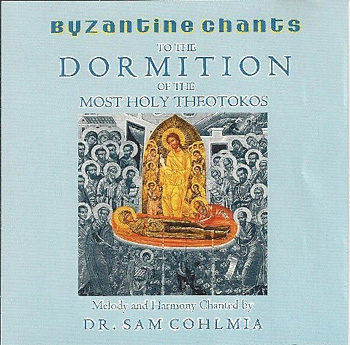
Review and a mini-interview: Dr. Sam Cohlmia, Byzantine Chants to the Dormition of the Most Holy Theotokos

Blogging has been light the last couple of months for what I hope are obvious reasons. The new school year starts up the week after next, so we’re all going to have to start making the adjustment back to the normal swing of things soon, so hopefully I can catch up then on some posts I’d intended to write over the summer but didn’t. (Of course, there’s also the matter of qualifying exams needing to happen sometime in the next twelve months.)


In the meantime, Dr. Sam Cohlmia, protopsaltis of the Antiochian Diocese of Wichita and the Midwest as well as St. George Cathedral in Wichita, was kind enough to send me a review copy of his new recording, Byzantine Chants to the Dormition of the Most Holy Theotokos. It contains many of the festal hymns for the Feast of the Dormition, with Dr. Cohlmia as solo cantor throughout (and providing his own isokratima via the miracle of modern recording technology).

The disc is fairly evenly split between English and Arabic, with Dr. Cohlmia using the Holy Transfiguration Monastery Menaion for most (not quite all) of the metered hymns (prosomoia), and Nassar (apparently modified in spots) for the non-metered hymns as well as the stichera at the Praises. In terms of musical sources, Dr. Cohlmia is using Arabic scores by composers such as Mitri El Murr and Andraos Mouaikel, and adapting those into English himself. The melodies for the Lamentations are a bit of a puzzlement to me — not necessarily on this disc, but in general — since what’s sung here represents the third set of permutations that I have been told are the “authentic” Antiochian melodies, so I’m not sure what that means.

There is a great deal to like on this disc; Dr. Cohlmia has a clear and lovely voice, and handles the vocal requirements of both languages nicely. Although Lebanese-born, his sung English diction is excellent, and all the texts sound smooth and natural throughout. He is able to bring a good sense of style to the presentation; while his approach as a solo cantor makes for a different realization of “Antiochian style” than one hears on, say, The Voice of the Lord (which represents the chant tradition of the Patriarchate of Antioch applied to an English-language choral context), the two recordings clearly share and are honoring the same heritage. That said, some of the differences in approach are evident in spots where the recordings are using the same melody — for example, in the Kathismata for both feasts, the nenano melody “Κατεπλάγη Ἰωσήφ” (“Joseph was amazed” in the HTM books) is employed, and the contrast between the choral and solo realizations is subtle, but interesting.

One thing that both recordings do that’s particularly nice for learning purposes is proper use of metered model hymns. This is a system that can be a bit opaque for cantors who are having to cut their teeth in the Antiochian Archdiocese; neither Kazan nor Nassar make note of their use, Nassar is unmetered anyway, and Kazan just writes them out and shoehorns the texts into them without telling the singer that that’s what’s happening. For metered translations one must turn to the Holy Transfiguration Monastery books, which seems to have something of a “Don’t Ask, Don’t Tell” status in the Antiochian Archdiocese, and which also aren’t complete outside of the Menaion. A metered Octoechos doesn’t appear to exist, neither does a metered Triodion, and the Pentecostarion has been being revised and “due any day now” for several years. Even if you have metered texts, however, sources for the melodies are tricky. HTM’s book of melodies is a bit idiosyncratic in terms of musical material, and while Fr. Seraphim Dedes’ is better in terms of being better-grounded in “classical” sources (like the Irmologion of John the Protopsaltis), it’s harder to use with the HTM books because the melody titles are different — sometimes marginally so, sometimes significantly so — and the translations are idiosyncratic. It’s better, frankly, to just learn Byzantine notation and learn the model melodies out of the Irmologion, but then there’s the problem of not getting the sung tradition in addition to the notated tradition. There’s this site, and the recordings are instructive, but not exactly stellar. All of this is to say, Dr. Cohlmia’s recording, as with the Theophany School disc, provides an English-language model for realizing a nice little handful of the model melodies realized with metered translations, and that makes it useful as well as enjoyable and prayerful to listen to. I’m not clear as to why he doesn’t use the metered translation for the stichera at the Praises, and the model melody is quite a bit different from the one that’s in the Greek books (“Ὡς γενναῖον ἐν μάρτυσιν”, “As one valiant”), but the others employed are wonderfully practical learning tools.

Anyway, I’d love to get Dr. Cohlmia and Rassem El Massih in the same church at some point for a Liturgy, and perhaps I will. The CD can be purchased through the Wichita Chancery (details here).

I also present Dr. Cohlmia’s responses to some follow-up questions that he was good enough to take the time to answer. I find them very illuminating, and I appreciate the perspective he brings to the table. I will be curious to hear what others think.

1) How were you trained as a cantor?

I self-trained beginning in 1991 out of interest.  Being born in Beirut and going to church there and being exposed to excellent chanting, it was relatively easy for me to understand the melodies, since several of them are derived from the 11 basic Oriental melodies, such as Hijaz (Tone 6), Nahawand (Tone 5), Bayyat (Tone 1), and so on.  I was not formally trained to become a chanter, but simply practiced constantly.

2) For this recording, did you sing off of notated scores, or did you just have texts that you knew how to sing from memory? If notated scores, did you use staff notation or Byzantine notation?

I wrote the music for the entire Orthros service of the feast of the Dormition (in Western notations).  For some of those pieces of music, I simply transcribed the Byzantine notations from Mitri Murr’s arrangements in Arabic to Western notations in English.

3) How do you approach chanting in English differently from how you approach chanting in Arabic or Greek?

Chanting in English is rather tricky when compared to doing the same in Arabic or Greek.  In English, you have to be extremely careful with the pronunciation of the various syllables in addition to the lack of enough vowels makes chanting challenging.  In Arabic, especially, there are lots of vowels, and generally it is easy to chant words without placing particular emphasis on specific syllables (that’s simply a general statement, of course).

4) Do you have a sense of how Byzantine chant in the Patriarchate of Antioch is distinct from, say, under the Church of Greece or the Ecumenical Patriarchate? How do you see how you chant as being different from how a Greek cantor might approach it, if at all?

Overall, Arabic Byzantine chant in our patriarchate differs, in my opinion, than Greek Byzantine chant in the ecumenical patriarchate.  To me, Arabic chanting is certainly more melodic and, horizontal (if you will) than Greek chanting, which at times sounds choppy.  It simply flows better and sounds more soothing, although Greek chanting is very beautiful.  My chanting style is certainly more based on the Arabic, as I use Mitri Murr’s and Fr. Nicholas Malek’s arrangements as a guideline.  I do also have Protopsaltis Kharilaos Taliadoros’ anastasimatarion (in Greek), and it is beautiful, but not as melodic as the Arabic arragements.  The arrangements of Mitri Murr, and Fr. Malek (new arrangements), truly bring the words to life, as the music is written to mirror the words.  His work is very brilliant.

5) In week-to-week services at the Cathedral, what materials do you use? Are you using the chant books of Mitri El-Murr for Arabic, for example, or something else? What do you use for English? Kazan/Nassar? Or something else?

I put together the Typikon Notes from the Arabic and Greek Typikon each week for the Sunday services.  The text that I use is a combination of that from Nassar’s book as well as the HTM Menaion.  At times, if the text does not exist, and it is called for in the Typikon, I simply translate it into English.  So, we basically use the book of Nassar, HTM Menaion, HTM Pentecostarion, +Kallistos Ware’s Lenten Triodion, to name a few.  For chanting purposes, we use the Byzantine music project put out by the Archdiocese (for English) and Mitri Murr’s work (for Arabic).  Rarely would I use Taliadoros’ anastasimatarion (for Greek) unless there are Greek parishoners at Vespers or Orthros.

6) What’s your sense of how Kazan/Nassar have represented and transmitted Antiochian tradition for English-language Orthodox Christians? What could be better? What would you hate to see changed?

Kazan’s music, like any other individual’s music, is one representation of Byzantine chant.  It is certainly very simplistic, but good enough for the minimally trained or unfamiliar chanter.  Most “chanters” in the US are not true chanters, but singers instead, so that music works fine for them.  In my opinion, true chanters need to fully learn Byzantine music.  As far as Nassar’s book, it is alright for the most part, although there are a few mis-interpretations, where the English could be better.  The best work is HTM’s Menaion and Pentecostarion, since the interpretation in extremely accurate and the special melodies are perfectly metered.  As far as what I would hate to see changed, I would hate to see the Church lose its Antiochian tradition.  I would hate to see the music being watered down from the original humble Byzantine to the more dramatic and grandiose choral.  Don’t get me wrong.  The church needs the two, but there needs to be more emphasis on Byzantine chant, because it seems that it gets put on the back-burner at times.  Furthermore, chanters need to learn Byzantine chanting and music, in addition to preserving some of the Arabic used in the church (depending on the individual church).

7) What’s the future of Byzantine chant in our Archdiocese, as you see it?

Hopefully the same if not better.  I would like to see emphasis on Byzantine chanting at the various seminaries (not just Holy Cross), as well as Byzantine courses being offered for ALL chanters.  Any person who plans to approach the Psaltyrion to chant needs to have a good education on Byzantine chanting, which hopefully could be learned at some Byzantine school or course of some kind.

In which I boil water

You may recall that a rather geeky purchase of mine proved to be difficult to reconcile with American wiring. An electric-savvy friend of mine came over and looked at our box to see what might be necessary to get it running without a transformer; the box itself would probably have to be replaced, since it was bought second-hand off of Moses, but that would probably be something that the landlord would take care of given sufficient justification. Once the box was up to code, it really wouldn’t be that big of a deal to put in a dedicated outlet for the kettle.

With a baby on the way, that was maybe sufficient justification to mention to my landlord, hey, a friend of mine checked out our fusebox and said that it probably wouldn’t be the worst idea in the world to have an electrician bring it up to date. I did so, and the landlord (who has always been a very cool guy to us) said, sure, no problem, here’s the guy I usually use.

Well, the electrician came out and definitely found some wiring issues that needed fixing, and said, yep, I can have a conversation with the homeowner about the fusebox. He wasn’t opposed to putting in a dedicated outlet, but said, you know, it’s possible that there’s a different base that will let it run on US electricity — check with the manufacturer.

But then other big things happened, and it kind of fell of my radar for awhile.

Then Madelene left a comment on the original post saying that she’d gotten this working without any massive rewiring of everything. The secret? That the US-based Chef’s Choice uses the same manufacturer as Russell Hobbs, and markets a variant of the same kettle in North America. It’s not exactly the same — no blue lights, the handle is different, other cosmetic differences — but the important thing is that the Russell Hobbs kettle will fit on the base of the Chef’s Choice version.

A phone call to Chef’s Choice confirmed the availability of replacement bases, and today the box arrived.

Which brings me to the moment where perhaps you will decide that six weeks of fatherhood have already robbed me of my sanity — yes, ladies and gentlemen, I’m posting a video of water boiling. One thing you’ll notice right off is that on American electricity, the whole “boiling in under a minute” thing doesn’t happen — more like five. Oh well. It still works.

Want a birth announcement?

Stationery card
View the entire collection of cards.

CD review: GOA Archdiocesan Byzantine Choir, Μέγαν εὕρατο (Vespers for St. Demetrios)

Archdeacon Panteleimon Papadopoulos was kind enough to send me a review copy of Μέγαν εὕρατο, the new recording released by GOA’s Archdiocesan Byzantine Choir.

The disc is a collection of the festal hymnody sung at Great Vespers for St. Demetrios (chosen to honor Abp. Demetrios), including the Anoixantaria (for those unfamiliar with the practice, Psalm 103 from “Thou openest thine hand, they are filled with good…” to the end is theoretically sung rather than merely read for major feasts in present-day Byzantine practice, although in my experience this is one of those things that a lot of people don’t do with the excuse that “nobody does that”), “O Lord I have cried” with stichera, Doxastikon, and Theotokion, hymns for Litya and Artoklasia, aposticha, apolytikion, and “Many years” for Abp. Demetrios. The ensemble, if I understand correctly from the list of participants, is a group of psaltes largely from the Northeast, including Dr. Grammenos Karanos, the current professor of Byzantine music at Holy Cross Greek Orthodox School of Theology, and others from the New York area.

The first thing that must be said is that this is a wonderfully sung program; the wall of sound produced by these gentlemen is never less than first rate, and hymns with slower, more melismatic textures such as the Anoixantaria are particularly beautiful.

One of the things that I try very much to do is to view recordings like this, labors of love by people who are clearly far more knowledgeable and able than I am, as master classes, opportunities to learn finer points that I haven’t had the opportunity to learn otherwise. I have been informed by a particular point of view that makes certain assumptions, and not everybody is necessarily informed by the same perspective and assumptions. (For example, given a number of factors, I tend to assume that even for Byzantine chant, choirs are ideal, with solo cantors needing to be judiciously used. However, I am well aware that for many people, for this repertoire, the solo cantor tends to be the assumption in terms of performing forces, with choirs only happening for special occasions.) To that end, there are questions that I have about aspects of the recording. Some of these questions veer into critical territory from an entirely subjective musical standpoint, but may well be entirely answerable in terms of style.

First off, something that is immediately apparent has to do with repertoire choices. These are, with a couple of exceptions, not selections out of what have been represented to me as “the classical books”. The melody used for the prosomoia at “O Lord I have cried”, for example, “Ὢ τοῦ παραδόξου θαύματος”, is not the melody found in the Irmologion of Ioannis Protopsaltis, and the Kekragarion is not from the Anastasimatarion of Petros Peloponessos, either. They’re not bad, necessarily (although I have to say I definitely prefer Ioannis’ melody for the prosomoia), but I am  curious about what informed the selections.

Second, there’s a tendency throughout the disc to cut off of endings of phrases (including isokratema) quite sharply; this is something that makes sense to me to do as a solo cantor, so that the congregation knows that the places where you’re breathing are intentional, but it makes less sense in a choral setting unless there’s a specific stylistic reason to do so. It’s obviously a choice, and one that is executed distinctively, carefully, and consistently, but I’m left wondering if it’s necessary for it to be as prevalent as it is here.

Third, the apichimata are sung chorally, which makes me wonder if there’s a performance tradition for apichimata that divorces them from their function. Soloists sing the verses at the “O Lord I have cried” stichera, so it’s not simply a matter of everything being choral for purposes of this disc.

Fourth, as performed, the ison moves around a lot more than I’m used to. I’m aware that this is a point where it seems everybody and their dog will tell you “the real way” you’re supposed to realize the drone, so I assume this is a stylistic point as well.

Strictly in terms of the physical presentation of the disc, it would be nice to have had more of a booklet; the performance is entirely in Greek, and while many of the texts are reasonably familiar, for those not used to Greek an included translation would help make the product more accessible. Doubtless this is a function of production cost; perhaps an “online booklet” or some such would be a way of accomplishing this in a cost-effective manner next time.

To sum up: this is a gorgeous-sounding recording that is probably best described as a snapshot of the state of Byzantine chant in Greek in the Northeast, which seems to be healthy indeed. I’ll be very interested to hear what the Archdiocesan Choir does next — the Archdiocesan School seems to doing a lot to try to raise the profile of Byzantine chant, and I’m looking forward to future developments.


adventures in writing alexander lingas all saints bloomington all saints orthodox church american orthodox architecture american orthodox music american orthodoxy Antiochian Archdiocese Antiochian Orthodox Christian Archdiocese of North America Antiochians books byzantine chant cappella romana chant church architecture ecclesiastical chant ethnomusicologists ethnomusicology fellowship of ss. alban and sergius Greece Greek greek food greekness hazards of church music international travel tips ioannis arvanitis joe mckamey john michael boyer kurt sander Latin liturgical adventures liturgical architecture liturgical music liturgical texts and translation liturgy liturgy and life lycourgos angelopoulos medieval byzantine chant Metropolitan PHILIP militant americanist orthodoxy modern byzantine architecture modern greek music music as iconography my kids will latin and greek when they're newborns my kids will learn latin and greek when they're newborns orthodox architecture orthodox architecture is bloody expensive Orthodox choir schools Orthodox Ecclesiology orthodox outreach orthodox travel pascha at the singing school Patriarchate of Antioch Patriarch IGNATIUS IV Patriarch of Antioch publishing random acts of chant richard barrett in greece richard toensing rod dreher sacred music st. vlads st john of damascus society Syriac the Bishop MARK fan club the convert dilemma the dark knight The Episcopacy The Episcopate the only good language is a dead language this american church life travel we need more american saints why do we need beautiful music in churches?

Blog Stats

  • 269,302 hits

Flickr Photos