Archive for the 'General' Category


Fellowship of Ss. Alban & Sergius, Days 2 (cont’d) & 3 (cont’d)

I am grateful that Eirenikon has seen fit to link to my rambling trifles on the Fellowship conference. Many thanks.

I got home at about two yesterday morning, distributed the spoils of the St. Vlad’s bookstore to The David and The Daniel (who were good enough to pick me up at the airport at half past midnight on a Sunday), and went to bed. Then I was up at 7am to go to work, and, well… yeah. Sleep? What’s that?

A couple of other things to highlight about Met. PHILIP’s talk — Dr. Dmitri Solodow, a lay delegate of the OCA’s Metropolitan Council from the Diocese of the West, made the wry observation, “The liturgy unites us as long as it is in our native language.”
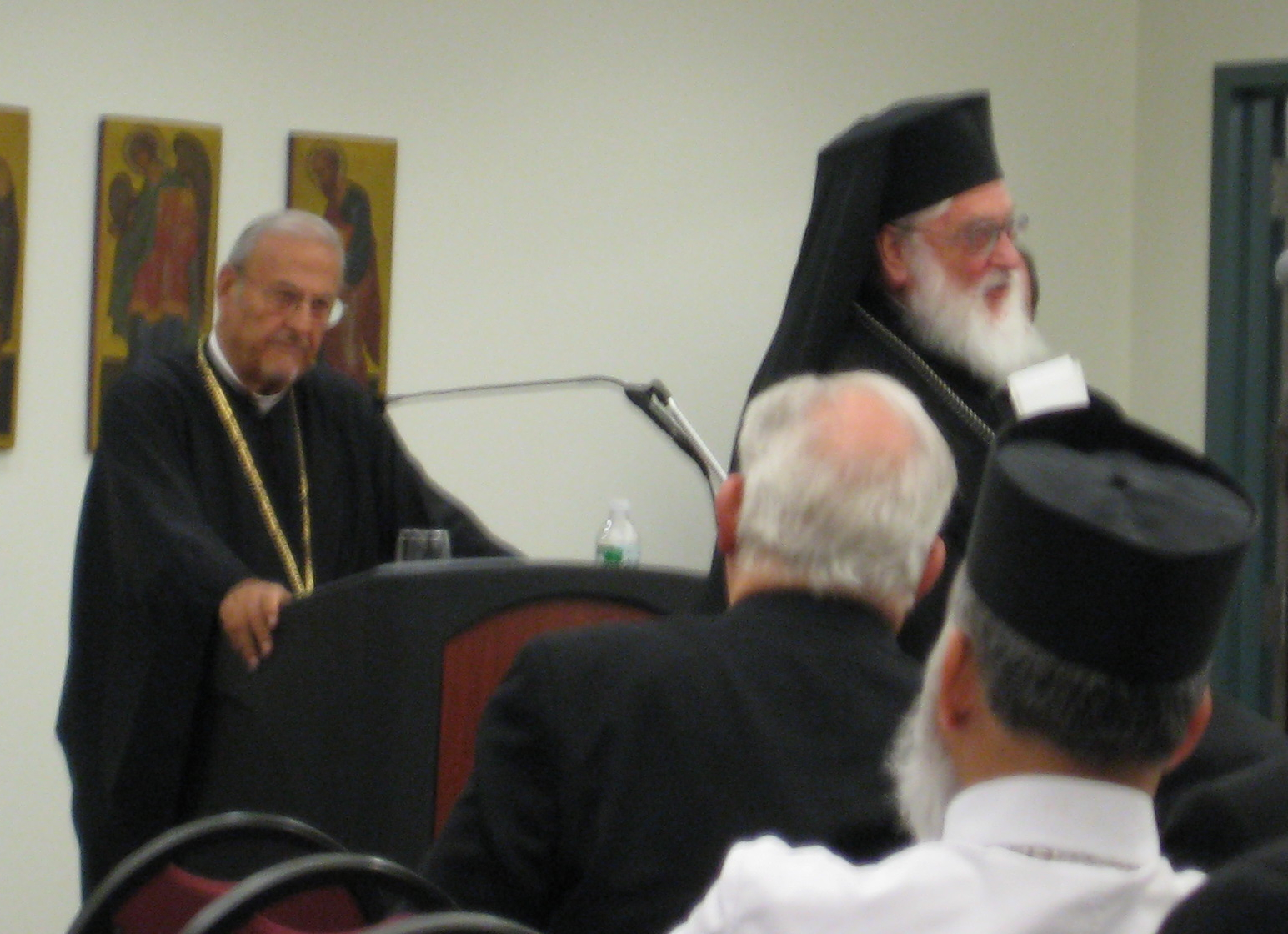
Met. Kallistos had a number of comments for his brother bishop, beginning by saying, “I agree with far more of what you say than I expected to!” (Always an encouraging thing to hear.) He concurred with Met. PHILIP that “[t]he defining characteristic [of a local church] is territorial, not ethnic[.]” In noting the that idea of the local church is the faithful in a given city gathering around their bishop to celebrate the Eucharist, he further observed that “the Eucharist is not an ethnic event.” A very humorous moment was when Met. Kallistos insisted that “we must not be canonical fundamentalists,” and Met. PHILIP replied, as if they were singing a psalm antiphonally, “Alleluia.” My favorite Met. Kallistos moment of the morning was when he reminded the room, “‘Committee’ is not a canonical word.” Fr. Patrick Henry Reardon ended the session by suggesting that administrative unity might have unintended consequences; he would not, for example, want to end up under a bishop who had no interest in evangelism, observing that the Romanian patriarchal cathedral in Chicago has really nothing to do with anybody else, and that he would just as soon remain under Bp. MARK.

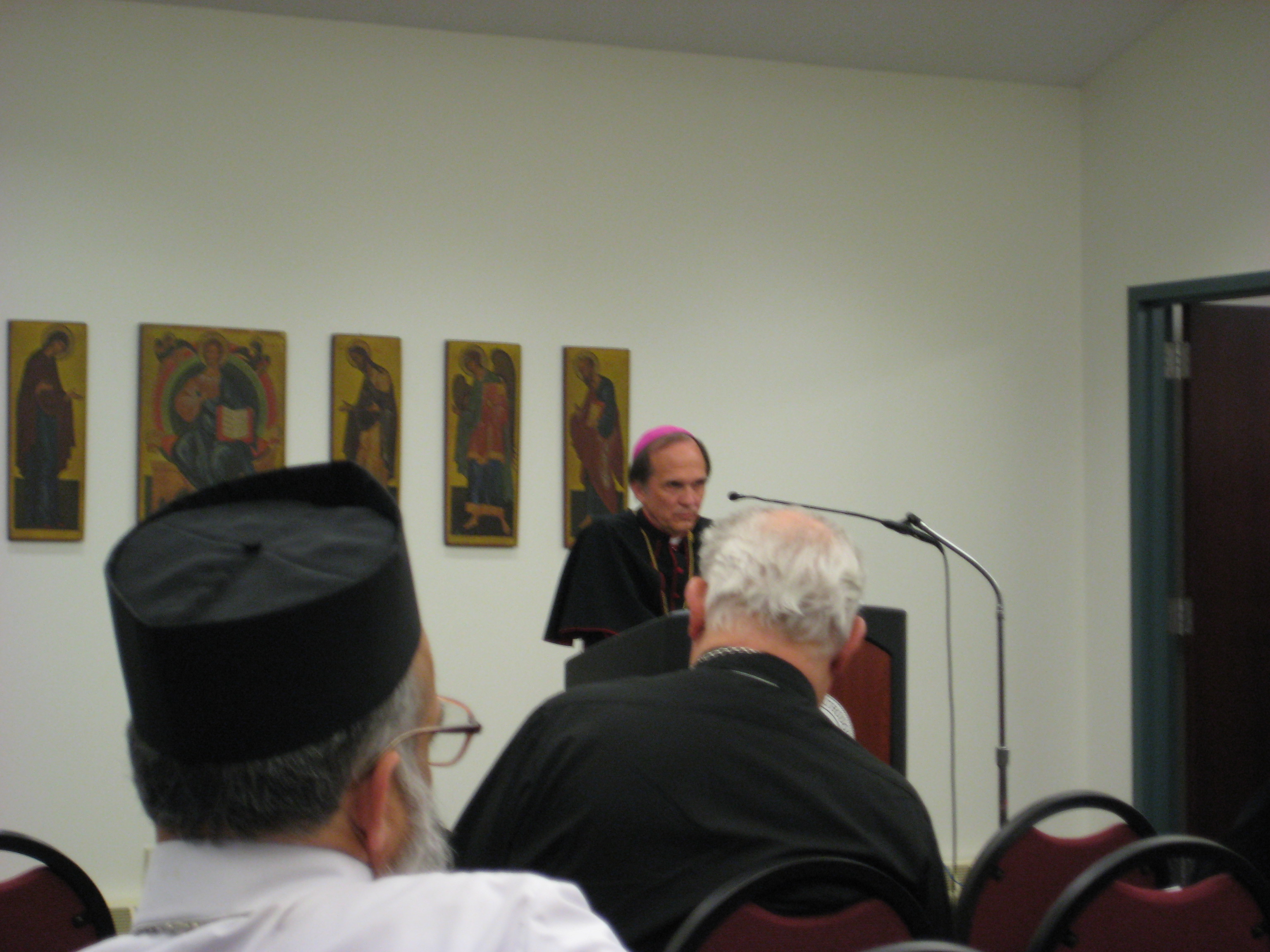
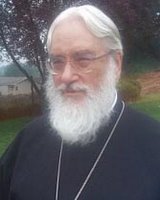
Thursday continued with Bp. Keith Ackerman, a self-professed “cradle Anglo-Catholic” and ECUSA bishop of Quincy, Illinois. I think I have to post a couple pictures of him to truly convey why I was confused when I was told he was ECUSA — there’s this one:
And then there’s this one, showing him from the rear (just because that’s really the only other picture I have of him):
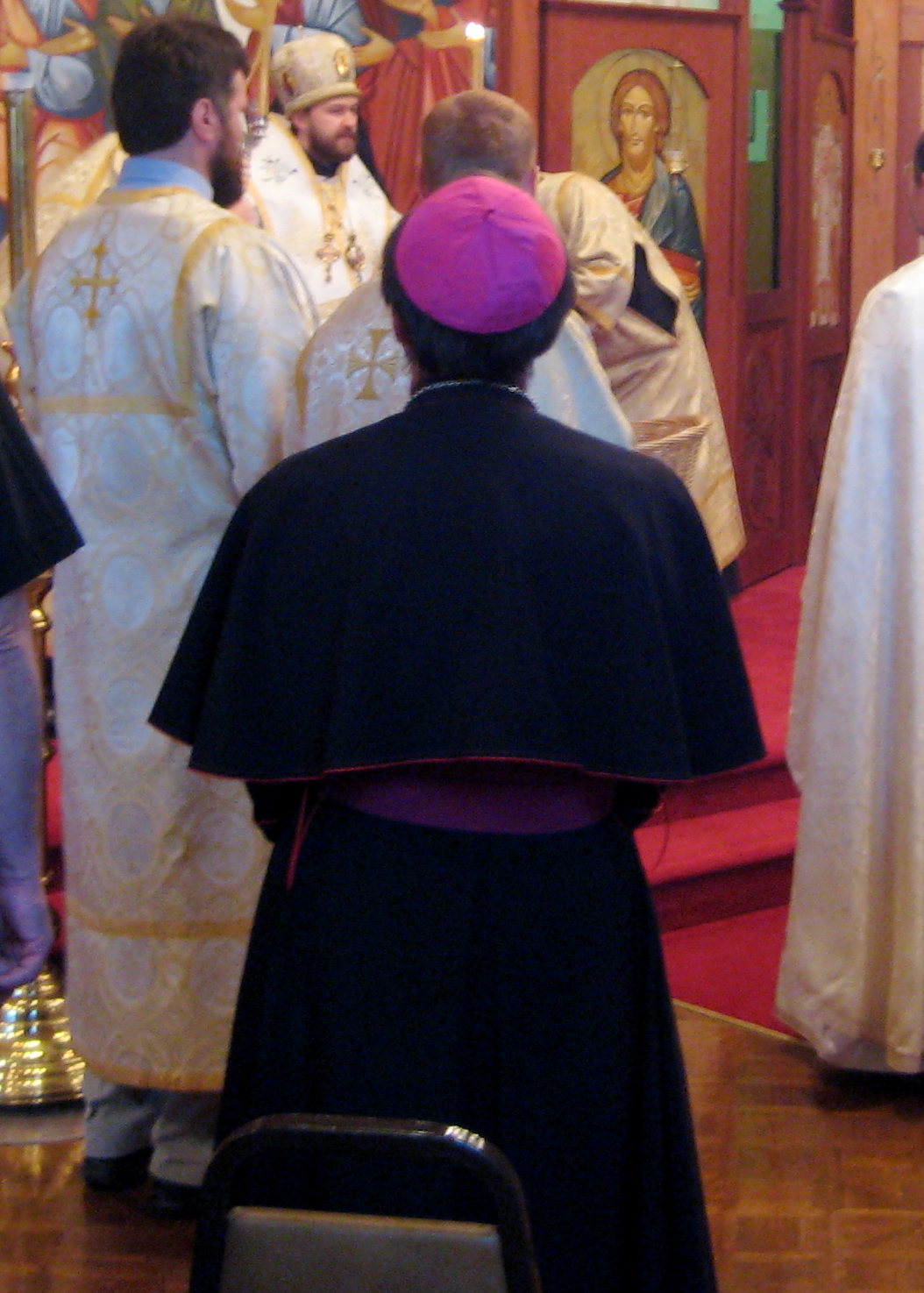
Get the idea? HIs Grace couldn’t be more Roman looking without a mitre. (Well, he mitre he might not.)

(Say it aloud and you’ll get it.)

(I’ll stop now.)

Anyway, he made several points which I truly appreciated; an important one, I think, is that unification of outer order can never move faster than the growth of the inner life. That’s a mouthful, isn’t it? To that end, he said, Eucharistic discipline — which, to him, includes fasting, prayer and meditation, and thanksgiving — is absolutely vital to unity, and because truth is the nature of the Church, unity of the “outer order” can only be achieved through doctrinal unity. (This is in remarkable contrast to the thoughts a later speaker, but I’ll talk about that when I get there.)

A very important point, I thought, related to the teaching office of the episcopacy; that is, “tactile succession” is not enough without orthodoxy.

He concluded by saying that we must be fully Catholic (and I don’t think I am misreading his intent for that to be an upper-case C), fully Orthodox, fully confessional, and fully renewed — and while I’m not sure I could put my finger on why I got this impression, but I rather got the sense that for him, Orthodoxy would be a no-brainer if we had our administrative house in order. It might very well be something that I read into his words, but I will nonetheless note that this was my impression.

Following Bp. Ackerman’s lecture, I was running around a bit. I was trying to touch base with Fr. John Behr, who had told me that morning, “Find me this afternoon and we’ll set up a time to talk.” Alas, we kept missing each other, and having plans in the city that night, I ultimately had to leave around 4pm to catch my train to Grand Central. (This also meant I was going to miss Fr. Patrick Henry Reardon’s talk (originally scheduled for the afternoon), but there wasn’t anything I could do about that at that point).

My previously mentioned friend Matthew Murray is a theatre critic and a Tony voter, so every time I’ve been in New York he’s made sure I’ve gotten to see something. My first time out it was Phantom of the Opera, and last time it was Fiddler on the Roof with Harvey Fierstein and Rosie O’Donnell.

Playing a married couple.

Let’s pause to contemplate this for a moment.

But I digress.

This time it was the current revival of Sunday in the Park with George, a production which dares to ask the question, “Is it live or is it PowerPoint?” Anyway, we arrive at the theatre, and I take notice of a very tall, bearded, and ponytailed man wearing a dress shirt and slacks standing in the doorway to the lobby, looking for all the world like an usher. And I think to myself, Wow, that guy looks a lot like Fr. John. No, really, it’s uncanny how much that looks like Fr. John. It could be his twin.

Wait.

That’s Fr. John.

What in the world is he doing being an usher? Doesn’t he make enough money as dean that he doesn’t have to moonlight?

But then his wife walked up to him and they entered the lobby, answering that question very quickly.

I walked up to him, saying, “Fr. John?” He did a double-take when he saw me, chuckled, and said, “So, you decided to take the evening off as well, eh?” He introduced me to his wife, who said, “Oh, Richard Barrett? I’ve read your book, I think.” I assured her that she hadn’t. We were able to arrange to meet for breakfast the next morning (“Lunch and dinner usually finds me eating with bishops, so let’s do breakfast,” he said), and that was that. What were the odds?

It turned out that a friend of theirs had won the tickets in a radio call-in contest, had given them the tickets and offered to babysit. Sometimes you just want to think (and this was not the last time I thought this over the course of the conference), there are no coincidences.

The hierarchical Divine Liturgy the next morning was celebrated by Bp. Hilarion. Rather at the opposite extreme from Met. Kallistos, his homily was short and pastoral, reminding us that as Christians, we need the Holy Spirit for anything we do to be successful — it is not the priest who makes the sacraments efficacious, or the worker of any ministry for that matter who may take credit for it, but the Holy Spirit, period. To that end, he concluded, as Christians, we should always be praying that the Holy Spirit is with us. Short and to the point, but well worth hearing.

Talking with Fr. John was fruitful; we discussed how a St. Vlad’s education might prepare me for further graduate work, and he was very encouraging, even having a couple of concrete suggestions regarding areas of research I might think about given my interests, and how I might make them more marketable. As with everybody there, he was very approachable and easy to talk to; one remarkable thing he said was that it took him all of two weeks write The Mystery of Christ — when he finished writing the three volumes of The Way to Nicaea, he realized there was a whole underlying, unexpressed argument to what he was saying, and that he needed to get that down on paper as well.

Two weeks.

The morning session was Fr. John Erickson’s talk, and I have to say I missed most of him; the pretense of “minimal impact” on the participation in the conference by us volunteers was dropped fairly quickly, and as a result there were a few sessions where I missed some amount of the presentation. I can’t complain — after all, they were doing us a favor, not the other way around. What I did hear was Fr. John suggestion that there might be a way for East and West to acknowledge each other’s differences as theolegoumena; he cited Pope Benedict’s oft-referenced statement that “Rome must not require more from the East with respect to the doctrine of primacy than had been formulated and was lived in the first millennium,” further saying that somehow the Orthodox could find a way to nuance Vatican I so that it was understood as a legitimate development for the West.

In response to a question about the possibility of redistributing the responsibilities of the Ecumenical Patriarch among several people, he gave the amusing response that “to be governed by a committee is worse than being governed by a tyrant.” I vote we have that printed on a t-shirt.

My friend Paul Bauer arrived during Fr. John’s lecture — I gave him a membership in the Fellowship as a Christmas present a few years ago, and he lives in New Jersey, so it was fairly easy for him to be there as a day participant.

Fr. Richard John Neuhaus gave the first of the afternoon sessions, entitled “Reconciliation between East and West: Eschatological hope and temporal urgency.” He was a wonderfully engaging speaker, and it was a boon to the conference that he could be there. He spoke of an “ecumenism of conversion,” saying that this is far more of what’s needed than the modern warm-and-fuzzy ecumenism. The modern ecumenical movement, he claimed, is quite dead, noting that where it is today represents a major decline from its status in the 1950s and 1960s. In 1965, he claimed, the National Council of Churches was the religious establishment in America, akin to Harvard University or the AMA — raising the question, at least for me, if that might not have been why it failed. He also told a story about Fr. John Meyendorff, who upon Ut unum sint being released, said “For a thousand years we have been waiting for a pope to say this, and the great tragedy is that we have not found a way to respond.”

Fr. Neuhaus also said a couple of things which I found troubling. First off, he said that the Catholic understanding of unity is full communion; fair enough, but I did not feel he adequately addressed the question of how doctrinal unity functions within this framework — that is, does doctrinal unity proceed from full communion, or vice versa?

He also spoke of the church having two aspects, communion and institution — but, vis-à-vis Bp. Ackerman the day before, where does the teaching office of the episcopate fit into that? Is orthodoxy part of the communion, or the institution? I wanted to ask him what he thought the proper relationship was between doctrinal agreement and full communion, but the Q&A was over by the time I was able to actually formulate the question.

Bp. Hilarion was next on the docket, speaking on “Catholicity in the Orthodox tradition.” His was a very basic lecture, in a lot of respects; all he did, really, was to lay out the Orthodox understanding of the episcopate and primacy in fairly irreducible terms. This was, however, given the nature of the gathering, a much-needed reminder of where we are, as opposed to where we might like to be. Catholicity is found in the local church, with the “universal” church as the totality of local churches. Characteristic of the local church is the presence of a single Eucharistic gathering presided over the bishop, who occupies the place of Christ in the Eucharistic assembly. There is not a single local church, he said, which has supremacy; a patriarch’s primary administrative role is to govern with the synod of bishops between council. In terms of a framework for reunion, he said, recognition of the primacy of Rome must be preceded by unity of faith. “We cannot simply invent an ecclesiology,” he said repeatedly.

My thought on this is that Bp. Hilarion, more than anybody else, rooted the proceedings very firmly in reality. For this reason I suspect he will not be remembered favorably by some of the participants, including some Orthodox, but much like Pope Benedict’s statement last year regarding the Christian bodies not in communion with Rome, I think it’s important that these things get said so that they may be dealt with directly and honestly. To put it another way, I think it might be important that we try to understand these kinds of statement prophetically rather than pessimistically.

That said, I was not always certain about what Bp. Hilarion understood in terms of questions from the floor. I asked what, in his view, the role of love was in the matter of primacy; he looked bewildered and said that love didn’t have anything to do with primacy. He recovered himself a little bit and said that he supposed that primacy was, ideally, exercised in love, but I still didn’t get the impression he understood what I was getting at.

The next speaker was Fr. Warren Tanghe of the Society of the Holy Cross, a “Catholic Anglican” group which grew out of the Tractarian movement of the nineteenth century. His lecture, frankly, was depressing; he painted a picture of traditional Anglicans being horribly marginalized (he used the word “outlaws” at one point), and on a ship which is sinking more and more quickly by the day. Still, he said, their belief is that as a “daughter church” of Rome, the proper order of healing requires the Anglican Communion to re-establish communion with Rome first, and to do so corporately rather than individually. To that end, he said, while he could not criticize those who have gone back to Rome (or to Orthodoxy) individually, his belief for himself at least was that he could not simply abandon his flock to the wolves. The question I wanted to ask was, “At what point do you have to change your mindset from not abandoning your flock to telling them they need to run for the lifeboats?” Feeling that would not be in keeping with the spirit of the conference, however, I asked it so that it had to do with the qualitative difference between returning individually and doing so as a body. His answer, it seemed to me, mostly restated the above, although he did say he wasn’t sure what his threshold would be for returning to communion with Rome as an individual.

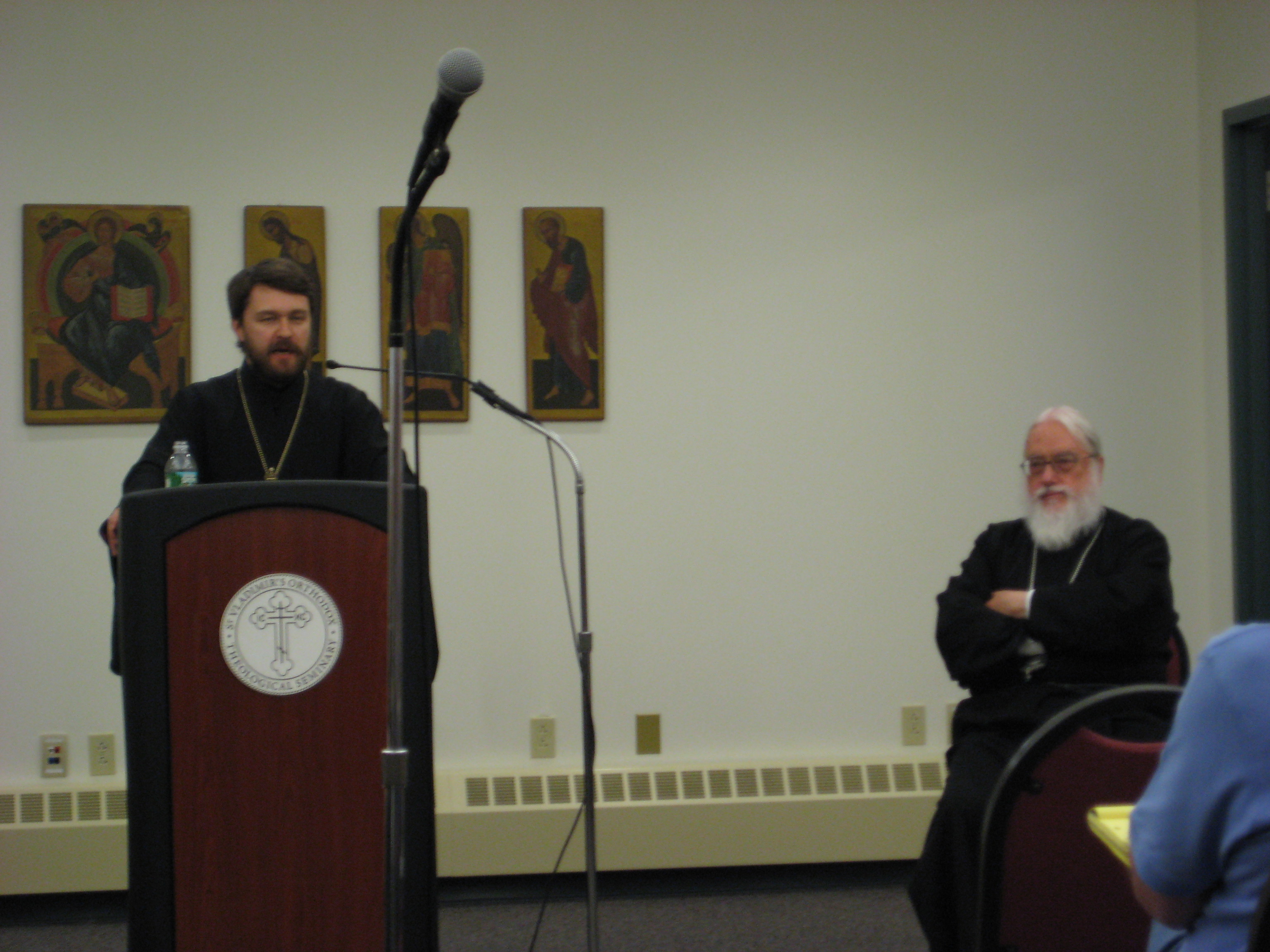
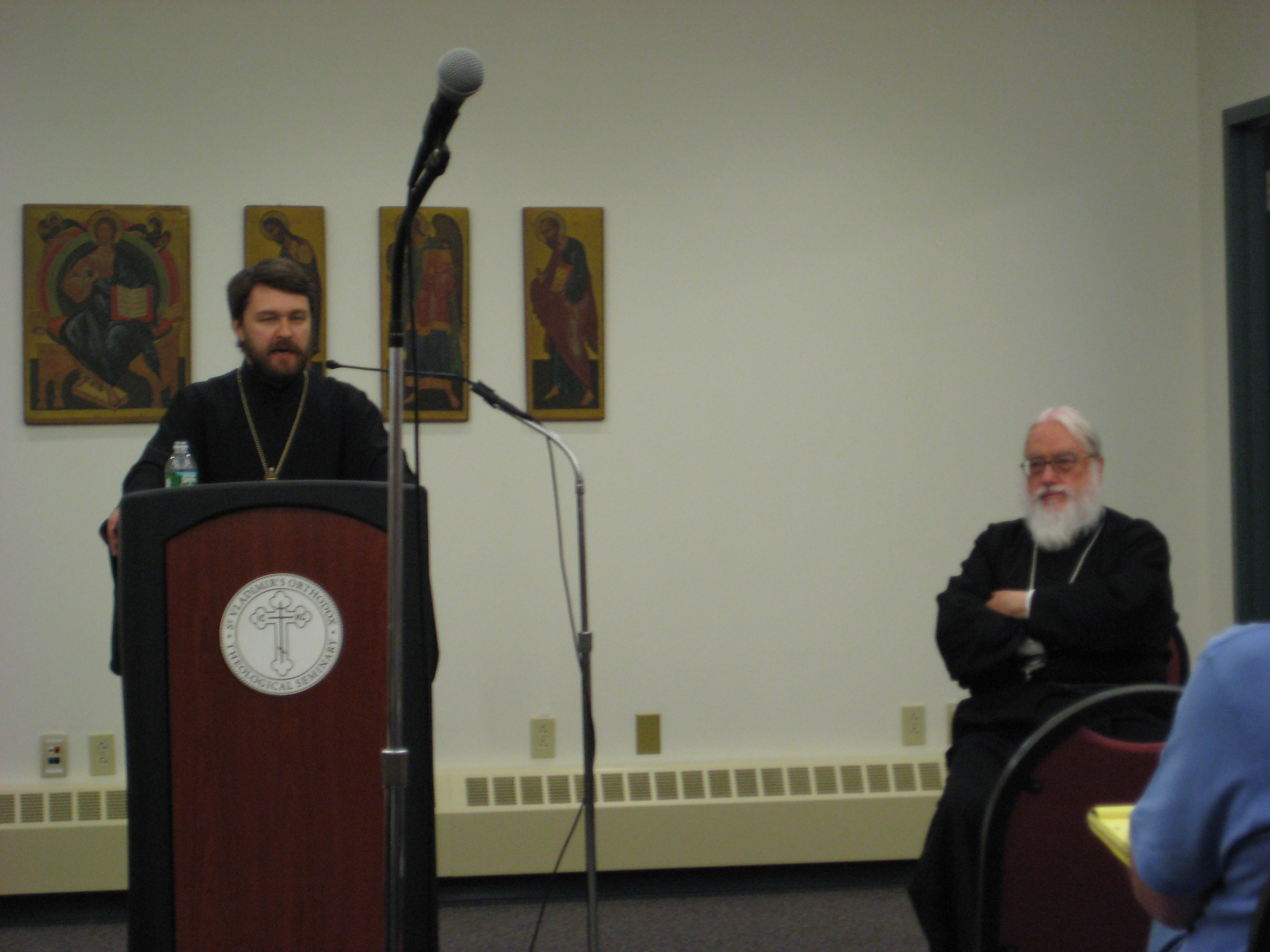
After dinner was a panel discussion, with the panel consisting of (as pictured, in order) Fr. Patrick Henry Reardon, Prof. William Tighe, Bp. Ackerman, Archimandrite Kyril Jenner, Fr. Arnold Klukas of Nashotah House, Met. Kallistos, and Bp. Hilarion. Fr. Patrick opened by saying that, in terms of primacy, “Rome has it hands down.” The tombs of Ss. Peter and Paul are there, he said, and that has to mean something, even if there has to be some work to understand exactly what it means.

This really was met with very little disagreement; even Bp. Hilarion agreed that primacy is clearly Rome’s, it is simply a question of what that means.  He quoted a friend of his as saying that the second and third Romes both fell, but the first one is still there, and that’s the reality we have to struggle to understand. Met. Kallistos put it this way — if Christ willed that there should be universal primacy in His church, it cannot be anyplace other than Rome. The question, then, is what kind of primacy, given that the definition as set forth in Vatican I is unacceptable to the Orthodox.

There were a number of genuinely moving moments during the panel; Fr. Klukas expressed that it was a relief as an Anglican to come to this gathering and find that the Orthodox have problems “just like us.” Bp. Ackerman appeared close to tears when he described the last time he was able to celebrate the Eucharist with Fr. Patrick before he became Orthodox, grabbing Fr. Patrick’s wrist as he did so.

An issue which came up during the panel was reception — to put it one way, how do we make the things we’re discussing here have an impact at the local level? When we speak of the various joint statements and conferences, are people at the parish level even aware that these things are happening? Met. Kallistos, in response to this question, asked how many of us had read either the Cyprus Anglican-Orthodox statement, The Church of the Triune God, or the Ravenna statement — and the reality was that maybe ten percent of us had done so. His point was, if even us highly-interested parties aren’t reading these statements, then we can hardly question lack of awareness at the local level, and it’s up to us to try to do something about that. I found that to be a very convicting thing to say, and my response was to order a print copy of The Church of the Triune God when I got back to the dorm.

By this session, Canon Jonathan Goodall had arrived, and was sitting in the front row. He made a statement that he felt that the proceedings seemed rather “anxious and North American,” and didn’t have as much bearing on worldwide Anglicanism as many might think. I spoke with him a bit afterwards; it turned out he remembered, and very well, meeting me on the streets of Oxford last summer, and it further turned out that he was an old school friend of my roommate’s. (This prompted my roommate to tell me, “There are no coincidences.”) Canon Goodall said that there is a problem with assuming that because certain problems exist in North America that they are representative of what’s happening in worldwide Anglicanism. “That just ain’t so,” he said.

Thus endeth the day. The report on Day 4 will come shortly.

By the way, I do exhort you all to listen to the talks, and to do so in order; I can’t (and do not set this forth as the aim) provide a transcript of the conference, and as such there are many important things which were said in the sessions which I won’t necessarily talk about here.
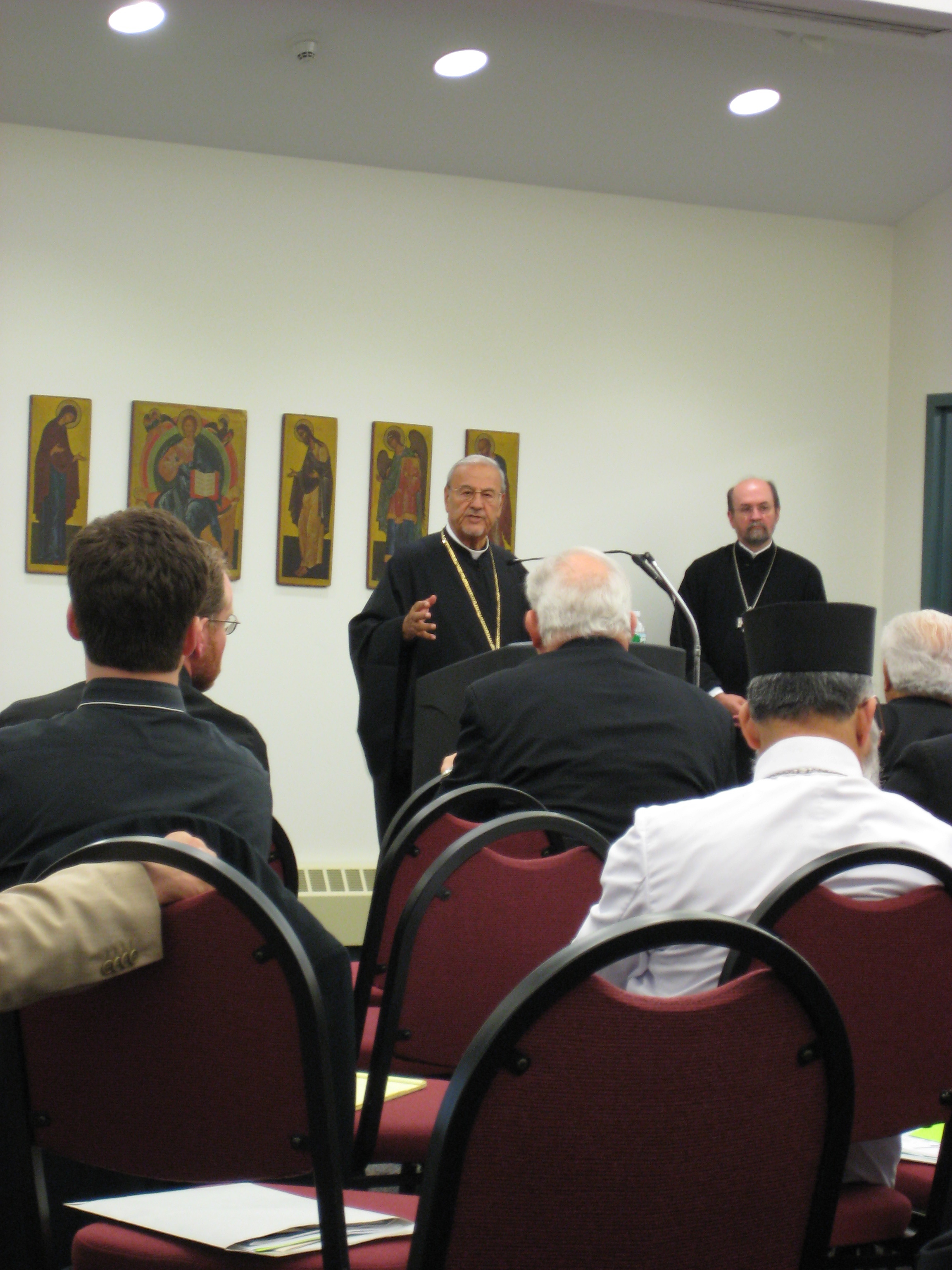
Fellowship of Ss. Alban and Sergius, Days 2 & 3

Just to give a sense of the general character of this event — there are two gentlemen regularly attired in black and purple robes and purple skullcaps; neither are Roman Catholic. One is an ECUSA bishop; the other is an Orthodox Western Rite archimandrite. By the same token, somebody in a cassock is just as likely to be an Anglican participant as they are an Orthodox participant. It gets a little confusing sometimes, particularly when one sees somebody dressed in typical Roman garb receiving Holy Communion.

I’m really tired. Sleep is always at a premium at things like this, and the last couple of nights have lent themselves poorly to sleeping much in particular, with the added issue of 7:30am Liturgies Divine. As noted earlier, the good news is that the commute is short. The North Dorm of St. Vladimir’s is on the opposite end of campus from the chapel, to be sure, but what that actually means is that it’s a four minute walk rather than a one minute walk. Nevertheless, I will try to highlight some points. (You can listen to all the talks online, as one of my commenters noted.)

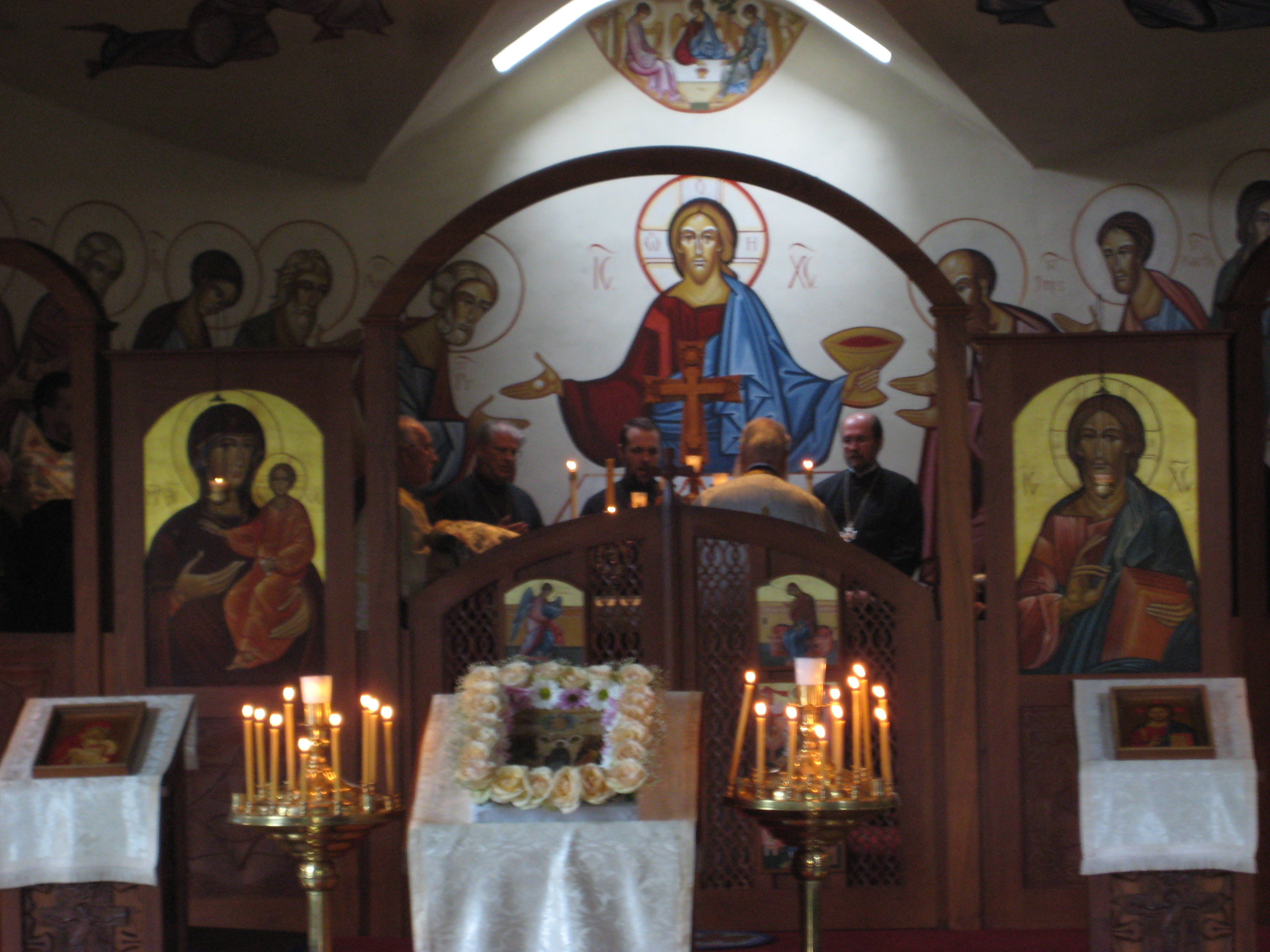
Thursday morning began with a hierarchical Divine Liturgy for the Feast of the Ascension celebrated by Met. Kallistos. He delivered a wonderful homily tying together diverse topics such as the observations of the pilgrim Egeria on her visit to Jerusalem, stained glass windows at the chapel of Queens College in Oxford, and the hymn texts of Richard Hooker. In essence, he told us that the Ascension signifies the elevation of our humanity with Christ, and that from a liturgical point of view, it completes the cycle, begun with the Nativity, commemorating Christ’s time on earth. He is a wonderfully engaging homilist, and one thing that the recordings do not capture is how animated he is when he speaks.

(Another fun part: During the Trisagion, he proclaimed the bishop’s prayer — “O Lord, look down from heaven and behold and visit this vineyard which Thou hast planted with Thy right hand” — once in Greek, once in Slavonic, and once in Latin. Good times.)

Metropolitan PHILIP’s lecture (delivered, appropriately enough, in the Metropolitan PHILIP Room) was powerful. I understand that there are those who take issue with many of his pastoral decisions, and perhaps how he does things in general. I even think there might be good reasons to take issue with him. Regardless, I am inclined to view him with as much charity as possible, particularly when I hear him saying what he said here. This is a man who is obviously very frustrated by the inability of Orthodoxy to have any kind of a visible impact on American life. The heartbreak he felt at Madeleine Albright’s refusal to meet regarding the bombing of Serbia during Holy Week was palpable. The apparent unwillingness of many within “the diaspora” to be more than “the diaspora” clearly causes him very real pain. It is also clear that to an extent, he is limited to what he can do within his own archdiocese (and to quote Bp. Hilarion, “I will not elaborate on that point”). When he said, “My generation is slowly but surely fading away. It is up to you,” it was a genuine, heartfelt, and emotional moment — at least because Metropolitan PHILIP is noticeably frail. He mentioned his dry macular degeneration, but in general he appears to be slowing down.

He was good enough to inscribe my copy of Feed My Sheep, but it also took a moment or two for it to register what I was asking. It has been roughly two and a half years since the last time I heard him in person, and the decline in his health was very stark. It would not surprise me at all if this were to be the last opportunity I had to hear him speak before his repose.

(By the way, I believe this is the parish he mentioned which started with the Jordanians he met at Nathan’s.)

I have much else to say, but frankly, it is 12:45am and there’s a lot more tomorrow. A few things I can mention as a preview (and hopefully I can write more tomorrow night):

  • For those who go back to the .Mac days — the gentleman to whom I spoke in Oxford is here, and much to my surprise, he remembered exactly who I was. He’s also an old friend of my roommate’s. Good heavens, it’s a small world.
  • I had a very fruitful chat with Fr. John Behr this morning, and I am encouraged. (There is also something of a funny story attached to how this came about.)
  • Bp. Keith Ackerman, ECUSA bishop of Quincy (Illinois), is an Anglo-Catholic (and I have emphasized the word Catholic for reasons that are hopefully clear from the picture I posted). Fr. Warren Tanghe of the Society of the Holy Cross, on the other hand, is a Catholic Anglican. Confused? So am I, but I’m pretty sure they’re not. I disagree with where they are, but I think it would be fair to say that so do they, and that it is with a lot of difficulty that they remain. I’ll talk more about this tomorrow.
  • Bp. Hilarion is an excellent homilist, but of a very different character from his Doktorvater. He is also the speaker who probably will be remembered as the most, shall we say, problematic of this conference. Thing is, I think what he had to say will doubtless be misunderstood by many. Based on what I heard, he says what he says, not to be a jerk or an anti-Roman polemicist; far be it! In fact, I think he desperately wants to avoid anti-Roman polemics. Rather, I think he wants everybody to be honest about what our starting point actually is, not what we (or anybody else) would like it to be for the sake of convenience. I firmly believe that he is one of the bright lights of Orthodox Christianity in the Western world, for all kinds of reasons that I’ll go into later, but I think he’s going to stick in the craw of a lot of folks for awhile. Let me suggest that we need to hear his words prophetically, rather than jumping to the conclusion that he’s just being an arrogant stick in the mud for the sake of Muscovite power.
  • Fr. Warren Tanghe’s lecture on the Society of the Holy Cross was at once very moving and very depressing.
  • The panel discussion was, I thought, very illuminating in terms of what we should be trying to take home from this conference (besides a suitcase full of books from the St. Vlad’s bookstore).
  • I met the new full-time, tenure track liturgical music professor at St. Vlad’s, and I’m heartened.

Okay, I’m wrapping this up for now. Tomorrow is an Anglican Eucharist; I think it’s only fair that we Orthodox go to this — after all, the poor Episcopalians here have sat patiently through roughly seven hours of our services so far, including a Vigil (I doubt very much that the vast majority of Episcopalians here had any idea what we meant by a Vigil, and from the conversations I’ve had, I’d say most of them still don’t) and two hierarchical Liturgies. An hour and fifteen minutes at one of theirs isn’t going to kill us.

Fellowship of Ss. Alban and Sergius: Day One

Well, I’m here.

We were up at 3am and on the road by 3:45am so I could catch a 6am flight, which was delayed half an hour by torrential downpours. (The other bummer here was that Megan leaves for Germany tomorrow, so this was goodbye for six weeks.)

The delay in Indianapolis meant that I had to basically sprint from one end of the Atlanta airport to another to catch my connection to LaGuardia, and they had already seated standbys and closed up the plane when I (and two others from the same flight) arrived. Because of a delay at LaGuardia, they were able to let us on, but I’m not sure they didn’t bump off people who had been seated on standby in order to do it.

My friend (and editor, groomsman, personal reference, and now tour guide) Matthew Murray met me at the airport to navigate me through the combination of bus-and-subway rides I needed to take to get to Grand Central Station. No big deal, really, but it was an excuse to see Matt for the first time since my college graduation in 2005. The subway, by the way, is basically identical to the London Underground, except that I didn’t hear the friendly “Please mind the gap between train and the platform” warning.

Grand Central, by the way, truly is a marvel. You want it, you can find it — except wireless access, it seems. For some reason the T-Mobile pay service wasn’t available, but then the real tease was an item showing up in my networks list called “Free Public Wireless,” only to have it not work.

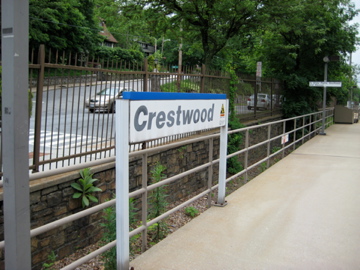
...for a day or a lifetimeFrom Grand Central, it was fairly straightforward to catch the commuter rail train I needed to Crestwood, making five means of transportation to get my from my house to the conference: car, plane, bus, subway, and commuter rail. (It was on the last of these, just for the sake of you transit geeks, that I heard the American version of “Please mind the gap…”) Then I had the short-ish walk to St. Vlad’s from the train station. (By the way, St. Vlad’s website folks: your online directions miss a very important stop sign.)

(Just as a point of reference: I left my house at 3:45am, and arrived at St. Vlad’s at roughly 1:30pm. This was with no particular idle time, too, meaning all told it took nine hours and forty-five minutes to get from my front door to the seminary. When I drove to St. Vlad’s two and a half years ago, it was about a fourteen hour trip.)

Check-in was painless; they finally processed the refund of my registration fee (half of which was reclaimed at the bookstore, but never mind that now), and I met the other volunteers. Interestingly enough, they’re all from Nashotah House, the ECUSA seminary for the Anglo-Catholic-minded (and where a particular individual teaches when he isn’t busy studying at the Pontifical Gregorian Institute). According to Chancellor Fr. Chad Hatfield (himself a Nashotah House alumnus), this is the largest gathering of Nashotah House folks ever at St. Vladimir’s, and it evidently represents an initial step with regard to establishing something of a formal relationship between the seminaries.

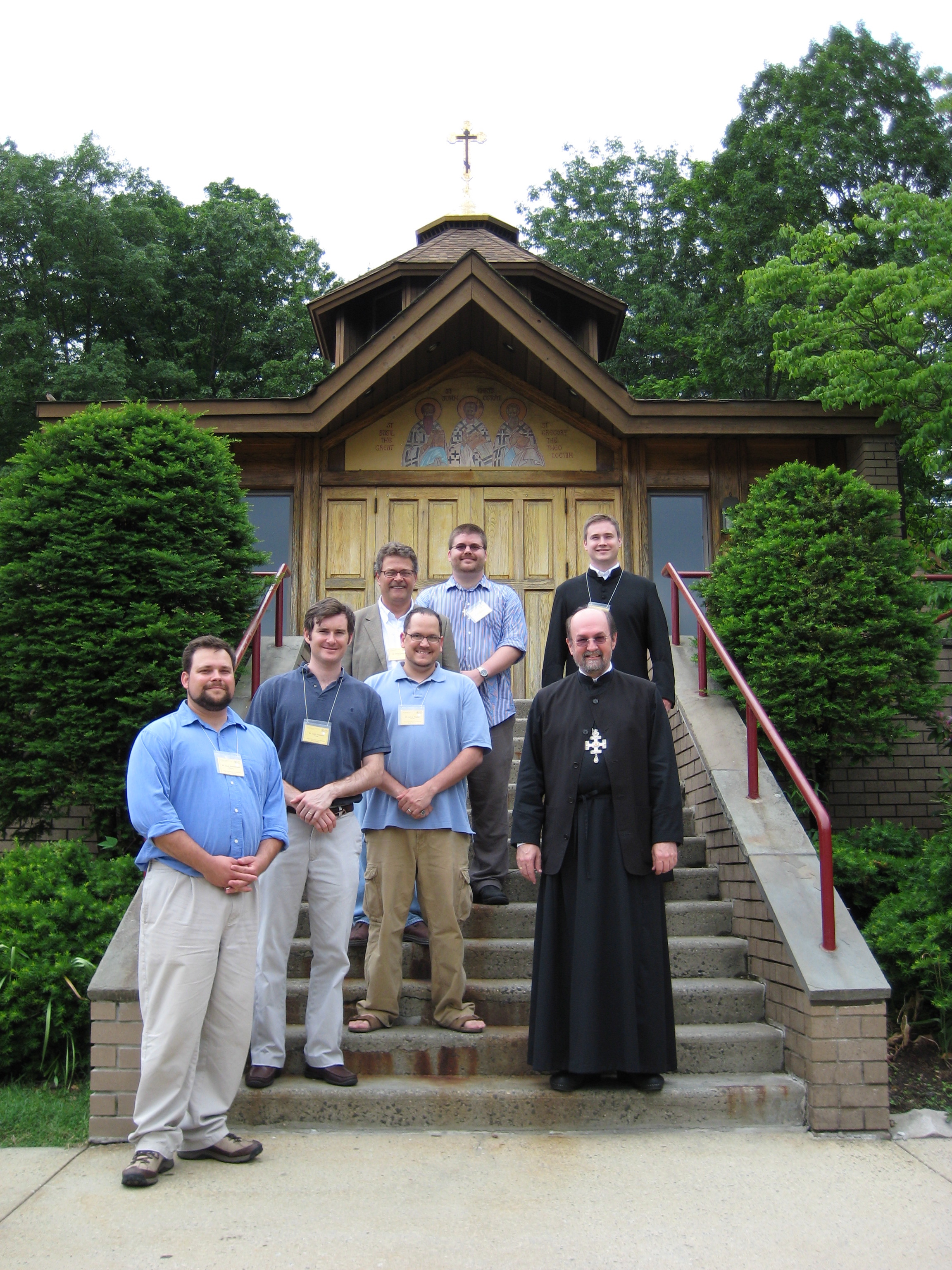
We\'re smiling because we didn\'t pay the $500 registration feeFr. Chad was very nice to the volunteers, giving us a tour of the campus and stopping for a photo op. He’s a bit of a crack-up; I’m not sure how many of his comments were intended to be repeated to the general public, so I won’t reproduce them here (nothing ill-fitting a priest, mind you, just some things about some possible future directions at the seminary), but I’ll just say he’s not afraid to speak his mind. According to one of the seminarians with whom I was talking, this is A Good Thing.

I’m meeting some very interesting people, and there are really several different kinds of folks here — it’s far more diverse than I thought it might have been. Fr. Peter Jacobsen, whom I met four years ago at the Antiochian Sacred Music Institute (and who spent a good chunk of time walking me through the Missale Anglicanum, AKA the Knott Missal), is here. My roommate is an Episcopal priest, and he’s been fascinating to get to know, even in the short time we’ve talked. The Nashotah crew are great. There’s an ELCA pastor, an Annapolis Naval Academy professor, and so on. One of the seminarians here to whom I’ve spoken is an Episcopalian himself who’s here specifically to study patristics with Fr. John Behr. And so on.

Vigil for the Ascension was a very peaceful end to the day, and as it happened, Met. Kallistos was at the altar (even though he wasn’t celebrating). His primarily liturgical contribution was to perform the anointings during the litia and artoklasia — but I believe he is celebrating the Divine Liturgy tomorrow morning.

Speaking of which, the bad news is that Liturgy is at 7:30am; the good news is that the commute is very short. Still, I’ve been up now for nearly 21 hours, and tomorrow is when the real fun begins, so I believe I will close this for the time being. Less exposition and more actual thoughts once, y’know, I can actually form some.

More later.

Coming soon…

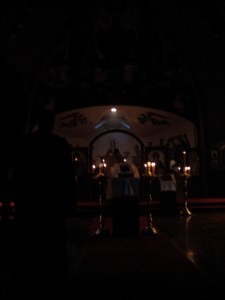
Three Hierarchs Chapel, St. Vladimir\'s Seminary, Crestwood, NYTomorrow morning, at the ungodly hour of 5:57am, I will depart Indianapolis for the Fellowship of Ss. Alban and Sergius Conference. I will note that it is by no means too late to give to the tip jar (as in “tip jar, baby, tip jar“). I will have my laptop and my brand-spankin’-new camera, so I will be providing updates as regularly as I am able.
I’m looking forward to any number of things; I am of course looking forward to getting to hear (and possibly meet) people such as Met. Kallistos Ware, Met. PHILIP, Bp. Hilarion Alfeyev, and so on. I hope that I’ll actually get to hear a particular priest (nameless for the moment but identifiable once you read the quote) say “Back when I was studying at the Pontifical Gregorian Institute…” with my own ears. I’m looking forward to the Divine Liturgy for the Ascension in the Three Hierarchs Chapel. I’m looking forward to meeting the eclectic group of people one usually meets at conferences. I’m looking forward to seeing how New York’s public transportation matches up to England’s and Germany’s.

More than anything, however, I guess I’m very much hoping to get a sense about whether or not St. Vlad’s is the place for me. I will have a chance to talk with Fr. John Behr at some point over the course of the trip, so hopefully that will be a fruitful conversation. I know I don’t belong at Indiana University, but that is not the same thing as actually having a meaningful direction.

If there’s something to which I’m not looking forward, it’s coming home Sunday night. It’ll be an empty house, and that’s what’ll be greeting me for the next six weeks.

Well — more from the road.

Many years

I can finally talk about this without any fear that it might reach certain ears prematurely (i.e., certain people who the parties involved would rather tell themselves):

Matthew and Erin, our newly-baptized godchildren (see photo), are engaged! They are planning for a wedding shortly after the Feast of the Dormition next year.

Erin started at IU as a freshman the same year I started as a transfer junior (fall of 2003), and because of the realities of how transfer credits typically don’t work with music schools, that meant we wound up taking many of the same classes together. Matthew started as a freshman the following year, and we met in the chorus for Eugene Onegin. Their story is theirs to tell, but I’ll just say that they started attending All Saints together two years ago and were subsequently blessed as catechumens last fall. All of this is to say that they have truly desired and made the effort to grow their faith in tandem with their relationship, and it’s been a really wonderful thing to see.

Many years!

Poking my head back up…

…at least for a moment. The thing about blogging is, when you’re doing it, you’re able to do it. When you’re not doing it, it’s hard to get back into it because you feel like you’ve got so much catching up to do.

In brief, I was deliberately keeping blogging on the downlow the first half of April or so while a couple of situations finished playing themselves out, and they did, and everything turned out okay, but then it was Holy Week, and my mom was here, and then it was Finals Week, and then I’ve also been adjusting to a new job, and, and, and…

The other thing is that my new job is significantly less stressful than my old one. By metric tons, even, and for every imaginable reason. Between that and having a break from classes, the decompression rate is astounding. One of the things this has underscored for me is the sheer amount of stress with which I’ve lived for about the last year and a quarter — it’s been a pressure cooker, and not entirely for great, rewarding reasons. There are details on which I’m not going to elaborate here, so let’s just say for the moment that when somebody stops communicating with you, or intentionally communicates poorly, but still makes you responsible for what you would have known had they been communicating with you, and makes that standard operating procedure, there is no longer any reason to stick around — that person has already decided you don’t belong there. You’re not going to win, nor are you going to be able to fix anything.

Anyway, the point is, in decompressing, I have found myself picking up threads of particular projects that have lay fallow for much of the last year. This has been a good and productive thing — although the main one is not something I’m yet ready to discuss here — but it’s also taken time from other things I might have done more readily a month ago. Like blogging.

But here I am now, nonetheless.

I’m in the midst of reading Sunday Matins in the Byzantine Cathedral Rite, the doctoral dissertation of Dr. Alexander Lingas, the founding Artistic Director of Cappella Romana. I don’t have a lot of specific commentary on it just yet because I’m only about a quarter of the way through it, but one thing I will say is that I’m somewhat bemused by the fact that I’m having to read it in the form of a copy ordered from Proquest rather than an actual published book. Amazon.com lists it as having a publication date of 28 June 2008, but it is not yet available for pre-order; on the other hand, it is available for pre-order on Amazon.co.uk. However, if you go to the publisher’s website, it isn’t listed anywhere — neither as a forthcoming release nor anything else. Thing of it is, this has happened before; two years ago it had a publication date listed on Amazon of June 2006, and then right around May the date was yanked. An e-mail to Ashgate generated a reply that publication had been rescheduled to 2008, and here we are, but there’s nothing from Ashgate right now to suggest this is in fact happening. And, so far as I can tell, this has been going on with this particular work, with more than one publisher, for about ten years.

Gotta love academic publishing. I mean, it’s going to be approximately a $100 book, and I suspect that a thousand copies is a fairly optimistic estimate of the print run for this specific of a project, so I’m sure that whoever the publisher ultimately is, they’re not going to pull the trigger until the numbers make the most sense possible, and everything I hear about academic publishing says that, frankly, the numbers suck more often than not.

I’m also reading Bp. Hilarion Alfeyev’s The Spiritual World of St. Isaac the Syrian, and that’s another fascinating case with regard to publishing. It is readily available from its publisher, Cistercian Publications; however, for whatever inexplicable reason, it is not available through Amazon. That’s not all; the current edition really looks like it needed an editor. Capitalizations are extremely inconsistent, for example; a sample sentence tells us that “[t]he christological position ofthe Council of Ephesus was purely alexandrian: it took no account of the antiochene position, and it was precisely the antiochene (and not ‘nestorian’) Christology that was the Christology of the Church of the East” (p22, entire quote sic). Bp. Hilarion is a native Russian speaker, I believe, not a native English speaker, so perhaps that explains it, but one might expect that a native English-speaking editor would normalize these things.

In terms of my own adventures with academic publishing, I submitted my “Sensory Experience and the Women Martyrs of Najran” paper to a particular journal that had a call for papers that seemed appropriate. I got the response on Monday, and it was a bit curious. It wasn’t a “yes,” but it was a “no” that I wasn’t totally sure what to do with, since it wasn’t a form letter rejection (I’m very used to those). Basically they said, “This is really interesting, but in its current form it’s not appropriate for us. If you wanted to make it appropriate for us, here’s what our reviewers suggest.” The letter specifically says, “While we are not asking you to revise and resubmit, we would be happy to look at the paper again, provided you address all of our reviewer comments.”

So, what does this mean? Is this how journals try to let people down easily (“You’ve got a really great personality”), or does this mean it might be worth my time to make the revisions they suggest? If the latter, I’m going to need some help deciphering the editor-ese, so I’ll make dinner for whoever might be interested on that front.

Humorous note: The salutation of the letter was, “Dear Prof. Barrett”. Heh. Uh, no, to say the least.

I will eventually have pictures and a more detailed report regarding Lazarus Saturday’s baptisms and chrismations, but there is a related matter I wish to mention regarding a couple of the people involved, and it’s not completely public knowledge yet. Watch this space.

In other matters… in case you were wondering, no, as it happens, melted wax from a beeswax candle does not improve the functionality of a laptop keyboard. My wife felt compelled to perform this experiment this last Friday, so please don’t think that you need to determine this for yourself. Now, thankfully, Dell laptop keyboards appear to be designed to have things spilled on them and are incredibly easy and inexpensive to replace with no further trouble; Triangle Laptops was a terrific source, and I have no complaints about their pricing or their service. Should this happen to you, that’s the first place I’d look.

There is an effort at All Saints underway to explore ways of “greening the church”; without wishing to get into an argument here and now about whether or not this is a concept with which Orthodox need concern themselves, I’ll pass along that there were a few ideas which immediate came to mind for me:

  1. Commit to burning only olive oil and beeswax (excluding incense) — no paraffin, in other words. Olive oil and beeswax are, first and foremost, the traditional materials to use for candles and lamps in the church, and they have the added benefit of being clean-burning. St. Gregory Palamas Monastery in Ohio, I believe, does this.
  2. Start an herb garden. Given the various liturgical uses of basil, at least, this strikes me as a no-brainer. No reason to spend tons of money on fresh basil for Holy Saturday and house blessings and so on when, for a small fraction of that cost, a church could grow its own. Grow enough and there might be a reason to have a regular presence at the local farmer’s market, which could itself be a form of outreach.
  3. On a completely basic, practical level–have a rain barrel, or two, or three, or however many would be useful to have.

Anybody have any other thoughts?

I will wrap this up for the moment with a plug for the book The Oldways Table. If you’re a Michael Pollan or a Rod Dreher person, you may very well find that this book helps to suggest practical ways that some of their ideas might be put into practice. I’ll have more to say about it later once I’ve tried a few more of its ideas (and more importantly, adapted them into some of my own).

(And yes, I did in fact finish the Patriarch’s book on Lazarus Saturday; I’ve got plenty to say about it, but it can wait. Suffice it to say, for the moment, that I believe his intended audience for the book is not comprised of the Orthodox faithful, but that this does not in and of itself have to mean that the Orthodox faithful are justified in viewing what he says uncharitably.)

Testing from flickr…

Nachos on Pascha, originally uploaded by richardtenor.

For your viewing enjoyment, Der Nachoberg…

Christus resurrexit! Vere resurrexit!

 In Old English: “Crist aras! Crist sodhlice aras!”

In Modern English: “Christ is risen! Indeed He is risen!”

In Modern South Central Indiana English: “Christ done riz! Sho’ ’nuff!”

I have a fairly long blog post or two in me, as well as notes for Lesson 3 of Hansen & Quinn, but it’s still going to have to wait until after this week. Last week being Holy Week and this week being Finals Week… yeah. Next week.

Brief updates, however (with explanations to come):

  • Lazarus Saturday saw the reception of six into the Orthodox Christian faith at All Saints; four by Baptism, two by Chrismation. Two of those baptized were my wife’s and my new godchildren, Matthew and Erin. Theirs is a good story, and the morning (not to mention the subsequent Holy Week) was a beautiful welcoming home (as it were) for them. I have pictures and I’ll post some eventually.
  • I started a new job on Monday of Holy Week. The new job is a Very, Very, Very Good Thing; truly, a major blessing. That said, I don’t ever recommend starting a new job during Holy Week. I also don’t recommend Finals Week being Bright Week, and I particularly don’t recommend having a Latin final at 10:15am on Bright Monday, but sometimes there’s little we can do about these things in a fallen world.
  • My mother was with us for most of Holy Week (starting with Unction on Wednesday evening) and Pascha. She survived, and would like to come back and do it again… someday.
  • I’ve decided to take the Reading French for Graduate Students course this summer. I’d like to refresh my French, particularly now that I’ve had a couple of years of Latin and Greek and actually understand some of the grammatical concepts and could actually explain to somebody what a subjunctive is.

Okay. More later.

A parable

Once upon a time there was a young man who was eating slices of of a particular baker’s bread, and had eaten perhaps half of a loaf, but the baker would not allow him to eat any more buying by the slice. “Any more and you have to buy the loaf,” he told the young man.

The thing was, this was a baker who was choosy about with whom he did business, and while anybody could buy slices, he wouldn’t sell an entire loaf to just anybody. He would only sell a loaf to somebody who had demonstrated that they understood how the bread was made, where the flour came from, what role the yeast played in the rising of the dough, and so on. Not only that, but he would only bake so many loaves per day.

The young man had done his homework about baking, and had gotten to know the baker by spending time in the shop. The baker seemed receptive to the idea of selling him the half of the loaf he hadn’t yet eaten. But then, suddenly, seeing how many customers were trying to buy loaves that day, the baker decided that the young man would need to come back another day for his loaf. “But what about the remainder half of the loaf I’ve already eaten in slices?” the young man asked. The baker didn’t answer him, and focused on getting to know the crowd of people in his shop to figure out who was worthy to buy his loaves of bread. The young man went away hungry and somewhat dejected.

Towards the end of the day, the young man, still hungry, dropped by the baker’s shop again, which was now empty except for the baker. The young man saw that all of the day’s loaves were sitting on the counter, including his uneaten half. “What happened?” he asked, incredulous. The baker replied, “By the time I figured out to whom I was willing to sell for the day, everybody had changed their mind and decided to go buy bread elsewhere.”

“That’s terrible!” the young man exclaimed. “Well, I’m still more than willing to buy my uneaten half!”

“No,” the baker said, gathering up all of the loaves into a trash sack, “everything has to be thrown away for the day. Bakers’ rules. Of course, since I didn’t sell anything I don’t know that I’ll have the money to buy ingredients for tomorrow’s loaves, but I guess that’s how it goes.”

“Wait a minute,” the young man said. “You know me, I had done my research on baking and bread, I was here early to talk to you, I had already eaten half a loaf paying by the slice, was willing to pay full price for a loaf for the remaining half, you still decided not to sell to me, and now you have nothing to show for the day?”

“That’s right,” the baker said, shrugging his shoulders.

The young man turned on his heel to go find a bake shop run by somebody with more sense, feeling fortunate, in a way, that his money ultimately hadn’t gone to a person so short-sighted and foolish.

Draw your own conclusions.

I should start calculating trends


My blog is worth $3,951.78.
How much is your blog worth?

If you agree with this at all — you know what I’m going to say, don’t you? — tip jar, baby, tip jar.

Also, I’d like to welcome my buddy Gavin back to the blogosphere! We’ve missed you!


adventures in writing alexander lingas all saints bloomington all saints orthodox church american orthodox architecture american orthodox music american orthodoxy Antiochian Archdiocese Antiochian Orthodox Christian Archdiocese of North America Antiochians books byzantine chant cappella romana chant church architecture ecclesiastical chant ethnomusicologists ethnomusicology fellowship of ss. alban and sergius Greece Greek greek food greekness hazards of church music international travel tips ioannis arvanitis joe mckamey john michael boyer kurt sander Latin liturgical adventures liturgical architecture liturgical music liturgical texts and translation liturgy liturgy and life lycourgos angelopoulos medieval byzantine chant Metropolitan PHILIP militant americanist orthodoxy modern byzantine architecture modern greek music music as iconography my kids will latin and greek when they're newborns my kids will learn latin and greek when they're newborns orthodox architecture orthodox architecture is bloody expensive Orthodox choir schools Orthodox Ecclesiology orthodox outreach orthodox travel pascha at the singing school Patriarchate of Antioch Patriarch IGNATIUS IV Patriarch of Antioch publishing random acts of chant richard barrett in greece richard toensing rod dreher sacred music st. vlads st john of damascus society Syriac the Bishop MARK fan club the convert dilemma the dark knight The Episcopacy The Episcopate the only good language is a dead language this american church life travel we need more american saints why do we need beautiful music in churches?

Blog Stats

  • 271,016 hits

Flickr Photos