Archive for the 'General' Category


Things Jesus would say if He were physically on the planet today…

“A city set upon a hill…”

“…probably isn’t wheelchair accessible!”

(Terribly insensitive humor inspired by the following chain —

This story: http://www.msnbc.msn.com/id/25825608/

Which then led me here: http://wirednewyork.com/forum/showthread.php?t=3426

And you have this quote from the architect here: http://wirednewyork.com/forum/showthread.php?s=9062f44d4a8168a55a0532331fbef550&t=3426&page=2

Planners for the archdiocese want the new building close to Greenwich Street, rather than behind or on top of the hill that will be formed by the entryway to the ramps.

“The church has to be accessible,’ said Nicholas P. Koutsomitis, an architect who is preparing the master plan for St. Nicholas. “It can’t be perched on top of a hill.” (emphasis mine)

Let it be said that I have every sympathy for the desire to make a church building accessible; I just find the irony of the statement to be quite thick.)

Something I don’t usually do…

I’ve kept my comments here restricted to a few general categories — more to the point, there are a few things I’ve avoided talking about. I don’t talk about politics here (although perhaps some stances are indirectly discernible), I don’t generally blog about what I do at work (mostly because that would generate an even smaller number of readers; I work a desk job, and there’s not much to say), I don’t say much (with some exceptions) about my personal life, and I don’t for the most part do things like movie reviews.

Well, this isn’t going to be a movie review, exactly, but it’s going to be about movies, and it’s going to deal with, in large part, a movie you had a statistical likelihood of seeing this last weekend if you bothered darkening the door of your local movie theatre at all between midnight last Thursday and Sunday evening. (No, shocked as you may be, I’m not talking about Mamma Mia!)

I’ve been a Batman guy for a loooooooooong time. There was a little Brave and the Bold digest my mom brought me home once when I was probably about five and home sick; it collected this neat little Batman vs. Deadman story which was drawn by Neal Adams — “You Can’t Hide From a Deadman,” originally printed in Brave and the Bold #86, Oct/Nov 1969 — and I was hooked ever since. It was still a few years yet before I started reading comics regularly, but I remember coming in on the tail end of Batman: Year 2, reading Ten Nights of the Beast, The Killing Joke, and A Death in the Family when they were first printed (The Dark Knight Returns I came to about three years late or so just ’cause it looked kinda ugly to this ten year old when I first saw it on the shelves — let’s face it, I was just too young to get it), and I was definitely at the movie theatre on 23 June 1989 for the first night the Burton/Keaton Batman was playing, which I saw three times that summer while it was still in the theatres. A tick over nineteen years later, maybe not much has changed.

I’ve also been a Christopher Nolan guy for a good bit. I saw Memento three times when it was in theatres, and keep in mind that meant, at least for the first couple of times I saw it, driving about half an hour to the arthouse which was playing it. I talked it up to whomever would listen, took friends to see it, bought David Julyan’s score CD, bought the DVD (both versions), and so on. I bought (and quite liked) Following when it came out on DVD, and while for various reasons had to miss Insomnia when it was in theatres, I’ve enjoyed it on DVD since (but, truthfully, it remains the one I’ve seen the least number of times — maybe that’s nothing to lose sleep over?).

For me, getting to know a director’s work is getting to know what kinds of themes interest them, what kinds of images they consistently use, what they like to do with structure, which actors they re-use, who scores their movies, what kind of pattern they’re continuing (or establishing) with new works, and so on. To put it another way, a director is always infinitely more interesting to me when there is something more I can get out of one of their movies by placing it in the context of the rest of their work.

Which brings me to The Dark Knight. There are major spoilers to follow from The Dark Knight, Batman Begins, Memento, Following, Insomnia, and The Prestige, so do read at your own risk.

I’ve seen it twice now; I was lucky enough to get in on the viral marketing IMAX ticket giveaway, only because I live in a market where two hours after the site went live there were still tickets available (although only just — I was 164/170), and thus saw it 50.5 hours before most of the rest of the world had a chance. I also saw it again (in IMAX, natch) last Friday night. I’ll get the easy stuff out of the way first: some movies are overhyped. A couple of well-edited trailers, a flashy marketing campaign, and a couple of glowing early reviews can all add up to a disappointing experience in the actual cinema because in the end, it’s “just a movie” and doesn’t cure cancer. The Dark Knight is not this movie — it is every bit as good as you’ve heard, and gets better on repeat viewings. Everybody brings their A-game, be they in front of the camera or behind the camera, be they in a big role or a small role, and they craft a crime epic for the ages along the lines of Heat or The Departed or L. A. Confidential. This isn’t Tim Burton’s self-aware, dark-but-comic freakshow; this isn’t Joel Schumacher tweaking your nose. And — I say this as somebody who saw Iron Man twice and who thinks it was absolutely terrific — this also definitely isn’t Jon Favreau’s bright, flashy, action-adventure story in which A Flawed But Ultimately Good Man Learns Something While Wearing A Costume. The Dark Knight takes the idea of a “comic book movie” and elevates it to a whole new genre and a whole new level of filmmaking; you’ll either like that or you won’t (I’ve read some reviews that say it’s pointless to try to elevate source material which is absurd to the core to the level of Hamlet), but if your reasons for not liking a movie like this have to do with the title character being dressed as a bat rather than wearing a shirt and tie, that’s really your problem, and not that of the filmmakers.

One thing about the story – two years ago, when the title was revealed and Nolan said it was “quite important to the film” (http://www.batman-on-film.com/batmovienewsarchives48.html), I immediately understood it to be a double entendre with “the dark night”. Putting that together with the recasting of Rachel Dawes rather than creating a new character (seeming to point to the need for somebody in whom we were already invested emotionally), I believed from that moment on that Rachel was going to be dead as a doornail by the end of the film. Sure enough. If the rumors are true that Rachel was originally supposed to be Harvey Dent in Batman Begins until there was a studio note saying “We need a chick in the pic, stat”, then that was a great way for Nolan to take it and run with it.

Okay — I haven’t said anything new there. You’ve probably read a dozen reviews which have said something similar, so I’ll move on now to what I really want to write about.

The Dark Knight keys off of several important ideas set up in Batman Begins; definitely that of “escalation,” established in the closing conversation in BB between Gordon and Batman, but also very much the repeated line, “It’s not who I am underneath, but what I do that defines me” as well as the notion that Batman isn’t just Bruce Wayne in a mask; it is in fact who Bruce Wayne actually is.

And as bleak as people are saying it is, the two important things with which you’re left at the end of the movie are a) nobody on either boat pressed the button and b) Batman did not let the Joker fall to his death — a correction of a huge misunderstanding on Tim Burton’s part nineteen years ago, and a clear indicator that Batman has decided that “I won’t kill you, but I don’t have to save you” is no longer a clear enough line in the moral sand, not when your enemy has no rules whatsoever.

All well and good. However, looking at it through the lens of Nolan’s other work, bigger themes start to emerge. Much has been made of how much Nolan likes to play with time, but that’s really window dressing, a story-telling tool rather than a theme (and it’s telling how, as he has matured as a filmmaker, he’s done it less and less). Identity, on the other hand, has been a key question in his movies from the get-go; Following and The Prestige study characters who deliberately take on other identities but then find that they can’t just simply go back to normal when they’re done. The narrator of Following turns himself into somebody who seems slick and clever and affluent, emulating Cobb as much as he can at Cobb’s own encouragement, but in doing so he makes it impossible to prove that Cobb ever existed and/or that he’s not, in fact, Cobb — which was, of course, “all part of the plan” in the first place. Angier and Borden in The Prestige both are leading double lives (I’ve always thought it was particularly clever of Nolan to cast as his leads actors most famous for playing superheroes, and that it added a fascinating subtext to the film), and must maintain the “act” at all costs, to the extent that their lives are quite dependent on it. In trying to figure out each other’s magic tricks, Angier and Borden are actually solving the problem of who the other person actually is.

Memento‘s Leonard Shelby, on the other hand, is an examination of how our natural identities depend on how we experience time and form memories — if we can’t, we’re slaves to external sources of information, never able to trust our own instincts about who we are. As a result, Leonard can never stop mourning the death of his wife, because his own perception of time (or lack thereof) can never provide any distance from it. It will always have just happened for him.

Batman Begins and The Dark Knight bring many of these concepts together. Bruce Wayne, as depicted by Nolan, his brother Jonathan, and David Goyer, has assumed at least one identity (if not two, counting the “playboy Bruce” persona) which changes him and those with whom he interacts permanently. At the same time, the whole reason he does so is because, to a certain extent, he can never get past the trauma of losing his parents, because the one way he knows to heal, revenge, has been taken from him — and he realizes it won’t necessarily do what he hopes for anyway. One way or the other, he’s permanently emotionally stuck, much like Leonard Shelby, and this drives him to take on the dual persona (which is itself an interesting inversion of Bale’s character/characters in The Prestige, Borden — two men having to lead one life). To apply Memento‘s questions, then — can Bruce trust his own sense of who he is? Is the Batsuit really a message he sends to criminals, or a message he’s sending to himself, much like Leonard Shelby’s tattoos? To apply The Prestige‘s questions, can he stop being Batman without causing himself, to say nothing of others, harm?

Several of the films deal with familial loss; Memento and The Prestige both with the loss of a wife under circumstances which are left ambiguous, Batman Begins obviously having the murder of parents as a pivotal point (but also has Ra’s Al Ghul talking about taking vengeance for a murdered wife), and The Dark Knight has the murder of Harvey Dent’s fiancée as a major engine of the plot (while also showing Gordon’s wife mourning his death in the line of duty). All of these cases are motivators for vengeance, but in The Prestige in particular it’s clear that Angier’s lust for revenge eventually wanes, and he continues out of the sheer momentum of hatred — “I don’t care about my wife, I care about his secret,” he spits out halfway through the movie. Looking forward, perhaps we can surmise that Bruce Wayne eventually faces the danger of being Batman just to be Batman, with no particular purpose driving him.

One can draw a line of connection between Dormer’s corruption in the name of catching the bad guys in Insomnia to what Gordon and Batman choose to do at the end of The Dark Knight; if it can be proven Dormer planted evidence even once, then it calls all of the convictions to which he’s contributed into question. In TDK, if Harvey’s spree as Two-Face is made public, their efforts to fight the mob will have been entirely in vain. Bending the rules to make the criminals pay is a slippery slope in Nolan’s universe, one with very real consequences. Even if everything ostensibly turns out all right, somebody will have to pay the piper — and sometimes it’s the wrong person.

(By the way, Nolan has mentioned that Aaron Eckhart was looked at for Memento. I think one can look at Eckhart’s Two-Face for a glimpse of what he might have been like as Leonard Shelby. I think that was a career-defining performance for Guy Pearce, so I wouldn’t have it any other way, but Eckhart would have been really interesting in the role. Different from what we got, but definitely interesting.)

In terms of recurring visual motifs — there is always a “lair” in Nolan’s film, a location where the main character’s dark secrets are hidden and their true identity may be found. This goes all the way back to Following, where The Young Man takes Cobb to his apartment under the ruse that it’s somebody else’s (and of course Cobb knows what’s going on immediately). In Memento it is the basement of the abandoned building where Jimmy Gantz’s body and Leonard’s real clothes have been left. In Insomnia it is Finch’s cabin. In Batman Begins and The Dark Knight it is the Batcave (or its temporary replacement). In The Prestige it is the theatre basement where all of Angier’s “prestige materials” are kept. More often than not it involves “going down” someplace; I will leave others more qualified to speak about Jungian psychology to discuss the implications of the “descent” into the place where one keeps secrets, potentially even from oneself.

Breaking of legs is something which has shown up twice in a row now — Angier falls through a trapdoor and the cushion has been removed, shattering the entire limb from the looks of the brace he’s put in, and Batman drops Sal Maroni from a height which is just enough to break his ankle (although Nolan is far more subtle about showing Maroni with a cane later than he is with Angier). Being a year and a half out from a broken ankle myself and still recovering to some degree, both of those moments make me squirm each time.

Casting is an interesting point — Nolan doesn’t quite seem to have the “stock company” of David Mamet or, to a lesser degree, of David Lynch or Tim Burton, but three films in a row now have starred Christian Bale and Michael Caine. To some extent, Bale, Guy Pearce, and maybe Following‘s Jeremy Theobald, too have a visual continuity I can’t quite explain — distinctive faces which wear woundedness well, maybe. Bale and Pearce definitely have a carved-out-of-wood quality — and I don’t mean that in a bad way — to their facial and bodily structures (harder to say with Theobald). Hugh Jackman and Aaron Eckhart are somewhat the opposite — classically good-looking men who you want to like and have be the ostensible good guys (which, naturally, is what makes their characters more interesting when they turn). Mark Boone Junior has had significant supporting roles a couple of times, Theobald showed up in a bit role in Batman Begins, and Larry Holden is quite the chameleon, going from L. A. lowlife Jimmy Gantz in Memento to the dapper D. A. Finch in Batman Begins (as well as having a bit in Insomnia). He gets really interesting performances out of people, be it well-established character actors like Joe Pantoliano or Andy Serkis or people harder to define, such as David Bowie — who, by the way, I really wished would have gotten a Best Supporting Actor nod for Tesla. He was onscreen for all of ten minutes, maybe, but he owned every frame in which he appeared. I’d love for Nolan to find a reason to cast Carrie-Anne Moss again — her appearance in Memento is still the most interesting thing she’s ever done, in black vinyl or out of it, as far as I’m concerned. (Probably, since she’s being cast in “mom” roles now — at all of 40! — she would be out of the running for a future cinematic appearance of Selina Kyle/Catwoman. Maybe she could play Selina’s mother, Cougarwoman?) Gary Oldman disappears so completely into the role of Gordon that it’s hard to tell if Nolan is actually giving him any direction or if he’s just getting out of the way.

So — back to The Dark Knight for a moment. What’s ahead? Where can a third Batman movie potentially go Or, to put it another way, what in the world do they do to top this one? And I think the answer is, they need to not bother trying. They need to go in the opposite direction and do something smaller, grittier, more – dare I say it – intimate. Maybe even something which feels more like a stage play than a movie – I don’t know, something more like Memento (and maybe even with David Julyan scoring rather than the Zimmer/Howard team, good as it is). They’ve set it up well to go in that direction – Batman is on the run (although presumably Bruce Wayne is not, since his being outed was prevented), his relationship with Lucius is strained (if not severed entirely) so that he won’t be able to just go to him with gadget requests anymore, and so on. Somehow he’ll have to repair what the events of The Dark Knight have broken, but that’s going to require operating on a smaller scale for awhile, I expect. Robin could work within this thematic framework, but it seems unlikely they’d go that way. Presumably in a third movie we’d be able to return to Wayne Manor, which itself could thematically represent some sort of shift back to the status quo.

In terms of what this means for a villain – hard to say. I would say that the Riddler could work on the thematic level – possibly something like Saw, only, y’know, worth watching. I’d be really surprised if the people at the helm wanted to revisit the character. Hard to say. I wonder if maybe somebody like Talia wouldn’t work, perhaps continuing her father’s efforts? It would certainly tie into what’s come before, and with Batman as a reluctant outlaw, there would be the element of temptation for him to join her on several levels. Catwoman could be done easily within the rules of Nolan’s universe, but I doubt Warner Bros. wants to go anywhere near that character for awhile.

(Here’s an idea – what about a Gotham Central TV series set in the Nolanverse between TDK and film #3 — The Dark Knight Returns??? — ? If Batman is having to be in hiding to some extent, then he can just be a vague, undefined presence to some extent who doesn’t have to directly appear.)

(Which reminds me – having watched the Gotham Knight DVD a few times now, too, I’ll say that presumably, Anna Ramirez was used instead of Renee Montoya because the powers that be didn’t want Renee Montoya to wind up as a dirty cop. That said, “Crossfire” now makes less sense as a result, not more – unless the point was to make her fall be even tougher for those who figured she was just a generic Montoya stand-in. Also, the Goyer segment doesn’t exactly jive with what we see of Crane at the beginning of The Dark Knight, but at the same time, Gotham Knight appears to also forget that Wayne Manor burned down during Batman Begins, so it’s not an exact match anyway.)

(I will also note that I think the Joker could be recast. Likely? No. Possible? Yes. Nolan would just have to do what he did this time, which is find the best actor for the job.)

(Okay, enough with the parentheticals.)

(I mean it.)

Maybe the biggest clue is in the final scene. It’s clear that Nolan and co. regard the Batman/Gordon relationship as the moral foundation of the particular stories they’re telling. That may seem obvious, but I think it’s very much underscored in the last scene of TDK, which is a clear counterpoint to the last scene of BB. For example –- Gordon telling Batman “thank you” and him replying, “You don’t have to thank me” seems to be very much a reference to the last line of BB, and in general both scenes function to wrap up the moral point of the preceding story and establish what the guiding principle will be for the next one. Given that, as much as escalation was the driving force of TDK, can we surmise that Gotham learning to accept the hero they need will be the plot engine of the third film?

Enough for now. I have plenty to say about all of this, but this is already quite long. I’ll come back to it another day, maybe.

It’s here…

Buy me!

Buy me!

Cappella Romana’s The Divine Liturgy in English arrived in the mail today. I will have more extensive comments about it later, but the bottom line is that once everybody in my choir has a copy, I can just tell them, for the most part anyway, “Sing it like that.” Let me assure you that I am not getting any incentive to advertise this disc in the slightest — it is no more and and no less that I firmly believe that this is a very important work which can serve as a model from here on out of what the ideal should be for Byzantine chant in English. There are some caveats there, but they have to do with circumstances which are going to change from parish to parish, and don’t really impact the general point.

Which is — buy it, listen to it, learn from it. Please don’t rip copies and give them out. This wasn’t cheap or easy for Cappella Romana to produce and it will impact the ability of ensembles such as CR to produce future such works if people just steal it. Cappella Romana ain’t Radiohead, folks.

Repost: An Interesting Point of Convergence

This is an old post from the .Mac days (14 February 2007 to be precise). A comment on this post over at the Ochlophobist’s blog reminded me of it (and seems to suggest that Fr. Alexander did, in fact, express some specific thoughts regarding Fr. Seraphim), and it seemed appropriate to put here. Enjoy.

I’m reading Fr. Alexander Schmemann’s Great Lent: Journey to Pascha as my Lenten discipline. I was struck by the following passage:

…Christian love is sometimes the opposite of ‘social activism’ with which one so often identifies Christianity today. To a ‘social activist’ the object of love is not ‘person’ but man, an abstract unit of a not less abstract ‘humanity.’ But for Christianity, man is ‘lovable’ because he isperson. There person is reduced to man; here man is seen only as person. The ‘social activist’ has no interest for the personal, and easily sacrifices it to the ‘common interest.’ Christianity may seem to be, and in some ways actually is, rather sceptical about that abstract ‘humanity,’ but it commits a mortal sin against itself each time it gives up its concern and love for the person. Social activism is always ‘futuristic’ in its approach; it always acts in the name of justice, order, happiness to come, to be achieved. Christianity cares little about that problematic future but puts the whole emphasis on the now–the only decisive time for love. The two attitudes are not mutually exclusive, but they must not be confused. Christians, to be sure, have responsibilities toward ‘this world’ and they must fulfill them. This is the area of ‘social activism’ which belongs entirely to ‘this world.’ Christian love, however, aims beyond ‘this world.’ It is itself a ray, a manifestation of the Kingdom of God; it transcends and overcomes all limitations, all ‘conditions’ of this world because its motivation as well as its goals and consummation is in God. And we know that even in this world, which ‘lies in evil,’ the only lasting and transforming victories are those of love. To remind man of this personal love and vocation, to fill the sinful world with this love–this is the true mission of the Church. (Fr. Alexander Schmemann, Great Lent, St. Vladimir’s Seminary Press, 25-6)

Compare this to the oft-quoted passage from C. S. Lewis’ Mere Christianity, III.10:

Hope is one of the Theological virtues. This means that a continual looking forward to the eternal world is not (as some modern people think) a form of escapism or wishful thinking, but one of the things a Christian is meant to do. It does not mean that we are to leave the present world as it is. If you read history you will find that the Christians who did most for the present world were just those who thought most of the next. The Apostles themselves, who set on foot the conversion of the Roman Empire, the great men who built up the Middle Ages, the English Evangelicals who abolished the Slave Trade, all left their mark on Earth, precisely because their minds were occupied with Heaven. It is since Christians have largely ceased to think of the other world that they have become so ineffective in this.Aim at Heaven and you will get earth ‘thrown in’: aim at earth and you will get neither. It seems a strange rule, but something like it can be seen at work in other matters. Health is a great blessing, but the moment you make health one of your main, direct objects you start becoming a crank and imagining there is something wrong with you. You are only likely to get health provided you want other things more–food, games, work, fun, open air. In the same way, we shall never save civilisation as long as civilisation is our main object. We must learn to want something else even more.

These are clearly parallel statements, and I’d suggest they ultimately reflect the heavenly economy discussed in Mark 8:35: “For whoever desires to save his life will lose it, but whoever loses his life for My sake and the gospel’s will save it.” Additionally, I’m not aware of Fr. Alexander having ever expressed any specific thoughts about Lewis (which isn’t saying very much, to be sure), but I at least wonder about the possibility of Lewis having directly influenced the Great Lent passage. Also, think about the literal meaning of the Greek word for sin, άμαρτία, “missing the mark.” According to both of these passages, “aiming for earth” will always result in a “missing of the mark.” To avoid sin, to hit the mark, we must “aim for heaven,” for something “beyond this world.”

What is also interesting about both of these passages to me is their unexpected resonance with the views of Fr. Seraphim Rose on what he identified as a modern manifestation of the heresy of chiliasm. Specifically, this term referred to the condemned belief that Christ will reign on earth for a thousand years before the end of the world, but Fr. Seraphim also used it to refer generally to a belief in the possibility of perfecting this world. (For a thorough treatment of Fr. Seraphim’s views on this point, see Hieromank Damascene’s Father Seraphim Rose: His Life and Works, St. Herman of Alaska Brotherhood Press, 242ff.)

Consider the following from Fr. Seraphim’s Orthodoxy and the Religion of the Future (St. Herman of Alaska Brotherhood Press):

The careful observer of the contemporary religious scene…cannot fail to notice a very decided air of chiliastic expectation. […] Thus, many traditionalist Roman Catholics believe in the coming of a chiliastic ‘Age of Mary’ before the end of the world, and this is only one variant on the more widespread Latin error of trying to ‘sanctify the world,’ or, as Archbishop Thomas Connolly of Seattle expressed it… ‘transforming the modern world into the Kingdom of God in preparation for His return.’ Protestant evangelists such as Bill Graham, in their mistaken private interpretation of the Apocalypse (Revelation), await the ‘millennium’ when ‘Christ’ will reign on earth. (177)

He continues:

The life of self-centeredness and self-satisfaction lived by most of today’s ‘Christians’ is so all-pervading that it effectively seals them off from any understanding at all of spiritual life; and when such people do undertake ‘spiritual life,’ it is only as another form of self-satisfaction. This can be seen quite clearly in [a] totally false religious ideal… [which promises] an experience of ‘contentment’ and ‘peace.’ But this is not the Christian ideal at all, which if anything may be summed up as a fierce battle and struggle. The ‘contentment’ and ‘peace’ described in these contemporary ‘spiritual’ movements are quite manifestly the product of spiritual deception, of spiritual self-satisfaction–which is the absolute death of the God-oriented spiritual life… Christian spirituality is formed in the arduous struggle to acquire the eternal Kingdom of Heaven, which fully begins only with the dissolution of this temporal world, and the true Christian struggler never finds repose even in the foretastes of eternal blessedness which might be vouchsafed to him in this life[.] ( 187-8 )

Fr. Seraphim, as is typical, is uncompromising in his criticism of the modern world, and his language is therefore far more militant than that of Lewis or Fr. Alexander, but the bottom line for him is clearly the same: if we do not begin and end with the eternal Kingdom of Heaven as our goal, we are deceiving ourselves and nothing will be accomplished for this earth anyway. Again, I’m not aware of Fr. Seraphim having ever commented directly on Lewis (which is, again, not saying much); certainly he knew of Fr. Alexander (although it ‘s not clear that the reverse is true), and published some fairly savage criticism of him. However, I believe points of correspondence such as this one show that they had more in common than perhaps they would have wanted to admit, and that this is further made clear by a comparison of of Fr. Alexander’s published journals (The Journals of Father Alexander Schmemann, 1973-1983, St. Vladimir’s Seminary Press) to Hieromonk Damascene’s biography of Fr. Seraphim and writings such as God’s Revelation to the Human Heart. (I have far more to say about the apparent tension between these two men, and believe it ultimately had more to do with ecclesial politics than actual tenets of faith, but that is an essay for another time.)

Three very different kinds of Christian thinkers in very different contexts: Lewis was a low-church Anglican and academic writing a popular apologetic. Fr. Alexander was an Orthodox priest and scholar writing a devotional book. Fr. Seraphim was a former Eastern philosophy scholar turned Orthodox ascetic and monastic writing a critique of contemporary spirituality. All wind up emphasizing essentially the same point nonetheless: Christian spirituality is formed in the arduous struggle to acquire the eternal Kingdom of Heaven. Aim at Heaven and you will get earth ‘thrown in’: aim at earth and you will get neither. Christian love aims beyond this world.

I will note that there are subtle differences in how this point is presented: for Lewis, aiming at heaven is something we do; it requires an act of will from our end. For Fr. Alexander, aiming beyond this world must occur in the context of Christian love. For Fr. Seraphim, acquiring the Kingdom (aiming for heaven, if you will) requires struggle on our part. Strict Calvinists might argue that Lewis and Fr. Seraphim’s constructions are absolutely in error, that our total depravity renders any act of will or struggle on our part towards heaven impossible. However, given the concept in Orthodox Christianity of συνεργεία or cooperation between divine grace and human freedom (cf. 1 Cor 3:9, “We are fellow-workers with God”), this objection may be set aside. I’d argue that all three perspectives are in fact correct; it does require an act of will on our part, it must come from love (making it a cooperation with God, since God is love, cf. 1 John 4:8), and it is a struggle.

The point bears repeating: Christian spirituality is formed in the arduous struggle to acquire the eternal Kingdom of Heaven. Aim at Heaven and you will get earth ‘thrown in’: aim at earth and you will get neither. Christian love aims beyond this world. How different a concept of “social justice” this forms from that which the secular humanists, and even those on the Christian left, preach.

Alexander Lingas talks about Cappella Romana’s The Divine Liturgy in English

Ancient Faith Radio has a half-hour interview with Dr. Lingas about The Divine Liturgy in English. This touches on the translation, the process used to make the settings workable in English, and much more. Highly recommended. (Hat tip to my godson, Subdn. Lucas Christensen the Blogless.)

Breaking radio silence…

Blogging has been quite inconsistent over the last six weeks, but I doubt that the two of you out there who check in regularly have lost much sleep over that. Bottom line is that I have worn my temporary bachelorhood neither well nor gladly, and it’s been difficult to motivate myself to do things like this. The good news is that Flesh of My Flesh gets home on Thursday; the bad news is that I’m going to have to move the books I’m reading off of her side of the bed now.

A brief update on Cappella Romana’s The Divine Liturgy in English: you can now pre-order it from their website, and there is also an absolutely gorgeous pdf of of the liner notes. I’d also bookmark this page for the future. Noting that the ship date for online orders is one week from today, I’m looking very much forward to posting a review of this sometime by the end of the next week.

My French class has been a good opportunity to formally review some things with this language, and to have a chance to start getting a bit of a sense of what kind of scholarship is out there in French in my areas of interest. As it works out, I’ll be translating a short article by Fr. John Meyendorff for my final project — it’s called “The Image of Christ According to Theodore the Studite.”

Along related lines, I have decided to swap out Coptic for Modern Greek this fall. Ultimately, I have a tough time making a case for Coptic in terms of being directly related to my areas of interest; if I were more interested in early monasticism or gnosticism or such things, that would be one thing — and if it were actually going to be fulfill a degree requirement (which, in the alternate universe where I was admitted to the M.A. program here, it does), that would be something too.

But I’m not, and it isn’t. I may keep the textbook for purposes of picking through it later if I ever figure out how to motivate myself independently; we’ll see.

By contrast, I can make a much better case for Modern Greek being directly related to my interests. There is scholarship in Modern Greek, it will be a good thing to be able to speak if I’m ever fortunate enough to be able to travel for research reasons, and in the more likely scenario that someday we’re at a church where Greek is the primary language of the people. Also, it is at least strongly related to something with which I already have some familiarity, so I won’t be starting over completely from scratch.

And, finally, a 12:20-1:10 timeslot is simply a heck of a lot easier for an 8-5 working man to manage than 8:00-9:15. Y’know, practical matters like that have to intervene at some point.

On a matter completely unrelated to academic or ecclesiastical pursuits — through a stroke of absolute dumb luck, I am going to have, shall we say, a rather early dark (k)night, and I’m expecting it to be cool to the (i)max. I’ll have more to say about this Wednesday morning, I expect.

Finally (for now), I’ll note that my stock has risen some in the last couple of months. If only I could figure out which ATM machine I’m supposed to use to get access to this…


My blog is worth $4,516.32.
How much is your blog worth?

Fellowship of Ss. Alban & Sergius: More pictures

Just a note: pictures which are much better than what I was able to get of the Conference may be found here. The problem I consistently had was taking pictures while trying to not make a nuisance of myself, which usually meant trying to take them from a fair distance off using the zoom, but which also made the pictures fairly susceptible to the slightest shake of my hand. Anyway, most of these pictures were, I believe, taken by Sofia Lopoukhine, the St. Vlad’s staffer who really made the whole thing happen (at least from a participant’s perspective). I encourage you to take a look.

The moment you’ve all been waiting for…

At long last, Cappella Romana is releasing their recording of the Divine Liturgy in English:

To be released this July
The Divine Liturgy in English
In Byzantine Chant – A 2-CD set

RELEASE DATE: JULY 14, 2008

The highly anticipated release of Cappella Romana’s groundbreaking recording of the complete Divine Liturgy in English, set to traditional Byzantine chant, will be released on July 14 at the Clergy-Laity Congress of the Greek Orthodox Church of America in Washington, DC.

The CD will first be available at the congress, and orders may be placed online beginning July 14. Shipments will begin July 19.

ABOUT THE RECORDING

Employing the official English translation of the Greek Orthodox Archdiocese of Thyateira and Great Britain, this 2-disc set presents the complete service (ακολουθία) of the Divine Liturgy of St John Chrysostom. Litanies and prayers pertaining to the entire Eucharistic assembly are rendered in full. The hymns and responses represent the central traditions of Byzantine chanting, including works adapted from Petros Peloponnesios, Nileus Kamarados, and St. John Koukouzelis.

A collection of musical scores for the chants on this recording will be available in Byzantine and Western (staff) notation through our website.

This recording was made possible by major grants from the Virginia H. Farah Foundation, the A.G. Leventis Foundation, the Fellowship of St. Alban and St. Sergius, and the National Forum of Greek Orthodox Church Musicians.

I realize that there are two of you pumping your fists right now cheering “Right ON!” and the remaining three of you who are wondering what the heck this is and why it’s important. That’s okay. Basically, this recording, has the potential to set the standard for what Byzantine chant should sound like in English. Right now there’s kind of a range of poor to really good — the best example in English of which I can think right now being the Mt. Lebanon Choir’s recording (but which doesn’t quite set the standard, at least for me, because it’s clear it’s being sung by non-native English speakers), and I’d really rather not go into which ones I don’t exactly find optimal, at least not in a public forum.

Let’s put it this way — it’s clear to me that the English recordings of the St. Vladimir’s Seminary Chapel Choir over the years have had a huge impact on what people expect to hear. I’m very hopeful that this recording, intentionally a thorough effort to match a good English translation to the traditional settings, sung by a professional choir which counts several faithful Orthodox Christians among its membership and staff (including its artistic and executive directors), can have a similar impact. If the entire recording is as good as excerpts to which I was treated a couple of years ago, it should also settle once and for all the silly question of whether or not Byzantine chant can sound good in English or if it will always sound like “camel-whipping music” (a particular friend’s term).

For my own part, I will say that I believe this recording was announced four years ago, and was completed two years ago or so, and I’ve definitely been one of the people “highly anticipating” its release that whole time. (I think I’ve been posting annoying “When does it come out?” comments on the CR blog for roughly the last year.) I’ll also briefly mention that the friendship of the executive director, Mark Powell, along with his wife Kathleen, to say nothing of the willingness to talk about his faith and to answer questions, was one of the major instruments by means of which Megan and I were initially exposed to Orthodox Christianity, and it’s been an example we’ve tried to follow since — but that’s a story for another time.

I will also note that Cappella Romana also has a sale going on where the Lycourgos Angelopoulos recording of the Divine Liturgy is available for roughly 20% off. This is one of the recordings which really captivated me early on, and I can’t recommend it highly enough. It was very difficult to find in this country five years ago, and could very well be so again with the way non-pop recordings come in and out of print, so I encourage you to get it while you can!

Qu’est-ce que je fais?

Brief check-in —

Many thanks to all of you who visited because of Eirenikon‘s links to my Fellowship of Ss. Alban and Sergius write-ups; I hope you stay for awhile.

My French reading class started last Friday. I’m finding that the Latin and the Greek I’ve had in the four years since the last time I set foot in a French classroom is helping immensely; I’ve likely forgotten far more than I realize, but so far so good regardless. (I doubt very sincerely that Syriac is helping my French in the least.) We have two translation projects in the class; one which will be a text the instructor provides, and the other which will be a text of our own choosing — the idea is that we read a piece of scholarship (or a piece of a piece — three pages maximum) in our own fields. As it works out, there’s an article Fr. John Meyendorff wrote called “Byzance: l’image du Christ d’après Théodore Studite,” and it’s exactly three pages long. Sounds like a winner to me.

Reading-wise — well, there’s a pile of books on my wife’s side of the bed (and yes, I mean on her side of the bed; it keeps me from getting used to taking up the whole mattress in her absence), and it contains some of the following:

  • The Spiritual World of St. Isaac the Syrian, Bp. Hilarion Alfeyev. Yes, still.
  • Sunday Matins in the Byzantine Cathedral Rite, Alexander Lingas. Yes, still (and I have, alas, confirmation from the publisher that this will not be released on 28 June, as I suspected, and they frankly have no idea when it will be published, characterizing it only as “severely delayed”).
  • The Glory of the Lord, Vol. 1: Seeing the Form, Hans Urs von Balthasar. I will note the following fun statistics about this particular book: it is volume one of seven, this volume alone is six hundred pages plus, and the “introduction” is over a hundred pages. I’m reading this because somebody made the professional suggestion that my interests in particular will ultimately be a lot more marketable if I can tie Balthasar in somehow. What I will say for now is that I really hope that I’m not someday told that I can’t claim to have read this unless I’ve done so in German; it’s going slowly enough in English.
  • The Church of the Triune God: The Cyprus Agreed Statement of the International Commission for Anglican-Orthodox Theological Dialogue.
  • An Exact Exposition of the Orthodox Faith, St. John of Damascus (as found in the Schaff-edited Nicene & Post-Nicene Fathers series).
  • A Patristic Greek Reader, Rodney Whitacre.
  • Hands of the Saddlemaker, Fr. Nicholas Samaras. I wound up at Fr. Samaras’ (as he prefers to be called) parish for Divine Liturgy the last day I was in New York for the Fellowship conference; this is a good story which I will tell later.

I also have various and sundry writing projects happening, scholarly and otherwise, some of which I might actually complete before the entropic cessation of the universe’s existence. My notes and answer key for Hansen & Quinn unit 3 I might even have done more quickly than that.

I hope to be able to distill the Fellowship experience into a magazine aricle; Prof. William Tighe is already doing the write-up for Touchstone, but we’ll see.

…and that’s the news from Lake Wifebegone, where the air conditioner is always on, the kitchen table is always messy, and the house always feels empty.

Fellowship of Ss. Alban & Sergius, Day 4

Saturday began with a Eucharist at the Church of St. James the Less in Scarsdale. Paul picked me up at St. Vlad’s, and we followed the MapQuest directions provided to drive there.

Except that they were wrong, as we found out. We made the last right turn the directions called for, and within a minute or two of driving through a neighborhood that certainly looked like a place where Northeastern Episcopalians might live, there was no church. We backtracked and tried again; no luck. We also started to see faces we recognized in other cars clearly having the same dilemma. “We are meandering ecumenists, literally in search of a church,” Paul chuckled. Finally we figured out where the directions went wrong, and we arrived.

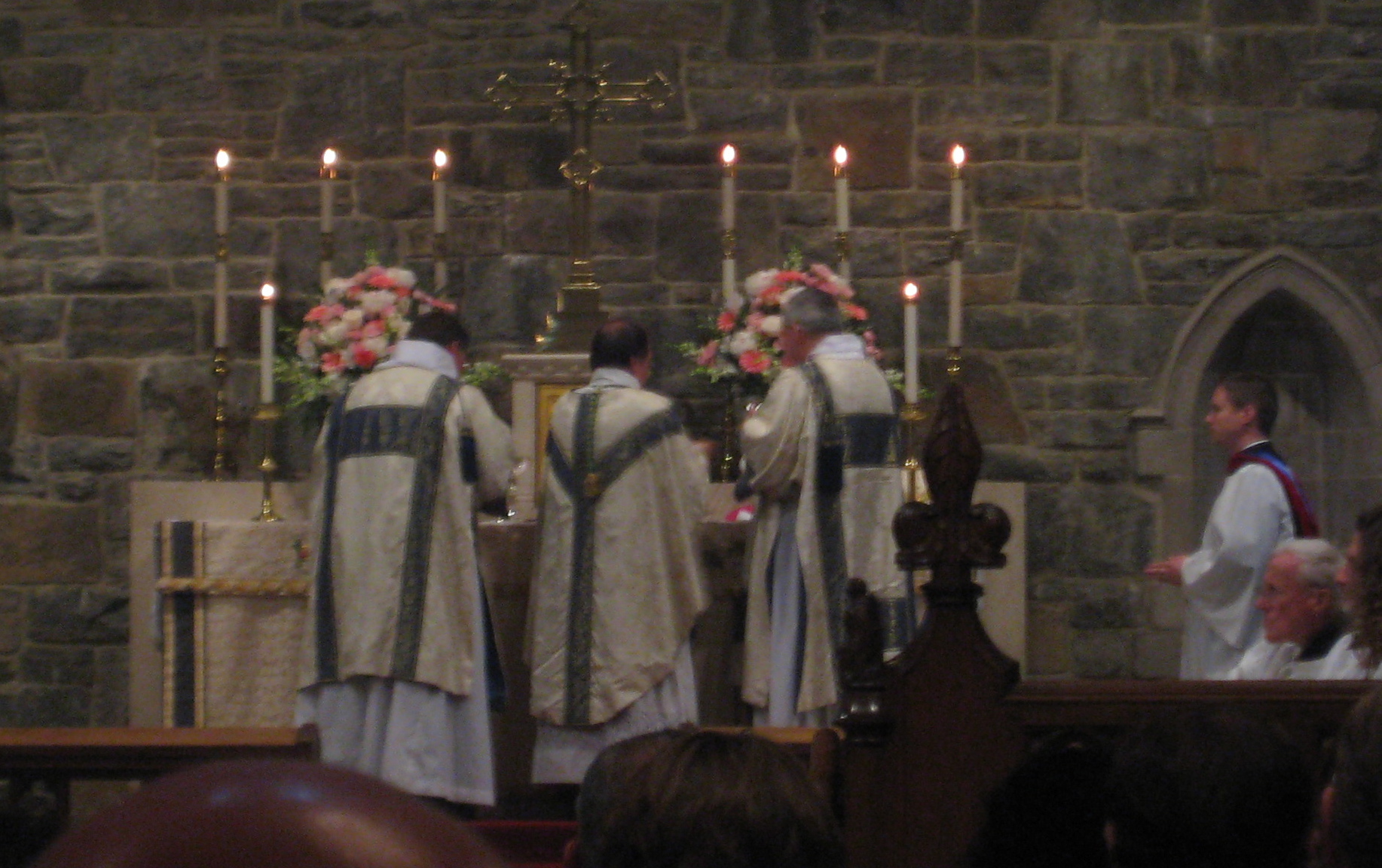
The Eucharist was Rite I, celebrated by Bp. Ackerman, with the choir singing a Byrd Mass in Latin for the ordinary. This was as high church as I’ve ever seen an ECUSA service be; if there ever was a time that this was representative, I can understand a little better where certain classical stereotypes of Episcopalians come. It certainly was never representative during my sojourn through ECUSA (and certainly no Episcopal church choir of which I was ever a part would have been capable of doing justice to the Byrd). All that was missing was a pointed psalm.

A couple of observations I might make about some practical contrasts between the Anglican Eucharist and the various Orthodox services which occurred during the conference: we Orthodox did a rather poor job of preparing the Anglican participants for our services — as in, we didn’t do any. By contrast, a well-arranged and easy-to-read service order was provided for us at St. James the Less.

And, frankly, as much as I think the St. Vladimir’s choir is good at what it does, the singing at St. James really put into stark relief what I think some of the problems are with a lot of Orthodox singing in this country. That’s somewhat out of the scope of this write-up, however, so I won’t deal with that now.

Following the service was a very, very ritzy reception — again, not exactly representative of my time as an Episcopalian. We were lucky to have coffee at St. Margaret’s. Paul and Jeremy Bergstrom, the aforementioned Episcopalian student at St. Vladimir’s, hit it off famously; they’re both Purdue alumni separated by a year, they’re both from roughly the same part of Indiana, and it turned out that Jeremy’s uncle was one of Paul’s elementary school teachers.

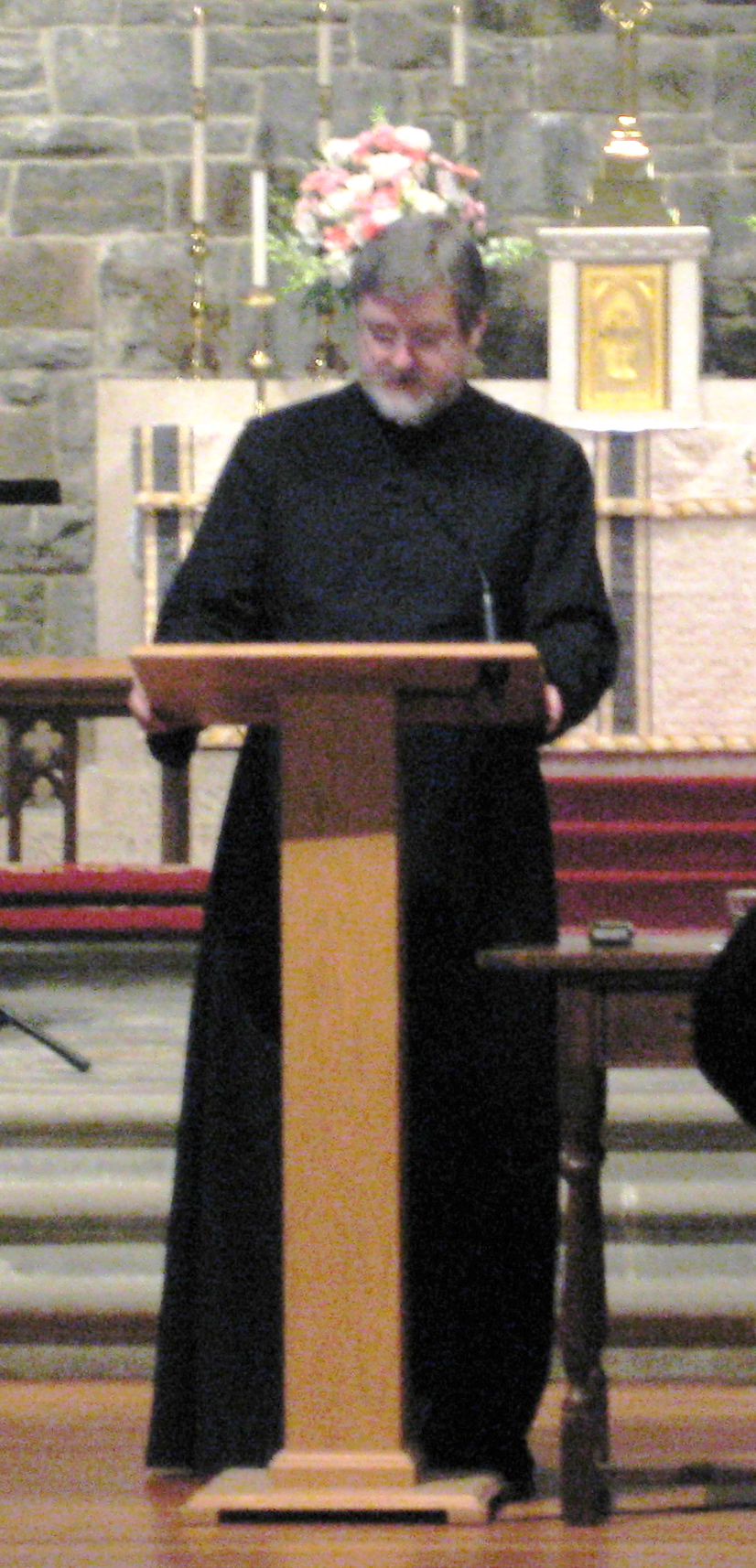
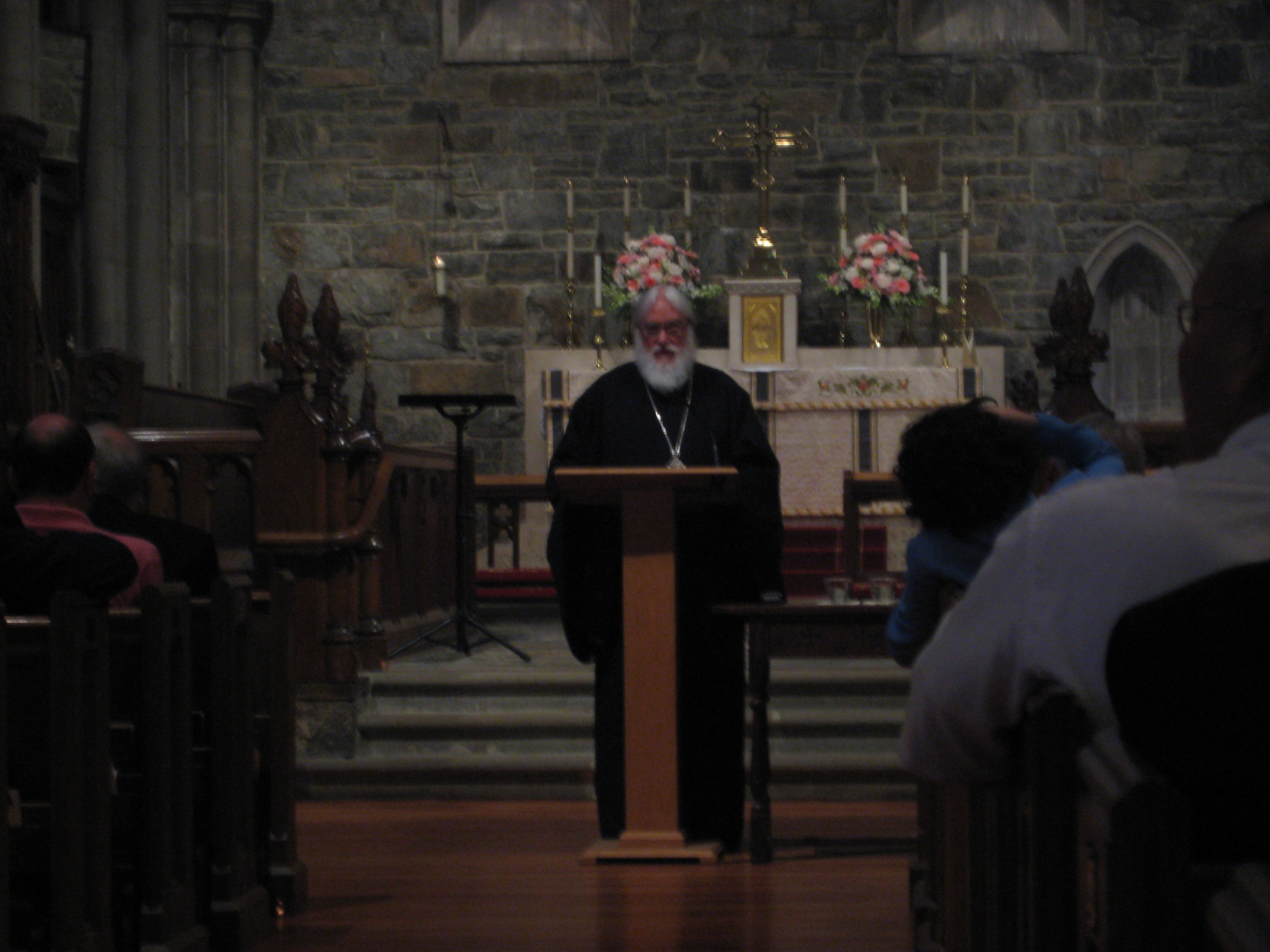
Canon Jonathan GoodallAfter the reception was an introduction by Fr. Stephen Platt, pastor of St. Nicholas Orthodox Church in Oxford and General Secretary of the Fellowship, and a greeting from the Archbishop of Canterbury read by Canon Goodall. (I am told that this will eventually be posted on the Anglican Communion website, but I do not yet see it.)

Finally, Bp. Hilarion introduced Met. Kallistos. I encourage you to listen to the entirety of his lecture, “Primacy and the Pope,” for there is no way I will be able to do it sufficient justice here, but here are a few points I wish to highlight:

  • He found the removal of the title “Patriarch of the West” from the papacy to be disturbing; he is concerned that this represents a further expansion of Rome’s understanding of herself.
  • He nonetheless found a couple of points of hope within the Ravenna statement, saying that while it clearly accepts the fact of universal primacy, it also accepts that there is a question of how it is to be exercised and how it manifests. In addition, the Ravenna statement applies the language of the 34th Apostolic Canon (“The bishops of all peoples should know the first among them and recognize him as the head, and do nothing that exceeds their authority without his consideration. Each should carry out only that which relates to his own diocese and to areas belonging to it. But the first among them should also do nothing without the consideration of all”) at the universal level: the bishops are to do nothing, outside of their own dioceses, without the head, the pope; but the head is likewise to do nothing without consultation of the bishops.
  • As such, he suggested that there might be a form of universal primacy, perhaps a certain power of initiative, which would be acceptable to the Orthodox.

The final lecture session was Igumen Jonah (Paffhausen), and I missed a very large portion of what he had to say, alas. What I did hear I had some issues with until it became clear that his talk on the nature of the episcopate was very much in the context of the recent leadership crises in the OCA, and his own impending elevation to the episcopate. I feel I must largely confine my comments, therefore, to the observation that there were many in the room who were visibly moved, some to tears, by the picture he presented of what the episcopate should look like (or the icon that he wrote of the episcopate, to use Fr. Peter Jacobsen’s words). As a seminary under the OCA and therefore with a front seat to the controversies, I can only imagine how healing his words might have been — I have said before that I count myself lucky to be under Bp. MARK; my hope is that the OCA Diocese of the South is at least as blessed with Fr. Jonah.

The afternoon concluded with a group discussion of where to go from here. The Fellowship would very much like to revive its presence in North America, and would like a conference on this side of the Atlantic to be a recurring event. Based on the discussion, it seems likely that it will alternate between St. Vladimir’s and Nashotah House; Nashotah House certainly seems like a focal point for the kind of Anglican(s) who would be interested in participating, and there is definitely a relationship between many Orthodox and Nashotah House, it being the alma mater of certain clergy (such with Fr. Chad Hatfield) or a sometime employer (as with Fr. Patrick).

This raises an issue, however, which presented itself most visibly at this particular session but would appear to have been bubbling under the surface throughout. One thing that Fr. Stephen Platt mentioned as a regret was that certain Anglicans whom they invited to be at this conference took one look at the list of speakers and said, “All you’ve done is invite the Orthodox and the most conservative Anglo-Catholics in this country. No thanks.” It would seem that conservative Anglicans do not agree amongst themselves what they wish to be; some, perhaps, wish only to be conservative Protestants — “mere Christians,” if you will. Others, on the other hand, want to be Anglo-Catholics — and still others “Catholic Anglicans,” who would be indistinguishable from a Roman Catholic save for the accident of history preventing communion. This division also manifested itself in some of the responses I heard after the morning’s Eucharist, particularly regarding the use of the Byrd Mass. “Too many people fought and died for the use of the vernacular and the right to participate in the liturgy for us to hold a concert in Latin and call it representative,” was the grumbling I heard from more than one person.

What is also clear for many of these people is that they feel like they have no place else to go, and I wonder if that isn’t part of what’s the heart of this kind of disagreement. At least one person said this explicitly to Paul and me; they rattled off various very frightening things within the ECUSA to us, but then shrugged and said, “Where else can I go?”

Regardless, I very much hope that a renewed North American presence becomes a reality; perhaps, at the very least, it can function as some kind of a safe haven for those Anglicans in this country who do not otherwise have one. Met. Kallistos (as I recall) admonished the attendees that the purpose of the conference needed to be something other than nostalgia; if the only aim was to go home at the end and say, “What a nice time with great speakers,” then the whole exercise was pointless. I do think that to some extent the future of the group will depend on its younger membership; the median hair color of the attendees, if you take my meaning, was on the grey side, but there were a couple of younger Orthodox there and certainly a decent-sized handful of younger Anglicans. This is hopeful, but only if we keep in touch with each other and try to keep the momentum going — if we don’t think it’s important enough to continue, it will die. I’ve attended conferences, such as the PSALM gathering a couple of years ago, where there are a lot of ideas and a lot of big things said, but ultimately just pulling everybody together for the event takes all the resources the organization has and there’s nothing left for any follow-through. (PSALM, as I understand it, is still recovering from what it took to stage the Chicago conference.) Hopefully that doesn’t happen here.

An important point which was raised was that wherever we do it in the future, common meals are a vital element of the fellowship enjoyed, and need to be retained. I agree with this; it’s such a simple thing, but it accomplishes very much, and there’s part of me that wonders if it so important and accomplishes so much because of the Meal which we cannot share as part of such a gathering.

That, really, was that; Great Vespers followed, and then there was a wine-and-cheese reception for the participants, but all of that was after-party stuff. I don’t have a ton to say about it, except that there was something that seemed apt about the Vespers service being for the Fathers of the First Council of Nicaea. The next morning I attended Divine Liturgy elsewhere (a separate, but good, story which I will relate in a separate post) and flew home.

If I may, if you’ve found these write-ups at all intriguing or useful, I would ask that you join the Fellowship of Ss. Alban and Sergius. The American presence, as demonstrated at this conference, certainly exists, but it is definitely on the small side (although not as small as I would have thought!). You do not have to be Anglican or Orthodox to join; there was, for example, an ELCA pastor there as an attendee. I would say that the Fellowship, being an “officially unofficial” group, exemplifies what I’ve said before — issues of dialogue and concelebration are out of the pay grade of most of us, but conversation and cooperation, preferably over wine and vodka, are very doable and perhaps more useful for us anyway. Membership really costs very little, and the journal, Sobornost, is definitely worth it. So, please, I encourage you to join if my account has at all piqued your interest.

(You are also still welcome to give to the tip jar, of course.)

There is much yet to process regarding the conference, so I may still have things to post as time goes on, but I’ve done my best, for now, to present what I experienced. The synthesis will occur over time. I will say that I left Crestwood infatuated with the place and with an aching desire to go back; more importantly, I left with a number of new friends with whom I very much hope to keep in contact, and to pray for. Given that the official mission of the Fellowship is that “it exists to pray and work for Christian unity, and provides opportunities for Orthodox Christians and Christians of Western traditions to meet and get to know one another, and so to deepen their understanding of each other’s spirituality, theology and worship”, I’d say that the mission was very much carried out at this conference.


adventures in writing alexander lingas all saints bloomington all saints orthodox church american orthodox architecture american orthodox music american orthodoxy Antiochian Archdiocese Antiochian Orthodox Christian Archdiocese of North America Antiochians books byzantine chant cappella romana chant church architecture ecclesiastical chant ethnomusicologists ethnomusicology fellowship of ss. alban and sergius Greece Greek greek food greekness hazards of church music international travel tips ioannis arvanitis joe mckamey john michael boyer kurt sander Latin liturgical adventures liturgical architecture liturgical music liturgical texts and translation liturgy liturgy and life lycourgos angelopoulos medieval byzantine chant Metropolitan PHILIP militant americanist orthodoxy modern byzantine architecture modern greek music music as iconography my kids will latin and greek when they're newborns my kids will learn latin and greek when they're newborns orthodox architecture orthodox architecture is bloody expensive Orthodox choir schools Orthodox Ecclesiology orthodox outreach orthodox travel pascha at the singing school Patriarchate of Antioch Patriarch IGNATIUS IV Patriarch of Antioch publishing random acts of chant richard barrett in greece richard toensing rod dreher sacred music st. vlads st john of damascus society Syriac the Bishop MARK fan club the convert dilemma the dark knight The Episcopacy The Episcopate the only good language is a dead language this american church life travel we need more american saints why do we need beautiful music in churches?

Blog Stats

  • 271,016 hits

Flickr Photos