You know, there’s a particular reality that’s a bit hard to face when it comes to organizations. Not just churches (but churches are definitely included) — really, any organization. What I’m talking about is, of course, the Golden Rule.
“Of course,” you’re thinking. “Do unto others as…”
Nope, sorry, that’s not what I mean. What I mean is this: He who has the gold makes the rules.
This is more or less true everywhere. Government, non-profits, business, so on and so forth. There’s a very simple reason for it: unless the people able to write big checks have an interest in staying in the game, they won’t. Probably most of us would like to think that if we had lots of money, we’d behave differently, but the fact of the matter is that the more you have to protect, the more you will act to protect it — that is, the more you will act in what you see as your own best interests, and you will define what your best interests are in terms of what you have to lose.
Take charitable foundations. Do you think those exist for any other reason than it is in the best economic interests of the people funding them to do so? These entities exist because what it costs to fund them is less expensive than paying taxes on the same money. Show me somebody who gives away lots and lots of money without setting up a foundation or a charitable trust, meaning that they don’t care what the tax implications are, and I’ll show you somebody who is being truly selfless with their money. That’s not to belittle those who set up these organs of charity with truly the best of intentions, not in the slightest; this interaction of tax laws, wealth, and charity functions as intended, and in our society there’s probably no other way it could work. I’m just saying that it is probably naive, at best, to think that there isn’t anything in it for the person writing the checks.
As I said at the start of this rambling monstrosity, of course this applies to churches. At Overlake Christian Church, which is where I spent the plurality of my childhood churchgoing, the folks who wrote the biggest checks were the ones who got facetime with Pastor Bob Moorehead. That was evident even to an eight year old. And, really, why would it be any different in a church of 6,000 people (huge by 1985 standards) which had a mammoth building to maintain and which had designs on building an even larger structure?
At the church where my wife and I were married, it played out a little differently, but it was still the same story. The service schedule was structured around giving pride of place to the “Contemporary Praise Music” Eucharist — why? Because that was the service that had the greatest attendance of young, wealthy families. The choir and organ Eucharist had several older wealthy people, but the Microsoft families were able to outbid them (this was the late ’90s and early Aughts, after all).
You have to keep the people paying the bills in the game. They have to get value for their money, and there has to be an additional benefit proportional to the additional giving. How can it be any other way?
In the same way, I tend to see the perceived discomfort between so-called “ethnic” or “cradle” Orthodox and converts, if it actually exists at all, as being primarily an economic issue. Pews? Organs? Byzantine chant? Liturgical language? Even, yes, how episcopal authority gets defined and exercised? These are all issues subject to how the bills get paid. This isn’t something many of us who came to Orthodox Christianity for convictions of faith want to hear, but I think it’s probably the case.
Let’s take a hypothetical Orthodox priest from a country we’ll call Dolaria. He’s got a parish of three-quarters ethnic Dolarians, the richest five of whom give approximately 95% of the parish’s annual budget. The other quarter is mostly converts and maybe people from other ethnic backgrounds for whom a parish from “their own” church is too far away; maybe this group gives more consistently and regularly than the previous group, and maybe not. One way or the other, all told, this quarter of the parish makeup gives about 15% of the annual budget. On a given Sunday, the church might be three-quarters full and attendance might be split 50-50 between converts and ethnic Dolarians. Despite a fulltime priest, the parish only serves Orthos and Divine Liturgy on Sunday during a normal week. The metropolitan area in which this predominantly Dolarian community finds itself has a number of other parishes which tend to be heavier on converts, but the Dolarian parish’s annual budget is bigger than all of the rest of them combined.
Perhaps this hypothetical priest doesn’t participate much in pan-Orthodox events when they occur. Maybe a convert priest presses him about this, and also rags on him a bit for building a brand new church, an exemplar of traditional Dolarian Orthodox church architecture — except that it has pews and an organ. We can hypothesize that the Dolarian priest replies, “You know, you converts can play happy-clappy pan-Orthodox unity all you want, but the reality is that I’ve got a big church of Dolarians that takes up all my time, and the people who pay me to do that are Dolarians. When you converts actually match or outnumber us in giving and in attendance, then we’ll talk. A convert who comes to every service but gives $1,000 a year doesn’t help keep the doors open and the lights on in the way that a Dolarian who comes maybe once a month but gives $500,000 a year does. If ten people are writing me checks for $1 million apiece towards a $15 million church, and they want pews and an organ, they’re going to get it. If a hundred people are writing me $100 checks towards that church, and they want an open floor with no organ, I’m sorry, but they’re in the wrong demographic across the board for me to be willing to die on that hill.”
And you know what? While I wouldn’t like it or agree with it, I wouldn’t necessarily be unsympathetic to that point of view. Freedom of religion in a pluralistic, capitalist society where there is officially a separation between church and state effectively means that you get the religion for which you’re able to pay. To put it another way, if you want a church to be a particular way, you have to put your money where your faith is. We speak as Christians about “sacrificial giving,” but the reality is that the vast majority of people, particularly the wealthy, even Christians, and yes, even Orthodox Christians, are not going to give anything they can’t afford to lose. Ten middle-class converts who have bookshelves of the entire Popular Patristics line from St. Vladimir’s Seminary Press are neither going to be able to match ten ethnic millionaire entrepeneurs who have no idea what the Council of Nicea decided and prefer to hear the Liturgy in <fill in name of language> because it makes them feel more <fill in name of ethnicity> even though that means they don’t even know what we actually sing in the Paschal troparion, nor are the middle-class converts going to bring in enough additional middle-class converts to outmatch the same.
We converts can say all we want that we just want to submit to the Tradition, that we should follow the Typikon, we want traditional music (but sung in English!), traditional architecture, have a fuller liturgical schedule, take out the pews and chairs, only have a tuning fork for instruments, have icons handwritten in Byzantine style with egg tempera and mineral pigments, and burn nothing but olive oil and beeswax with not an electric light to be found. I myself am firmly in that camp, believe me.
Economic realities interfere pretty fast with that picture, however. First of all, a priest costs money, or at least he does if you actually want him to be able to survive. Not paying a priest carries its own cost — if he works a secular job, that means he will have less time for his parish. Plus, if you really want a fuller liturgical schedule, and you have a priest with a family, you almost need two priests. That costs money, too.
Traditional music? It takes having people who know what they’re doing musically. Guess what? That will in all likelihood cost money.
Traditional architecture? Hoo boy, does that cost money.
Take out the pews and chairs? Since that will likely cause a chunk of your congregation to leave, that has a cost.
Longer services? You’ll probably lose people over this, too. Check.
Handwritten icons? Wait till you see the bill. Yes, that costs money. A lot of it.
Olive oil and beeswax? Inherently higher maintenance, which means it costs money.
To apply this to current events, if there is a perception among people who write checks with lots of zeros (at least, zeros to the left of the decimal point) that an organization is in the process of giving away the farm to people who write checks with far fewer zeroes, behave in a way which makes them uncomfortable, and frankly, whom they might perceive as having less of a vested interest in that organization than they do (because, let’s be honest, this is a group of people who already left something else to be part of this organization, so how do we know they won’t do it again?), they are going to pressure the leadership of that organization to start making different choices. And, eventually, the power of the pocketbook will be the deciding factor. The outcome will go to the highest bidder. He who has the gold makes the rules. Issues of canonicity, conciliarity, communion, doctrine, tradition, etc. simply do not have the force in our current system, the so-called “marketplace of ideas,” that being willing to write a check does. When the emperor was able to outbid everybody, that was one thing, but that’s not how we do things here and now.
Let me make something clear: this is in no way an indictment of the people who write the checks and expect, implicitly or explicitly, things to go their way — neither is it an indictment of the people to whom those checks are given and who then act accordingly. That is, for better or for worse, the way our culture works. Adjunct to that is the idea of choice — if you don’t like it, go someplace else or start your own. That Orthodox ecclesiology doesn’t exactly allow for that is an internal technical matter, not truly the concern of the culture at large.
Rather, I’m really talking to fellow converts. We need a reality check, folks. I include myself in that — I’m low-level support staff at a university and a part-time grad student, married to a full-time grad student. I can only do so much, and even that’s hard to do. The people whom I have brought to church with me are people in similar situations — students and working class folks who read a lot. It would take around sixty pledging units like us to be able to pay the priest’s compensation (which is already less than what he’s worth), and two hundred pledging units like us to be able to completely replace our parish’s budget. As it is, our parish has around eighty pledging units total. Yes, I’m there for virtually every service, but so what? That means I’m taking up more space and resources than that for which I am able to pay, more than likely. I’m a net loss for my parish, in other words, particularly since as the choir director and cantor I’m also one of the only paid staff. My potential as a net loss is further amplified by music having a status as a potential flashpoint of controversy. The most mild, reasonable, and practical of musical decisions made by a cantor/choir director — say, picking a setting of the Liturgy that the choir is actually able to sing — has the potential to be a reason for somebody to leave, and take their pledge with them. Trust me on this point.
We need to assume that we, as converts, will get the respect we can afford. Metropolitan PHILIP likes to point out the growth in the number of Antiochian parishes since he was became primate; what would be a better metric of growth, I think, would be an aggregate total of the annual budgets of all parishes, adjusted for inflation. I’m going to guess that that number would not suggest as optimistic a present reality as the number of parishes does.
I suspect that current events are, in one way or another, related to people in charge having to follow the money. I’m not sure it’s any one person; I think both New Jersey and Damascus have vested financial interests which need to be tended, which, again, canonicity or no canonicity, is the way things work in the here and now. The rent has to be paid, whether or not a bishop has been canonically enthroned as a diocesan bishop and not as an auxiliary. We proclaim ourselves to be the true Church; it does not follow that we are the perfect Church or a Church which, under current circumstances, can operate independently of financial concerns.
Does that change what anything looks like, for good or ill? No. However, does it change anything about the faith or how we are supposed to live it? No. Does it change Christ? It would be blasphemy to suggest that it did. What it does mean is that we must necessarily scale our expectations about what parish life is like to appropriate levels, and not to expect that people who are human are going to be anything other than human. Our deacons, priests and bishops (and cantors — especially cantors) are all working out their salvation with fear and trembling, too. It also means it is incumbent upon us to pray, to confess, to act and give according to our convictions, as much as we possibly can, and to understand that the way the world works, to say nothing of all the broken people in it, things are going to move slowly even if we do that.
I’m not thrilled about what I’m hearing about this decision from Antioch or the potential consequences; I love my bishop dearly and do not like seeing him demoted, not in the least. It’s actually rather shaken me to the core, simply because it seems to be a very large and significant action which is about nothing so much as power and money and which has nothing to do with the faith. But that’s exactly it — it has nothing to do with the faith. It does not impact who Christ is, or my need for communion with Him, one whit. As well, given that this is the very beginning of Lent, to rush to judgment and start separating the various figures into the “good guys” and the “bad guys” is very clearly a temptation which requires resistance. Avoiding Big Macs and nachos over the next few weeks isn’t all we have to do; we also have to avoid judging our brothers… and our priests, and our bishops… and especially our cantors who have to sing so many ginormously long services over this week alone to say nothing of Holy Week… and instead put in the effort to love them.


 Sutton Hoo exhibit, which while having a rather high percentage of replicas and reconstructions is still fascinating — particularly since I took a class a few years ago where the professor had worked on the site in her grad school days and incorporate the material into her lectures.
 Following the British Museum, we went to the Royal Academy of Arts for their Byzantium exhibit with a stop at a place called Rendezvous in Leicester Square for gelato. It was good and hit the spot, but it was definitely expensive. I’ll also point out that the sign they had posted to let people know they can’t sleep in doorways is a bit odd. It looks like the caption should be, “No sensual reclining in doorways.”
 The Byzantium exhibit is stunning; the examples of iconography are really breathtaking and leave you wanting to venerate them, even though there are ropes that quite handily keep you from doing so. There was also a 13th-century Syriac Gospel lectionary on display; that was pretty darn cool. Something that rankled a bit was the caption on the wall about church life that talked about how the iconostasis was to keep the unholy masses from even being able to see the altar and how the chanting was done by all-male voices, words that seemed specifically chosen to play up how backwards these Byzantines with their alien form of Christianity were, but I suppose the real question is, what should I have expected?
 A leisurely walk from RAA to Westminster Cathedral for Sung Mass took us through Green Park and past Buckingham Palace. We bought some tea and some other gifts from one of the many Buckingham Palace gift shops; Megan hoped to find a tea cozy, but those turned out to be as hard to find as black pudding, for some reason. Finally we had coffee at the Costa across the street from the Cathedral, and then it was time for Mass.

 We walked back to the hotel afterwards, with me pausing to be amused by a sign from the Considerate Builders Scheme, and started packing things up. We decided to go to the Sherlock Holmes Pub and Restaurant for dinner; please let me caution you against making the same mistake. It is a tourist trap with a capital T, capital TR. The food is expensive and not good enough to merit the price (although now I know what “Toad in the Hole” is, and it would be curious to try it again someplace better), and overall it is just not worth it at all.
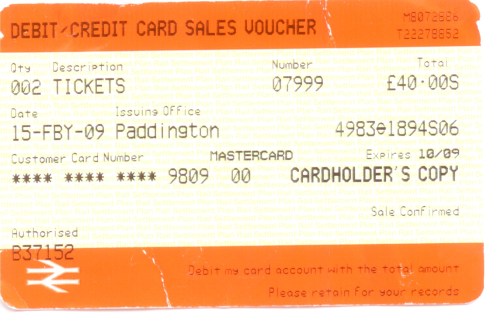 Back to happier things.
 This was the first time I had seen the interior of the Oxford church; while humble in a lot of respects — it is a very simple brick building — they have done a lot with what they have. Also, while somewhat smaller than All Saints, I’d say they packed in about 30-40 more people than we typically do — it was filled to the gills. On the other hand, it was 2 February on the Old Calendar (the Meeting of the Lord, or Candlemas as doubtless some of the English converts might call it), so it being a major feast might well have accounted for the attendance.
 The rest of the day was spent strolling around the town and the campus, and it was a gorgeous, if chilly, day for it. In some respects, it was good we were there on a Sunday — most places where we might have been tempted to spend lots of money were closed. That said,
  Finally, it was time to go back into the city. We got good sausage rolls from a bakery called La Croissanterie, and boarded the train.
 Yeah, Oxford is still my favorite place in the universe. What can I say?
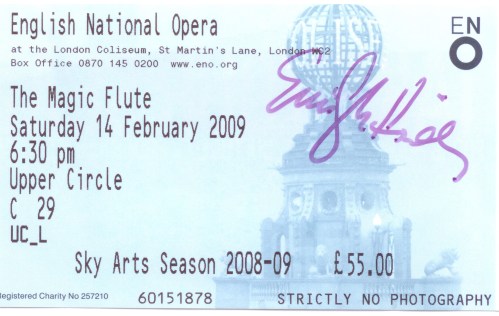 Word to the wise: programs are £4 apiece at ENO, and cash only.
 Following the show, Megan, I, Frank, Emily, and Ayla, an old schoolfriend of hers, and her boyfriend went to a bar called
  Now, just because it was now out in the open we were going to London, it did not precisely follow that the jig was entirely up. When asked where we were staying, what we were doing, so on and so forth, I just put on my best clueless expression (see photo at right for one of my many options) and said, “Hopefully whoever planned this will make it clear what we’re supposed to do by the time we make it to Heathrow.”
 We took the Tube (“This is a Picadilly line train to… Cockfosters!” — cracks me up every time) to South Ealing, minded the gap, stood clear of the doors, walked a bit, and found ourselves in a neighborhood looking very much like the one pictured here. At 9:10am, ten feet from the prescribed door, it opened and out stepped Emily, with coffee (well, Nescafé, but I’ll talk about that later), tea, and breakfast all ready for us.
 We toddled away (as all averred) after a couple of hours to check in at our hotel. We quickly checked e-mail, peeled off the rags in which we had been traveling for close to 24 hours by this point, showered, put on fresh clothes, and felt like brand new human beings.
 So, late last summer, my friend


 Leitourgeia kai Qurbana: Contra den Zeitgeist