Archive for the 'Early Christianity' Category


Alliteration in liturgy, or things that don’t work in translation

Something that anybody accustomed to the Divine Liturgy of St. John Chrysostom in English hears on a regular basis is, right before the Koinonikon, is the priest saying:

Holy things are for the holy.

And the response:

One is holy, one is Lord, Jesus Christ, to the glory of God the Father. Amen.

I noticed something the last time I attended a Divine Liturgy in Greek, however. The priest says:

Tα Ἅγια τοῖς Ἁγίοις.

And the response is:

Εἷς ἅγιος, εἷς Κύριος, Ἰησοῦς Χριστός, εἰς δόξαν Θεοῦ Πατρός. Ἀμήν.

εἷς and εἰς are homophones, the former being the masculine singular word for “one,” the latter being the preposition which usually means some variation of “to”, and with ecclesiastical pronunciation (meaning, among other things, all of the diacritics are ignored except insofar as they indicate stress accent — sorry, classicists), they are pronounced the same way as the first syllable of Ἰησοῦς. (There is a slight glide at the beginning of Ἰησοῦς the way some say it, but I’d argue it’s undetectable for all intents and purposes.) Rendered more or less phonetically, with italics on the sound in question: “Ta Aghia tees Agh-ee-ees.” “Ees aghios, ees Kirios, Eesous Hristos, ees dhoxan Theou Patros. Ameen.”

So, the response is alliterative, set off by the last syllable of the last word of the priest’s part. I don’t know that this suggests anything earth-shattering, beyond being something interesting that appears to be unique to the Liturgy in Greek. Anybody know if this also happens in Slavonic? I don’t know that there’s any real way to reproduce the effect in English, unless we were to do something like “Gee, he’s holy, gee, he’s Lord, Jesus Christ…” Or, um, maybe not.

If I were really digging for a practical point, it would be that maybe this allows the call and response to overlap somewhat? That might possibly make sense from the standpoint of a live acoustic. Probably this is just a fun little nugget of evidence that those writing the liturgical texts knew what they were doing.

I’ll also add a Latin note, while I’m thinking about it: I’m reading the Life of St. Hilarion right now, as noted earlier, and the following line is in the third section, when St. Hilarion is still learning from St. Anthony and observing his ways — “cibique ejus asperitatem nulla umquam infirmitas frangeret.” Fremantle translates this as St. Anthony never on account of bodily weakness deviating “from the plainness of his food,” but asperitatem is actually a more interesting word than that. It can also mean “dryness”, which would make this line a reference to the practice of xerophagia “dry eating”, or eating only raw fruits and vegetables. This is certainly a practice associated with monasticism, and I pointed it out to my advisor, for whom this was evidently news.

Anyway — the little bits and pieces one gets from the source languages are an enrichment of one’s understanding of the texts, to say the least. They may not be showstoppers, necessarily, but they definitely make the flavor more complex.

Week 5 of grad school and all is well

The last couple of times I had a hiatus in blogging, it was because things weren’t altogether well for me.

This time, to be honest, I’ve got nothing to complain about. Things are going really well.

I’m going to repeat that, just for emphasis and the sheer joy of being able to say that truthfully and unreservedly, perhaps for the first time since moving out here over six years ago:

Things are going really well.

The last several weeks have been something of a whirlwind; after getting back from Greece I had two papers to finish, a godson’s wedding to hold crowns for, my wife to murder, and Guilder to frame for it — er, wait. That is to say, two days after the wedding, Orientation Week started, during which I had to take a Latin and a Greek diagnostic exam; then the semester started for real, and it was off to the races.

Im photographing them being photographed. Theres something kind of uncomfortable meta about this, dont you think?

I'm photographing Matthew and Erin being photographed. There's something kind of uncomfortably "meta" about this, don't you think?

Matthew and Erin’s wedding was wonderful; we were in South Bend for the three days leading up to it to help out with various things, and it was a joy to be part of it at every step. Fr. George Konstantopoulos at St. Andrew’s Greek Orthodox Church in South Bend served with Fr. Peter, and this was a lucky match for everybody — Fr. George has decades of experience and knows all of the little things that often get left out in the simplified versions of services that are often done these days. For example, I was a lot busier as the koumvaros at this wedding than I was for another one at All Saints last year — at that wedding, I just stood there. Here, I did the crown exchange and the ring exchange — and let me tell you, I was sweating it during the ring exchange. Oh, I thought. These rings are very small, and my fingers are very big. And all three sets of hands are shaking. If I drop them it will be very bad. Now I remember why I don’t do brain surgery. Fr. George also had the gravity and authority (to say nothing of the beard) that comes from many years of doing this, and it complemented well Fr. Peter’s still-youthful energy (he’s 35, I guess it’s not inappropriate to say that, right?).

The next morning, the newly-crowned Mr. and Mrs. Wells met us at St. Andrew’s for Divine Liturgy, and Fr. George gave them a big ol’ head pat during the announcements — “Matthew and Erin from Bloomington were married here yesterday,” he said, “and this morning they were here for Divine Liturgy. To me, that is an example of what living life as an Orthodox Christian is all about.” His meaning could hardly be plainer had he hoisted a neon sign saying, Please take being here as seriously as they do.

I need a calculator to adequately express in mathematical terms how much shorter than me you are, Megan...

"I need a calculator to adequately express in mathematical terms how much shorter than me you are, Megan..."

Before driving home, we headed to Chicago to see our friend Tessa Studebaker, an old singing colleague of mine from Seattle whom we hadn’t seen since before we moved to Indiana. When I met her ten and a half years ago, she worked at Barnes and Noble for the discount and was still in high school; now she’s in her upper twenties, is a college graduate, took a job in France for a while, moved back, and is possibly getting serious about somebody. It’s incredible to think that the last ten years have gone by so quickly that all of that could have happened, but there we are. It’s even more incredible that the majority of that ten years has been spent here in Bloomington — it means I’ve spent more time here than I spent in Seattle after dropping out of college the first time. It means that the address I’ve had the longest in my entire life (four years) has been here. It means that by the time I’m done with my PhD, I’ll have spent probably over ten years at a place I thought maybe I’d spend three years at the very most.

But enough with the existential pondering for the moment. I guess seeing old friends has a way of bringing that out of me.

Orientation was more or less a non-event; I’ve been here for six years, I know where the library is, my e-mail account hasn’t changed in all of that time, so there wasn’t really any particular novelty for which I required context. That said, a couple of things stick out for me — one, Ed Watts, the Director of Graduate Studies for the History department here (who also happens to be my PhD advisor), strongly impressed on everybody to find a schedule for working, a rhythm of grad school life, that gets the job done and can be adhered to, and then to stick to it. Coming from a situation where I was trying to fit being a half-time (or more like three-quarter time) student in around having a fulltime 8-5 job, that advice really resonated with me; I’ve done my best to take that to heart, and I think it’s served me well thus far.

Secondly, I observed this kind of thing while students were introducing themselves:

“Hi, I’m Jacob Goldstein, and I’m doing Jewish history with an emphasis on Holocaust education.”

“My name is Sankar Ramasubramanian, and I’m interested in modern Indian history.”

“I’m Ramon Santiago, and I do early modern Latin American history.”

Do you see where I’m going with this? It seems that who one is can’t help but inform their research interests, and the correlation there appears to be entirely natural and predictable. That said, the same correlation appears to be viewed with some amount of suspicion when it comes to Christians doing Christian history. I haven’t directly experienced that among my cohort yet, but I’ve seen it in other contexts, and something I’ve picked up on a bit is a certain point of view, perhaps almost subconsciously held, that can be expressed as, I’m interested in history because I want to prove that everybody has always been as petty, nasty, and not to be trusted as they are now. It’s a fundamental skepticism of humanity bordering on loathing (but ironically, I think its proponents would probably self-identify as humanists), and it seems to cross disciplinary and ideological lines. I’m not exactly sure what to make of it.

My Greek and Latin exams evidently went well enough; for each language, I had three passages, a dictionary, and an hour. In each case I got through more or less the first passage and the first third to the first half of the second. I don’t remember what the passages were, but they didn’t generate any particular concern. I was worried, when I next saw Watts, that he’d get a concerned look on his face and say, “We need to talk,” but that didn’t happen. He just said I did very well with the Greek, and while the Latin wasn’t as good, it was still pretty good. I figured the Latin would be the weaker of the two anyway.

Then it was time to actually start classes.

So, I’m taking three classes for real, sitting in on two, and then doing some individual reading with Watts for one credit. I’m taking third year Modern Greek, a mandatory “Welcome to the History Department” course called “Introduction to the Professional Study of History,” and then a course in Classical Studies where we’re reading Ancient Greek judicial oratory — Antiphon, Lysias, and Demosthenes, namely. Modern Greek I have to take for my funding (and I should be doing as much with it as I can, anyway), and then Watts wanted me to take some upper-level Classical Studies courses so I could have a chance to sharpen my Greek a bit. The one credit of individual reading we’re doing finds us reading St. Jerome’s Life of St. Hilarion, so I’m also getting some Latin in this semester. Since I’m ahead of the game a bit in terms of my coursework, Watts thought it was important to give my languages some extra time, and he’s right — it’s been a good thing.

(Watts and I have had a couple of simpatico moments with our iPhones — today, for example, we were reading Jerome and needed to look up a word. I pulled out my sketchy little pocket dictionary, and he said, “I’ll one-up you there.” With a gleam in the eye only recognizable by the fellow geek, he pulled out his iPhone and asked, “Do you know about the Latin Dictionary app?” I didn’t, but within two minutes I had it along with its companion Greek Lexicon by the same developer.)

I’m also sitting in on an undergraduate survey Watts is teaching on the Late Antique Roman Empire, as well as a seminar in Art History called Problems in Early Christian Art. The former is really useful background, and I’m doing it instead of taking Watts’ actual graduate seminar on the same material (since I’m actually at a point where it’s vital I take seminars from people other than him). The latter is a result of recognizing a) that my interests, the way I want to talk about them, are interdisciplinary, and b) given certain realities, I will be best served doing some of the interdisciplinary work on my own time. The course is basically dealing with Christian art up to Iconoclasm; the reading is actually highly useful stuff for me, and I’m learning a lot, with certain things I can already talk about being discussed in a very different context than that to which I’m accustomed.

Anyway, it’s a lot, but it’s not a back-breaker of a schedule by any means. Yes, it’s a good amount of work, but I’m finding it easier to manage now than I found it to manage less work while having to juggle a fulltime job. It means I’ve had less time for blogging, yes, but it’s been for a good reason. I think I’m at a point where I understand the rhythm well enough that I can post a bit again.

So, in brief, that’s where I’ve been and what I’ve been doing. Coming up, there’s another wedding this weekend, that of a certain Daniel Maximus Greeson and Chelsea Coil, plus I’m also supposed to run a book review for these folks by 10 November. Plus there are any number of other things for me to talk about regarding what I’ve been reading and what I’m thinking about — it’s more “Where the heck do I begin?” than “What do I have to say?” Let me tell you, these are all problems I am thrilled to have.

I will close this post in the manner which I think I may start closing for the time being — that is, with a rundown of what I’ve recently finished reading and what I’m currently reading.

Recently finished:

Currently reading:

“Μπορείτε να ετοιμάσετε ένα Manhattan;”: in which the author is faced with the dilemma of what to do when the bookstore that has everything he wants is actually open

There are a couple of housekeeping things I would like to bring to your attention.

First of all, I would like to congratulate my godchildren Subdn. Lucas and Stacey Christensen on the 20 June 2009 arrival of Theodore Lucas Christensen. He was born the day before Father’s Day, so Lucas’ first Father’s Day as a father was in fact within the first 24 hours of his tenure as a father. Life’s not terrible, huh? Many years to Theodore Lucas and parents!

Secondly, I would like to help spread the word about the Society for Orthodox Christian History in the Americas. This effort appears to being spearheaded by Fr. Oliver Herbel, Matthew Namee, and others, and so far as I can tell, it’s a good, honest, scholarly approach to questions that seem to be largely dominated thus far by ideological wishful thinking. I for one am looking forward to reading Fr. Oliver’s dissertation when it is published; I hope that it will serve to balance works that are out there such as The American Orthodox Church: A History of its Beginnings.

Thirdly, I’d ask your prayers for my stepfather, Joe. He is undergoing some pretty major surgery on 1 July, and as my mom put it, he’s tightly wrapped around the axle about it. So, please, if you think about it, that’d be appreciated.

Okay. Where to begin?

I’ve been gone about three weeks. My previous longest trip abroad (of the three) was something like two and a half weeks. I’ve got five weeks to go.

I’d like to tell you that everything is great, that it’s been a really smooth ride so far, and that pretty much all is going as expected.

This would be a lie.

Now, to clarify, what would also be a lie is to say that things are terrible, I’m having a horrible time, I’m getting nothing out of this trip, I want my mommy, etc. I’m saying only that reality, as is often the case, is a bit more complicated under the best and easiest of circumstances, and that adjusting to a more-or-less totally unfamiliar environment where virtually all of one’s instincts about how things work, what to say, to whom to say it, and so on, are wrong, does not exactly represent the easiest of circumstances. This is, of course, part of the education of this kind of trip, and this means that one way or the other, I will be returning to the United States having learned a tremendous amount. Whether or not it is exactly what I thought I would learn is a different question, but never mind that now. The point is, I haven’t just been thrown into the deep end of the pool; rather, it’s at the very least one of the Great Lakes. (Or maybe the Aegean Sea.) Perhaps ironically, perhaps not, the most familiar thing I encounter here is the Divine Liturgy (even given ecclesiastical Greek as the liturgical language), which is perhaps the least familiar thing for many Americans who travel here.

To put it one way, I will see foreigners in the States for extended periods with different eyes from here on out.

All that having been said, that photo of the Acropolis at the top of this entry is exactly what I see every day on my way to school, as is the Olympic stadium from the 1896 Summer Games. That’s saying something, isn’t it?

I left off last time just before a trip to a nearby beach for Anna’s goodbye party (this would be two Sundays ago, 21 June). At the beach, I had the, er, amusing experience of trying to explain to the bartender, in Greek, how to make a Manhattan. I did so; they didn’t believe me and looked on some recipe card that told them to add orange juice of all things, and I got to pay 7 Euros for the privilege of drinking what I didn’t order (and with Jack Daniels as the whiskey, no less). It wasn’t horrible; it was actually kind of interesting and potentially worth playing with further. It just wasn’t a Manhattan. The next night, for the after-party of Anna’s goodbye party, I more than happily paid 8 Euros for drinks that I knew were made the way I wanted them. (By the way, I have become a fan of the Pomegranate Splash for fruity drinks that don’t just taste like juice with attitude. There’s a bar here in Halandri that makes a very nice one, but I am blanking on the name. I’ll get back to you on that.)

I decided to change up my route to school; rather than walking 15 minutes to catch a bus all the way into Athens and it taking 45 minutes, I now catch a bus from a block away from the house, take it a short way to a metro station, take the metro into downtown Athens, and then a streetcar (“tram”, and you have to say it with a flipped r) to the bottom of the hill where the Athens Centre is located. It can still take a little over an hour, but there’s also the possibility of it taking closer to 40-45 minutes depending on when the bus comes. The tricky thing is that the bus route goes through two different metro stations; the second is theoretically is closer to the destination, but the traffic bottleneck just before that station is horrible in the morning. The first day I went this way I rode the bus all the way to the second station (Katehaki), and got to school about twenty minutes late thanks to the traffic. The second day, I got off the bus at the stop right before Katehaki, and beat the bus there by about fifteen minutes. From the skybridge going to Katahaki Station:

The third day, I just got off at the first metro station (Ethniki Amina), which has turned out to be the best option all around. I regularly get to school now between 9:00-9:15 instead of 9:20-9:40 — and while, as my teacher told me on the first day, “This is Greece, not Germany,” I still prefer being on the early side.

While I will be very curious to see what the system is like once the three metro stations presently under construction are open and everything is running everywhere, I have to say that it’s not bad. For the international traveler, it’s a heck of a deal; you can buy a weeklong pass for 10 Euros that gets you everywhere, or you can buy a monthlong pass for 35 Euros. Couple of things to note about the monthlong pass: you have to provide a photo (four passport photos typically cost 7 Euros at a photography shop), you have to buy it at the beginning of the calendar month, and if you show a student ID, you’ll get it for 18 Euros. The passes are not like the London Underground where there’s a card you keep and top off and use with a card reading system; these are disposable tickets, and to some extent, the system is “on your honor.” You should be able to produce a validated ticket at any time, but I’ve never actually seen anybody checking.

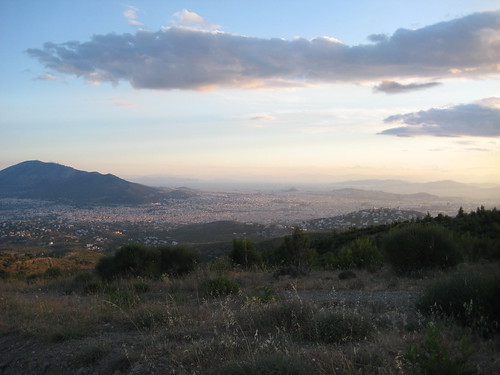
Thursday evening, Giorgos (Anna’s dad) said to me, “Go get your camera. I’m going to take you someplace you’ll like.” He took me to some spots overlooking Athens, as well as Penteli Monastery in, appropriately enough, New Penteli. From the vantage points above the city with the landscape spread out in front of us, Giorgos talked a lot about how really, even twenty to thirty years ago, almost none of the sprawl was here. What are now the suburbs were really separate villages, and the end result of the buildup of Athens into something they want to be a major European city is that people have emptied out the real villages and small towns of Greece. “We Greeks are eating each other, and the reason why is because people are getting rich off of it,” he said.

The monastery is really lovely; I can’t say I’ve ever seen any place quite like it in the States. While we were there, Giorgos pointed out a priest and identified him as a “left-wing monk” named Fr. Timotheos, saying that he’s quite the publicity hound. He didn’t go into a lot of detail, but what I was able to dig up later suggested that he’s more of a nationalist figure than anything. Not quite certain what the deal there is.

A disquieting moment was when we were standing in front of the gates of the monastery, and Giorgos pointed out the bullet holes in the doors from attacks in decades past. He also showed me the following:

“What do you suppose that slit in the wall next to the mosaic is all about?” he asked me. I had to confess I didn’t know.

“That was where they pointed the guns against intruders,” he said.

(Oh, and paging Rod Dreher: the monastery has chickens.)

One thing that would be really difficult to overstate is how there are churches everywhere. Big churches, little churches, medium-sized churches, tiny village chapels. You’ll turn a corner and just see something like this:

Or this:

As I said the other day, when I walked to one church and found they weren’t having Vespers, I was able to walk ten minutes to another church and see what they were doing. Had I been inclined, another 5-10 minute walk would have gotten me to another church. Coming from a country where I have to drive 15 minutes to get to church, and then my next nearest option is an hour and twenty minutes away, it’s remarkable.

Friday morning, I attended a session of the second annual “Greece in the World” conference, with this year’s theme being Byzantine Studies. This particular session was titled “Byzantine Studies and the Orthodox Tradition”; Metropolitan John (Zizioulas) of Pergamon was the moderator, and the speakers were Dimitrios Balageorgos of the National and Kapodistrian University of Athens, who gave a talk on Byzantine music in today’s educational system, Giorgos Filias of the University of Athens, who spoke on liturgy and the Byzantine tradition, and Archimandrite Nicholas Ioannides of the University of Athens, who spoke on theology and Byzantine tradition.

Now, I can’t tell you what these gentlemen said in their papers, exactly. There were headsets that allowed English speakers to listen to the talks being translated, but let’s just say that the level of translation wasn’t exactly that of the United Nations. I will acknowledge freely that I would not want to be a translator who had to deal with such a particular and specific vocabulary, so I’m not casting aspersions on anybody — that’s just the way it was. Still, there were three big takeaways for me from attending this session:

  1. Catalogs from a lot of academic publishers in Greece on Byzantine topics. Megan, stop rolling your eyes; this is more useful than it perhaps initially sounds, because it gives me an idea of the sources that are out there in modern Greek, and it gives me a sense of the institutions here who are doing Byzantine Studies in one form or another. It will be useful information in trying to determine what good possibilities might be for academic exchange if I’m ever applying for certain kinds of grants and fellowships, in other words.
  2. I officially see Modern Greek as a basic requirement for Byzantine studies, just as Ancient Greek is. There is so much scholarship over here in this field — and why should this make anybody scratch their head? It is their national heritage, plain and simple, and they really regard church history as their own history. You can walk into the equivalent of a Borders here and find the collected works of St. Romanos the Melodist in one volume, in Ancient Greek and Modern Greek on facing pages. I’ve seen it; it’s freaking huge. I am coming to see it as the same as needing to know modern English if you’re going to do American history. If you can’t read texts in the language, you’re cutting yourself off from a mammoth body of work in the field. My instinct, based on my own experience, is that a native English speaker interested in pursuing this path should probably do Ancient Greek before Modern Greek; I don’t know if there’s a consensus on this one way or the other. I think I would have had a much harder time if I had started out with Modern Greek’s periphrastic forms and then tried to see how they related to their Attic ancestors; the way Ancient Greek works actually forced me to learn the grammatical concepts accurately and precisely, which allowed me to make more sense of why Modern Greek does what it does when I got there.
  3. I know the names of some of the players over here. Knowing who Giorgos Filias is, for example, is a good thing for somebody interested in liturgy.

(Unofficial #4: a native English speaker who knew the terminology well enough to do simultaneous translation of these kinds of talks could potentially do very well for themselves.)

In the evening, Giorgos introduced me to his childhood friend, Giorgos. (“And that’s Nicky, Nicholas, Nick, Nick, Nicky, and Nick.”) Giorgos Secundus (or perhaps I should say Dhefteros) is well-read in history and very adept at ancient Greek; we had a lot to talk about, even if my Greek and his English are about on the same level. I told Giorgos Prime (or Protos, I suppose) later that I very much enjoyed meeting him; he got a bit of a smile on his face and said, “Yes, George always has something to say.” I’m not certain what that meant.

Saturday I spent some time exploring Athens and points south. I found Apostoliki Diakonia, the bookstore of the Church of Greece; well, to be more precise, I had found it the previous Monday, but the hours of operation for smaller shops are governed by rules I’m still not sure I understand, and Saturday was the first day I could get over there when they were open.

I can best describe this store by saying that they carry everything that is virtually impossible to get in the States without mammoth effort and economic expenditure. You want an Ieratikon? Check. A Typikon? No problem. The services, the Menaion, Triodion, and Pentecostarion in Byzantine chant bound into real books? You betcha — how many and which edition? A complete Synaxarion? Right this way, sir.

This poses its own set of problems, however, as a moment’s thought should make clear.

In other words — where the heck do you begin????

I mean, okay, you could just buy one of everything. Things are reasonably inexpensive, and it would be a lot less to just buy them here rather than have them shipped.

Except… oh, wait. There’s a 50 pound limit on items of luggage before overweight charges are incurred. And you can only check two items of luggage before you start paying per item. And I have other stuff to get home. And… and… and…

Suddenly you realize there’s only so much you can take back with you before you’re not really making it any more cost-effective and just giving yourself a heck of a lot more to carry — because make no mistake, these books are heavy.

I found myself thinking, I could easily spend hundreds of Euros here, and then have to spend hundreds of more Euros toting it all back home… Ultimately, I just bought a couple of small prayerbooks for now. I will go back later and buy some other things, gifts for a few people and then one or two chant books for my own reference. Other stuff… well, this won’t be my last trip here.

Ack. So many books, so little room in the suitcases.

I had lots of time before Vespers at St. Irene, so I took the train down to Piraeus Harbor. This is where one catches the boats to the various islands; for example, I’ll be going to Aegina from here on 18 July, where I’ll get to pay my respects to St. Nectarios.

There wasn’t a tremendous amount to do down here for somebody who was still a few weeks away from embarking, but I walked around for a bit before heading back. Here’s St. Dionysios Church, right next to the harbor:

And from the front:

Gotta love the Constantinopolitan flag, still flying after all these years… (By the way, in case anybody was wondering, yes, you can find an AEK onesie here.)

I returned to Athens and enjoyed a frappé at Singles, the café behind St. Irene Church, jotting down some notes for later before going into the church at 6:30 for 7pm Vespers.

(Did I mention there are a lot of cats and dogs in Athens? Here’s one at a table near where I was sitting at Singles.)

As I entered the church, I clearly heard Lycourgos Angelopoulos intoning the apichima for Tone 2 (or Second Authentic mode, as I think Arvanitis would prefer I say) and then proceeding to sing the Doxastikhon for “O Lord I have cried”. I guess Vespers actually started at 6 this week. Oops. As it worked out, in the morning for Liturgy I didn’t arrive until the very last doxology before the Trisagion. I’ll live.

Monday I was walking home through Halandri after my chant lesson, and as I passed St. George Church, I was aware of a large reception on the lawn with music, a sit-down dinner, and so on. Is this a wedding reception? I wondered. Then it occurred to me that it was a celebration of Ss. Peter and Paul (29 June), which seems to be a big deal over here. Anna told me that she didn’t know what the Apostles’ Fast was before she started going to All Saints in Bloomington, but the Greeks definitely know what 29 June is. I had seen other signs and posters elsewhere indicating festal services for Ss. Peter and Paul, as well.

This brings me pretty much up to today. I still have a lot to say, but since I’m already nearing 3,000 words for this entry, let’s call this the narrative and the next post will be the analysis and reflection. I need your paper topics by tomorrow, the quiz will be Monday, and the final is scheduled for — wait, where are you going?

More for my own organizational needs than anything else, let’s say that the next post will cover the following:

  • My Greek class, colleagues, classmates, etc.
  • Chanting lessons
  • Some more specifics on the adjustment to an unfamiliar environment, including, but not limited to, the linguistic experience
  • Travel tips, to say nothing of unavoidable realities, for heat-sensitive folks
  • Other cultural observations
  • Anything else that comes to mind

Hello from Athens — er, rather, “Γεια σας”: in which the author just learns to process the thought, “Hey! I’m in Greece!

(That’s pronounced “Ya sas” for those of you who can’t read Greek letters.)

I checked in online on Tuesday; I was flying Indianapolis to Newark, with a nonstop from Newark to Athens. I had a window seat, and the plane was empty enough that I had two empty seats between me and the aisle. I thought I’d probably only need to check one bag, but I indicated two just to be on the safe side — I had packed an empty carry-on suitcase in my big suitcase, both to keep myself from overpacking as well as to have a carry-on for side trips, and to give myself room to pack gifts on the way back. I had an empty duffel bag in which to pack overflow if it actually turned out the suitcase was over.

Wednesday morning, when I actually checked in at the airport, I was told that they were a bit concerned about me not having enough time in Newark to make my connection, but not to worry — they would reroute me through Charles de Gaulle Airport in Paris if there was a problem. Still, everything looked good for the Indianapolis flight to be on time, so looked like everything would be all right. I wound up having to move a few things into the duffel bag after weighing the suitcase, and I checked both bags.

Saying goodbye to Flesh of My Flesh at the airport with me being the one taking off for the summer was very strange feeling. She’s gone away four summers in a row; now it was my turn to go off and have an international adventure and for her to stay home. How would this time be different, with our roles reversed? Ask me again in two months.

The plane boarded, we pushed off from the gate only slightly late, taxied off… and parked on the tarmac for an hour and fifteen minutes. Air Traffic Control had issued a new wheels-up time just as we closed up the plane for an hour and a half later, so there we sat. It was a tiny aircraft, and even with nobody in the seat next to me it was cramped. Air travel FAIL.

My flight to Athens was at 5:30pm; perhaps it would be delayed as well and it would be no big deal. Arriving in Newark at 5:26pm, the gate agent looked up my flight — “It’s still listed as on time,” she told me. “But who knows — you might still make it.” Of course, the gate for the Athens flight was all the way on the other side of the airport. Even with a shuttle bus, it took twenty minutes to get over there, by which time the flight was long gone. Air travel FAIL.

I was rebooked for the Paris connection; that meant waiting in Newark for another four hours, and it would also mean arriving in Athens at 4:30pm rather than 10:30am. Air travel FAIL.

Turned out I wasn’t alone; I met an IU undergrad named Alex Edwards who was on her way to participate in an archaeological dig on the island of Aevia, and for whom this was her first major international trip. “Well,” I said as we stood in line to get our flights rebooked, “the good news about this kind of rough start is that there’s someplace for the rest of the trip to go.”

The good people at the Archives of Traditional Music had gotten me a rather hefty iTunes gift card as a parting gift, so I decided to buy a pair of video glasses for my iPod and download some movies to watch on the flight to Paris. I bought Burn After Reading, Star Trek the Motion Picture, and Star Trek II: The Wrath of Khan. Unfortunately, it turned out that, at the speed of the Boingo hotspot at Newark, it would take about three hours to download the movies, and by this point I had less than an hour. I’d have to finish downloading them once I got to Greece. Also, the goggles themselves would require charging overnight before I could use them. Finally, I discovered in horror that my iPod power/sync cable had managed to be left at home, so I had to buy one of those too. Wi-Fi FAIL; Inflight entertainment options FAIL; Richard packing FAIL.

The flight to Paris boarded late; it was also jam packed. I still had my window, but boy oh boy was I crammed right up against it for the duration of the trip. Flying Northwest I’ve become accustomed to international flights being noticeably better and more comfortable than domestic flights; this is not the case with Continental Airlines, it would seem — word to the wise. Rather than any additional legroom, with the couple sitting next to me I had exactly one inch short of enough room to extend my leg at all comfortably; as a result I had a bad cramp in my knee two hours into the flight about which I could do exactly nothing. A good number of people on that flight seemed to be there because they had missed another plane, and were all in the resulting absolutely sunny mood. Even when I went to the bathroom, within two minutes there were angry pounds on the door. Needless to say, I didn’t sleep. Air travel FAIL.

Flying in over Paris really is lovely, I will say that; the countryside is green and open and seems like a place I’d be very interested to explore. On the other hand, Charles de Gaulle Airport is nothing I really needed to see under the circumstances. The best thing I can say is that between getting a coffee and croissant and navigating through the barely-organized chaos that was boarding the flight to Athens, I got to use un petit peu of my French. I will also say that I got to see the humorous sight of a group of nuns going through security and having to take out laptops.

The Paris-to-Athens leg of the trip had me, once again, packed in with the rest of the sardines, meaning I didn’t sleep — or rather, I did sleep for a bit until the flight attendant dropped a can of tomato juice into my lap. Air travel FAIL. (That said, we did get real food on the Air France flight.)

Landing at Athens International Airport, I noticed with some amusement that I could see a very large IKEA from the air, with an Orthodox church at the end of the parking lot. Yep, I thought, this is Greece.

My big suitcase was the first bag off the conveyor belt; after twenty minutes, though, it became clear that the duffel bag hadn’t made it (and neither had any of Alex’s luggage). After another twenty minutes in line at customer service, I found out the bag was still in Newark (Air travel FAIL FAIL FAIL) and would be delivered to me the next day.

So it was that at long last, my friend Anna Pougas and her dad Giorgos found me, a bedraggled, sweaty, tired Anglo in a Panama hat, ultimately about seven hours later than originally planned. Nonetheless, when Giorgos asked if I wanted to see anything before we went home, I said yes, absolutely.

We walked around Porto-Rafti, a lovely bay with beaches and swimming, as well as old trenches from World War II. We also drove by the temple of Artemis where Iphigenia is said to have been buried, and then had very decent seafood in a restaurant by the harbor. Interestingly enough, there’s a music store in the area called “Ριχάρδος Μουσικός Οίκος” (Ριχάρδος being a Hellenicization of Richard — “Rihardhos”). If I had been sharp enough at the time, I would have taken a picture. Perhaps later.

By the way — if you ever plan on coming to Greece, be aware that the culture of driving is much different from what it is in the States. Chalk Athens up as another European city in which I would never want to drive (so far, that’s just about all of them in which I’ve travelled), and here it’s because drivers here are simply much more aggressive by custom. I suppose we could say that here the rules of the road really are guidelines at best. The other side of this is that, when you’re talking about people who have driven this way all their lives, it’s not really a problem — they know what they’re doing. For me, however, I think my inexperience with that kind of driving would just make me a hazard on the road.

When we got to the Pougas’ house in Halandri, I immediately jumped in the shower and subsequently collapsed in bed. Jet lag? What jet lag?

The next day I woke up around noon. After my bag was delivered, around 3pm, Anna and I walked into the downtown part of Halandri to see if I we could get my cell phone situation straightened out. (Side note: there are pomegranate and orange trees just growing in people’s yards and on the sidewalks.) I’m an AT&T customer so my phone — a Samsung SGH-A437 — is quad-band, and they had given me an unlock code so I could replace the SIM card overseas. We went into a Vodafone store, I unlocked the phone, put in the card they gave me, and… “Wrong card,” the phone’s display told me, even after entering the PIN for the card. I tried again. “Wrong card,” the phone’s display stubbornly repeated. “It’s difficult with Samsung phones,” they told me. Cell phone FAIL. Anna said that they had an old unused phone at home that I could use for the time being; ironically, it turned out to be the same Nokia phone that Megan has loathed for the last two years.

One thing I discovered really quickly: much like London, where Anglican churches are virtually around every corner, so it is here with Orthodox churches. You can’t swing a dead cat without hitting a church. It’s also clear that, in most instances, the churches were here first, and people built around them (with one case in particular being a remarkable demonstration of this, but I’ll get to that later). The central church in Halandri is St. Nicholas Church, and we attended Vespers there. There’s a lot of restoration of the frescoes going on inside; on the north wall are very bright icons which have clearly been cleaned up, and scaffolds are around indicating that work is being done. From the darkness hanging over a lot of the iconography, it’s apparent that a lot of work is needed — I don’t know if it’s particulate from incense or just what happens to egg tempera after a century or so.

It was a Friday evening, and much like the States, weekday services are clearly expected to have, er, light attendance — the priest did it entirely as a reader’s service, and I mean as a reader’s service. Nothing was sung at all except for the apolytikion for Pentecost — everything else was simply read, and quickly. We were out in less than half an hour.

We walked around afterwards — Anna showed me the new church which is being built in Halandri, St. George, which she said has been under construction all of her life (her brother was baptized in the basement, where they’ve held services up until a few years ago when the nave was finally ready) and for which Giorgos later said he remembered helping to dig the foundations as a boy. Only (“only,” I say as an American who worships presently in a church that’s just trying to figure out how to not look like an office building) the apse and dome are frescoed at this point, and the bell tower is still being finished; “That’s still a lot farther ahead than many churches in America,” I said.

After our little walking tour of Halandri, we headed back to the house to find Giorgos. We were meeting Anna’s brother, Stephen, and his girlfriend Liana to go out to a movie — and I mean out. As in outdoors. Drive-in without the cars. The movie? Well, it was Angels and Demons (Dan Brown FAIL), but never mind that now. Beyond the novelty of watching it in the open air with a concession stand where I could have ordered a martini if I had wanted one, it was also a useful exercise to listen to the English soundtrack while trying to follow along with the Greek subtitles.

Saturday, Anna and I decided to head into downtown Athens and attend Vespers at St. Irene, which is Lycourgos Angelopoulos’ church. (Gavin Shearer, this paragraph is for you.) Athens’ gradually expanding metro system is really nice; on the whole, I have to give a big thumbs-up to the public transportation system here, which seems to be very useful and quite economical. I’m paying 35 Euros for a monthly pass that gives me access to everything — buses, the metro, streetcars, even some of the regional rail I think — as opposed to the 30 pounds we paid apiece for the weekly Tube pass in London. As I said, the system is new (I think it opened in 2001) and thus is still expanding, so there is no metro station near where I’m staying (but there will be one a five minute walk away in a year or so!), but the buses also aren’t too bad. (And hey, the Athens metro even has its own version of “Mind the gap”.) As it is, we made it to Syndagma Station, in central Athens right by the National Gardens, without a whole heck of a lot of muss or fuss. Real cities have trains.

Here’s some useful advice about walking around downtown Athens: there is no such thing as a soft sell there. If you’re walking around the tourist-heavy areas, everybody will be trying to get you to come into their shop or sit down at one of their tables; if you go into a shop, they will do everything they can to get you to leave some of your money there. I was more-or-less prepared for this and only went into a shop because there was something specific I wanted (a little triptych in this case), and only discussed with the saleslady the exact item I was buying, no matter what else she tried putting in front of me. Interestingly enough, she assumed I was Russian; this is not the first time Greeks have jumped to this particular conclusion about me (such as when I visited the Greek cathedral in London a couple of years ago). I’m not sure what that’s all about, but never mind. “Ευχαριστώ, όχι” (Efharisto, ohi “Thank you, no”) coming from the lips of an Anglo raised more than a few eyebrows, and not all of them with respect; I got more than one snarky “Μιλάς καλά Ελληνικά!” (Milas kala Ellinika “You speak Greek well!”) After a couple of those I wanted to reply, “Όχι, δεν μιλώ καλά και το ξέρω!” (Ohi, dhen milo kala ke to xero “No, I don’t speak well and I know it!”)

We got much-needed coffee from Χατζή (“Chatzi’s”), and soon found a rather stark example of a church being there first and people building around it. Here is the chapel of the Holy Power of the Virgin, a chapel of the monastery of the Dormition at Pendeli. In the United States, obviously developers would do everything they could to buy and demolish the property; that they don’t do that here may lead to what look like awkward solutions, but they are definitely conversation starters.

Just a little further down is the Cathedral of the Annunciation, the cathedral of Athens. Services are not being held right now while renovations are happening, but it is still open to the public. Among other things, they have the relics of Patriarch St. Grigorios V (the icon over his reliquary even depicts him hanging in front of the Phanar) and Athenian St. Philothei.

By the way — even the phone booths here are with LEMON!

And how much do you have to love being able to stand on one street corner and see a centuries-old church (foreground), a centuries-old mosque (right), and the Acropolis (hill in background)?

After walking around a bit, we ate a late lunch at Thanasis, a souvlaki place a few blocks from the Cathedral. There I developed a new love: tirokaftiri. ‘Nuff said.

As might be expected, Vespers at St. Irene Church with Lycourgos Angelopoulos as the protopsaltis was a much different experience from the Friday night Vespers at St. Nicholas, to say the least. All I can say is that was the fullest Great Vespers I have ever experienced, in every sense of the word. The church is beautiful, it was celebrated reverently without a single thing cut (although, curiously, “Gladsome light” was read, not sung — as was the Nunc dimittis, for that matter, but I already knew that to be read in Byzantine practice), and it was sung by left and right Byzantine choirs. All told, it was about an hour and a half.

Observations about churches in Greece: all but one I’ve been in so far have a left/right choir setup in front of the iconostasis in the part of the church which would actually have the architectural term of “choir” — that is, between the altar (the iconostasis in this case) and the nave, with a rail in front of the nave. This has the positive effect, particularly when one sees how the two choirs interact with each other, the clergy, and the congregation during a service, of making the two choirs integral parts of the church architecture in a way that reflects the basic cruciform structure of the building. This also strongly emphasizes that the clergy, left choir, right choir, and congregation all have distinct roles in a given service, very much unlike how in many American churches the two choirs have been collapsed into one, which is then for all intents and purposes collapsed into the congregation.

This also has a couple of effects which no doubt many Americans would immediately find distasteful: it means that the altar is farther away from the congregation than it would be without the choir, and it also means that the congregation’s role, generally, does not involve singing — at least nowhere near as much as one finds in many American parishes. While acknowledging that I say this as a church musician who has the role of singing during services one way or the other, I would like to stress that, in context, these are not the Very Bad Things that some might already be thinking they are. When it is working, there is not only no confusion, but there is really no particular reason for the congregation to sing along. The choirs are leading the worship in a different way, and to a very real extent it would seem arrogant in this context for a member of the congregation to try to sing along — the piety of the congregation is largely silent and inwardly-focused, and these are people who would be scandalized by it going any other way. Seen thus in action, I would be hard-pressed to describe the members of the congregation as not participating — it is only that participation means something else than what we often mean as Westerners. It will perhaps be no surprise to find out that I think there’s something there we Americans learning to be Orthodox can draw from this manner of piety — certainly something more than we’ve convinced ourselves is worth taking from it.

The churches also all have galleries (i.e., upper levels in which to stand in the nave), there is a tendency (but by no means a rule) to have the women standing on the left and the men on the right, they all use amplification, they all have rows of chairs, and there’s a good bit of Western-style iconography in most of the older churches. I asked Anna about the chairs; she said that as long as she can remember, churches have had rows of chairs in Greece. (Notice I didn’t say “pews”.) I am curious to find out if this a recent, urban development, or if the simple truth is that, quite frankly, the churches I’ve been in so far have been populated mostly by people over sixty. Yes, it’s true; Orthodox Christianity in Greece seems to be pretty much the faith of the elderly. God bless their steadfastness, but somewhere along the way the faith didn’t get passed on to their children or grandchildren except in a handful of instances.

The poor also tend to congregate outside of churches here. This makes sense; the churches are in population centers, and there is reason to believe that people going into the churches might be willing to be instruments of charity. This is convicting to me, accustomed as I am to the local church being well away from the rest of the world and inaccessible to the poor and being culturally accustomed to ignoring the people we deem “panhandlers”. Can I go into a church and in good conscience worship the God-man who told me to clothe the naked and feed the hungry while ignoring those very people at the door? How do I know that they are truly in need? Do I have the right to judge? What do I do? I do what I can at any given moment, I suppose, whatever that is, make the Sign of the Cross, and pray I’ve done the right thing, whatever that is.

Sunday morning, we attended Divine Liturgy at a little church in downtown Athens, St. Nicholas (there are just a few of those in the area). It was quite different from St. Irene; it was very small — perhaps seventy or eighty people would fit in there total — small enough so that they didn’t have sufficient space for left and right choirs, nor the extended choir area in front of the iconostasis. There was a very different character of service here than I found at St. Irene; there were liberal cuts all over the place (during Orthros they jumped from the Gospel reading to “More honorable than the cherubim…”, the Great Doxology was trimmed down significantly, there were only two iterations of the Trisagion instead of three, only the Resurrectional apolytikion was sung followed by the kontakion and all the festal apolytikia were omitted, etc.), and while the choir was all men, they sang almost entirely four-part music. It was somewhat disconcerting; the sound approximated that of a barbershop ensemble singing Russian music in Greek. That said, they sang with as much gusto and enthusiasm as they could muster, and it was beautiful even if it left me scratching my head a bit. The priest did not question my coming up to the chalice at all, although I did not realize unil after I had received that, with no servers, it was up to me to hold the napkin to my chin. Richard taking Holy Communion FAIL (although, thankfully, knowing the ins and outs of local parish practice are not a general requirement for partaking so far as I know).

Following Liturgy, we went across the street to the Byzantine Museum. Reading their brochure, it said that students of non-EU universities who were doing Classical Studies or Fine Arts could get in for free with a student ID; I showed my ID at the door and was told I would have to pay because I was a non-EU student. Right, I explained, having anticipated the misunderstanding; your brochure says that’s fine, given my area of study (which I didn’t think was too much of a stretch of the truth). The woman’s brow furrowed and she picked up a Greek version of the brochure. Finally she nodded, but still had a confused look on her face. “I guess that’s what it says,” she told me, and waved me in. Glad I read the fine print more closely than she did.

The exhibit there is decidedly more modest than that at the Royal Academy of Arts back in February, but it had the advantage of not presenting it as “Look at how these crazy, backwards, superstitious Byzantines did things”. It is far more matter-of-fact with less editorializing. The exhibit guide was going at far more leisurely a pace at each section than I had patience for, however, so I worked my way through it on my own. Definitely worth the visit for the iconography portion; it’s also fun to see prosphora seals from Late Antiquity.

Lunch was in an Athenian suburb a little bit north of Halandri called Kifisia; for those of you with a point of reference in the Pacific Northwest, this would be the Attiki Bellevue. We went to a souvlaki place (“Dear Lord, thank you for our daily souvlaki,” Giorgos said) called Gourounakia Kifisias (“The Little Pigs of Kifisia”), and I once again swooned over my latest crush, tirokafteri. (Food here will be an entirely separate posting, as will, I think, travel tips for the heat sensitive.)

Back at home, I called Ioannis Arvanitis and set up a meeting for Monday; shortly thereafter, I started to fall asleep while e-mailing somebody, and I decided retreat was the wiser part of valor, particularly since the next day would be my first day of school.

More to come.

“Western Emperor Excommunicated by Bishop of Milan over Massacre”

This is credited as being from the “Ille Curator News Service”, but my guess is that it’s more likely from a publication called Caepa. Enjoy. (Hat tip to RightWingProf.)

Exercises in translating liturgical Greek: “With these blessed powers…”

I’ve been getting something of a double-dose of the Divine Liturgy of St. Basil this Great Lent; our priest has decided to follow the practice of doing a Saturday of Souls Divine Liturgy every Saturday of the fast, and he has done so with St. Basil’s.

He serves the Saturday liturgies without a deacon, so all of the prayers wind up being read aloud, more or less sequentially, and he told us on the first Saturday of Souls to use the opportunity to contemplate their content, that, as he put it, the story of our salvation is told very beautifully in those prayers.

With that in mind, and knowing that I needed to start preparing for a diagnostic exam in Greek this fall (also in Latin, but never mind that now), I thought that a very appropriate way to contemplate the content of St. Basil’s was to do my own translation of part of it — in particular the long prayer starting just after the Thrice Holy (the Sanctus, if my giving the Latin name of a section helps) and leading into the Words of Institution. I also decided that, in order to maximize the educational utility, I would pretty much look up everything, even words I knew, and force myself to get to know alternate definitions. For verbs I didn’t know, I would write down their principal parts. As much as possible, I would also analyze syntax and make sure I wasn’t just divining meaning based on familiarity with an English version. To that end, I would refer only to an English version (in this case, that printed in the Liturgikon published by the Antiochian Archdiocese) if I got absolutely and totally lost.

First I had to come up with a text; I’m going to look for an Ieratikon when I go to Greece (along with so many other things — one thing I’d be really curious to see is a textbook for Ancient Greek written in Modern Greek), but in the meantime, some digging produced this site as a source. I copied the text to a Word document, blew it up to 14pt, triple spaced it, printed it off, and armed with my good friends Hardy, Gerald, Henry George, Robert, Frederick, Walter, William, and Felix, off I went.

Just so we’re clear: this isn’t a critical edition or a translation intended for scholarly or literary use. At best this is a working document, intended primarily as an exercise for my own benefit, but in the spirit of the other Greek resources I’ve provided, if there is a way it can benefit other people, then terrific. Just know ahead of time that “Well, Richard Barrett says this…” is not likely to to win any arguments.

So, on this last Sunday of Great Lent on which the Divine Liturgy of St. Basil is offered, here’s the Greek text:

Μετὰ τούτων τῶν μακαρίων Δυνάμεων, Δέσποτα φιλάνθρωπε, καὶ ἡμεῖς οἱ ἁμαρτωλοὶ βοῶμεν καὶ λέγομεν· Ἅγιος εἶ, ὡς ἀληθῶς, καὶ πανάγιος, καὶ οὐκ ἔστι μέτρον τῇ  μεγαλοπρεπείᾳ τῆς ἁγιωσύνης σου, καὶ ὅσιος ἐν πᾶσι τοῖς ἔργοις σου, ὅτι ἐν δικαιοσύνῃ καὶ κρίσει ἀληθινῇ πάντα ἐπήγασες ἡμῖν· πλάσας γὰρ τὸν ἄνθρωπον, χοῦν λαβὼν ἀπὸ τῆς γῆς, καὶ εἰκόνι τῇ  σῇ, ὁ Θεός, τιμήσας, τέθεικας αὐτὸν ἐν τῷ Παραδείσῳ τῆς τρυφῆς, ἀθανασίαν ζωῆς, καὶ ἀπόλαυσιν αἰωνίων ἀγαθῶν, ἐν τῇ τηρήσει τῶν ἐντολῶν σου, ἐπαγγειλάμενος αὐτῷ, ἀλλὰ παρακούσαντα σοῦ τοῦ ἀληθινοῦ Θεοῦ, τοῦ κτίσαντος αὐτόν, καὶ τῇ  ἀπάτῃ τοῦ ὄφεως ὑπαχθέντα, νεκρωθέντα τε τοῖς οἰκείοις αὐτοῦ παραπτώμασιν, ἐξωρίσας αὐτὸν ἐν τῇ δικαιοκρισίᾳ σου, ὁ Θεός, ἐκ τοῦ Παραδείσου εἰς τὸν κόσμον τοῦτον, καὶ ἀπέστρεψας εἰς τὴν  γῆν ἐξ ἧς ἐλήφθη, οἰκονομῶν αὐτῷ τὴν  ἐκ παλιγγενεσίας σωτηρίαν, τὴν  ἐν αὐτῷ τῷ Χριστῷ σου· οὐ γὰρ ἀπεστράφης τὸ πλάσμα σου εἰς τέλος, ὃ ἐποίησας, ἀγαθέ, οὐδὲ ἐπελάθου ἔργου χειρῶν σου, ἀλλ’ ἐπεσκέψω πολυτρόπως, διὰ σπλάγχνα ἐλέους σου. Προφήτας ἐξαπέστειλας, ἐποίησας δυνάμεις διὰ τῶν Ἁγίων σου, τῶν καθ’ ἑκάστὴν  γενεὰν εὐαρεστησάντων σοι, ἐλάλησας ἡμῖν διὰ στόματος τῶν δούλων σου τῶν Προφητῶν, προκαταγγέλλων ἡμῖν τὴν  μέλλουσαν ἔσεσθαι σωτηρίαν, νόμον ἔδωκας εἰς βοήθειαν, Ἀγγέλους ἐπέστησας φύλακας. Ὅτε δὲ ἦλθε τὰ πλήρωμα τῶν καιρῶν, ἐλάλησας ἡμῖν ἐν αὐτῷ τῷ Υἱῷ σου, δι’ οὗ καὶ τοὺς αἰῶνας ἐποίησας, ὅς, ὢν ἀπάγαυσμα τῆς δόξης σου, καὶ χαρακτὴρ τῆς ὑποστάσεώς σου, φέρων τε τὰ πάντα τῷ ῥήματι τῆς δυνάμεως αὐτοῦ, οὐχ ἁρπαγμὸν ἡγήσατο τὸ εἶναι ἴσα σοὶ τῷ Θεῷ καὶ Πατρί, ἀλλά, Θεὸς ὢν προαιώνιος, ἐπὶ τῆς γῆς ὤφθη, καὶ τοῖς   ἀνθρώποις συνανεστράφη, καὶ ἐκ Παρθένου ἁγίας σαρκωθείς, ἐκένωσεν ἑαυτόν, μορφὴν δούλου λαβών, σύμμορφος γενόμενος τῷ σώματι τῆς ταπεινώσεως ἡμῶν, ἵνα ἡμᾶς συμμόρφους ποιήσῃ τῆς εἰκόνος τῆς δόξης αὐτοῦ. Ἐπειδὴ γὰρ δι’ ἀνθρώπου ἡ ἁμαρτία εἰσῆλθεν εἰς τὸν κόσμον, καὶ διὰ τῆς ἁμαρτίας ὁ θάνατος, ηὐδόκησεν ὁ μονογενής σου Υἱός, ὁ ὢν ἐν τοῖς κόλποις σοῦ τοῦ Θεοῦ καὶ Πατρός, γενόμενος ἐκ γυναικός, τῆς ἁγίας Θεοτόκου καὶ ἀειπαρθένου Μαρίας, γενόμενος ὑπὸ νόμον, κατακρῖναι τὴν  ἁμαρτίαν ἐν τῇ σαρκὶ αὐτοῦ, ἵνα οἱ ἐν τῷ Ἀδὰμ ἀποθνήσκοντες, ζωοποιηθῶσιν ἐν αὐτῷ τῷ Χριστῷ σου, καὶ ἐμπολιτευσάμενος τῷ κόσμω τούτῳ, δοὺς προστάγματα σωτηρίας, ἀποστήσας ἡμᾶς τῆς πλάνης τῶν εἰδώλων, προσήγαγε τῇ  ἐπιγνώσει σοῦ τοῦ ἀληθινοῦ Θεοῦ καὶ Πατρός, κτησάμενος ἡμᾶς ἑαυτῶ λαὸν περιούσιον, βασίλειον ἱεράτευμα, ἔθνος ἅγιον, καὶ καθαρίσας ἐν ὕδατι, καὶ ἁγιάσας τῷ Πνεύματι τῷ ἁγίῳ, ἔδωκεν ἑαυτόν ἀντάλλαγμα τῷ θανάτῳ, ἐν ᾧ κατειχόμεθᾳ, πεπραμένοι ὑπὸ τὴν  ἁμαρτίαν, καὶ κατελθὼν διὰ τοῦ Σταυροῦ εἰς τόν, ᾍδην, ἵνα πληρώσῃ ἑαυτοῦ τὰ πάντα, ἔλυσε τάς ὀδύνας τοῦ θανάτου, καὶ ἀναστὰς τῇ  τρίτῃ ἡμέρᾳ, καὶ ὁδοποιήσας πάσῃ σαρκὶ τὴν  ἐκ νεκρῶν Ἀνάστασιν, καθότι οὐκ ἦν δυνατὸν κρατεῖσθαι ὑπὸ τῆς φθορᾶς τὸν ἀρχηγόν τῆς ζωῆς, ἐγένετο ἀπαρχὴ τῶν κεκοιμημένων, πρωτότοκος ἐκ τῶν νεκρῶν, ἵνα ἦ αὐτὸς τὰ πάντα ἐν πᾶσι πρωτεύων·  καὶ ἀνελθὼν εἰς τοὺς οὐρανούς, ἐκάθισεν ἐν δεξιᾷ τῆς μεγαλωσύνης σου ἐν ὑψηλοῖς, ὃς καὶ ἥξει, ἀποδοῦναι ἑκάστῳ κατὰ τὰ ἔργα αὐτοῦ. Κατέλιπε δὲ ἡμῖν ὑπομνήματα τοῦ σωτηρίου αὐτοῦ πάθους ταῦτα, ἃ προτεθείκαμεν ἐνώπιόν σου, κατὰ τὰς αὐτοῦ ἐντολάς. Μέλλων γὰρ ἐξιέναι ἐπὶ τὸν ἑκούσιον, καὶ ἀοίδιμον καὶ ζωοποιὸν αὐτοῦ θάνατον, τῇ  νυκτί, ᾗ παρεδίδου ἑαυτὸν ὑπὲρ τῆς τοῦ κόσμου ζωῆς, λαβὼν ἄρτον ἐπὶ τῶν ἁγίων αὐτοῦ καὶ ἀχράντων χειρῶν, καὶ ἀναδείξας σοὶ τῷ Θεῷ καὶ Πατρί, εὐχαριστήσας, εὐλογήσας, ἁγιάσας, κλάσας.

Ἔδωκε τοῖς ἁγίοις αὐτοῦ Μαθηταῖς καὶ Ἀποστόλοις, εἰπών·  Λάβετε, φάγετε. Tοῦτό μού ἐστι τὸ Σῶμα, τὸ ὑπὲρ ὑμῶν κλώμενον εἰς ἄφεσιν ἁμαρτιῶν. Ἀμήν.

Ὁμοίως καὶ τὸ ποτήριον ἐκ τοῦ γεννήματος τῆς ἀμπέλου λαβών, κεράσας, εὐχαριστήσας, εὐλογήσας, ἁγιάσας.

Ἔδωκε τοῖς   ἁγίοις αὐτοῦ Μαθηταῖς καὶ Ἀποστόλοις, εἰπών· Πίετε ἐξ αὐτοῦ πάντες. Τοῦτό ἐστι τὸ Αἷμα μου, το τῆς Καινῆς Διαθήκης, τὸ ὑπὲρ ἡμῶν καὶ πολλῶν ἐκχυνόμενον εἰς ἄφεσιν ἁμαρτιῶν. Ἀμήν.

Τοῦτο ποιεῖτε εἰς τὴν  ἐμὴν ἀνάμνησιν· ὁσάκις γὰρ ἂν ἐσθίητε τὸν Ἄρτον τοῦτον, καὶ τὸ Ποτήριον τοῦτο πίνητε, τὸν ἐμὸν θάνατον καταγγέλλετε, τὴν  ἐμὴν Ἀνάστασιν ὁμολογεῖτε. Μεμνημένοι οὖν, Δέσποτα, καὶ ἡμεῖς τῶν σωτηρίων αὐτοῦ Παθημάτων, τοῦ ζωοποιοῦ Σταυροῦ, τῆς τριημέρου Ταφῆς, τῆς ἐκ νεκρῶν Ἀναστάσεως, τῆς εἰς οὐρανοὺς Ἀνόδου, τῆς ἐκ δεξιῶν σοῦ τοῦ Θεοῦ καὶ Πατρὸς Καθέδρας, καὶ τῆς ἐνδόξου καὶ φοβερᾶς δευτέρας αὐτοῦ Παρουσίας.

Τὰ Σὰ ἐκ τῶν  Σῶν, σοὶ προσφέρομεν κατὰ πάντα, καὶ διὰ πάντα.

And here is my intentionally literal, uncleaned-up, unpoetic translation:

With these blessed powers, benevolent Master, even we the sinners cry out and say: Holy are you, so truly, and all-holy, and there is no measure for the majesty of your holiness, and devout are you in all your works, so that in true justice and judgment you built all things for us: for forming man, taking dust from the earth, and to your image, God, honoring, placing him in the Paradise of delight, immortality of life, and for enjoyment of good ages, in the observance of your commands, promising to him, but (man), ignoring you, the true God, having created him, and by the deception of the serpent being led away, being put to death with his kinsmen by means of his own transgressions, (you), banishing him in your just verdict from the Paradise into this world, and returned him unto the earth from which he was taken, planning for him the salvation of regeneration in your Christ himself: for you were not turned away from your handiwork unto the end, (your handiwork) which you made, O good (one), neither did you forget the work of your hands, but you looked after him in many ways, through the affection of your mercy. You sent prophets, you performed deeds of power through your saints, (the saints) well-pleasing to you according to each generation, you spoke to us through the mouth of your servants the prophets, (the ones) foretelling to us the salvation about to come, you gave the law unto (our) aid, you appointed angels (as) sentinels. And when the fullness of the times came, you spoke to us in your Son himself, through whom you formed even the ages, who, being (the) effulgence of your glory, and (the) outward appearance of your essence, and bearing all things by means of the word of his power, did not consider it robbery to be equal to you, the God and Father, but, God being pre-eternal, was seen on the earth and associated with men, and was enfleshed from the holy Virgin, emptied himself, taking the outward appearance of a slave, being made of the same form in body as our humble station, in order that he might make us of the same form as the image of his glory. For since through man sin entered into the world and through sin death (entered the world), your only-begotten Son, who being in your bosom, the God and Father, born from woman, (namely) the holy God-bearer and ever-virgin Mary, born under the law, consented to pass sentence on the sin in his flesh in order that the dead in Adam might be made alive in your Christ himself, and becoming a citizen in this world, giving orders of salvation, absolving us of the error of the idols, he drew near in the knowledge of you the true God and Father, procuring us for himself (as) a chosen people, a royal priesthood, a holy nation, and cleansed in water and consecrated to the Holy Spirit, he gave himself in exchange for death, in which we were confined, having been sold under sin, and going down through the Cross into Hades in order that he might fulfill all things of himself, he destroyed the distresses of death, and rising on the third day, and making a path for all flesh (of) the resurrection from the dead, because the originator of life was not able to be seized by corruption, he became the first portion of them having fallen asleep, first-born from the dead, in order that he might be first, all things in all things. And going up into the heavens, he sat on the right hand of your majesty in the heights, who even will come to recompense for each according to his works. And he left behind for us these remembrances of his salvific suffering, which we have set forth before you, according to his commandments. For, being about to go to his voluntary, famed, and life-giving death, on the night in which he was handing himself over on behalf of the life of the world, taking bread in his holy and undefiled hands, and showing forth to you the God and Father, giving thanks, blessing, consecrating, breaking:

He gave to his holy Disciples and Apostles, saying: Take, eat. This is my Body, which is broken on behalf of you unto forgiveness of sins. Amen (Let it be).

In the same way, taking the cup of the fruit of the vine, mingling, giving thanks, blessing, consecrating:

He gave to his holy Disciples and Apostles, saying: Drink out of this, everybody. This is my Blood, which is of the New Covenent, which, on behalf of you and many, (is) poured out unto forgiveness of sins. Amen (Let it be).

Do this unto me for remembrance: for as often as you are eating this Bread, and drinking this Cup, you proclaim my death, you profess my resurrection. Remembering then, Master, his salvific Sufferings, his life-giving Cross, his three-day Burial, his Resurrection from the dead, his Ascension into the heavens, his sitting at the right hand of the God and Father, and his glorious and fearful second Advent:

We offer to you Your (things) of Your (things), on behalf of all (things) and through all (things).

Notes:

In general, this text is an exercise in tracking participles. As you can see from the English, it’s really hard to figure out what goes with what when you don’t have inflection (that is, agreement in gender, number, and case) to tell you. It also demonstrates very clearly the Greek preference for participles over finite verbs, and how, in a cleaned-up English translation, participles would need to be re-spun into finite verbs that have relative pronouns as their subjects and objects in order to aid understanding. (I would do that here, except that I still have the voice of my first Greek teacher in my head telling me, “Translate what it says, not what you think it means” and “That’s an English problem, not a Greek problem”.)

There are three words in this text which you won’t find in BDAG, and then there are some variants with which BDAG won’t help much, either. σαρκωθείς, as I noted earlier, is found in Sophocles; ἀοίδιμον and ἀχράντων you will find in the “Middle Liddell”. Also, κρίσει, despite looking like an Attic dual, is a dative singular, thus identical in meaning to κρίσῃ. Similarly,  ἀπάγαυσμα is the same as ἀπαύγασμα, which is how the word is spelled in Hebrews 1:3. I don’t know enough to be certain if these are just common Byzantine variants or what; that’s my assumption, but somebody who actually knows what they are doing with Byzantine Greek hopefully can chime in here.

φιλάνθρωπε — translating this as “philanthropic” seemed to me to a) be a cop-out b) not really have the meaning in English that it does in Greek. Translating it as “man-loving” would be literally correct, but also not quite have the right connotation in English. BDAG gives “benevolent” as a possibility, so I went with it.

καὶ ὅσιος ἐν πᾶσι τοῖς ἔργοις σου — in this entire, very long, sentence, if we see a nominative masculine singular noun, adjective, or participle, and we can’t otherwise figure out how to make sense of it, we can see if it makes any sense if we pick up the εἶ from the beginning, adding “are you”. That works here, giving us “and devout are you in all your works” instead of the less-clear “and devout in all your works”. Since there’s only one thing something nominative, masculine, and singular could possibly agree with here, it makes sense anyway, but this helps to solve “the English problem”.

νεκρωθέντα τε τοῖς οἰκείοις αὐτοῦ παραπτώμασιν — I have yet to see an English transation which picks up τε τοῖς οἰκείοις at all, and I’m not sure why this is. I have taken it as a dative of accompaniment.

Ἀγγέλους ἐπέστησας φύλακας — the Antiochian translation says “thou didst appoint guardian angels,” which gets across the meaning, but φύλακας is properly a noun rather than an adjective, and given that it is separated from Ἀγγέλους, I have taken this as a double accusative — to appoint somebody (as) something. The translation on the Greek Orthodox Archdiocese of America website also reads it this way.

καὶ κατελθὼν διὰ τοῦ Σταυροῦ εἰς τόν, ᾍδην, ἵνα πληρώσῃ ἑαυτοῦ τὰ πάντα, ἔλυσε τάς ὀδύνας τοῦ θανάτου, καὶ ἀναστὰς τῇ  τρίτῃ ἡμέρᾳ, καὶ ὁδοποιήσας πάσῃ σαρκὶ τὴν  ἐκ νεκρῶν Ἀνάστασιν — this is very interesting, because the text doesn’t use a dative of means to describe how Christ descends into Hades, but rather uses διὰ + gen., which literally means “through”, similar to Latin via. I assume this is so that there is poetic resonance with ὁδοποιήσας πάσῃ σαρκὶ τὴν  ἐκ νεκρῶν Ἀνάστασιν, “making a path for all flesh (of) the Resurrection from the dead”. Do note that, as with the Paschal apolytikion, it is not “from the dead” as from death as a stateνεκρῶν here is plural. Christ is risen from the place where all the dead people are.

ἀοίδιμον — the Antiochian and GOArch translation uses “ever-memorable”; the word is not to be found in either BDAG or Sophocles, but Liddell & Scott gives “sung of, famous in song or story”. I have thus gone with “famed” as something which is equivalent in meaning but doesn’t weigh down the translation.

τῇ  νυκτί, ᾗ παρεδίδου ἑαυτὸν — παρεδίδου is imperfect indicative active, meaning that Christ was handing himself over on a progressive and/or repeated basis. This is interesting; it suggests that during the whole night he was having to yield himself up, not just when he allowed himself to be arrested.

Tοῦτό μού ἐστι τὸ Σῶμα…Τοῦτό ἐστι τὸ Αἷμα μου — 1 Cor 11:24. Ah, the big doctrinal question — and it depends on what your definition of “is” is, doesn’t it? Given that I belong to a Communion which proclaims the Real Presence in the Eucharist, my definition of “is” should be obvious, but besides that, I will point out that given that Greek doesn’t require the verb “to be” to express a predicate, the presence of the verb “to be” as well as a demonstrative pronoun come across very much as, “No, really, I’m serious, this actually is my Body and Blood.” Yes, fine, go ahead and trot out John 10:9, ἐγὼ εἰμι ἡ θύρα, but that fits in with the very specific Old Testament reference of “I AM”. There’s no corresponding “THERE IS” so far as I know.

Τοῦτο ποιεῖτε εἰς τὴν  ἐμὴν ἀνάμνησιν· ὁσάκις γὰρ ἂν ἐσθίητε τὸν Ἄρτον τοῦτον, καὶ τὸ Ποτήριον τοῦτο πίνητε — ποιεῖτε is a present imperative; that is, rather than “do this once,” which would be an aorist imperative, it’s more like “be doing this continuously”. Additionally, the syntax of ἐσθίητε and πίνητε is that is present to show progressive/repeated aspect, subjunctive because it is in a present general temporal clause, showing simultaneous action (I think — I am assuming that ὁσάκις ἂν works the same way as ὅταν, a supposition which I believe to be backed up by Smythe’s Greek Grammar, 2383.A). This is simply a quote of 1 Cor 11:25-6, but given that the Greek makes very clear that the eating of this bread and drinking of this cup takes place on a continuous basis, it is unclear to me how one might argue that the celebration of the Eucharist as an ongoing liturgical act is unscriptural.

Μεμνημένοι — BDAG gives μέμνημαι as the perfect indicative active principal part of μιμνῄσκομαι, but also notes that is present in meaning. Thus, I translate it here as “remembering” (as the GOArch translation does) instead of “having remembered” (as the Antiochian translation does).

I invite questions, corrections, discussion, or feedback otherwise.

Lauding two great resources and mourning another

The bad news first: ReGreek, which was a really useful online New Testament Greek resource, has gone the way of the dodo. I’m still not sure I totally understand all the intricacies of what happened, but it sounds not dissimilar to the legal flap between Warner Bros. and Fox over Watchmen — basically, permission had been given to use something (in this case, a version of the UBS critical text) by somebody who did not have the right to give permission. That may be a crude and inaccurate representation; see here and here for more information. Alas. This means I’ll actually have to look things up and analyze forms when I read the New Testament now… sigh.

On the other hand, another really fantastic, if old-school, resource which just came to my attention is the Google Books online verson of E. A. Sophocles’ Glossary of Later and Byzantine Greek from 1860. I discovered this while doing my own translation of the long prayer of consecration in the Divine Liturgy of St. Basil (which will be its own post here shortly). I have to take a diagnostic Greek test this fall, so I’m taking the opportunity to work through various texts, looking up even the words I think I know just to familiarize myself better with various nuances, principal parts of verbs, etc. Anyway, I came across  the word σαρκωθείς, and while its meaning was obvious both from context as well as knowing what σαρκ- means and also being able to clue into the fact that there was a theta at the end of an aorist stem (that means it’s formed off the sixth principal part of the verb, that is, the aorist passive), but I nonetheless wanted to find it in a dictionary. Well, Messrs. Liddell, Scott, Bauer, Danker, Arndt, and Gingrich were collectively no help, so I started searching for the word online. This search led me to the Sophocles, which, as expected, gave me the dictionary form σαρκόω, meaning “enflesh”. It otherwise seems like an excellent resource, and I will be adding a link to it under the Greek Resources tab. (Although, when I post on the prayer of consecration, I’ll have to talk about the two words which weren’t in BDAG or Sophocles but were found nevertheless in Liddell & Scott.)

Finally, the Dynamic Horologion and Psalter just rocks. Period. The service texts generated appear to assume that a priest is not present, and not quite all the service text variables are worked in yet (stichera at “O Lord I have cried” during Vespers, for example), but it nonetheless seems incredibly useful.

Counting hatched chickens, nos. 1-3

In which I explain three of the four of my heretofore uncounted hatched allegorical poultry…

As both of my longtime readers might recall, I was in a very real state of professional despair at the beginning of the 2008-2009 academic year. Much had gone wrong; I had been working my tail off only to be told, “You can’t get there from here,” it appeared that nobody had any idea what to do with me, and it seemed like I was totally out of options.

Wanting to still take advantage of my IU employee fee courtesy but feeling overwhelmed at the thought of taking more Syriac and starting Coptic with no clear road to having anything I might be able to do with them, I did a two-for-one swap for Modern Greek, figuring that I would be able to leverage the work I’ve done with ancient Greek and have a reasonable semester or two.

Long story short, the Modern Greek professor and I uncovered the idea that me doing a Masters in West European Studies would be beneficial for both of us. It would help me convert a good chunk of my unmatriculated credits into a degree within a semester and a half or so, and having an additional graduate student who specialized in Modern Greek issues whom he could add to his roster would help him in his efforts to raise the visibility of the Modern Greek program here. He gave me some very useful counsel on my personal statement, wrote a letter of recommendation, and in general went to bat for me every step of the way.

This brings me to hatched chicken #1, previously announced here, that I was admitted to the Masters program in West European Studies back in December.

While I was gathering my letters of recommendation for West European Studies, a member of the History faculty whom I had approached to write for me said, “Yes, I’m happy to write, but have you thought about applying to History again?” No, I replied, I hadn’t; it had rather seemed to me that the door had been closed on that possibility when I was turned down three years ago. This person disagreed, and very much encouraged me to apply. “You’re a much different candidate than you were then,” I was told, “and I’m not concerned about you having a B.Mus. rather than a B.A. in light of the other things you’ve accomplished in that time. I think it would be worth the fifty bucks for you to apply.” I was told, very frankly, that funding could well be an issue for a number of reasons, and it would take some talking to get me admitted as an unfunded student if it came down to that, but I was also told that as much advocacy for my case as this person could legitimately offer throughout the process would be employed. I was dubbed a “professional applicant” by another member of the History faculty when I discussed this matter with them. This is somebody who has been there since the first time I applied to History, and with whom I’ve had a near-annual conversation about what I’m applying to next. I alluded to this in an intentionally vague manner here.

To make a really long and drawn-out story a little less long and drawn out, I am thrilled to say that hatched chicken #2 is that I have been admitted to graduate program in the Ancient Studies field of the Department of History, and I’ve been awarded a five-year funding package. Exactly where I’m focusing my interests is still coalescing, but it will be the Late Antique Byzantine Empire someplace, probably with a particular interest in Syria and the Middle East.

We’re not quite done yet. West European Studies encouraged me to apply for a kind of a fellowship called a FLAS — Foreign Language and Area Studies. Essentially, it’s federal money which supports graduate study of modern languages, and there are two components, an academic year component and a summer component. The academic year component is full support for two semesters; the summer component supports summer study of at least a certain number of contact hours, including travel if necessary. I applied for both components with Modern Greek as my language; once again, my Greek professor had some very useful advice on my personal statement, and was happy to write a letter of recommendation.

And thus and so it came to pass that I found myself with hatched chicken #3, the academic year FLAS. History has been obliging enough to allow it to displace, rather than replace, a year of my funding package with them, meaning I have six years of full support with a good chunk of coursework already completed.I still have a lot of work ahead of me, but I should have a reasonable amount of space in which to get it done.

Then there is that fourth κοτοπουλάκι running around here someplace. He’s hatched, but I need to make sure he calms down and won’t try to fly away (thus falling to the ground like a stone) before I show him to my friends. That shouldn’t be long.

In terms of why I’ve had to be circumspect about some of this, well, word on blogs and Facebook accounts tends to travel fast, and I have both an employer to consider as well as various other people whom I could put in an awkward position if I said anything prematurely. Until egg #4 hatched (or broke apart revealing a runny yolk), I couldn’t tell those good people anything for certain (and it will be clear why once I can tell you about it), and I couldn’t really announce it publicly until I told them what was happening. In general, I try to not post anything that might come back to bite me later on.

One way or the other, this has all been a rather stunning turn of events for me. Although my path has remained less-than-linear, to say the least, it’s been a real game-changer of a year, let me tell you. Δόξα τῷ θεῷ πάντων ἕνεκεν!

Varii (go see Watchmen) and (go see Watchmen) sundries (go see Watchmen)

A “Byzantine” monastery from the late 5th/early 6th century has been found about five miles west of Jerusalem, reports CNN:

During the first few weeks, the team exposed the church’s narthex, the broad entrance at the front of the church, whose floor is covered with colorful mosaics in geometric patterns, he said.

“Unfortunately, at the conclusion of the excavation this mosaic was defaced and almost completely destroyed by unknown vandals,” Mor [the leader of the excavation] said.

Ouch. On the other hand, I smile at this detail (particularly since I just finished my first-ever attempt at homebrewing):

The excavators also partly exposed a complex wine press, said Mor. Grapes grow well in the region, and it’s likely the monks sold the wine.

And it’s in my period and region, too. Hmmmmmmmmm.

The screenwriter of Watchmen urges people who liked it to see it again, preferably this Friday or Saturday (a tip of the hat to WatchmenComicMovie.com):

This is a movie made by fans, for fans. Hundreds of people put in years of their lives to make this movie happen, and every one of them was insanely committed to retaining the integrity of this amazing, epic tale. This is a rare success story, bordering on the impossible, and every studio in town is watching to see if it will work. Hell, most of them own a piece of the movie.

So look, this is a note to the fanboys and fangirls. The true believers. Dedicated for life.

If the film made you think. Or argue with your friends. If it inspired a debate about the nature of man, or vigilante justice, or the horror of Nixon abolishing term limits. If you laughed at Bowie hanging with Adrian at Studio 54, or the Silhouette kissing that nurse.

Please go see the movie again next weekend.

You have to understand, everyone is watching to see how the film will do in its second week. If you care about movies that have a brain, or balls, (and this film’s got both, literally), or true adaptations — And if you’re thinking of seeing it again anyway, please go back this weekend, Friday or Saturday night. Demonstrate the power of the fans, because it’ll help let the people who pay for these movies know what we’d like to see. Because if it drops off the radar after the first weekend, they will never allow a film like this to be made again.

Fine by me — er, seeing it again, that is, not the other proposition. Who wants to see it with me on Saturday sometime?

I saw Watchmen in IMAX last Friday. It is worthy of its own post, and that might happen after I see it a second time, but I will say for the moment that it is a challenging, adult, in-your-face, no-holds-barred piece of art which is worth seeing and to which it is worth reacting. Yes, it is violent and the violence makes you giggle in a way which makes you very uncomfortable with yourself after the fact. Yes, there is a bizarre use of Leonard Cohen’s original recording of “Hallelujah” (which, I must say, is very jarring listening to begin with when you’re used to the — dare I say it? — superior Jeff Buckley version). Yes, I read the book — I read it for the first time probably twenty years ago and have read it any number of times since then, including reading it aloud to my wife. I’ve read much of what’s been published about Watchmen the book and have been following its development as a film since way back in the day when Comics Scene had a half-page interview with Sam Hamm about his screenplay and about how Terry Gilliam would direct it. Hamm, as I recall, speculated about perhaps Michael York as Adrian Veidt and Robert DeNiro as Edward Blake. Might have been interesting.

Anyway, go see it. I’ll go see it with you. Blade Runner shouldn’t have taken as long as it did to be recognized, and I’d hate to see a similar fate befall Watchmen. It’s a big-budget Hollywood art movie, much like The Dark Knight was, but unlike TDK this doesn’t have much in the way of presold factors that allow people to be fooled into thinking it’s just an action movie. It’s not perfect, but that’s okay. Just go see it, and then we’ll talk.

After the Liturgy of the Presanctified Gifts tonight, Fr. Peter was talking about how Orthodox Christianity permeates the first film of The Matrix trilogy. “It’s all about the Fathers,” he said. “It’s an Orthodox movie through and through.”

“If that’s the case,” I replied, “it must be advocating specifically the Western Rite.”

“Why is that?” Fr. Peter asked, tilting his head at me with a quizzical expression (which is not uncommon).

Without missing a beat I looked him right in the eyes and said, “There is no spoon.”

I will be going to Confession this weekend, I imagine. I don’t look forward to the penance.

Just a pinch of incense

I am categorically not interested in the things for which V. Gene Robinson generally receives media attention. I am far more interested when somebody who bears the title of a Christian bishop says things like this:

Bishop Robinson said he had been reading inaugural prayers through history and was “horrified” at how “specifically and aggressively Christian they were.”

“I am very clear,” he said, “that this will not be a Christian prayer, and I won’t be quoting Scripture or anything like that. The texts that I hold as sacred are not sacred texts for all Americans, and I want all people to feel that this is their prayer.”

Bishop Robinson said he might address the prayer to “the God of our many understandings,” language that he said he learned from the 12-step program he attended for his alcohol addiction.

The issue here is no more and no less that if he, as one who bears the title of a Christian bishop — that is, a successor to an apostle, a transmitter of the apostolic faith, the very faith witnessed to and died for publicly by the same people he is in theory supposed to succeed — does not believe that the inauguration should have a “specifically” Christian prayer, then it is his responsibility to stand down from the event. Period. He does not get to have it both ways. Christians, those who believe Christ is God in the flesh, the Way, the Truth, and the Life, do not have the option of praying “To Whom It May Concern” for purposes of playing nice with civil functions.

The martyrdom of Polycarp (c. 155 A. D.) is useful here:

And there the chief of the police, Herod, and his father, Nicetas, met [Polycarp] and transferred him to their carriage, and tried to persuade him, as they sat beside him, saying, “What harm is there to say `Lord Caesar,’ and to offer incense and all that sort of thing, and to save yourself?”

At first he did not answer them. But when they persisted, he said, “I am not going to do what you advise me.”

Then when they failed to persuade him, they uttered dire threats and made him get out with such speed that in dismounting from the carriage he bruised his shin. But without turning around, as though nothing had happened, he proceeded swiftly, and was led into the arena, there being such a tumult in the arena that no one could be heard. But as Polycarp was entering the arena, a voice from heaven came to him, saying, “Be strong, Polycarp, and play the man. No one saw the one speaking, but those of our people who were present heard the voice.

[…] But the proconsul was insistent and said: “Take the oath, and I shall release you. Curse Christ.”

Polycarp said: “Eighty-six years I have served him, and he never did me any wrong. How can I blaspheme my King who saved me?”

This old man was strong, played the man, refused to offer incense, refused to bow the knee to civil religion. Was he being too “specifically and aggressively Christian” for the comfort of V. Gene Robinson, I wonder?

By contrast, a man who bears the title of a Christian bishop is elbowing to be first in line to offer his own pinch of incense. He’s falling all over himself to do exactly what Polycarp (and, incidentally, Rick Warren, whatever else I may think of him) refused to do — be something other than what he is for purposes of better fitting into a civil function.

I say again: if he thinks being “specifically Christian” has no place at the inauguration, fine. Then he should stand aside and let somebody else take his place — somebody who, unlike him, makes no claims to be “specifically Christian”. Of course, this seems like a very unlikely course of action.

How did Christianity change the world again, all those centuries ago?

However it happened, there’s no way it could possibly work today. Just no way.


adventures in writing alexander lingas all saints bloomington all saints orthodox church american orthodox architecture american orthodox music american orthodoxy Antiochian Archdiocese Antiochian Orthodox Christian Archdiocese of North America Antiochians books byzantine chant cappella romana chant church architecture ecclesiastical chant ethnomusicologists ethnomusicology fellowship of ss. alban and sergius Greece Greek greek food greekness hazards of church music international travel tips ioannis arvanitis joe mckamey john michael boyer kurt sander Latin liturgical adventures liturgical architecture liturgical music liturgical texts and translation liturgy liturgy and life lycourgos angelopoulos medieval byzantine chant Metropolitan PHILIP militant americanist orthodoxy modern byzantine architecture modern greek music music as iconography my kids will latin and greek when they're newborns my kids will learn latin and greek when they're newborns orthodox architecture orthodox architecture is bloody expensive Orthodox choir schools Orthodox Ecclesiology orthodox outreach orthodox travel pascha at the singing school Patriarchate of Antioch Patriarch IGNATIUS IV Patriarch of Antioch publishing random acts of chant richard barrett in greece richard toensing rod dreher sacred music st. vlads st john of damascus society Syriac the Bishop MARK fan club the convert dilemma the dark knight The Episcopacy The Episcopate the only good language is a dead language this american church life travel we need more american saints why do we need beautiful music in churches?

Blog Stats

  • 262,835 hits

Flickr Photos