Archive for the 'College' Category


Breaking radio silence…

Blogging has been quite inconsistent over the last six weeks, but I doubt that the two of you out there who check in regularly have lost much sleep over that. Bottom line is that I have worn my temporary bachelorhood neither well nor gladly, and it’s been difficult to motivate myself to do things like this. The good news is that Flesh of My Flesh gets home on Thursday; the bad news is that I’m going to have to move the books I’m reading off of her side of the bed now.

A brief update on Cappella Romana’s The Divine Liturgy in English: you can now pre-order it from their website, and there is also an absolutely gorgeous pdf of of the liner notes. I’d also bookmark this page for the future. Noting that the ship date for online orders is one week from today, I’m looking very much forward to posting a review of this sometime by the end of the next week.

My French class has been a good opportunity to formally review some things with this language, and to have a chance to start getting a bit of a sense of what kind of scholarship is out there in French in my areas of interest. As it works out, I’ll be translating a short article by Fr. John Meyendorff for my final project — it’s called “The Image of Christ According to Theodore the Studite.”

Along related lines, I have decided to swap out Coptic for Modern Greek this fall. Ultimately, I have a tough time making a case for Coptic in terms of being directly related to my areas of interest; if I were more interested in early monasticism or gnosticism or such things, that would be one thing — and if it were actually going to be fulfill a degree requirement (which, in the alternate universe where I was admitted to the M.A. program here, it does), that would be something too.

But I’m not, and it isn’t. I may keep the textbook for purposes of picking through it later if I ever figure out how to motivate myself independently; we’ll see.

By contrast, I can make a much better case for Modern Greek being directly related to my interests. There is scholarship in Modern Greek, it will be a good thing to be able to speak if I’m ever fortunate enough to be able to travel for research reasons, and in the more likely scenario that someday we’re at a church where Greek is the primary language of the people. Also, it is at least strongly related to something with which I already have some familiarity, so I won’t be starting over completely from scratch.

And, finally, a 12:20-1:10 timeslot is simply a heck of a lot easier for an 8-5 working man to manage than 8:00-9:15. Y’know, practical matters like that have to intervene at some point.

On a matter completely unrelated to academic or ecclesiastical pursuits — through a stroke of absolute dumb luck, I am going to have, shall we say, a rather early dark (k)night, and I’m expecting it to be cool to the (i)max. I’ll have more to say about this Wednesday morning, I expect.

Finally (for now), I’ll note that my stock has risen some in the last couple of months. If only I could figure out which ATM machine I’m supposed to use to get access to this…


My blog is worth $4,516.32.
How much is your blog worth?

I like New York in June…

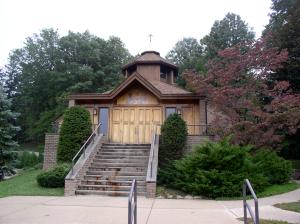
Three Hierarchs Chapel, St. Vladimir\'s Seminary, Crestwood, NY…how about you?

I am registered and have booked a flight for the Fellowship of Ss. Alban & Sergius conference. Signed, sealed, delivered, money has exchanged hands. I will have my laptop with me, of course, so I will be there reporting on the events as a blogger, I will also be there as a prospective student, and I will also be there as someone with a genuine interest in the subject matter (euphemism for “wide-eyed tourist”). If you can be there, I think you should go too. If you can’t be there, the tip jar still awaits its first contribution — I’d rattle it, but there’s nothing in it to rattle.

Who else is going? I frankly have heard of nobody else who is. I guess I’m not totally surprised, since the Fellowship really is, for all intents and purposes, a group of people with the most specialized of special interests, but I would think that the roster of speakers would have at least generated a bit more attention. Maybe it’s too soon for that. Well, regardless — I’m very much looking forward to the experience. (It is also, not terribly coincidentally, the only trip I’ll really be able to take this summer.)

I’ll note that since registering, I received an e-mail announcing that they would be making available the opportunity to students and seminarians to work at the conference in exchange for the registration fee, and would I be interested? I e-mailed back and said yes, but we’ll see how all of that works out.

Moving on to different matters… I really appreciate what Alden Swan had to say regarding a post from Michael Spencer:

I think it’s telling that the two most prolific evangelism programs in evangelicalism both approach their audience with questions that Jesus never used.

“Do you know that God loves you and has a wonderful plan for your life?”

“If you were to die tonight, and God were to asked you, why should I let you into my heaven, what would be your answer?”

[Spencer] points out that Jesus merely proclaimed the Kingdom of Heaven, which had very different connotations than our dangling Heaven on a stick (my terminology).

The comments on Spencer’s post are themselves fascinating — give them a read. I’m also considering printing up a t-shirt that says, “The Orthodox Church: Refraining From Dangling Heaven On A Stick Since 33 A.D.”

Okay, maybe not. But that’s still a great phrase which I’d love to figure out how to use sometime.

Moving on.

Rod Dreher’s “Conservatism is dead. Long live conservatism!” examines at the Tory Anarchist’s “look at the future of the right,” who says the following:

Orlet asks whether a movement with as much young talent as conservatism has can really be doomed. Of course it can. Young journalists are one thing, but there’s no young Willmoore Kendall or young James Burnham or young Frank Meyer on the scene. No, I wouldn’t expect a 20-year-old or a 30-year-old to have the gravity of any of those thinkers — but even looking at our 40-year-olds and 50-year-olds, I can’t think of too many who are of much significance as theorists or academics. […]

Part of the problem on the theoretical side is that too many of the best young minds in conservatism have followed Buckley’s example by shunning grad school and embracing journalism or the movement instead.

With that in mind, consider my liberal friend Emily Hindrichs’ opinion:

I have long maintained that the nation in which I live will not have an academic as a president for one simple reason: people fear the educated. They fear the big words and the complex sentence structure and the literary references. Instead, they elevate the mediocre with descriptors such as “down to earth” and “plain-spoken.”

Now take this incident into account. Mostly what I wish to focus on is a response in the comments:

Universities, especially humanities and social science departments, have long since ceased channeling received wisdom and have turned into liberal advocacy organizations. A good deal of what they do either subtly or overtly pushes liberal ideology. […]

One should hold one’s head low and get a technically oriented degree at a university.

If we accept that premise that conservatives have largely ceded academia, the question then becomes, “Why?” (I accept this premise in part, by the way, but not entirely.) Does Emily’s assertion and the comment about the Delaware problem answer the question satisfactorily? Is it that conservatives are anti-intellectual? (Perhaps.) Or afraid of their ideological purity being tainted? (Probably, at least in part.) Is it a utilitarian view of education? (Largely, I think.) Or maybe it’s a marketing issue — getting back to Emily’s point, they’d rather play in Peoria than compete on the academic front. It’s a way of catering to the masses, which ensures their continued ability to eat with the classes.

What is the best way to synthesize this? I don’t know. What I do know is that conservatism only has itself to blame for its intellectual bankruptcy if the only acceptable response is retreat. The alternative is not easy — that being, conservatives have to be superior in their scholarship and not hope that correct ideology will do their work for them — but it’s what needs to be done.

Last year, a question came up in a class about Nestorius — what did he actually teach? I offered what I understood to be the basic summary of the Orthodox understanding, and the liberal skeptic in the class was able to quote Nestorius’ writings chapter and verse, offering a snarky comment to the effect of, “You Orthodox types have cooked up a lot of your own issues with him.”

By contrast, I heard a lecture the same year by a scholar who is Orthodox who teaches at an Ivy League school. This. Person. Knows. Her. Stuff. Top to bottom, in and out, she’s got it cold. Somebody from here who falls under the category of a liberal debunker went up to her afterward and said, in a manner more or less suggesting a rivalry that was friendly and professional but a rivalry nonetheless, said, “There are major problems with your thesis.” At that point it becomes about which bias informs the scholarship — and make no mistake, atheism is a bias, it is not a guarantee of objectivity by any means — but there was no denying that she was right on in terms of the sources, the languages, and everything else.

That’s what we have to do. If conservatives aren’t willing to put in the time and the work, they shouldn’t be surprised when their lunch gets eaten by people who may be on Mars ideologically but have the facts and the sources straight.

Dorushe 2008

So, I arrived in South Bend Friday evening with The David and The Daniel in tow, and headed to the dinner for conference participants. It was at the home of a faculty member, and the first thing my hostess said to me as I entered the house was, “I know it’s Lent, but you are bound by manners to eat what I put in front of you.” I’m not even sure how she knew I was Orthodox, but she clearly was Catholic, and pretty much everybody there was either Catholic or Orthodox (save a couple a self-described disgruntled Evangelical and an “ex-low-church Pentecostal who’s trying to figure out what to believe”), and everybody was aware of that and comfortable with it. It also became clear that I was in a room of people who had the same interests I did, and had them from more or less the same point of view — that is, there wasn’t anybody trying to tease out sadomasochistic imagery from martyrdom accounts, for example. If somebody wants to make the argument that faith informs the scholarship of people like this, well, sure — faith informs all scholarship. It would be impossible for this not to be the case, even with atheists. What you don’t believe is as much an article of faith as what you do. It is merely a question of how much one acknowledges this, and whether or not one pretends that the bias, whatever it is, is objective.

The dinner was extremely informative on other points, as well. There were a couple of people who were St. Vlad’s alumni, and it was very useful to be able to hear their perspective on some matters. One somewhat stark reality which was driven home is that all of these folks are basically, shall we say, older teenagers in the field, but still not fully formed one way or the other, and I’ve got at least five years to go (by current reckoning) before I’ll be anywhere close to where they are. Nonetheless, the conversations I had with them lead me to believe I can get there.

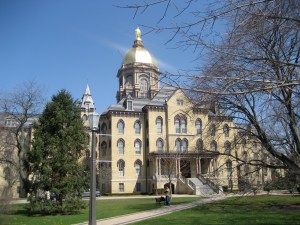
The Main Building at Notre Dame on a particularly gorgeous dayConference day itself was a fascinating experience. The papers were all very interesting, ranging from linguistics to textual traditions to St. Ephrem the Syrian and so on. The intellectual dynamic, largely because of reasons mentioned above but also because of other factors — it was on an openly Christian campus, there was a crucifix on the wall of the room in which we presented, a faculty member said a blessing before lunch, one of the Notre Dame faculty present as well as the keynote speaker were priests themselves, etc. My paper, which deals with liturgical imagery in martyrdom accounts, includes some supporting detail such as specific attestation to the baptismal practice of threefold immersion in sources such as the Didache, Apostolic Constitutions, etc. and it’s there because the professor for whom I wrote it was extremely skeptical of the legitimacy of assertions about exactly that kind of liturgical practice. When I was reading that part of the paper to this group, however, I felt sort of silly, because it was clear that these weren’t people who needed to be convinced on those kinds of points.

I felt generally good about my presentation; the odd part was that once the moderator called for questions, there was this awkward silence that filled the room, and nobody had anything (even the cheering section of The David and The Daniel — but then again, it would have been obvious that their questions would have been plants). I got direct comments during the break, and they were all positive, but during the actual question-and-answer period nobody had anything to say. A few different people offered me their takes on this; one person suggested that the after-lunch slot is always problematic when it comes to questions, and it was just luck of the draw. Another thought that part of the problem was that everybody else was talking about manuscript and textual issues, and I was talking about theology and theory. Another person said, “Well, everybody in there knows each other but you, and it’s clearly their playground. They meet, toss around ideas, read each other unfinished chapters of their dissertation, and have a good time. You’re here as an unknown quantity with a pretty polished piece of research, and you’re presenting it authoritatively. I think nobody quite knew what to do with you on that basis.” Could be — I really don’t know.

I’ll say this — it was not lost on me that the vast majority of participants were people from places like Notre Dame and Catholic University of America. Besides that majority group, there were two from Princeton, two from University of Chicago, one from Brown, and then lil’ ol’ me from IU (I suppose I might count as half a student from there). When I said where I was from, more often than not I got a very curious reaction — “Really? IU? Who are you working with down there?” An awkward question, to say the least, since the answer is, well, nobody. I would tell people the name of the professor for whom I wrote my paper, which would usually generate a furrowed brow, and then the name of my Syriac teacher, which would then garner recognition — but usually accompanied by some surprise that he would have students at an event like this. “Well, I’m not really his student, per se,” I’d tell them, and explain my situation a little more. (“Oh,” said one faculty member. “I guess that leaves you a bit at loose ends then, doesn’t it?” Um, yes, it does, thanks, very kind of you.) Anyway, the point is that I’m understanding a little better why over the last month, post-rejection, what I’ve been hearing is “People with your interests aren’t trained at places like IU, and they don’t work at places IU either.”

Not that these things are necessarily bad; as I said, the reactions as expressed afterward were positive. The keynote speaker told me, “Very good, Richard, and the way you lay it out, it’s obvious.” I explained to him the skepticism I had encountered with the professor in question when I had proposed the paper topic, and was told in reply, “Well, I don’t know why he would have told you that.” One of the faculty members in attendance asked if I would send him a clean copy of the paper, which I did. It seemed like a good start in getting to know the other people in this field, and one way or the other, that will have been worth something. (It also cements my resolve to go to New York in June. Tip jar, baby, tip jar.)

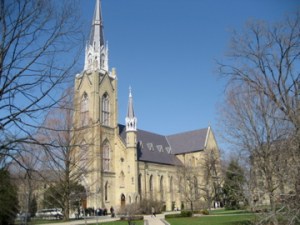
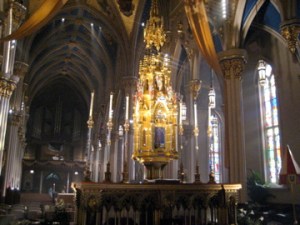
On a less academic and more tourist-y note, I’ll just say the Notre Dame campus struck me just the right way on just the right day. The Basilica is something else, inside and out — although, people, I don’t care what you think about Catholicism, don’t go into Catholic churches if all you’re going to do is go in to leave Jack Chick tracts. That happened while I was in the Basilica, and it was simply embarrassing. I’m not going to go in and start leaving Archbishop Chrysostomos publications in the pews — it’s just bad manners, and shows an utter lack of class. Going into somebody else’s house for the express purpose of insulting them is poor Christianity indeed.

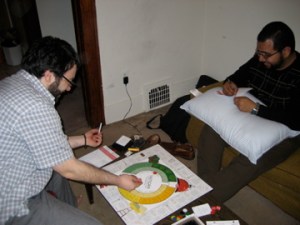
The Daniel is about to be elected the first British popeSo, one thing we found at the Notre Dame bookstore that I volunteered to buy as soon as I saw they had it: Vatican, the Board Game. I had heard of this for the first time about a year ago, but had gone beyond looking at the website. I played it with The David and The Daniel that evening, and The Daniel was elected the first English pope. I will say, it does a great job of never slipping into satire or wearing biases on its sleeve; it seems to genuinely attempt to be educational. Whether or not it truly succeeds, I have no way of knowing — I just know that there was nothing that leapt out at me as a fundamental disrespect of the Catholic faith. If there are people with differing opinions, I’d be glad to hear them. Anyway — consider it recommended.

Matins and Divine Liturgy were at St. Andrew’s, the Greek parish in South Bend — it would have been very nice except that I had to run out of the church four times during the Liturgy because I was sick. Quite embarrassing, and I’m not entirely sure what brought it on. The last time was right before Holy Communion, and I limped back in after it was over. Oh well; I guess it solved the dilemma of what to do if I should throw up after receiving.

In my Syriac class this morning, I recounted my experience. As a point of background — we’re reading the Life of St. Ephrem the Syrian in class, and one of the things it depicts is St. Ephrem meeting St. Basil of Caesarea. Whether or not this actually happened has been discussed in class as being a point of contention, and a voice or two in class have been very specific about believing that it’s pure fantasy. After describing the weekend, I jokingly mentioned that I didn’t ask any of the hardcore Ephrem scholars there whether or not they thought he met Basil; somebody replied, “Sounds like they were probably the kind of people who do.” Ouch. As I said earlier, I think I’m beginning to understand why I’ve been told what I have about IU ultimately being a bad fit for somebody like me.

Anyway — I’m really glad I was able to participate. I hope I’m able to play with some of the older kids again at some point. One way or the other, there was a bit more of this crazy world which I was able to see, and it’s a lot to process. I think it may take some time.

I leave you with my favorite of the pictures I took inside the Basilica:

All Saints Choir invited to be Midwest franchise of Cappella Romana

And before I say anything else about that, do check today’s date.

Fr. Peter with the choir during the Great LitanySaturday evening, the choir’s first public outing, did go very well, however. They learned the music, they were able to do it outside of the church building in front of a group of people specifically there to listen to (and, to some extent, watch) them, and I am inestimably proud of all of them for doing it and keeping it together throughout. For most of them it would have been the first time they would have ever done anything like this, and certainly the first time the choir as an ensemble has ever participated in this kind of outreach. There are always things you’d hope would go better, but they maintained composure throughout the whole program and never once crashed and burned. Just being able to do that is a fantastic start for a group like this, and now we all know we can do it (I’ve always known they could do it, it was just convincingRichard with the men them), we’ll move forward from here. This group wouldn’t have been able to do this at all a year ago, and it sure isn’t because of me that they can now, so that they were able to do this is a measure of the hard work they’ve put into this.

(Thank you to Anna for taking photos, but really just for being there.)

Here are some highlights:

Troparion of Bridegroom Matins

Lauds with stichera, Bridegroom Matins of Holy Tuesday (Matthew Wells, Megan Barrett, and me, cantors)

15th Antiphon, Great and Holy Friday (John Labban, cantor)

I’m hoping the next opportunity to do something like this comes along soon (but preferably after Pascha, at least).

In other news, my paper went well at the Medieval Studies Symposium; I felt good about the research and the presentation, particularly since I had been able to go back and replace many of my key references to English translations of Syriac sources (for which I didn’t really have a choice when I started writing the paper a year ago) to the Syriac sources themselves. I also felt like I handled the questions well. I’m looking forward to seeing how the Dorushe conference goes at Notre Dame this weekend.

I’m leaning increasingly towards going to the Fellowship of Ss. Alban & Sergius conference one way or the other. It seems very much like it would be worth the money and would behoove me to be there. Maybe I can “blog the conference,” as it were. Even so, at the risk of sounding like I’m begging for money — tip jar, baby, tip jar!

If I can just say — I am well to have March behind me. It has been a really awful month on several levels, and I have felt despairing at many points throughout the last 31 days. I am hopeful that April is beginning on a brighter note, with an eye towards the fact that the month is ending with Pascha (and Finals Week, but never mind that now). Onward and upward, with God’s help.

More on the alleged plurality of means by which one may remove flesh from a feline

So, I had a conversation a couple of days ago with one of the people who wrote letters of recommendation for me. This person wasn’t directly involved with the admission process, but had knowledge of what had happened, and was pretty up front with me about it. I wasn’t told anything I hadn’t already figured out, but this person remained encouraging, and had some concrete suggestions about better paths for me.

The bottom line seems to be this — there’s not really a way to make me look like a conventional applicant on paper. (Read this for what I’m talking about.) It’s one thing for faculty members to say, “Well, he doesn’t fit in this particular box, but he’s very capable, he’s a known quantity and has proven himself,” but when it comes down to having to make hard decisions, admissions committees have to look at me and say, “He may be capable and a known quantity, but he doesn’t fit into the same box as everybody else we’re admitting.” Without a liberal arts undergraduate degree, my application goes into a different pile than those who do, and that’s not the pile which makes it to the next round of cuts, regardless of my other qualifications. There was the hope on the part of those who supported me that I would be able to transcend these limitations, but sheer numbers did not allow for that.

As I said, this wasn’t anything I hadn’t already figured out. Two years ago I was told what ducks I needed to get in a row for grad school, but the person giving me this advice also said, quite bluntly, “Even then, if it’s somebody like me reading your application, you’re not going to have a lot of luck.” With a non-liberal arts background, plus the fact that within five seconds it becomes clear that it took me eleven years to finish a four year degree (i.e., I was a dropout), I was told, my letters of recommendation appear to be talking about a totally different person and can’t be seen as reliable. The person I was talking to on Tuesday told me that, unfortunately, all of that may be harsh, but it is not necessarily wrong, particularly when a humanities department is faced with more graduate applications than they’ve ever had before. “The reality is, we’re admitting people who have the option to turn us down to go to Princeton, Yale, Duke, and Columbia,” I was told. There is also the issue that my particular academic interests are generally more specifically addressed at religiously affiliated institutions, not big liberal arts universities. Being a “non-traditional applicant” combined with my interests being, in the long run, not the greatest fit in the world for how things are done here, and the work I’ve done over the last couple of years simply does not level the paper playing field.

So what will? In an ideal world, my interests would have been identified, encouraged, and fostered during my early teens, I suppose, but this isn’t what happened, and in the woeful absence of a Time-Turner, I must find a different path.

The suggestion which has come from a couple of people, including the person with whom I was speaking on Tuesday, is that I might be best served at this point by getting a Masters from an institution where that’s the highest degree they offer. In particular, an M.Th. from a seminary would likely be a great way for me to go. St. Vlad’s was brought up as being probably a great fit; I’ve mentioned that before as a possibility, so we’ll see. I’d have to do the M.A. before the M.Th., so we’re talking about 2-3 years to finish both, but I’d come out on the other end with a substantial piece of research (the M.Th. thesis is 100-200 pages), connections to some good places, presumably some very helpful letters of recommendation, and all of that within the context of concurrent and ongoing Orthodox spiritual formation. (I’m not going to get into the argument right now about whether or not St. Vladimir’s is “truly Orthodox.”) There’s something about that idea which is a little freaky to me — that is, my thesis advisor also potentially being my confessor — but there’s also something refreshing about the idea of being at an institution for a little while which would be the polar opposite of what I’ve been around for the last five years. All factors taken into account, it will likely be a couple of years before I can actively pursue that route, but it’s at least good to know that there are still possibilities for me.

Another concrete piece of advice I was given — and this is the kind of thing I wish I had heard two years ago — is, as alluded to earlier, that people with my interests generally go to religiously-affiliated institutions for their training, particularly Catholic institutions. Notre Dame, Catholic University, Fordham, etc. Not only that, but those are also the institutions where they typically wind up getting jobs. I was advised that this is the network which I need to be figuring out how to cultivate now, and that someplace like St. Vlad’s will do probably do more to make me competitive for PhD programs, and ultimately jobs, at those kinds of schools than anything else I could realistically do right now.

In the end, all is not lost, and nothing will have been wasted. There are, nonetheless, some concrete lessons I have learned over the last few years which I would like to pass on to whomever might find them valuable. I’m looking at having to spend my 30s doing what I should have done in my 20s, and that’s a substantial chunk of life to simply get pushed back ten years — don’t let this happen to you!

If there is anybody reading this, or who ever will read this, who might be considering dropping out of school…

DON’T.

I know the arguments. I made them all, twelve years ago. None of them are insuperable. Dropping out seemed like the only thing I could do at the time for all kinds of reasons, and maybe it was, but I nonetheless am still paying the price for that choice. A break in your transcript before the completion of a degree will always raise red flags for certain kinds of people in certain kinds of roles who are evaluating you for certain reasons — Just. Don’t. Do. It.

If your kid has any kind of a love of learning, reading, writing, in general thinking and synthesizing — This Is Not A Bad Thing. It’s not even an unpractical thing, and it certainly doesn’t have to be a perplexing thing. Cultivate it. Encourage it. Guide it. Provide a structure for it. There are jobs for people like them. They don’t have to be accountants or lawyers to make a living. They can go to grad school, if they do it right they can go to grad school without too much of a mountain of debt, and they can become academics. These are, in fact, “real jobs.” It’s also self-perpetuating to some extent — the more we cultivate this kind of thing in our kids, the more jobs there will be in the long run for people like that.

If you can have your kid learn a “dead language” when they’re thirteen — heck, when they’re six — do it. It’s going to be a lot easier for them then than it will be when they are 29, and it will open up new worlds to them and to you. Besides, the ability to learn another language is itself a discrete ability, and when you learn Latin or Greek you understand better why “practical” languages like French or Spanish are the way they are. You can learn French or Spanish without it, sure, but it’s sort of like learning music by ear vs. reading the notes. You have a more in-depth comprehension of how it’s working on several levels.

If you’re an atheist reading this, then feel free to ignore this paragraph, but help your kid cultivate a real, lasting faith to go with their intellectual curiosity. It’s the only thing that will put it in any kind of meaningful perspective. The alternative ultimately leads to nihilism.

If you’re struggling with any of these kinds of choices, drop me a line. Let me help. richardtenor (AT) gmail.com, richard_barrett (AT) mac.com, or rrbarret (AT) indiana.edu. Learn from my mistakes — it’ll help make them worth it.

On Forgiveness Sunday, the alleged plurality of methods by which one may relieve a feline of its flesh, and other musings

First off, this very important announcement:

My Peculiar Aristocratic Title is:
Imperial Majesty Richard the Mad of Nether Wombleshire
Get your Peculiar Aristocratic Title

Right.

So, Cheesefare Week, as noted earlier, started off with some bad news. I had been obliquely informed about a month ago that good news would come via e-mail, and bad news would come via postal mail; therefore, when I saw the envelope in my mailbox on Monday, I knew exactly what it contained before I even opened it. Bottom line: I will not be a matriculated graduate student this fall. Ricardus est insufficiens petitor.

Exactly what is next for me is unclear. I was instructed to thank God for keeping me from going down this path since He obviously has something better in mind for me, so I’ll start there. There are some well-placed people who have told me they absolutely believe I can do this and want to talk about what happened and what they think I can do from here; I’m more than happy to listen, but in the meantime, I am beginning to consider what my other options are, up to and including the possibility that, being 31, perhaps my window of opportunity just isn’t open anymore.

However, without conceding that point just yet, I can say that I will finish this school year with two years of Latin, three semesters of Greek, and a year of Syriac. By the end of next year, I will have the fourth semester of Greek, a second year of Syriac, and a year of Coptic. I will also begin the St. Stephen’s course through the Antiochian House of Studies in the fall, with a concentration in Byzantine Musicology. This will, eventually, lead to a Masters in Applied Theology accredited by the Balamand Seminary (although I am under no illusions that anybody will take that seriously if I try to pass that off as my only Masters degree). I plan to forge ahead with a project I proposed in my personal statement, since I still think it very much worth doing, and I believe I’ve got the toolbox at this point to at least give it a shot and see if something productive (and perhaps publishable) comes of it. I will perhaps discuss it here from time to time as I make progress on it.

After that… I guess we’ll see. Perhaps there is something to be said for trying to do a Masters at a seminary such as St. Vlad’s; it wouldn’t exactly be ideal financially (depending on what our other circumstances are at that point), but there might be far worse things than working with Fr. John Behr and Dr. Paul Meyendorff for a couple of years. At least given what the current data are, Bloomington does not exactly seem like the place I am meant to thrive, so perhaps once some other things are clear, it will simply be time to move on.

My path has been less than linear up to this point; why should it be any different now?

Meanwhile…  Forgiveness Vespers has been served, and Great Lent is upon us. Forgiveness Vespers is a fascinating service; I’ve never seen the Mutual Forgiveness portion have the same tone two years in a row. Some years it seems quite somber; some years it can seem very chipper and cheery. I’m sure somehow that sets the mood for a given year’s Great Lent one way or the other, but I haven’t yet figured out how. Regardless, it’s a beautiful and moving service — I just wish more people came. It seems to me that if everybody isn’t there, part of the point has been missed.

On a different matter altogether — things like this just make me sad:

The Kingsway Cathedral in the Sherman Hill Neighborhood may be demolished to make room for a gas station and convenience store.

Right, because that’s what the world needs.

And then things like this just make me shake my head: “Satanism in Orthodox Catholicism!” It being Forgiveness Sunday, I suppose my most appropriate reaction would simply be to say, “Forgive them, Lord, for they know not what they do.”

Forgive me, a sinner.

Missionaries, not professionals

Unlike many, I didn’t grow up singing in church; the music of the churches I went to growing up actually made me distinctly uncomfortable. I didn’t really start singing in church as a regular practice until I was eighteen and part of the choir at St. Paul’s Episcopal Church in Bellingham, WA. (By the way, I have nothing but the fondest of fond memories of St. Paul’s.)

The St. Paul’s experience, it must be said, made a church musician out of me, or at least started the process. I have never been one for whom either prayer or singing is as natural as breathing, but I found that by putting them together it makes both significantly easier. Fourteen years, lots of singing, and a music degree later, I serve in the function of choir director and cantor at All Saints Orthodox Church, where I was received by chrismation a little over three years ago. So — I am Orthodox; I am a church musician; therefore, I am an Orthodox church musician.

My Orthodox church musicianship does not exist in isolation, however; I am also trying to be a scholar of things liturgical, and I am also just a guy trying (unsuccessfully, more often than not) to live a Christian life. These matters, it may be said, all feed into one another — the scholar I am trying to be wants to understand the tradition, how it developed, how it was received, how it was expressed, how it was proclaimed, and how it was handed down; the church musician I am wants to figure out how I might best apply the tradition to the function I presently serve, not just in my own parish but in a way that will be more broadly beneficial; the “little Christ” I really wish I were and am not has his hands full just failing to order my own life around the same principles which the scholar and church musician are trying to place in a larger context.

And if it was confusing reading that, I can tell you it’s also confusing living it. I’ve never wanted to be a “church musician” in the sense that I go where the paycheck is (I never would have become Orthodox if I had); I eschewed “church jobs” so that I could sing in the choirs of the parishes I actually attended, and eventually became the choir director at All Saints. For me, it is service; it is a vocation in its own way; it is application of my research interests; I seriously doubt it will ever be a way for me to earn a living. Those kinds of jobs simply do not yet exist in Orthodox parishes in this country, with the number of exceptions perhaps in the low single digits.

It is also very much the case that being aware of what the ideal might be which informs the tradition that ultimately filters down to present-day parish practice is not necessarily an asset as a parish choir director. I expect that many choir directors are familiar with the cognitive dissonance which arises when an attempt to adhere more closely to traditional practice, rather than enriching parish experience, clearly diminishes parish practice for some people, if not outright disenfranchising them, for no other reason than it isn’t what they know or expect. I’m sure my colleagues know what it’s like to hear somebody say, “But nobody ever does it that way” — meaning, at times, the two parishes they’ve been to don’t do it — “and we’ve never done it that way here, and it doesn’t go with the music everybody already knows.” I would assume that other choir directors are aware that sometimes that response even comes, not from an in-depth theological or historical justification, but from merely pointing out what the service books actually say. This is not — let the reader understand — to speak ill of anybody; we choir directors are certainly not perfect, and if I’ve learned anything in my tenure as choir director, it is that it is impossible to please everybody no matter what you do, and that doesn’t need to be taken personally. (What I describe, by the way, isn’t specifically an Orthodox problem, either. Read The New Liturgical Movement sometime — although I would argue the historical reasons the Orthodox have some of these issues in America are different from why Roman Catholics might have them.)

If it sounds like I’m saying, more or less, that it’s a lot of unappreciated work for next to zero compensation, and the harder you work and the more you put into doing it right the less it will be appreciated — well, okay, sometimes that’s indeed how it seems. However, that’s looking at it from a strictly professional point of view. I would argue that Orthodox liturgical musicianship is quite far away from being able to consider itself a professional endeavor, that the necessary structures to support such a notion simply don’t yet exist, and that we need to consider ourselves first and foremost missionaries rather than professionals. In so doing, we will be in a much healthier spiritual place as choir directors and cantors.

Which brings me to “Historical Models of the Patronage of the Liturgical Arts,” by Rev. Deacon Nicholas Denysenko, in the Winter 2008 issue (Vol. IX, No. 2) of PSALM Notes.

Dn. Nicholas, a Ph.D. candidate at Catholic University’s Liturgical Studies program, puts forth the thesis that

[t]he Church…finds herself in an increasingly prophetic situation, with the need to define her distinct identity in the midst of religious pluralism and confusion. Within this context, Orthodoxy needs to develop a new model for supporting the liturgical arts for the proliferation of the Church’s tradition. (p. 4)

No question about that — as Dn. Nicholas also says, we don’t have a well-funded and well-heeled state church in this country to fund the kinds of artisans and craftsmen who built Hagia Sophia, and many parishes struggle to pay a fulltime salary for a priest, let alone a building sometimes. Pay musicians? What?

Some of Dn. Nicholas’ examples of alternate models ultimately undermine his point, however. He speaks of the “liturgical movement” of the early twentieth century which, as he notes, culminated in the Constitution of the Sacred Liturgy at Vatican II. The Liturgical Arts Society was a

small group of art professionals… [who encouraged] new styles… that would facilitate full ecclesial participation in worship… [and engaged] many clergy in the discourse on good liturgy and by carving a niche for the important role of the arts in the [Constitution on the Sacred Liturgy]. (p. 5)

“This legacy,” he writes, “provides a positive example of the good influence the gathering, cooperation, and educational endeavors of liturgical arts professionals can have on the life of the Church” (p. 5).

Dn. Nicholas is very careful to not speak of how the recommendations of Vatican II were implemented in the Mass, but it is nonetheless troubling to me that he would point up as a positive example efforts which culminated in such a radical discontinuity from what came before. This example is ultimately unhelpful because the post-Vatican II reforms have made life harder, not easier, for many who would consider themselves traditional Roman Catholic church musicians.

What is also troubling is an uncritical use of the phrase “full ecclesial participation” — what does that mean? In practice, it seems like more often than not what people want it to mean is “if everybody isn’t singing everything, then they aren’t being allowed full participation.” “Full participation” is also the language used by many who want to see a revision in the understanding of clerical eligibility. We need to clarify what “full participation” means from an Orthodox perspective — better yet, let’s avoid reflexively adopting language that isn’t ours in the first place.

Then there is this hypothetical example:

Let’s say the choir director at St. Mary’s parish in Anywhere, USA, has run across a new setting for the Eucharistic Canon that provides a perfect fit for both her parish and her choir. The price for a single copy is $1.75… Before making the purchase, however, she needs to receive approval from the choir council for the expenditure. The choir treasurer tells her that the choir’s budget is entirely devoted to an upcoming event, and asks her if she can buy one copy and then photocopy as many as the choir needs… Feeling frustrated, the director decides to wait on ordering the music until the choir budget has sufficient funds. (pp. 1-2)

To be perfectly frank, this example is so divorced from the reality I face as a choir director as to be close to absurd. The idiosyncrasy of Dn. Nicholas referring to the Anaphora as the Canon aside (unless St. Mary’s happens to be a Western Rite parish), if I were to simply decide on a new setting of it, I would have people calling for my head. Beyond that, the idea of a “choir council” or “choir treasurer” is completely removed from the little heartland parish I serve. Dn. Nicholas prefaces this example by saying that “[i]n an ideal situation, the conductor will have the opportunity to review new and fresh compositions for the weekly services and liturgical seasons at least semi-annually,” but I’m trying to imagine my choir, let alone my congregation, being receptive to that kind of constant flow of “new and fresh compositions.” Perhaps it makes sense to me as a musician to have different settings of the Liturgy available for different liturgical seasons, but I guarantee Dn. Nicholas that my own parish would not view such a rhythm favorably. At least not yet.

Now, I understand that the thrust of Dn. Nicholas’ point has more to do with the hypothetical choir director’s choice to not buy the music, and to some extent he acknowledges my situation as a possibility when in the next paragraph he speaks of these problems being rooted in “a lack of appreciation for the integral role liturgical music plays in church life, and a lack of knowledge of the arduous work that is put into creating and expressing this art,” but I suppose my point is that at least some of us are very much in, as Dn. Nicholas put it, “prophetic roles” in our own parishes, perhaps more than others might realize.

The part of his example that does actually resonate with my experience is the issue of photocopying. When I first took on the choir directorship, the choir books were filled with umpteenth-generation photocopies, often of handwritten stuff of uncertain origin. I have no idea what the copyright status of any of it was; some of it I’m sure was authorized to be copied for liturgical use, but it’s hard to say. I will say that in general, the Antiochian Archdiocese is very good about making its musical resources readily available and affordable, but it is very true that copyright status and the financial implications higher up in the food chain generally aren’t the first consideration of the folks whom I would ask to write a check for additional Vespers books, etc.

There is certainly a conversation worth having about copyright, photocopying, and how to make money off of liturgical music. I’d point the interested reader to this piece on The New Liturgical Movement for a point of view to which I’d be interested in hearing Dn. Nicholas’ response.

My overall reaction to Dn. Nicholas’ article is this — I’d argue along with him that the fullness of our music practice can itself be just as expensive as the fullness of any other part of our liturgical life. A well-trained cantor and choir director with a professional degree who is at every service and also rehearsing the choir regularly could very well be spending 20-30 hours a week doing what they do, particularly during Great Lent. If they’re trying build towards anything that looks remotely like a traditional two-choir setup (go here and click on the photo labeled “Please click on the photo for an excerpt of Sunday services” to see what I’m talking about), that’s going to be even more work. Copies of music for everybody will cost; traditional-looking kliroi and/or choir stalls will most certainly cost, and so on and so forth. It won’t just be a dollar cost, either; because most people haven’t seen anything like this in their parishes, something of a public relations effort will be required as well. If you pay what all of this would actually be worth, you’re looking at capital investments, at least one full-time salary for the protopsaltis, and maybe a few part-time salaries as well. I don’t know that there is a single parish in this country which is exactly falling all over itself to provide this, and to that extent, Dn. Nicholas is absolutely right — the liturgical practice which we have inherited is, in many regards, predicated on the availability of resources which we just don’t have, and we have to find new ways of making provision for them.

However, my sense from my own parish experience is that we’re just not there yet, and some parishes are, shall we say, less “there” than others. Saying “we’re not there yet” isn’t just applicable at the parish level, either; the means by which we systematically cultivate and train choir directors and cantors and composers for service in the Orthodox Church are still nascent at best. It’s going to take work, and a lot of it, to get this into place, and to cultivate a love for the best what we can do as liturgical musicians among the faithful. (I have weighed in elsewhere about what I think a step in the right direction could be — “get ’em while they’re young” being a guiding principle.) As I said earlier — missionaries, not professionals. Missionaries, in particular, who aren’t afraid to stick their neck out and be prophetic. Pastoral, certainly, but still prophetic. Dn. Nicholas gets there, sort of, in saying that “professional liturgists and musicians must take the initiative in educating the Church” (p. 6), but there’s that word “professional” again for which I’m not at all convinced we’re ready.

I must also confess that I don’t know what a “liturgist” is in an Orthodox context. The services already exist. We don’t need to mess with them, and moreover, we shouldn’t mess with them. Pull the book off the shelf and follow it. Liturgy, and liturgical music, adapts organically. Let it, and don’t force it. Let’s not make changes we don’t need to make just for the sake of doing things differently.

Which brings me to my final thought (for now). Dn. Nicholas asserts that “the liturgical arts of the Church are steeped in repetition and aridity, with no new expressive elements… Tradition cannot… be understood as mere repetition of past models” (p. 2). Agreed that we cannot define Tradition as “we do it this way because we’ve always done it this way and don’t have a better answer,” but liturgy expresses the faith of a community first and foremost, and individuals secondarily. Liturgical musicians and artisans should not be in the business of trying to “express themselves” — that’s not the point, anymore than an iconographer should be trying to “express himself.” What they are tasked to express is the faith of the community as it was received and as it always has been. While there is certainly room for creativity within that, it is creativity within definite boundaries — particularly given the fact that a culture of Orthodox liturgical singing in this country is far, far, far from mature. To put it another way, if we find ourselves dialoguing (I really hate that word) with Tradition, let’s remember it’s not a conversation between equals.

If I had a concrete, positive suggestion to make, I’d say let’s figure out how to adapt genuine American folk singing (for example, Sacred Harp/shapenote) to Orthodox liturgical use. That would be creativity within the Tradition, and I argue it will be a lot more productive in the long run for Orthodox Christianity in America than continuing to try to cram the English language into a Slavic paradigm of setting texts.

(I lied — I’ve got one more thing to say, and that’s the observation that Dn. Nicholas’ bibliography is not exactly crammed to the gills with the work of Orthodox scholars. Is that because it’s not out there for it to be cited, or is it for another reason? Either way, it seems to me that’s another issue we need to address.)

Evangelism the old-fashioned way

As long as we’re talking about Western saints, here’s this item from Aaron D. Wolf (what a great name) by way of Ben at the Wittenberg Trail (to whom I’d love to link, but I can’t, because the Wittenberg Trail is evidently a private forum) by way of Alden Swan:

Here’s what I can’t figure out: How in the world did Saint Patrick evangelize all of those Druid priests and clan chieftains without a mission statement? After all, history and tradition tell us that he walked around preaching and performed an occasional miracle. But how did he know what his mission was? Aaron D. Wolf, The Mission of Souls: When Experts Attack

[…] Mr. Wolf raises some interesting questions and challenges to modern Evangelical concepts of evangelization and mission, contrasting the wisdom of being “pupose driven” to the pre-marketing (pre-modern) habit of simply proclaiming the Gospel.

Wow. What a concept.

This gets me thinking about something which has occurred to me before — I have to believe that liturgy is one of our better and more underappreciated evangelism tools. I guarantee you that St. Patrick wasn’t just walking around preaching and “performing occasional miracles” — he would also have been celebrating the Mass, with the Eucharist as his “mission statement.”

small country churchThe model of evangelism that would be wonderful, if cost-prohibitive, would be to go places where there aren’t churches and start by building simple, but identifiable, churches (such as Trinity Church in Antarctica of all places, pictured at right) where they would be visible and accessible, start publicly holding services so that people can tell that’s what you’re doing, and equip them so that they can host a soup kitchen or something similar. The problem with so many missions is that they can ill-afford being in a place where they would actually be visible and it would be clear what they are doing, so they wind up evangelizing only the people who are already there. Right now, at least in the Antiochian Archdiocese, you have to have some number of pledging families (25?) before you can have a priest assigned to you; that’s good business and fiscally responsible, no question about it, but who’s doing the evangelism in that case but people who aren’t necessarily equipped to do it? I’m not saying that any Orthodox jurisdiction in this country has the money to spend, say, a half million to a million dollars planting missions so that they have buildings, priests, and services for the poor at the outset, but I sometimes wonder if that wouldn’t be a better witness all around.

I’m still waiting. Actually, I’m waiting on a couple of things — one fairly big thing, and one thing that is big-ish, but not on the same level as the other thing. (Confused yet?) In the meantime, however, I can reveal that I’m presenting a paper at Indiana University’s Medieval Graduate Symposium on 29 March. I can also give a heads-up that my church choir will be publicly presenting music from Holy Week as part of  IU’s Middle Eastern Arts Festival on 29 March. (Yes, the same 29 March. It’s gonna be a busy day.) Details for the whole ongoing program are here, but here’s the blurb for this particular event (I’m not going to use the word “concert,” for several reasons):

Concert: Choral Music of the Middle East
Behold, the Bridegroom cometh: chants from Holy Week in the Lebanese and Syrian tradition

March 29, 2008, 8 pm
St. Paul’s Catholic Center

The All Saints Antiochian Orthodox Christian Choir under the direction of Richard Barrett will present an evening concert of liturgical music from the Middle East. The program will highlight music from the Syrian and Lebanese traditions. Meditative and celebratory selections drawn from Holy Week and Easter services exemplify how this music became an integral and functionally practical part of Orthodox ritual. While the traditional liturgical languages for the Orthodox in the Middle East are Greek and Arabic, selections will also be performed English.

I didn’t write that, by the way. I will be writing a set of program notes, however, which I will post here. I can say that this is exactly the kind of thing I hoped we’d eventually be able to do, and I’m really encouraged by how the rehearsals have gone — it’s stretching them beyond what their comfort level has been, but in a very doable fashion, and it will be a good thing for us to participate in this kind of outreach. Hopefully I can post a snippet or two from the evening itself afterwards.

We seal a dial, she weans a Liam…

I am slowly but surely cramming the Latin verb system back into my head. Today, in class, I realized why I was having trouble distinguishing between second and third conjugation verbs based on the infinitive form: we weren’t using macrons anymore! With saintly patience as though explaining it as though to a four year old, my instructor reminded me that you pretty much have to go to the first principal part to tell the difference without macrons; -eo being the characteristic ending of the first principal part for the second conjugation. And then, of course, for the vowel change in the subjunctive, “we fear a liar.” “He eats caviar.” Or something.

I love being thirty-one and being more-or-less newly at an educational level which, ideally, I would have been at when I was twelve or thirteen.

On the other hand, Syriac was good fun yesterday; we’re reading the Gospel of St. Mark now, and it’s not bad. I do sincerely wish there was an equivalent of the Nestle-Aland critical New Testament for the Peshitta–i.e., with an apparatus and glossary; alas, the UBS edition has none of that, and is extremely hard to read. Sounds like somebody up the road might be working on something like this…? Anybody know?

While I’m thinking about it, anybody know how to get my blogroll displayed using this template?

And yes, I know that my notes for Unit 2 of Hansen & Quinn aren’t posted yet. I’m working on them–the last month or so has just been busier than I would like for such things.

More later.

Varia

latin_ms.jpgI’m slowly getting back in oscillationem rerum with Latin. The grammatical concepts are all more or less there, it’s just little things like, oh, vocabulary and the whole freakin’ verb system I have to cram back into my head. Optare, optavisse, optaturus esse, optari, optatus esse, optatum iri… if you see me on the elliptical machine at the gym looking like I’m having a very agitated conversation with myself, I’m reviewing Latin.

Fr. Stephen Freeman has an interesting look at the the word “fullness” and its implications within Orthodox Christianity. It is very much worth reading in its entirety, but a couple of points jump out at me:

Fullness means more than being correct. It is possible to be correct about something, and yet be empty and lifeless. Fullness is correct because it is a true reflection of God and not because it can be measured against the law or a set of rules (or the canons, etc.).

“It is possible to be correct about something, and yet be empty and lifeless.” So true as to not require any comment, only repetition.

Fullness implies a completeness.

The word Fr. Stephen is hinting at without saying is catholic–from κατά + ὅλον kata-holon, “according to the whole.” Catholicity, while a much-debated word, really boils down to the state of lacking nothing. The fullness of our faith, in other words, is where our catholicity is to be found–but this brings us to an irony:

I do know, and have said elsewhere, “Why would anyone want something less than the fullness of the faith?”

The irony here is that the very claim of “the fullness of the faith” is exactly what turns away some who I’ve known. Even if it’s true, so some have said to me, that shouldn’t be anything we care about if we are to preach only Christ, and Him crucified. If you think you’ve got the fullness of the faith, in other words, that’s proof that you don’t.

Isn’t epistemology fun?

Get Religion has a good post on political writers ignoring Roman Catholics. The last line sums it up well:

Yes, there is a longstanding antipathy between intellectuals devoted to the Enlightenment and Catholics devoted to Rome. Yet magazine writers wrote about Catholic voting trends. So why don’t political reporters?

I’m reminded of how in 2004, something of a big deal was made about how the Catholic vote was important enough to the Republicans that Bush paid a visit to the Knights of Columbus. I remember thinking to myself, “Do the Orthodox even have a comparable group for any of the political parties to snub?”

And, well–no, we don’t.

Not yet.


adventures in writing alexander lingas all saints bloomington all saints orthodox church american orthodox architecture american orthodox music american orthodoxy Antiochian Archdiocese Antiochian Orthodox Christian Archdiocese of North America Antiochians books byzantine chant cappella romana chant church architecture ecclesiastical chant ethnomusicologists ethnomusicology fellowship of ss. alban and sergius Greece Greek greek food greekness hazards of church music international travel tips ioannis arvanitis joe mckamey john michael boyer kurt sander Latin liturgical adventures liturgical architecture liturgical music liturgical texts and translation liturgy liturgy and life lycourgos angelopoulos medieval byzantine chant Metropolitan PHILIP militant americanist orthodoxy modern byzantine architecture modern greek music music as iconography my kids will latin and greek when they're newborns my kids will learn latin and greek when they're newborns orthodox architecture orthodox architecture is bloody expensive Orthodox choir schools Orthodox Ecclesiology orthodox outreach orthodox travel pascha at the singing school Patriarchate of Antioch Patriarch IGNATIUS IV Patriarch of Antioch publishing random acts of chant richard barrett in greece richard toensing rod dreher sacred music st. vlads st john of damascus society Syriac the Bishop MARK fan club the convert dilemma the dark knight The Episcopacy The Episcopate the only good language is a dead language this american church life travel we need more american saints why do we need beautiful music in churches?

Blog Stats

  • 262,835 hits

Flickr Photos