Archive for the 'College' Category


All Saints in the Herald-Times

Bloomington’s local paper, The Herald-Times, ran a piece on All Saints for their religion page in today’s edition. If you’re a subscriber, you can find it here; otherwise, it’s posted over at Orthodox Hoosiers.

The story here is this — last weekend was our annual pastoral visit from His Grace Bp. MARK (about which more a bit later), and we realized somewhat at the last minute that it might be a good event to try to publicize to the greater community, particularly since he was giving a post-Vespers talk about ministry in a college town. Parish council chair Jeff Weber had called the paper, and they told him they’d be happy to run whatever we sent them as long as it was 400 words or less and we got it to them by noon Wednesday. Somebody had taken a shot at writing a really short press release, and while it wasn’t bad as an event announcement, I knew from my own experience getting press releases to the Herald-Times that what had been written wasn’t going to fly. So, Tuesday night, in consultation with Fr. Peter and parish council chair Jeff Weber, I wrote a press release for Bp. MARK’s visit as well as a short, rather general feature article about All Saints and Orthodoxy in Bloomington. With Fr. Peter’s and Jeff’s suggestions and tweaks, we got them over to the paper at 11:59am Wednesday.

And on Saturday, we opened the paper and saw nary a word of what we had sent them.

This last Thursday, Fr. Peter left me a voicemail, saying that he had talked to the appropriate editor at the Herald-Times, and they had been very apologetic, saying that somebody had been out of town, wires got crossed, etc., they would run what we sent them this weekend modifying for past tense, and that they looked forward to covering All Saints more in the future.

So, today, the feature article was there, and true to their word, they printed the whole thing, changing only the applicable verb tenses relating to the episcopal visit.

Anyway, all’s well that ends well; we’re hoping that cultivating a bit more of a relationship with the Herald-Times will help raise awareness of All Saints in the community, so there will hopefully be more of these in the near future.

The ison cannot be the “dummy note”: in which the author gets to be a Cappella Romana groupie and gets to know the Oakland Police Department better than ever anticipated

I’ve forgotten some things about what it’s like to be a “professional musician” in the intervening years since I went into remission for it.

First of all, I’ve forgotten that there really are things about it I enjoy. I’ve had a ball the eleven days or so that I’ve been here, getting to make music with people who know what they’re doing, in a setting where getting notes and rhythms right is assumed to be the basic starting point, not something unrealistically hoped for as the entirety of the final product, and in an environment, physically, acoustically, and otherwise, that is conducive to such an effort. The rehearsals we’ve had for the Josquin Singers have all gone by really quickly; the three hours are up before I know it.

It’s also a mode of existence that tends to be nomadic, and that brings together very interesting groups of people for short periods of time.

While we were planning my trip, John mentioned that he was taking a group of Cappella Romana singers to Pepperdine University for the Ascending Voice II conference while I’d be here, and that I’d be welcome to tag along if I wanted.

We’ll just say it didn’t take me long to think about it.

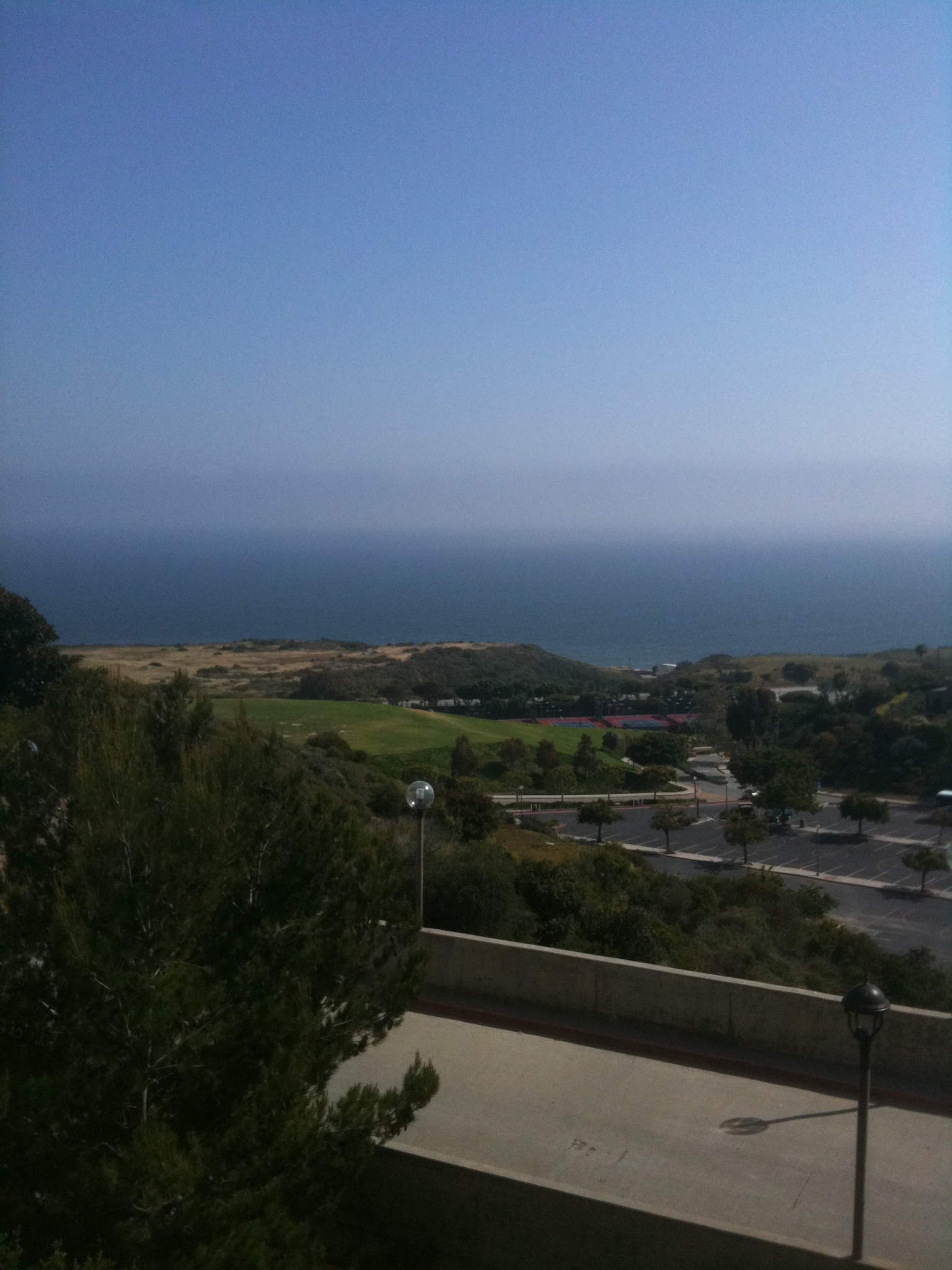
So, last Thursday, after singing Matins and Divine Liturgy for the Ascension at John’s parish, John, his student Dusan, and I took the short flight to Los Angeles, and there we met up with CR singers Andrew Gorny, David Krueger, and John’s dad, John S. Boyer (whom I had met once before in 1997 for a joint concert between Cappella and the Tudor Choir in which I sang). The six of us hopped in a rental minivan and drove to the Pepperdine campus in Malibu, met up with the other member of the crew Alex Khalil, and we were able to catch about three quarters of the evening’s Chanticleer concert (the showstopping highlight of which was countertenor Cortez Mitchell’s solo in “Summertime”).

The purpose of Cappella Romana’s presence at Ascending Voice was to give a Byzantine chant demonstration lecture and a workshop on Friday, and to sing a full Matins Saturday morning. John asked if, since I was there, I wouldn’t mind holding isokratima with David Krueger; sure, no problem, I said. So, following the concert, we rehearsed the demo repertoire.

Theoretically, really strong, solid musicians would be placed on the ison. It’s there so that the singers on the melody can hear the home note of the mode, and so it needs to be steady and unwavering. It can be really difficult even for singers who know what they’re doing. My experience with the drone note in parish practice, as a practical matter, is that it tends to be the “dummy note” — that is, it tends to be where people who can’t read music or who are otherwise not the most capable musicians in the choir get stuck. The intent is usually that even if singing the melody isn’t a realistic way for these people to participate, they should at least be able to hold a single note. Unfortunately, the result is often that non-singers wind up not being able to sustain the pitch; it goes flat and they can’t hear it, they can’t hear how the moves work, and so on and so forth. The deadly case is when such a singer decides that, because it’s the ison, it needs to be woofed up as much as possible, which usually means it goes way flat instantly, losing maybe a major third in pitch within seconds. In other words, the function of the drone — to be a tonal support and foundation for those on the melody — winds up being completely defeated, and those singing the melody have to work twice as hard in order to ignore what they’re hearing from those singing the ison and still stay in tune. There tends to be not much that can be done about this; yes, as stated, you actually do need strong musicians on the drone every bit as much as you do on the melody, but there usually aren’t enough people who are sufficiently confident with both reading and singing as it is to be able to spare them to support the isokratima. So you make do.

David Krueger, let it be said, does not have this problem. The guy is a freakin’ rock, and he’s got low notes that shake the floorboards. The rehearsal was a tremendously educational experience, and was great until the Southern Appalachian Chamber Singers came down around midnight and told us we were keeping them up. (“That probably wasn’t exactly successful evangelism,” John Boyer père quipped later.)

By the way, the very first thing I discovered Friday morning was that somebody was asleep at the switch in terms of finding a location for Pepperdine University. I mean, come on. What were they thinking? Terrible. Just terrible.

Both the demo and the workshop were fun; the lecture was largely the same as what John said at All Saints, but with live musical examples instead of recordings. Among other things, the examples included Ps. 102 and the Beatitudes (as heard on the Lycourgos Angelopoulos Divine Liturgy recording), the Polyeleos, and a setting of the Cherubic hymn, all off of Byzantine notation. The workshop involved teaching the participants music from the Divine Liturgy in English off of Western notation scores.

Matins on Saturday was quite an experience; we set it up with antiphonal choirs, we were all in cassocks, and we did the canons for the day in their entirety. I mostly held isokratima for the left choir, but lampadarios Alex Khalil was nice enough to let me sing a handful of troparia in the canons.

The priest who served was Fr. George Taweel of St. Nicholas, the Antiochian Cathedral in Los Angeles. Finding a priest was a bit of a challenge; John had called virtually every Greek priest in the area with no luck, but Alex knew Fr. Michael Najim, the Cathedral’s dean, and he was able to send Fr. George. Fr. George’s daughter Diana actually went to IU, and I knew her a bit from her time there. It was nice to meet him; we had lunch with him afterward, and he was a terrifically knowledgeable man and very interesting person with whom to have a conversation.

After lunch, it was back to the airport, back to Sacramento, just making it back to Annunciation for Vespers. It was a trip, short and guerilla-style as it was, that was great for which to be a fly on the wall; Alex Khalil in particular was a great person to meet. He’s an ethnomusicologist who just completed his PhD, and his dissertation is something that I think will have applicability for what I’m doing. Short version is that in his research, he applied a historical context to an ethnographic study of Byzantine chant; what I’m thinking about is sort of the reverse, where I’m interested in seeing if I can give an ethnomusicological context to a historical study of liturgy. I hope I get more of a chance to talk to him down the road.

I had hoped that friend-of-this-blog and Pepperdine employee David Dickens and I would have a chance to meet; we set up a lunch on Friday, but we managed to miss each other and he wound up being caught up by work anyway. Alas. Better luck next time.

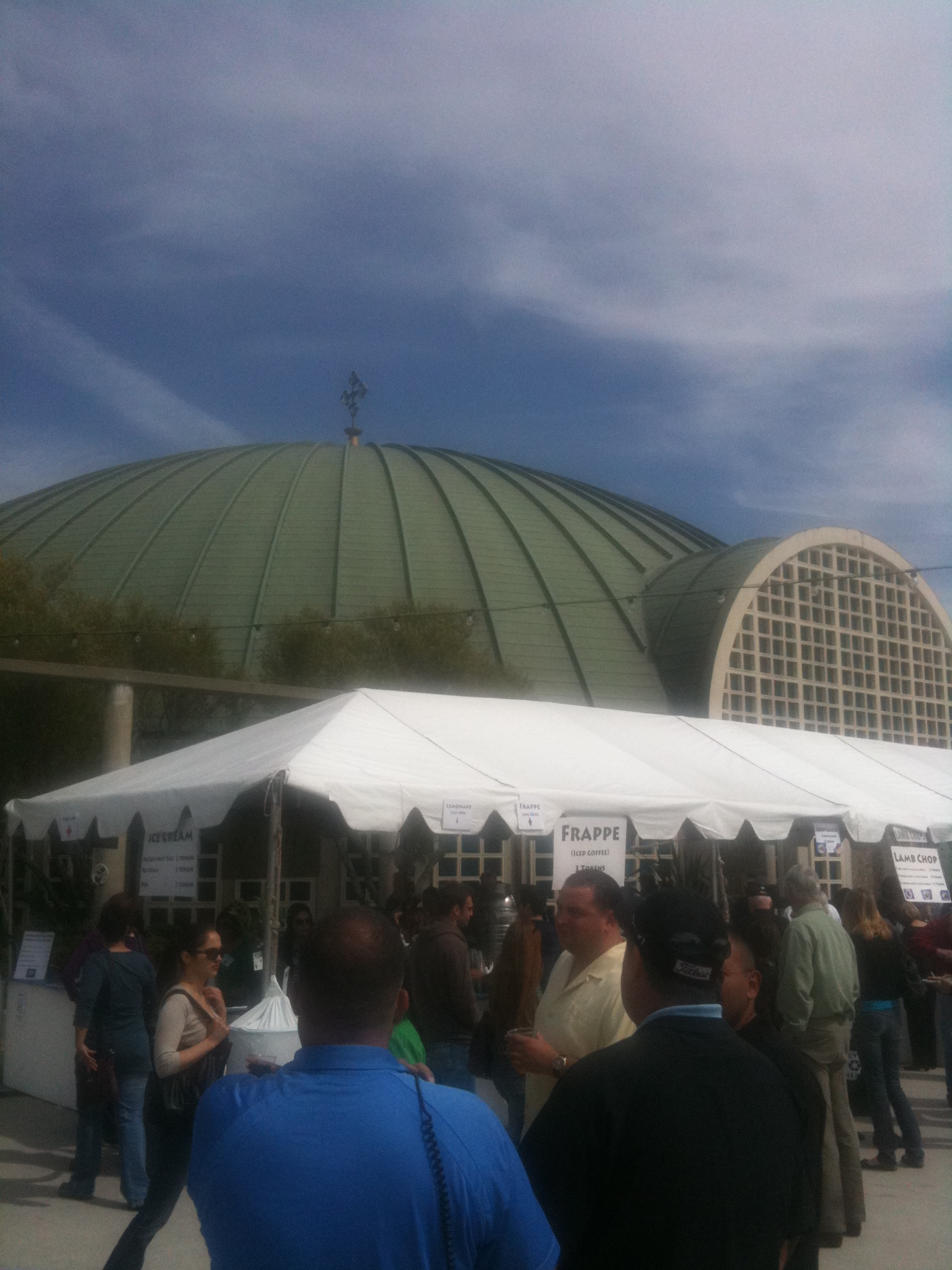
After church on Sunday it was back on the road, heading first to Ascension Cathedral in Oakland for another Byzantine chant demonstration at their Greek festival. It was largely the same repertoire as what we did at Pepperdine, again off of Byzantine notation; I had assumed that I was holding ison again, but John pulled me over and had me follow along with the melody as best as I could. (This was, in general, a more successful effort on the slower pieces.) In the audience was my friend Ian Jones, a cellist who was the very first person I ever met as a student at IU, and for whom Oakland is home. He will hopefully be able to make the Friday concert at the Cathedral; in any event, it was great to see him on his own turf.

After that it was time to head to rehearsal, and as we had rehearsal again in the Bay area Monday night, John and I stayed overnight in Oakland at his friend and fellow Josquin Singer Andrew Chung‘s condo overlooking Lake Merritt rather than drive back to Sacramento.

In theory this was a smart move; we hopefully were going to have much of Monday to hang out in the San Francisco area, with seeing St. John Maximovitch’s cathedral being on the agenda. Unfortunately, John’s car got broken into during the night, leaving him minus a driver’s side window (although nothing got stolen, thank God), and we ended up  having to spend the day dealing with that. It took close to two hours just to file a police report; the form took all of two minutes to fill out, but then waiting in line to actually turn the piece of paper in to get a case number took upwards of an hour and a half. It then took another couple of hours to actually get the window replaced, and then — hey, look at that! It’s time to go to rehearsal.

Oh well. It happens.

Anyway, today has been the “day off,” which has consisted of pretty much just enjoying being in one place for the day on my part, and John furiously putting together the program for this weekend’s concerts. I don’t know how the guy does it; he’s got these concerts, his normal church duties, students, the Pepperdine thing last week, and then next week he has Cappella commitments in Oregon. He runs around a heck of a lot more than I ever did as a singer, vocally he’s always giving everything he’s got, and I know that if I were trying to do all of that, I wouldn’t last a week. He’s got to have vocal folds made of steel, that’s all I can say.

Tomorrow is the dress rehearsal, then the concerts are Thursday, Friday, and Saturday; after Liturgy on Sunday it will be off to the airport and I’ll be on my way home. It seems odd that I’m almost to the last stage of the trip, but there we are. More a bit later.

At the tail end of Paschaltide: in which the author finishes his first year of for-real grad school, counts a couple of mutually-exclusive chickens, and winds up unexpectedly in Sacramento

The first half of spring semester got away from me as a result of my extracurricular activities at the beginning of the term, and then my losing a week from illness. The second half of spring semester got away from me because of the remainder of Lent, Holy Week, Pascha, getting the Orthodox Hoosiers website up and running, presenting a paper as well as singing some Byzantine chant for IU’s Medieval Studies Symposium, and then finishing all of my regular schoolwork for the term. It now being the last 30+ hours of the Paschal season or so, I suppose I should say this one last time: Ortanne Laivino! Anwa ortanne Laivino!

Which reminds me: I’m about twenty pages or so away from finally finishing The Silmarillion. I’ve started it any number of times, and gotten a little farther each time, but I finally made a point to keep forging on ahead, come what may. It’s been a rewarding read; it’s not necessarily Tolkien’s most transparent prose and it is a bit challenging to keep track of who is who the whole way through, but that’s probably just because I’m not terribly bright and it is nonetheless very much worth it. I’ll have more to say on it later.

As the end of the semester was coming into view, a couple of interesting things happened. First, I wound up, somewhat unexpectedly, with a choice as to what I could do this summer. I was offered a summer FLAS again to go back to Greece if I wanted, but the truth is, as much as I want to go back, this summer just didn’t seem like the right time. For one thing, Megan is going to Germany for the next academic year, from the end of September ’10 to the beginning of August ’11, and it’s been six years since we’ve both been home during the summer. For another thing, the logistics of being in Greece this summer would be significantly more complicated than last summer was, and with airfare having jumped since last year, most of my stipend would be spoken for before I ever set foot in the country, and that mostly for “redundant” expenses (i. e., having to pay for two places to live for the summer, one in the States and one in Athens). For yet another thing, I have a mammoth Greek and Latin exam to take in about a year, as well as my qualifying exams in Fall ’11, and my advisor and I agreed that with those events on the schedule, eight weeks in Athens doing Modern Greek would probably not be the best use of my time this summer.

While I was contemplating some of these issues a few months ago, I mused to a colleague that it was too bad History didn’t seem to do any sort of summer support if you didn’t have an instructor position. “Oh, no, that’s not true,” he said. “The e-mail just went out — you can apply for pre-dissertation fellowships.”

“Really? I thought I wasn’t far enough along for one of those.”

“Are you writing your dissertation yet?”

“No.”

“Then you’re pre-dissertation. Apply.”

So, I went ahead and wrote up a research proposal for the summer. My advisor said that people either traveling somewhere or who have taken their exams tend to be more competitive, but that it would be worth a shot.

As it happened, a couple of weeks ago I was notified that I am the Hill and Lilly Pre-Dissertation Fellow for History. On a practical level, it is a much better deal financially than the FLAS was going to be, and it means that both Megan and I can be in the same place for the summer. On an academic level, the project that I proposed will do a lot to prepare me for my impending exams, so hopefully I’ll end the summer feeling reasonably ahead of the game. I will look at trying to go back to Greece next summer; it would probably be good for me to look at the American School of Classical Studies’ Byzantine Greek program, and the nice thing about that is that there are a few different possible avenues of funding which aren’t mutually exclusive. That’s sort of an issue with the FLAS — if you have it, you can’t have anything else. I think the idea is sort of that they want you to have enough money to get where you need to go and do what you need to do, but they don’t want you to have enough money to be distracted by other possibilities.

In any event, I have to blink a bit at the realization that not only has History opened their doors to me, but they also seem interested enough in what I’m doing to want to facilitate it during the summer, too. It’s a nice turn of events to have happened.

The other interesting thing that happened was that, a couple of weeks after Pascha, I got an e-mail from John Boyer asking if I might be available to sing in a concert he was putting on with the Josquin Singers in the Bay Area over Pentecost weekend. Long story short, I flew out to Sacramento this last Saturday, the day after finals week was over, and I’ll be here until Sunday, 23 May. I’ll give the details of the concert in a different post, but it’s a neat project in which to be able to participate, and I’m really glad it’s worked out. To be honest, it’s been a little strange how it’s all come together; I haven’t really actively sought out professional singing opportunities for about five years, and it isn’t exactly like I spent hours talking myself up to John while he was in Bloomington. The trip has already worked musician muscles I haven’t had to work in half a decade; as soon as I got off the plane, John asked, “How are your dictation skills?” Turns out there is this three-part Russian setting of the First Ode of the Paschal Canon for which the score has not yet been published, but John wanted to do it in the concert anyway, so I was given the task of transcribing it. It was reasonably easy until the last repeat of the troparion; that’s 40 seconds of polytonal madness, and it took me about two days to get anything that seemed even reasonably close. I will be very curious to look at the published score and see just how many laughs are warranted. (Many thanks, incidentally, to Ivan Plis at Georgetown University, aka “SlavicPolymath,” for giving it a listen and confirming that much of what I had come up with was about as close as we were gonna get.)

That’s the long and the short of it for now. More a bit later. One last time for this year, probably: Christ is risen! Truly he is risen!

Finally some news about Orthodox Hoosiers

Christ is risen! Indeed he is risen!

I have a rather large handful of things to write about here, but we’re at that point in the semester where everything has to be done within the next couple of weeks. I anticipate having my papers done ahead of time much as with last semester, so hopefully I’ll get something up soon. Holy Week, Pascha, recovery from Pascha, and then all of my work for school has just been a prohibiting factor — but I haven’t abandoned the blog by any means. Just having to prioritize.

In the meantime, thanks to the not-insignificant assistance of the overall incarnation of awesomeness John Berry, Orthodox Hoosiers(discussed briefly in these posts) now has the beginnings of an online presence. Please go over and check it out; it’s only a beginning, but any thoughts you’ve got about what should be up there and/or how things should look, please by all means let me know. We’ve got to start somewhere.

Orthodox Hoosiers

A brief note of interest — if you are an Orthodox Christian and an IU alumnus, current student, or are otherwise an interested party, AND you are on Facebook, please take a second to join the Orthodox Hoosiers Facebook group. This is an effort that just started today (like, twenty minutes ago), so this just the beginning, and there’s much, much more coming, but let’s start here.

Update, 19 January 2010, 9:45pm: www.orthodoxhoosiers.org has been registered; there’s nothing there yet, but the site exists. The long-term goal here is to create a formal Orthodox IU Alumni Network; watch this space for details.

Embracing paleostructuralism

It is late afternoon on Wednesday, and I have somehow managed to accomplish everything I needed to accomplish by this time. On Friday, this seemed like a goal that was unattainable, so I am reasonably pleased.

Somebody mentioned to me this last Saturday, “I occasionally read your rants against post-structuralism.” It had not been explicitly discussed in class that Foucault and company actually constitute an “-ism”, so I’m sure I was a deer in the headlights for a second while I figured out what my friend meant. Flesh of My Flesh has been explicitly exposed to more theory than I have, so I’ve been hearing about the supposed difference between signifier and signified for some time, but again, that this movement had a name was new information for me. A couple of things clicked once I understood the label; this is the same friend who a few years ago overheard me saying that it made no sense to me to read modern ideas of sexual equality and identity into texts for which those ideas would be anachronistic, and consequently chided me for “not believing in gender theory,” adding, “Applying theory is not ‘reading something into’ anything. That’s just you having an ideological problem.”

For all I know, maybe he’s right. He’s in the English department, and maybe there’s a way these things actually make sense from the standpoint of literature. Maybe, too, this is the difference between a “scholar” and an “intellectual” — I do not give a fat, furry, flying rat’s hindquarters about theory. I have not entered an academic discipline because I am interested in the “isms” which seem to plague the humanities right now. (I am told that “thing theory” was rather well-represented at last week’s Byzantine Studies Association of North America conference, which makes me want to tear out my own teeth with a rusty screwdriver.) I have entered an academic discipline, because, funny and naïve and idealistic as it may sound, I am actually interested in, and even like, my subject of study.

What does that make me? A paleostructuralist? If so, then so be it. (“Paleostructuralist” sounds cooler and more dignified than “anti-post-structuralist” anyway.)

I still have more to write on Foucault in this space, but it’s going to have to wait a bit yet while I finish some other things. In the meantime, my most recent (and last) response paper for my “Introduction to the Professional Study of History” course starts to sketch out some of the thoughts that will show up there. Certain elements will be no surprise to those who visit here somewhat regularly, there are a couple of moments where it will be evident that I just got through watching all of Christopher Nolan’s movies in chronological order (which merits its own post), and the couple of somewhat coy suggestions that certain things should be discussed elsewhere will be developed in my final paper for this course.

The Safe Retreat into Omniscient Third-Person:

The Problem of Historicizing Oneself

Or

A Response to Kate Brown’s “A Place in Biography for Oneself”

(As Well as a Number of Other Bits and Pieces from the Fall 2009 H601 Course)

“Historians,” writes Kate Brown in her essay “A Place in Biography for Oneself,” “expose other people’s biographies, not their own.”[1] How can this be, however, when according to Marx, “[m]en make their own history” [2]? How, ultimately, may historians be their own agents of history while being true to their own profession? How might historians assume the first person voice in their own work, that is to say, our own work, or still more to the point, my own work – honestly?

To expand Marx’s quote, men make their own history, “but they do not make it just as they please; they do not make it under circumstances chosen by themselves, but under circumstances directly found, given and transmitted from the past.” Brown certainly did not choose her circumstances. She is from a small Midwestern town whose economic history could have stepped out of the pages of The Marx-Engels Reader; in her home town of Elgin, Illinois, as she tells it, the beginning of her life intersected with a narrative of Western expansion, labor strife, industry flight, economic redevelopment, and gentrification.[3] Her own retelling of the story gives significant credibility to Marx’s claim that “[t]he tradition of all the dead generations weighs like a nightmare on the brain of the living”[4]:

From Elgin… I came to understand how closely one’s biography is linked to one’s place… I recognized the impulse to bulldoze and start over, to push on toward a brighter, cleaned-up destiny, which meant abandoning some places and people and losers of an unannounced contest.[5]

The past – that is to say, one’s history – and its relationship to location are a weight that one must learn to carry or learn to jettison. Perhaps this can be understood as an inversion of the opening line of Pat Conroy’s novel The Prince of Tides – rather than the wound being geography, the anchorage, the port of call, it is geography, and the confluence of circumstances that one encounters in that geography, that is the wound.

All well and good — but how real is this confluence of circumstances? How objectively may its existence be assumed? Per Benedict Anderson and his analysis of how seemingly disconnected events make up the front page of a newspaper, perhaps not much:

Why are these events so juxtaposed? What connects them to each other? Not sheer caprice. Yet obviously most of them happen independently, without the actors being aware of each other or of what the others are up to. The arbitrariness of their inclusion and juxtaposition… shows that the linkage between them is imagined.[6]

What, then, is the difference between one’s life and the front page of a newspaper? Do they both represent a constructed – that is to say, not objectively real – and affected way of arranging events? For the historian, how does that construction and that affectation influence how they read history, view history, and write history? How does understanding how one’s life interacts with one’s work impact either, for better or for worse?

As a scholar, I have been carefully trained to avoid using the first person in my work. “Don’t ever say things like ‘We can see the following…’ in your research,” I remember being told in one undergraduate course. “This is not a journey ‘we’re’ going on together. It’s a research paper.” My training in languages also tends to inform how I view texts – “Read what it says, not what you think it means,” my first Greek instructor repeatedly told our class. My research goal, therefore, is typically to state a clear, impersonal thesis and then get the hell out of the way of my own argument, simply letting the facts and the observations speak for themselves as much as possible. If I present it as something that “I” think, then I will have fundamentally devalued and undermined my argument – why should anybody care what I think?

Naturally, there is far more to it than a hope to rest comfortably on objectivity. Why should anybody care what I think, indeed. I’m a nobody, a college dropout from nowhere, a first generation college graduate at the age of 29, having taken eleven years to finish a four year degree (a B. Mus. at that, not a liberal arts degree), who then, even with good grades and test scores, still had to do three years of coursework as an unmatriculated student before there was any way to be competitive for graduate schools, all the while hearing from a chorus of professors, “I’m more than happy to write you a letter of recommendation, but I’m not sure you’re going to be able to get there from here.” Why should anybody care what I think? Good heavens, I will need to make sure I publish under a pseudonym just to be taken at all seriously. Better yet, I should somehow indicate on my C. V. that I simply sprang forth fully-grown from the head of Zeus with my PhD already in hand.

But there is still more to it than that, surely. I’ve been at Indiana University in one capacity or another since 2003, somewhat ironically making it the longest I’ve ever lived anywhere. My family bounced around a lot for reasons best recounted elsewhere, and even now, they live, quite dispersed, in places I have never lived, in houses I never called home, in zip codes I never visited until they moved there. Brown can rely on her connection with the place of Elgin, Illinois as an anchor for where she is now, but I am literally from nowhere, in the sense that I have had to construct my notion of “home” from different raw materials than place and family, and I find it very difficult to relate to concepts of home that do center around place and family. If my family moved around for reasons having to do with the military or career development, than I might be able to legitimately claim – as a friend of mine, the son of a prominent Russian History scholar, does – to be a “citizen of the world,” to be from everywhere. Alas, I can claim nothing quite so romantic or interesting. Robert Frost once said that home is where, if you have to go there, they have to take you, but the places where that is even marginally true are places that have never actually been a part of my life. If Brown is correct that one’s biography is closely linked to place, than I truly am the Nowhere Man – so again, why should anybody care what I think?

But, of course, there is still more to it than that.

“In my quest to explore the human condition,” writes Brown, “I have hidden behind my subjects, using them as a scrim to project my own sentiments and feelings.”[7] There is an undeniable connection between who somebody is and what interests them; for her own part, Brown describes this connection by saying, “I believe that I was able to see stories that had not yet taken shape for other historians because of the sensitivities I acquired in my past.”[8] My advisor, Professor Edward Watts, is potentially an example; he is an academic raised in a family of academics. His parents are both academics, and his sister is an academic. What was the subject of his dissertation? Rhetorical education in Late Antique Alexandria and Athens. As I told him after I read the book, it is difficult to not see his work as having an aspect of meta-commentary on the academic life. He chuckled and said, “You wouldn’t necessarily be wrong.”

Beyond that example, I saw with my own eyes how the personal connection between historian and subject might manifest with my colleagues during orientation and initial class meetings:

“Hi, I’m Roberto Arroyo, and I’m interested in Latin American history.”

“My name is Isaac Rosenbaum, and I do Holocaust history.”

“I’m Lakshmi Patel, and I’m studying the history of relations between India and Pakistan.”

The Late Antique Byzantinist whose last name is not “Ioannides” or “Sotiriou” is left at something of a disadvantage in such company. Yes, there is, in fact, a personal reason that connects me to my subject of inquiry, a personal reason that should not be too hard to surmise for the careful observer (but one that is best discussed in another setting), but a personal reason that is nonetheless internal, abstract, and conceptual rather than immediately and concretely constructed by place or family – that is to say, by the circumstances which I did not choose. I have personal stakes that led me to my areas of interest, but because they are of my own choosing I must be circumspect in how I speak in terms of “I”, “we”, and “our” if I am to be seen as having sufficient distance from my subject to be credible as a scholar. Edward Said and Dipesh Chakrabarty appear adamant that cultures and societies must define themselves, that to not allow such self-definition is cultural imperialism,[9] and yet this mandate of courtesy with respect to communal identity does not appear to extend to those who have embraced certain communities voluntarily.

Of course, I also have the problem that I am not interested in my subject from a critical point of view; I find it anachronistic to explicitly read whatever my own political beliefs and values may be – and, for today’s purposes, we may broadly describe them as uncomfortably conservative as Russell Kirk defined the word, which according to contemporary definitions probably makes me liberal – into my historical subject, but per Elizabeth Blackmar as quoted by Ted Steinberg, we historians are not supposed to evade the question of politics.[10] According to Steinberg, the role of the historian in the present day is evidently to explore “the history of oppression,”[11] and this attitude is one I see largely borne out in my cohort. Nonetheless, the reality is that such a history is not the history of the Late Antique Eastern Roman Empire I have any desire to write. I have better things to do than study something with the express purpose of tearing it down. I fundamentally believe it is possible to be more productive and constructive – but do I only believe that because of my other beliefs in the first place? Is my choice of the word “constructive” itself telling, possibly signifying that I would rather buy into the social constructions that historians are supposed to deconstruct? The 3rd person voice of objectivity keeps me from having to mess with such potentially treacherous questions.

If men make their own history, but not under circumstances they choose for themselves, and history is supposed to be the history of oppression, then must a historian writing their own history engage in self-hatred by definition? Brown does not appear to write a piece of self-hatred, but it is clear that she is uncomfortable with the implications of her own essay – “My palms sweat as I write this… The intimacy of the first person takes down borders between author and subject, borders that are considered by many to be healthy in a profession situated between the social sciences and the humanities.”[12] Chakrabarty suggests one possible way out, explicitly referencing autobiography and history as two separate and distinct genres[13] – so not only is autobiography, the history of oneself, not history, but history isn’t a discipline anyway, it’s a genre. But here is the rub – if history is a genre somewhere “between” the social sciences and the humanities, and a historian writing their own history must find a methodologically honest way to not engage themselves at the level of self-hatred, which then in fact moves the work into a different genre altogether, then the historian can never actually engage in a real work of self-historicization that is not self-mutilatory.

At any rate, can we claim objectivity anyway by avoiding biographical detail or the first person? In a post-structuralist world where we must assume a fundamental disconnect between signifier and signified, does it really matter to begin with? Or is a research paper written in the omniscient third person much like Bruno Latour’s depiction of the laboratory[14] or Bonnie Smith’s history seminar and archive[15] – a socially constructed, that is to say false, space of knowledge-based privilege that can assert authority it does not actually have simply because a particular group of people have become convinced that it does?

I do not have answers to my own questions, posed at the outset of this musing. I am not certain where to go with them. My inclination is to say the various circumstances of my own life may appear as arbitrary as Anderson insists the front page of the newspaper actually is, but by virtue of the very fact that I in fact experience those circumstances in chronological order, I nonetheless perceive them as my own narrative. My inclination is to say that I cannot be forced to historicize my own life as a history of oppression any more than I can legally be required to self-incriminate in a court of law. My inclination is to say that nonetheless, I am better off keeping my arguments in the third person and keeping my “self” out of the voice of my own work, that regardless of what I think, we all know what a coffee table will feel like if we rap it with our knuckles, and that in saying that I am not privileging people who have hands or who do not have nerve damage. My inclination is to say that there must be a world outside of our own minds, and that there must be a way we can discuss it, even if our own minds tell us how we’re going to organize our perceptions of that world. Are these words and ideas too strong, too dangerous, too naïve, too uninformed? I do not know, but I do not know where else to start.

And perhaps that is why it is good I work in a period many people find irrelevant. It keeps me from becoming a danger to myself or to others.

Works Cited

Anderson, Benedict. Imagined Communities. 2 ed. New York: Verso, 2006.

Blackmar, Elizabeth. “Contemplating the Force of Nature.” Radical Historians Newsletter no. 70 (1994).

Brown, Kate. “A Place in Biography for Oneself.” American Historical Review no. 114 (2009): 596-605.

Chakrabarty, Dipesh. “Postcoloniality and the Artifice of History: Who Speaks For “Indian” Pasts?” Representations no. 37 (1992): 1-26.

Latour, Bruno. “Give Me a Laboratory and I Will Raise the World.” In Science Observed: Perpsectives on the Social Study of Science, edited by Karin Knorr-Cetina and Michael Mulkay, 141-70. London: Sage, 1983.

Marx, Karl. “The Eighteenth Brumaire of Louis Bonaparte.” In The Marx-Engels Reader, edited by Robert C. Tucker, 594-617. New York: W. W. Norton and Company, Inc., 1978.

Said, Edward. Orientalism. New York: Vintage Books, 1994. Reprint, 2003.

Smith, Bonnie. “Gender and the Practices of Scientific History: The Seminar and Archival Research.” American Historical Review 100, no. 4 (1998): 1150-76.

Steinberg, Ted. “Down to Earth: Nature, Agency, and Power in History.” American Historical Review 107, no. 3 (2002): 798-820.


[1] Kate Brown, “A Place in Biography for Oneself,” American Historical Review, no. 114 (2009), 603.

[2] Karl Marx, “The Eighteenth Brumaire of Louis Bonaparte,” in The Marx-Engels Reader, ed. Robert C. Tucker (New York: W. W. Norton and Company, Inc., 1978), 595.

[3] Brown, “A Place in Biography for Oneself,” 600-3.

[4] Marx, “The Eighteenth Brumaire of Louis Bonaparte,” 595.

[5] Brown, “A Place in Biography for Oneself,” 604.

[6] Benedict Anderson, Imagined Communities, 2 ed. (New York: Verso, 2006), 33.

[7] Brown, “A Place in Biography for Oneself,” 603.

[8] Ibid., 605.

[9] Edward Said, Orientalism (New York: Vintage Books, 1994; reprint, 2003). Dipesh Chakrabarty, “Postcoloniality and the Artifice of History: Who Speaks For “Indian” Pasts?,” Representations, no. 37 (1992).

[10] Elizabeth Blackmar, “Contemplating the Force of Nature,” Radical Historians Newsletter, no. 70 (1994)., 4. Quoted in Ted Steinberg, “Down to Earth: Nature, Agency, and Power in History,” American Historical Review 107, no. 3 (2002), 804.

[11] Steinberg, “Down to Earth: Nature, Agency, and Power in History,” 802.

[12] Brown, “A Place in Biography for Oneself,” 603.

[13] Chakrabarty, “Postcoloniality and the Artifice of History: Who Speaks For “Indian” Pasts?”, 8.

[14] Bruno Latour, “Give Me a Laboratory and I Will Raise the World,” in Science Observed: Perpsectives on the Social Study of Science, ed. Karin Knorr-Cetina and Michael Mulkay (London: Sage, 1983). Accessed online at http://www.stanford.edu/dept/HPS/Latour_GiveMeALab.html on 9 November 2009.

[15] Bonnie Smith, “Gender and the Practices of Scientific History: The Seminar and Archival Research,” American Historical Review 100, no. 4 (1998).
Conceptualizing the “liberal bias” of academia

Have I mentioned I’m glad I’m not a modern historian? Seriously. So much of the scholarship of modern history I’m reading in my “Introduction to the Professional Study of History” course is angry, ultra-liberal work that arrogates to itself a point of view of objective correctness, using theory as a blunt instrument against people, institutions, and events with which/whom they might disagree politically. Anything that might discuss an event or institution without criticism is nationalistic, conservative, anti-intellectual nonsense. There’s a strain I perceive among some of my cohort of choosing to be a historian because of a particular anger about a particular issue — colonialism, nationalism, treatment of one group or another, and so on.

But hold on. Is that really what’s happening? What is the “liberal bias” of academia, really? Does it actually exist? Would those whom conservatives accuse of having a liberal bias actually see it that way themselves (and, alternately, would those conservatives recognize a corresponding conservative bias)? What’s really going on?

What I’m starting to wonder is this — is what some perceive as a “liberal bias” not much more than the very human reaction to the horrible things of the 20th century, but that reaction occurring in a post-Reformation, post-Enlightenment, postmodern world? Is it as simple as a group of well-meaning, intelligent people saying, very understandably, “These are awful, evil things! How do we explain them, understand them, and prevent them?” Except with the caveat that the structures that might exist to help explain them, understand them, and prevent them, are no longer seen as reliable?

Perhaps we’re in an age where what we’ve got is “choose your own adventure humanity” — there’s no reason for society to assent to a particular religion, but you go ahead if you want. There’s no reason for society to recognize as legitimate any particular power of the state, but you go ahead if you want. There’s no reason for society to acknowledge and privilege any of the constructs society used to acknowledge and privilege, but go ahead if you want. Don’t agree with X? Great, don’t do it, but don’t tell somebody else they can’t, because there’s no legitimate framework to do so. As a consequence of these points, there’s no reason for any particular group of people to have any particular advantage or privilege, perceived or real, over anybody else; not only that, but there is no legitimate definition of a difference of function that asserts a lack of difference of privilege, because there is no institution privileged to make that distinction, and any institution that would assert the privilege to make that distinction must automatically be seen through the lens of power relationships.

The end result is very well-meaning, very humane people trying to solve humanitarian problems out of context, which winds up being perceived as “liberal bias”, but it isn’t, really. It’s just that they’ve backed themselves into a theoretical corner. From a Christian standpoint, what we might say is that these people can perceive — and quite unmistakably so — the effect of the Fall, but they don’t have any means of actually discussing it meaningfully. The anger I sense in the scholarship I’m reading and in some of my colleagues is maybe not poorly motivated, but the only way they have to talk about it is to say is in terms of historical constructs like colonialism, nationalism, racism, gender inequality, and so on — Foucauldian language regarding power and domination emerges as a seemingly sensible way to discuss historical problems.

Christians also wind up being backed into the same corner, and have to at least discuss problems that are a result of the Fall as though the Fall never happened. Even Christianity has to function according to the rules of a postmodern, post-Christian world, in other words.

Is this an impasse? Perhaps to some extent. Bad things continue to happen; people continue to have a very human response to said bad things. It’s not a liberal vs. conservative problem; the problem with conservatives is that the potential is there to go to the opposite extreme — “Oh well, it’s a fallen world, you can’t make an omelette without breaking eggs, nothing you can do about it except be thankful if you’re on the winning side and hope the Second Coming happens before things get much worse,” being how I might broadly sketch out such an extreme.

Understanding the problem as a liberal bias is not ultimately going to be helpful, I don’t think. I think we can assume more often than not that people take certain positions in good faith and with good intentions (although by their fruits shall ye know them, of course). Kicking against the goads of a perceived liberal bias isn’t going to change anything; what might change some things — and more importantly, what might change some minds and hearts — is providing well-reasoned persuasive arguments for alternative theoretical understandings, and doing so within the context of a genuine Christian witness. At times that may very well mean having to be a witness in the sense of “martyrdom,” but it’s hard to deny that that can be necessarily part of the deal.

Which reminds me — I still have more to say about Foucault. I haven’t forgotten about that, and I’ll talk about that reasonably soon.

The division of disciplines and the implications for people like me

Registration time is upon us, and next semester, I’ll be diving into the deep end of the actual History pool, taking a colloquium titled “Essential Readings in Early Medieval History,” and a seminar called “Greek Democracies: Athens and Beyond.” The former is with one Prof. Deborah Deliyannis, from whom I took an undergraduate course in medieval history four years ago and who has been a great source of encouragement and help every step of the way ever since. I’m looking forward to finally getting to take a graduate course from her (and also reading some Latin under her supervision).

As we start to enter the last few laps of this semester, I’m starting to see some interesting challenges relating to the notion of interdisciplinarity. My academic interests center around the interaction of liturgy and history; the way I’m approaching the matter is necessarily interdisciplinary, so I’m doing things like sitting in on art history and ethnomusicology courses. I’m also pretty much having to go through yet another department — Classical Studies — to work on my languages, so there’s an interdisciplinary component there, too. The issues I’m starting to see appear to have to do with differing methodologies, different kinds of evidence producing different results, and different departments being protective of what they see as their own intellectual territory.

For example, in Art History’s “Problems in Early Christian Art” course for which I’ve been attending the lectures and discussions, I have been somewhat taken aback at how some of the students appear to be totally disinterested in textual sources. Now, I state that as somebody who is not an art historian, so I assume that what we’re talking about here is a methodological difference between disciplines, except that both the professor (as well as one of the other candidates whom I heard do a job talk for the position last spring) seem completely comfortable dealing with textual sources and actual historical context. This has manifested itself in a couple of different scenarios; a couple of weeks ago, when students were doing initial presentations on their paper topics, what seemed to be the common methodological approach was first to pick an image or set of images, track down as much secondary literature about the image as possible, and then construct an argument on that basis. In other words, the only relevant primary source is the image with which you are working. I asked one or two of the presenting students if they planned on tracking down any contemporary literary sources related to their topic, and all I got was a shrug, with an answer amounting to, “Sure, I could see how that might be useful. Maybe if I have time I’ll look into that.”

This week, our readings dealt primarily with literary sources. I was part of the group that was “leading the discussion” (what seems to be a euphemism for “doing the reading so that the rest of the class doesn’t have to,” given how involved in the discussion the rest of the class seemed willing to be), and the reading I was discussing was the an excerpt from Robin Cormack‘s book Writing in Gold: Byzantine Society and its Icons. Cormack examines how images function in the Byzantine world of Late Antiquity, using as evidence the Life of St. Theodore of Sykeon and then the Miracles of St. Demetrios of Thessalonica. I also put together a small slide deck about St. Nectarios’ monastery on Aegina as a contemporary example of what Cormack talks about.

The reactions all around were fascinating; they ranged from indifference towards using literary sources to what seemed to be active hostility towards what Cormack was trying to accomplish. “It’s really dangerous to be relying on these kinds of sources for what we do,” I heard more than once. The argument seems to have been that literary sources can only interpret the image for you, and art historians need to be able to see them with their own eyes. Historical context is a nice-to-have, maybe, but ultimately unnecessary and irrelevant compared to actually being able to see what you’re dealing with and to do one’s own analysis of the visual material. Never mind the open criticism I got from one student for trying to relate what we were talking about to a contemporary example, saying point blank, “You can’t do that” — even though Cormack, in the body of the text, invited exactly such an application of his analysis to other scenarios. The professor appeared to understand what I was doing, and tried to bridge the gap between the concerns and what I was actually saying, but my colleague seemed unimpressed and, curiously, quite upset. It was a very odd class session, and I’m still trying to figure out what to make of it. Is Art History, at least as taught here, just adamant about wanting to be Art History, rather than “History of Other Things Where We Occasionally Use Pieces of Art as Evidence”? Like I said, it not being my field, I don’t know exactly what to think, particularly since the professor herself seems to be somebody who is more than adequately conversant with matters of historical context.

Another example I’ve run into has to do with the relationship of Classical Studies to other departments that routinely refer to texts that are in the languages they teach. In History, for example, I have to prepare a reading list with a decent number of texts in both Greek and Latin for my exams; the trouble is that there is not a fantastically economical way of preparing these lists in the context of coursework. Readings courses are difficult for professors to make time for on the History side, and there just isn’t anybody in Classical Studies who is interested in much later than 100 B. C. The forensic oratory and rhetoric course I’m taking this semester starts to approach relevance (and I will be able to include all of these texts on my reading list), but that’s about it. I am reminded of a conversation I had a couple of years ago with a faculty member on the Greek side; I told him my interests and asked if there would be a way of pursuing them in Classical Studies, and he just said, “You’re outta luck, kid. The last person here who was anywhere close to your interests retired ten years ago.” Along the same lines, I am told that the instructor for 2nd year Greek had originally included St. John Chrysostom in the curriculum for this semester, but dropped it almost as soon as the term began. Now, just as was the case when I took the same class from the same instructor two years ago, all they’re reading is Plato’s Ion.

Even if it the History faculty did have the bandwidth to do readings courses, so I am told, Classical Studies would oppose such offerings; they are very protective of Greek and Latin and don’t want anybody else going near them in a classroom setting. The only reason Religious Studies is able to teach Syriac and Coptic is because they have a course number coded as “Readings in Early Christian History” that can be used. It theoretically could be used for reading Greek texts, but not, it seems, without drawing the ire of Classical Studies, so it just isn’t done. Students can do individual readings if a faculty member has time, but good luck with that.

Now, on the one hand, I think I can understand some of where Classical Studies might be coming from. If I had to guess, I’d say that, not dissimilar to Art History, they want to remain distinct as Classical Studies, not “The Guys Who Teach Greek and Latin to Other Departments.” Thing is, they still make everybody else come to them to learn Greek and Latin anyway — and then they make it clear they don’t take the texts other people want to deal with seriously. There was the snarky remark I heard from one of their faculty once about “undergraduates who enroll in first-year Greek because they want to read a certain famous text that is decidedly not part of the Classical corpus”, and then there was the whole way said text was treated when I took second year Greek — we spent all of two or three weeks on it, the instructor was sightreading, they clearly weren’t familiar with the text at all, and constantly made remarks like, “Yeah, that’s not real Greek” and “Why is is this guy making comments about bridegrooms and all that? I tell you, you can’t make this stuff up.” (Frighteningly enough, this person went to a Catholic university for undergrad.) One solution might be to make people in History or Religious Studies adjunct Classical Studies faculty, but it sounds like that’s a way they don’t want to go. They don’t want to teach the texts we’re interested in, but they don’t want anybody else to teach them, either.

I’m told that right now, there just aren’t enough History students who need Greek to be able to influence Classical Studies’ thinking on the matter, but we’re close — sufficiently close that if we have the same rate of growth over the next couple of years we’ve had over the last two (that is, from zero to close to ten or so) the game could easily change.

Interdisciplinarity — it’s a nice buzz word, but when it comes down to it, you’ve got to be able to take care of yourself to make it work, it seems. I assume that will be part of my education.

Reflecting on shame and identity

Rod Dreher has what is, at least for me, a very thought-provoking essay over at Crunchy Con. Actually, “thought-provoking” is a euphemism. I’ll be blunt — it hits what is, for me, a permanently raw and open nerve. The next 3200+ words will reflect this. Turn back now if you don’t want me to take you there.

Mr. Dreher begins with a discussion about shame, obesity, and race, and how he has personally experienced them function and interrelate as someone who considers the American South home. He takes it someplace else, however, and the key part for here at the conclusion:

A fellow Southern exile once said to me that it’s so easy to love where we’re from when we don’t live there, because we can edit out the stuff that’s hard to live with. That’s very true. And yet, I confess it’s hard for me to feel quite at home anywhere else. When I go back to visit, there’s something about the place and its people I dearly love, and treasure as part of myself. […] [However,] I chose to separate myself from it (and anybody who thinks Dallas is the South is sadly mistaken; it’s the southernmost Western city)… [F]or me, [what motivates my writing is] a sense of cultural rootlessness, and a craving for a sense of belonging to a place. Too much has happened to me over the years to form the kind of man that I am to make me feel at home in my actual homeland. And yet, when I’m away from Louisiana, I think about it a lot, and long for it. True story: I used to walk around Brooklyn romanticizing Louisiana, then go back to Louisiana and after a few days, start pining for my old borough home in Yankee Babylon.

[…] For me, displacement and a resulting craving for authenticity. But the fact that I chose displacement and exile adds a shake of shame about disloyalty into the cocktail too. […] Me, I don’t have anybody to show anything to (this was the greatest gift living and working in New York City gave me). When I sit down to write, almost always I think not about showing myself, but about finding myself.

I’m somewhat circumspect about elements of my personal life in this forum. This is not out of any sense of needing to protect anything, exactly; leastways, it’s not about protecting myself. Anybody who happens upon this blog knows my real name, my wife’s name, and more or less where to find me; this may or may not be wise, but there we are. There are certain things I have not discussed here, like politics, because I don’t want to detract from my main objective — namely, some record of my path as an Orthodox Christian on the way to something vaguely resembling an academic career. It’s also, by far, primarily for my own use, rather than being intended as any kind of a public news service. So, since I find myself heavily burdened talking about politics — feeling in the main that I ultimately can’t pick a side because I’m not at all sure anybody is on my side — I just don’t go there for my own sanity.

Other things I haven’t discussed simply out of respect for the fact that the blog is public, and I have to be mindful of what that can mean. I was stuck in a horrible, horrible, horrible employment situation until April 2008 that I could not (and can’t) discuss here, because if certain parties were to run across my blog, it would only make things quite a bit worse. Even once I was out of that situation, I had to be careful about how I discussed the unexpected ways my grad school opportunities were developing, because out of respect for my new employers, about whom I cared very much, I needed to time how I told them what was happening in a particular fashion.

All that out of the way, Dreher’s essay hits home for me in a number of ways, not the least being shame over the struggle with weight I’ve had as long as I can remember, but even more in how he discusses his sense of displacement. Unlike him, I have no particular pride in any particular place as home — but I’ll talk about that in a bit.

There’s not much to say about my weight that’s, um, earth-shaking — as I’ve said before, my ancestors were swinging battleaxes in northern Europe; I grew up swinging a backpack full of books, there was never anything about sports that was terribly attractive to me growing up, and I have spent much of my adult life behind a desk of some sort. My parents both had weight struggles they didn’t want me to have, which unfortunately meant that my weight as a child was monitored with the unapologetic and militantly nasty use of shame as a motivating tactic. (This is still hashed over yet today from time to time, and the parent who primarily engaged in this practice continues to defend their techniques, saying that they did these things because they wanted me to be healthy, and the only alternative they saw was to simply not care. That what they did didn’t actually work is only evidence to them that they didn’t do it enough for it to truly be the behavioral deterrent it was intended to be.) A growth spurt in junior high made me tall and reasonably thin (not skinny, I guarantee you — my frame does lend itself to skinniness to begin with) for the first time in my life, and I mostly stayed that way strictly by virtue of having a teenager’s metabolism. I put on a lot of weight my sophomore year of college as a result of various stresses (which I will discuss), lost it the next summer from even more stress, gained it all back (and how) once the school year started up again, and then got back down to my freshman year weight (more or less) about ten years ago. It stayed off roughly until my wedding, at which point it crept back on. When I moved to Indiana, a fencing class and a soccer class my first semester here took care of a good chunk of it, but then required courses edged further such intentions off of my schedule, and it came back on. For the last fourteen months, I have diligently made use of a treadmill, which between August and June took about ten pounds off very slowly; walking around Athens for two months got rid of another fifteen, and while much of it came back once I returned to the States, the addition of hand weights and other exercises to my routine has gotten me down to within five pounds of where I bottomed out in Athens. I am down two belt holes from where I was in August of 2008 one way or the other, and while the weight loss is slow, there is some very clear weight redistribution happening, as well as a development of muscle tone that didn’t used to be there. It’s a problem that anybody who has known me for any length of time knows I know about; the irony is that I am not sedentary by any means — I walk everywhere I can, in addition to the intentional exercise I get — but I also still eat the teenager’s portions of an adult diet, so I have to be very intentional about being active. This is more difficult when I’m not happy about large chunks of my life, and that’s been the case for most of the last six years. In the last year that has changed in some big ways, and my hope is that the physical aspect will also change concurrently. So that’s that.

The displacement issue is more complex. I was born in Anchorage, Alaska, which is where both of my parents had been born and raised and where the vast majority of their respective families were; when I was four, due to some disagreements over business matters within the family, we moved to Wenatchee, Washington where my dad tried to reinvent himself as a small businessman. Wenatchee wasn’t an active enough town for him, however, so we moved to the Seattle area when I was seven, he bought another small business that he was going to try to grow, and we built a big house with the intent of it being the family homestead. Four years later, a combination of factors, including economic collapse in Alaska and further business disagreements within the family, led to us basically losing everything. Over the next five years, we bounced from rental house to rental house, my mom went back to work, and my dad poured more and more of his soul that he wasn’t going to get back into a business that really couldn’t exist anymore (namely, office supplies) given the initial appearances of big box competitors in the late ’80s/early ’90s.

In 1993, Dad moved back to Alaska, having been offered a job by an old friend. As he likes to say, he was lured back to Anchorage with one word: “Saturday.” It was my senior year of high school, so the plan was for Mom and I to stay in Washington until I graduated, after which she’d move up there with him and I would start my freshman year of college at Western Washington University in Bellingham, Washington.

My senior year was a real struggle; not having a father at home, that year of all years, was a nightmare, and it wasn’t easy for any one of the three of us. It wasn’t easy for the two of them getting along with each other, and it wasn’t easy for me getting along with either of them. It was made worse by the fact that I started dating for the first time that year, and I also developed a close relationship with a couple of male teachers as sort of surrogate father figures, all developments my parents had trouble regarding with anything but suspicion and resentment.

The day before I graduated high school (Inglemoor High School, class of ’94), my dad flew into town. The day after I graduated high school, he and my mom flew back to Alaska, leaving me behind to supervise the load-in of their moving truck. I spent the summer going back and forth between Anchorage and Seattle, decidedly not feeling at home in a place of which I had no particular memory, and not being allowed to feel at home in the place that had been home for the previous ten years.

Freshman year at Western was a disaster. I had been to the campus all of once before; we lacked the resources, in terms of time or money, to really launch any kind of a school visitation effort, and the main reasons we picked it were because it wasn’t University of Washington, but it was in-state, close enough to home, and yet far enough away. With my parents’ move, however, none of these really meant anything anymore. I was at a school with no good reason to be there. I had no family left in the place that I had considered home for two-thirds of my life, and had no place to go back to that I could really call home. The place where my family now was, despite being my birthplace, was unfamiliar, and being now at the beginning of adulthood I had no compelling reason otherwise to be where they were. In short, I felt like they had left me. Unfortunately, when it became clear this arrangement wasn’t making any of us happy, the rhetoric that I heard more often than not was that of me having left them.

I no longer belonged where I had grown up, so I was being told, and where I was being told I belonged by virtue of my parents having moved there just as I was starting college was not anyplace that felt like home, and since the end result was that I felt like I had no home, I never really felt comfortable at Western. My two and a half years there were a miserable attempt at trying to eke out an undergraduate existence with no familial or financial support; lacking any particular guidance, I made very poor decisions during that time regarding money, my heart, and school (among other things). I spent the summer after my sophomore year in Anchorage trying to figure out how to put my relationships with my family back together, and found that at that particular point, there simply wasn’t anything to reassemble. My parents couldn’t deal with each other at that stage of the game, let alone me, and that summer was the lowest I had ever been up to that point. I lost weight simply by virtue of the fact that I wasn’t eating or sleeping for about a month; eventually a psychiatrist put me on both Soma and Serzone, and things evened out enough to be able to survive the rest of the summer. (I took myself off of both as soon as I returned to Bellingham.) After one quarter back, however, it was clear that college was something I just wasn’t in any position to be able to pursue properly, and I dropped out after having thoroughly ticked off virtually everybody in the Department of Music with my inability to cope and what had become a tendency to lash out.

I now had no particular reason to stay in Bellingham, I wasn’t going to move to Alaska, and that left me with no real place to go except back to Seattle. I started job hunting, selling classified ads in Bellingham for the time being to at least have some way to live, and after a year finally had the opportunity to take a contract position (which was fulltime within a year) with a Major Software Company.

Life settled into enough of an equilibrium over the next year, and my parents appeared to have put enough of their own lives back together, that there seemed to be some kind of peaceful relationship that could exist with me in Seattle and them in Anchorage. They still nudged and wheedled me to consider moving to Alaska, but the fact remained that beyond the two of them, there just wasn’t any reason for me to be there. I sometimes thought that maybe once they’d retired, they would move back to Seattle; I dreamed that, having made my initial couple million working in the software industry (with subsequent millions to be made as the Great American Hope of lyric tenors, of course), I could buy back the house they built that was supposed to be the Barrett family home and give it to them.

Except that, about the same time that Megan and I started dating, in the early spring of 1999 (she and I having met freshman year at Western, so I guess it wasn’t a total disaster), my parents announced that they were getting a divorce. This was not the first time they had made this announcement, but this time it was final. The one time my wife ever saw us all together, apart from our wedding day (when they studiously avoided each other as much as possible — the family photo has them at opposite ends of the line), was a few days before the divorce was finalized, and they were yelling at each other over a snowblower.

By 2001, we were married, and shortly thereafter my dad left Alaska to spend a couple of years in West Virginia. By 2003, we moved to Indiana so that I could finish my undergraduate degree; part of the idea was that we’d be five hours away from Dad, which would have been the first time in a decade that I had lived within driving distance of a parent. Shortly before I left for Bloomington, however, he headed off to Phoenix, Arizona to be near the older of his two daughters (from his first marriage) and her children. Living near family was simply not to be.

Six years later, we’re still here. We’ve lived in our little rental house for a tick over four years; at 32 (less than a month away from 33), it is the longest I have ever had the same address. Ever.

My dad is still in Phoenix; my mom is in Wasilla, Alaska. Megan’s family is in the Seattle area. There is no one place we can ever live and be reasonably close to everybody.

Jaroslav Pelikan once quoted Robert Frost in saying that “home” is where, when you have to go there, they have to take you, but “home” has come to mean, at least for me, where my wife and I are able to share a life. It has no meaning relative to roots or family, at least not for me; for it to take on that meaning would mean choosing between my parents individually, or choosing between her family and mine. Everybody has an argument for why we should do one thing or the other, but there’s nothing we can do without having to make a painful choice. In some ways, it seems best to live near nobody, thus treating everybody equally.

Like Mr. Dreher, I crave roots and something authentic, but unlike him, I feel at home precisely nowhere. I have never walked around Bloomington pining for Anchorage (or Seattle, for that matter), nor vice versa. My parents both live in houses in which I never lived, in zip codes I never visited until after I was an adult. The place where I grew up has exactly nothing to offer me now. I have lived for years with a lot of shame and pain because I belong nowhere, but not because of a sense of disloyalty — unlike Mr. Dreher, I didn’t choose this displacement. Ironically, my displacement is precisely because I didn’t choose it. Rather, my parents moved away just at the very moment I needed them to stay put. (I will emphasize that I say this descriptively, not to assign blame; they did what they had to do. This has not made it any easier over the years from an experiential standpoint, however.) No, my shame is that I have no roots, no sense of home, to pass on to my own children once I have them. I have nothing to give them but the culture of a stray, a transplant. A stray who married up and who gets to eat pretty well for a stray, but a stray nonetheless.

Like Mr. Dreher, much of the work I have chosen is implicitly a means of trying to “find myself”; unlike Mr. Dreher, I’ve been trying to “show them myself” for years — to show “them” that I’ve risen above the rootlessness, the struggles with finding a path, the forced independence, the displacement, the lack of any visible connection to anything except a woman who loves me with all her heart, the confusion about how to simply be that burdens me from lack of guidance. I’m still trying to “show them,” which I guess means I haven’t actually accomplished rising above any of those things yet.

I don’t know if this pain ever goes away. I managed to get saddled with it at 17, and I keep waiting to feel normal again, keep thinking that understanding of the last several years is right around the corner. I at least feel less stuck than I have in years, like I’m working towards something now, something productive, so maybe it really is right around the corner. I don’t know.

Talking turkey and talking Turkey

I would like to note that All Saints’ annual Festival is this Saturday, from 11am until 5pm. Most importantly, this is a chance to eat Johnny Ioannides’ gyroi, which are the absolute best in Bloomington. That said, the planners asked if I’d participate in the “Meet the Author” activity since they’d heard that I write magazine articles sometimes. I decided it might be a good opportunity to try to drum up a bit of interest in Pascha at the Singing School, and as it works out, John will have some of the illustrations done to display along with the manuscript.

I’ve got an exam on Monday in my Ancient Greek Oratory class. Between now and 2:30pm on Monday I’ve got approximately 91 paragraphs of Antiphon’s Greek to make sure I’ve got down cold. I figure that the utility of a course like this is that it really makes you feel like you know what you’re doing when you go back to reading Greek in saints’ lives and so on.

Last night I attended a talk entitled “Turkey Today,” given by Mr. Kenan Ipek, the Consul General of the Republic of Turkey. I had been warned that it would likely be mostly diplomatic hot air, and for the most part that’s what it was, but there were some notable bits. First of all, he said that the two pillars of Turkish foreign policy are their relations with the European Union and their relations with the United States. He affirmed a couple of times Turkey’s intention to become part of the EU, saying that it will demonstrate that the EU is “not a Christian club”. (At the same time, he also repeatedly emphasized that Turkey is a secular state.) Curiously, he also said that the support of Turkey’s own population regarding their application to the EU has seen a sharp drop in the last few years.

He spent some time talking about Turkey’s neighbors — Iran, Iraq, and Russia being those about whom he chose to speak. Greece only got a passing mention; an audience member asked about Turkey’s policy with respect to the Balkans, and in that context, Mr. Ipek said that they support Macedonia’s independence “as long as it does not contradict Greece.” I’m still not sure what that means.

The Halki seminary came up (I was going to ask about it but got beaten to the punch), and he gave a very predictable answer about how they expect it will be reopened, but only if the Patriarchate agrees to operate it according to Turkish law. “We respect that it is a Christian seminary,” he said, “but as a seminary it has to function the same way Jewish and Muslim schools are expected to function in Turkey.”

A fascinating moment came up when an audience member asked about the possibility of Turkey opening their Armenian border. At this point, Mr. Ipek said that they are open to the idea but that Armenia’s “allegations regarding certain historical facts” have to be dealt with first. They have suggested a joint historical commission between Turkey and Armenia to research the truth of the matter, he said, and that Turkey will abide by whatever this hypothetical commission finds to be true. “We are willing to do that because we know the allegations are false,” he said, and added that Armenia has not responded to this suggestion. At this point, another woman from the audience identified herself as a member of a family of Armenian survivors from the events of 1915, and she asked why the Turkish government has not followed the lead of many Turkish intellectuals and simply apologized pre-emptively for the genocide (her word). At this point, the consul general began to backpedal; suddenly the events of 1915 were a “tragedy for all concerned,” the result of “wartime,” with “Armenians and Turks” being killed, and so on. But, he insisted, no matter what archive somebody might go into, “You will not find any piece of paper anywhere that says, ‘The Turkish government decrees to all of its people that they are to kill every Armenian they see.’ That doesn’t exist.” Therefore, he maintained, there was no Armenian genocide. There were a few audience members who went up to that woman afterward and thanked her for her courage.

I will have a lengthy post or two coming up regarding my initial thoughts upon reading Foucault for the first time. I hope to have that within the next couple of days. What will probably happen is that the response paper I wrote for class will be one post, and then a second post will contain all of the stuff that couldn’t really be said in class.

Dix and Ober are still what I’m reading. Probably will be for another couple of weeks yet.


adventures in writing alexander lingas all saints bloomington all saints orthodox church american orthodox architecture american orthodox music american orthodoxy Antiochian Archdiocese Antiochian Orthodox Christian Archdiocese of North America Antiochians books byzantine chant cappella romana chant church architecture ecclesiastical chant ethnomusicologists ethnomusicology fellowship of ss. alban and sergius Greece Greek greek food greekness hazards of church music international travel tips ioannis arvanitis joe mckamey john michael boyer kurt sander Latin liturgical adventures liturgical architecture liturgical music liturgical texts and translation liturgy liturgy and life lycourgos angelopoulos medieval byzantine chant Metropolitan PHILIP militant americanist orthodoxy modern byzantine architecture modern greek music music as iconography my kids will latin and greek when they're newborns my kids will learn latin and greek when they're newborns orthodox architecture orthodox architecture is bloody expensive Orthodox choir schools Orthodox Ecclesiology orthodox outreach orthodox travel pascha at the singing school Patriarchate of Antioch Patriarch IGNATIUS IV Patriarch of Antioch publishing random acts of chant richard barrett in greece richard toensing rod dreher sacred music st. vlads st john of damascus society Syriac the Bishop MARK fan club the convert dilemma the dark knight The Episcopacy The Episcopate the only good language is a dead language this american church life travel we need more american saints why do we need beautiful music in churches?

Blog Stats

  • 262,832 hits

Flickr Photos