A brief post for the moment (with a longer post coming) — anybody out there planning on going to the St. Vladimir’s Annual Summer Symposium next week? I am strongly considering going, last minute though it may be, and am curious who else might be there. Let me know.
Archive for the 'Academia' Category
St. Vlad’s symposium next week
Published 4 June 2010 Academia , General , The Orthodox Faith 1 CommentTags: st. vlads, SVS annual summer symposium
The ison cannot be the “dummy note”: in which the author gets to be a Cappella Romana groupie and gets to know the Oakland Police Department better than ever anticipated
Published 18 May 2010 Academia , College , General , Media , music , The Orthodox Faith 6 CommentsTags: alexander khalil, andrew chung, andrew gorny, annunciation church sacramento, ascending voice ii, ascension orthodox cathedral oakland, byzantine chant, byzantine notation, cappella romana, chant, chanticleer, cortez mitchell, david dickens, david krueger, diana taweel, ecclesiastical chant, ethnomusicologists, ethnomusicology, fr. george taweel, fr. michael najim, hazards of church music, ian jones, isokratima, ison, john michael boyer, john s. boyer, liturgical music, pepperdine university, random acts of chant, sacred music, southern appalachian chamber singers, st. john maximovitch, st. nicholas cathedral los angeles, taverner/tavener, tudor choir
I’ve forgotten some things about what it’s like to be a “professional musician” in the intervening years since I went into remission for it.
First of all, I’ve forgotten that there really are things about it I enjoy. I’ve had a ball the eleven days or so that I’ve been here, getting to make music with people who know what they’re doing, in a setting where getting notes and rhythms right is assumed to be the basic starting point, not something unrealistically hoped for as the entirety of the final product, and in an environment, physically, acoustically, and otherwise, that is conducive to such an effort. The rehearsals we’ve had for the Josquin Singers have all gone by really quickly; the three hours are up before I know it.
It’s also a mode of existence that tends to be nomadic, and that brings together very interesting groups of people for short periods of time.
While we were planning my trip, John mentioned that he was taking a group of Cappella Romana singers to Pepperdine University for the Ascending Voice II conference while I’d be here, and that I’d be welcome to tag along if I wanted.
We’ll just say it didn’t take me long to think about it.
So, last Thursday, after singing Matins and Divine Liturgy for the Ascension at John’s parish, John, his student Dusan, and I took the short flight to Los Angeles, and there we met up with CR singers Andrew Gorny, David Krueger, and John’s dad, John S. Boyer (whom I had met once before in 1997 for a joint concert between Cappella and the Tudor Choir in which I sang). The six of us hopped in a rental minivan and drove to the Pepperdine campus in Malibu, met up with the other member of the crew Alex Khalil, and we were able to catch about three quarters of the evening’s Chanticleer concert (the showstopping highlight of which was countertenor Cortez Mitchell’s solo in “Summertime”).
The purpose of Cappella Romana’s presence at Ascending Voice was to give a Byzantine chant demonstration lecture and a workshop on Friday, and to sing a full Matins Saturday morning. John asked if, since I was there, I wouldn’t mind holding isokratima with David Krueger; sure, no problem, I said. So, following the concert, we rehearsed the demo repertoire.
Theoretically, really strong, solid musicians would be placed on the ison. It’s there so that the singers on the melody can hear the home note of the mode, and so it needs to be steady and unwavering. It can be really difficult even for singers who know what they’re doing. My experience with the drone note in parish practice, as a practical matter, is that it tends to be the “dummy note” — that is, it tends to be where people who can’t read music or who are otherwise not the most capable musicians in the choir get stuck. The intent is usually that even if singing the melody isn’t a realistic way for these people to participate, they should at least be able to hold a single note. Unfortunately, the result is often that non-singers wind up not being able to sustain the pitch; it goes flat and they can’t hear it, they can’t hear how the moves work, and so on and so forth. The deadly case is when such a singer decides that, because it’s the ison, it needs to be woofed up as much as possible, which usually means it goes way flat instantly, losing maybe a major third in pitch within seconds. In other words, the function of the drone — to be a tonal support and foundation for those on the melody — winds up being completely defeated, and those singing the melody have to work twice as hard in order to ignore what they’re hearing from those singing the ison and still stay in tune. There tends to be not much that can be done about this; yes, as stated, you actually do need strong musicians on the drone every bit as much as you do on the melody, but there usually aren’t enough people who are sufficiently confident with both reading and singing as it is to be able to spare them to support the isokratima. So you make do.
David Krueger, let it be said, does not have this problem. The guy is a freakin’ rock, and he’s got low notes that shake the floorboards. The rehearsal was a tremendously educational experience, and was great until the Southern Appalachian Chamber Singers came down around midnight and told us we were keeping them up. (“That probably wasn’t exactly successful evangelism,” John Boyer père quipped later.)
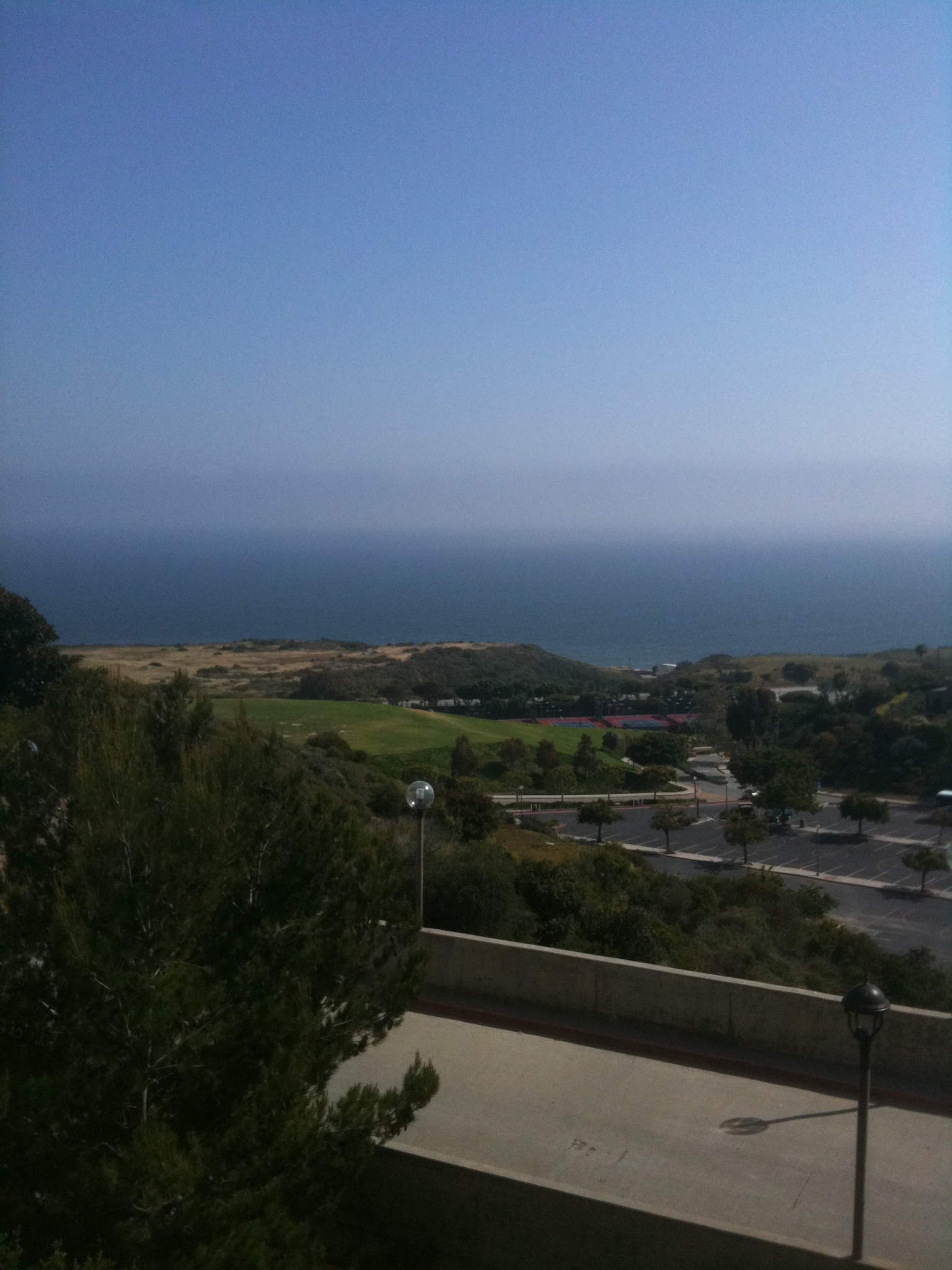 By the way, the very first thing I discovered Friday morning was that somebody was asleep at the switch in terms of finding a location for Pepperdine University. I mean, come on. What were they thinking? Terrible. Just terrible.
Both the demo and the workshop were fun; the lecture was largely the same as what John said at All Saints, but with live musical examples instead of recordings. Among other things, the examples included Ps. 102 and the Beatitudes (as heard on the Lycourgos Angelopoulos Divine Liturgy recording), the Polyeleos, and a setting of the Cherubic hymn, all off of Byzantine notation. The workshop involved teaching the participants music from the Divine Liturgy in English off of Western notation scores.
Matins on Saturday was quite an experience; we set it up with antiphonal choirs, we were all in cassocks, and we did the canons for the day in their entirety. I mostly held isokratima for the left choir, but lampadarios Alex Khalil was nice enough to let me sing a handful of troparia in the canons.
The priest who served was Fr. George Taweel of St. Nicholas, the Antiochian Cathedral in Los Angeles. Finding a priest was a bit of a challenge; John had called virtually every Greek priest in the area with no luck, but Alex knew Fr. Michael Najim, the Cathedral’s dean, and he was able to send Fr. George. Fr. George’s daughter Diana actually went to IU, and I knew her a bit from her time there. It was nice to meet him; we had lunch with him afterward, and he was a terrifically knowledgeable man and very interesting person with whom to have a conversation.
After lunch, it was back to the airport, back to Sacramento, just making it back to Annunciation for Vespers. It was a trip, short and guerilla-style as it was, that was great for which to be a fly on the wall; Alex Khalil in particular was a great person to meet. He’s an ethnomusicologist who just completed his PhD, and his dissertation is something that I think will have applicability for what I’m doing. Short version is that in his research, he applied a historical context to an ethnographic study of Byzantine chant; what I’m thinking about is sort of the reverse, where I’m interested in seeing if I can give an ethnomusicological context to a historical study of liturgy. I hope I get more of a chance to talk to him down the road.
I had hoped that friend-of-this-blog and Pepperdine employee David Dickens and I would have a chance to meet; we set up a lunch on Friday, but we managed to miss each other and he wound up being caught up by work anyway. Alas. Better luck next time.
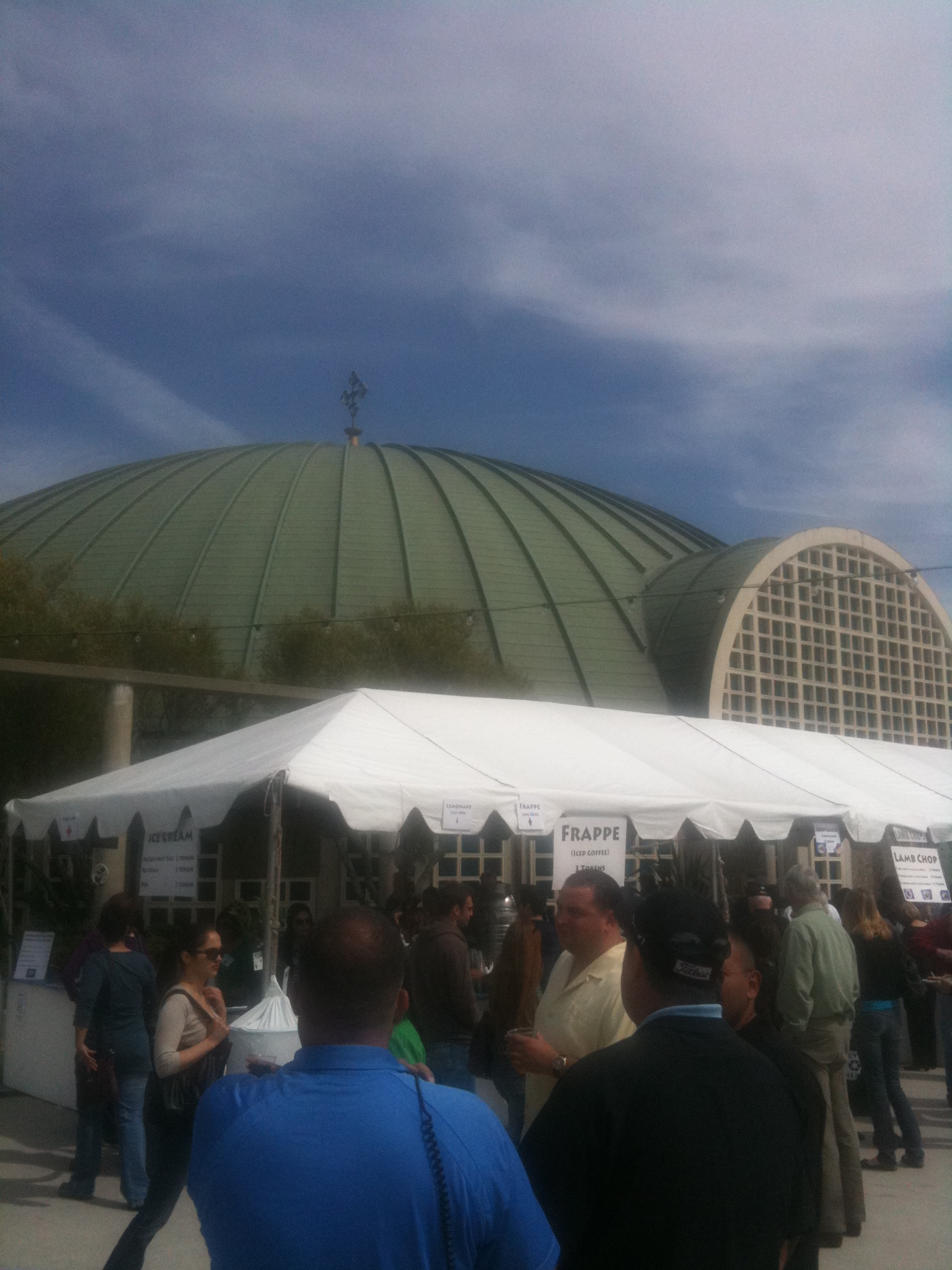
After church on Sunday it was back on the road, heading first to Ascension Cathedral in Oakland for another Byzantine chant demonstration at their Greek festival. It was largely the same repertoire as what we did at Pepperdine, again off of Byzantine notation; I had assumed that I was holding ison again, but John pulled me over and had me follow along with the melody as best as I could. (This was, in general, a more successful effort on the slower pieces.) In the audience was my friend Ian Jones, a cellist who was the very first person I ever met as a student at IU, and for whom Oakland is home. He will hopefully be able to make the Friday concert at the Cathedral; in any event, it was great to see him on his own turf.
After that it was time to head to rehearsal, and as we had rehearsal again in the Bay area Monday night, John and I stayed overnight in Oakland at his friend and fellow Josquin Singer Andrew Chung‘s condo overlooking Lake Merritt rather than drive back to Sacramento.
In theory this was a smart move; we hopefully were going to have much of Monday to hang out in the San Francisco area, with seeing St. John Maximovitch’s cathedral being on the agenda. Unfortunately, John’s car got broken into during the night, leaving him minus a driver’s side window (although nothing got stolen, thank God), and we ended up having to spend the day dealing with that. It took close to two hours just to file a police report; the form took all of two minutes to fill out, but then waiting in line to actually turn the piece of paper in to get a case number took upwards of an hour and a half. It then took another couple of hours to actually get the window replaced, and then — hey, look at that! It’s time to go to rehearsal.
Oh well. It happens.
Anyway, today has been the “day off,” which has consisted of pretty much just enjoying being in one place for the day on my part, and John furiously putting together the program for this weekend’s concerts. I don’t know how the guy does it; he’s got these concerts, his normal church duties, students, the Pepperdine thing last week, and then next week he has Cappella commitments in Oregon. He runs around a heck of a lot more than I ever did as a singer, vocally he’s always giving everything he’s got, and I know that if I were trying to do all of that, I wouldn’t last a week. He’s got to have vocal folds made of steel, that’s all I can say.
Tomorrow is the dress rehearsal, then the concerts are Thursday, Friday, and Saturday; after Liturgy on Sunday it will be off to the airport and I’ll be on my way home. It seems odd that I’m almost to the last stage of the trip, but there we are. More a bit later.
Event of interest: Extraordinary Form Mass at Indiana University
Published 28 April 2010 Academia , General , music Leave a CommentTags: aquinas institute, even more liturgy, fr. bob keller, fr. dominic holtz, fr. michael magiera, holy rosary church indianapolis, liturgical adventures, liturgical music, liturgical scholarship, liturgy, liturgy and life, mass appeal, more liturgy, our liturgy is older than your liturgy, st. louis university, st. paul's catholic center bloomington, traditional latin mass, tridentine mass
I was poking around my alma mater‘s online events calendar this last weekend, looking for something else, when I noticed that there was a lecture scheduled for this evening (Wednesday) titled, “Liturgical History and Musical Performance Practice: Issues to consider for a performance of a Missa Tridentina,” to be given by one Fr. Dominic Holtz, O. P., of the Aquinas Institute of Theology at Saint Louis University. Well, of course I needed to be there, so I made sure it was on my schedule for the day.
The next day, my godson Matthew mentioned to me that he would be singing in a Tridentine Mass Thursday evening that was being celebrated as part of the final project for the graduate Choral Literature course. I mentioned the lecture to him, and he said, yes, Fr. Holtz was the celebrant.
So this got all kinds of interesting really quickly. First of all, the Mass is going to be at St. Paul’s Catholic Center, the Newman Center at Indiana University. St. Paul’s, and Fr. Bob Keller in particular, has been really nice to us Orthodox, having let the OCF folks use the chapel for ostensibly “on-campus” services and so on, plus they hosted the All Saints choir’s concert a couple of years ago, so as far as I’m concerned they’re friends, but they are in no way, shape, or form architecturally or aesthetically intended for a Tridentine Mass. The church was built in 1968 and decidedly reflects what was in the air at the time. Secondly, they’re using a School of Music choir for a course project but taking great pains to celebrate it as a real Mass, and bringing a priest from St. Louis to do so? Fascinating — there have been a couple of EF Masses in Bloomington in the last two or three years, but they’ve been celebrated at St. John’s, and Fr. Michael Magiera of Holy Rosary Church in Indianapolis has been the celebrant.
Anyway — I’ll have more to say when I have more time in which to say it, but what I will say for the moment is that I found Fr. Holtz’s lecture very engaging on, and sensitive to, a number of issues, and he also came across as quite knowledgeable. I am looking forward to the Mass, and I think it would be a good thing for anybody in the area for whom this kind of thing is of interest to go and show their support, particularly given that it is being held at St. Paul’s. It will be at 8pm (with a brief talk at 7:30pm), at St. Paul’s Catholic Center, 1413 E. 17th St., Bloomington, IN. Hope to see you there; I’ll be the guy crossing himself in the wrong direction.
Finally some news about Orthodox Hoosiers
Published 17 April 2010 Academia , College , General , The Orthodox Faith Leave a CommentTags: bloomington, Christ is risen! Indeed He is risen!, Holy Week, Indiana University, john berry, john berry has a posse, orthodox hoosiers, Pascha
Christ is risen! Indeed he is risen!
I have a rather large handful of things to write about here, but we’re at that point in the semester where everything has to be done within the next couple of weeks. I anticipate having my papers done ahead of time much as with last semester, so hopefully I’ll get something up soon. Holy Week, Pascha, recovery from Pascha, and then all of my work for school has just been a prohibiting factor — but I haven’t abandoned the blog by any means. Just having to prioritize.
In the meantime, thanks to the not-insignificant assistance of the overall incarnation of awesomeness John Berry, Orthodox Hoosiers(discussed briefly in these posts) now has the beginnings of an online presence. Please go over and check it out; it’s only a beginning, but any thoughts you’ve got about what should be up there and/or how things should look, please by all means let me know. We’ve got to start somewhere.
Spring break at last: in which the author returns from blogslackdom
Published 12 March 2010 Academia , General Leave a CommentTags: adventures in writing, blogslackdom, pascha at the singing school, publishing, Well-Intentioned Academic Mistakes
The end of January and beginning of February were crazy because I was catching up on work after the extracurricular activities I had going on in the second half of January, and then the first week of February I also had to prepare for a workshop I was helping with at St. Nicholas Church in the Urbana-Champaign area. Megan was flattened with the flu that week as well, but I seemed to be okay.
As I was driving to Champaign Friday night, I started to feel a little tickle in my throat. When I woke up Saturday morning, I could only pray that I would make it through the day. I did, sure enough, but as soon as Vespers was over and it was time for me to head home, it was as though a metric ton of unfinished brick was dropped on my head.
I got home, went to sleep, and woke up long enough Sunday morning to croak voicelessly at Megan, “I don’t think I’m going anywhere today, let along singing anything.” (Actually, it came out more like “CHHHHccckkkkAAAAAAAaaaaHHHHHhaaaaaeeeeeeeeecccccchhhhhiiiiiick”, but she got the point.) I then proceeded to not leave my house until the following Friday.
Let me tell you, losing an entire week when you’re in grad school suh-HUCKS. I was out of commission enough that I really couldn’t do anything productive, so come Saturday, when I actually felt like I had some life in me, I really did have the entirety of the previous week as well as the coming week to prepare in order to catch up.
And, as can happen, I missed something.
As I sat down in my seminar on democracy in Ancient Greece on my first Tuesday back after being sick, the professor said, “…and today we’re going to hear from Richard on whether or not the generalship in Athens was a democratic institution…” and my heart jumped out through my throat. I had managed to miss an entire presentation. Had I written it down? Yes. I just didn’t catch it when I was reviewing what I needed to do post-illness. In four years of taking graduate courses, I had never just not done something; of course, this particular professor didn’t know that. That said, he wasn’t a jerk about it, and it will be made up somehow, but this is somebody who will probably be on my committee and this isn’t exactly the kind of impression I like to make on people. Since it was a faculty member in my home department, I thought it probably would be a good idea to drop my advisor a line, saying, “Just because I’d rather you hear this from me…” This appears to have been a good call; he wrote back saying, glad you told me, don’t let it happen again, produce at your usual level from here, and this should fall under the category of “no harm, no foul.”
Thus, I had to make sure I was on my best behavior, and how, for my next presentation, which was this last Tuesday. That involved reading German, French, and Greek; this was my first shot at actually reading academic German, which is tougher than it looks. However, I managed to misread the syllabus for this particular assignment in a way that worked in my favor; I understood the reading to be a 15 page German article or a 15 page French article, and then one way or the other a 50 page French chapter of a book. Still, as I was wrapping up the German piece, I realized that the “or” was rather ambiguously placed, and I asked the professor for clarification. “Oh, good Lord, I didn’t imagine that somebody would be able to read both German and French,” he told me. “Tell you what — read the shorter French piece along with the German and I’ll be happy.” So that’s what I did.
In addition to that, I’ve also had two book reviews to write for another class, and we also took a long-delayed trip to Arizona last month to see my dad and stepmom for a few days.
Oh yeah, and it’s Lent.
I haven’t had time to exercise in the last six weeks, let alone blog. Yesterday was my last day of classes before Spring Break; I promptly came home and hopped on the treadmill. (And yes, today, I’m sore as hell. Heading back to the treadmill as soon as I wrap up this post.)
I’ll say it again: losing an entire week in grad school sucks. It really has taken me this whole month to catch up, and Spring Break really could not have come soon enough in terms of giving me a much-needed breather.
I need to wrap this up for now so that I can go exercise before Akathist, but one update I’ll give for now: Pascha at the Singing School has hit an interesting phase of development. I had been waiting until John finished all of the illustrations before sending it anywhere, but I looked at the submission guidelines for one of the publishers I’ve always envisioned as being ideal, and found that it wasn’t necessary to have them all done before sending them a proposal. So, I went ahead and fired off a book proposal, and two hours later got an invitation to send them the manuscript and sample illustrations.
Two and a half weeks after sending it to them, I got an answer.
It wasn’t “no,” but neither was it an unqualified “yes.”
Essentially, what they said was positive but that they would want to see certain revisions before they considered it any further. Once I’ve made those revisions, we’ll go from there. And, in all truthfulness, the feedback they had was all legitimate and useful. So, one of my goals over the break is to rework the manuscript based on their suggestions. My assumption is that they wouldn’t have bothered with this level of feedback if they didn’t think it would be worth their time; rejection slips are usually what one sees, not thoughtful suggestions. So, I’m taking this as a positive, and we’ll see what happens there.
More later.
On the difference between καιρός and χρόνος and building a church that makes the difference clear (Part II)
Published 30 January 2010 Academia , General , music , The Orthodox Faith 8 CommentsTags: all saints bloomington, all saints orthodox church, american church architecture, american orthodox architecture, american orthodox music, american orthodoxy, byzantine chant, chant, church architecture, early music institute, ecclesiastical chant, hazards of church music, john michael boyer, liturgical architecture, liturgical music, medieval byzantine chant, militant americanist orthodoxy, modern byzantine architecture, music as iconography, orthodox architecture, orthodox architecture is bloody expensive, random acts of chant, sacred music, this american church life, we need more american saints
Organizing an event is a heck of a lot of work.
I had originally contacted John Boyer in late fall of 2008; I was looking around for Western notation transcriptions of Byzantine chant in Greek, and my friend Mark Powell said he was the guy with whom to inquire, and that I might also be interested in the curriculum he was developing for Byzantine notation. John was more than generous in providing very useful materials, and I figured, while I was corresponding with him and he was seeming friendly, I may as well ask what it would take to get him out to Bloomington for a workshop. This had been an idea I’d been trying to develop for a couple of years, since we were encouraged at PSALM in 2006 to try to put together local and regional events, but I’d never gotten more than a lukewarm response — “Who?” “Isn’t he too far away and too expensive?” etc. I figured it couldn’t hurt to ask him while I had his attention, however, so I did.
He quoted me a much more reasonable number than I was anticipating. I told him, right, let me check on a couple of things; I was able to convince a private donor to pay John’s fee and travel, Fr. Peter had no problem with it (particularly since it wasn’t being paid for by the parish), and I wrote back and said, let’s do it.
Well, then it took a year to make it work with everybody’s schedules. We decided on this last weekend back in August, and what I will say is that given a host of factors (not the least of which was the decision, made a month later, to bring out Andrew Gould the weekend before John’s visit) I would not have wanted any less time to get everything together. Even with five months’ advance planning, a significant chunk of my choir still couldn’t make the weekend work (although, in all fairness, one of them, Megan’s goddaughter Erin, was busy winning the Met auditions, so I guess that’s an acceptable excuse).
In October, the money from West European Studies happened; this really expanded the scope of what I had originally considered from maybe my choir and a couple of other interested parties to something that could be (well, had to be, given WEST’s terms) open to the public and conceived of as an educational outreach event. John and I finalized the schedule and the repertoire on 23 December; the Friday evening session would be the “lecture” of the series, intended to function as the academic side of the weekend, and then Saturday would be the all-day practical part. I set up a Facebook event and sent out press kits to 30 different churches, chairs, institute directors, community choral ensembles, and local news organs the first week of January, and was astounded at the responses that started rolling in. I heard from School of Music faculty; both an Early Music Institute and a Choral Conducting professor registered, and it came back to me that the Choral faculty member was even telling her entire doctoral seminar to come. I heard from a faculty member at University of Louisville presently teaching a seminar on early notation (although she ultimately decided she couldn’t make it); I heard from choir directors and priests in Indianapolis, Evansville, and Louisville; I heard from a Medieval Studies professor at Wabash College; I heard from local people in the community. By the time the registration deadline passed the week before, 45 people were registered; another ten confirmed over the course of the following week, and then still more showed up unannounced.
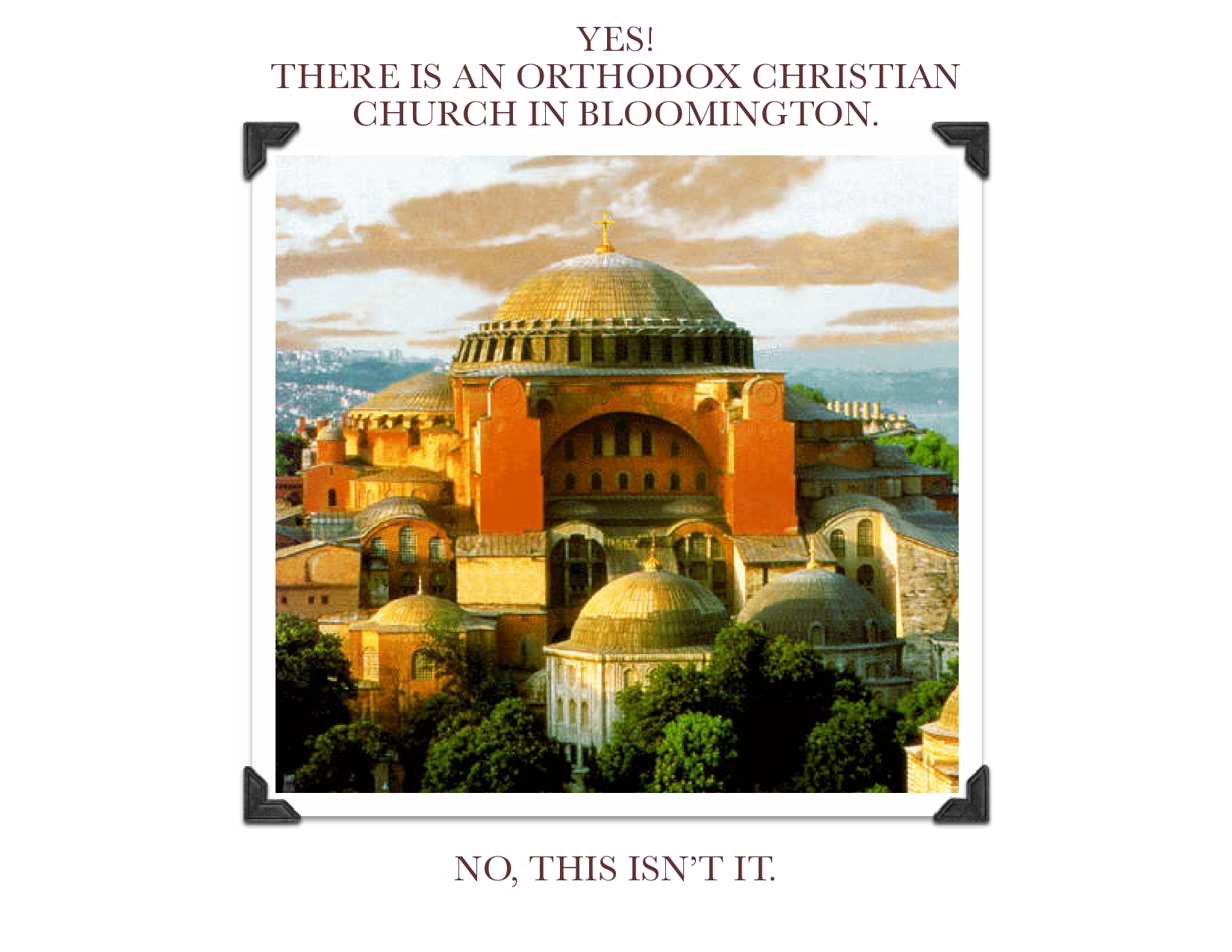
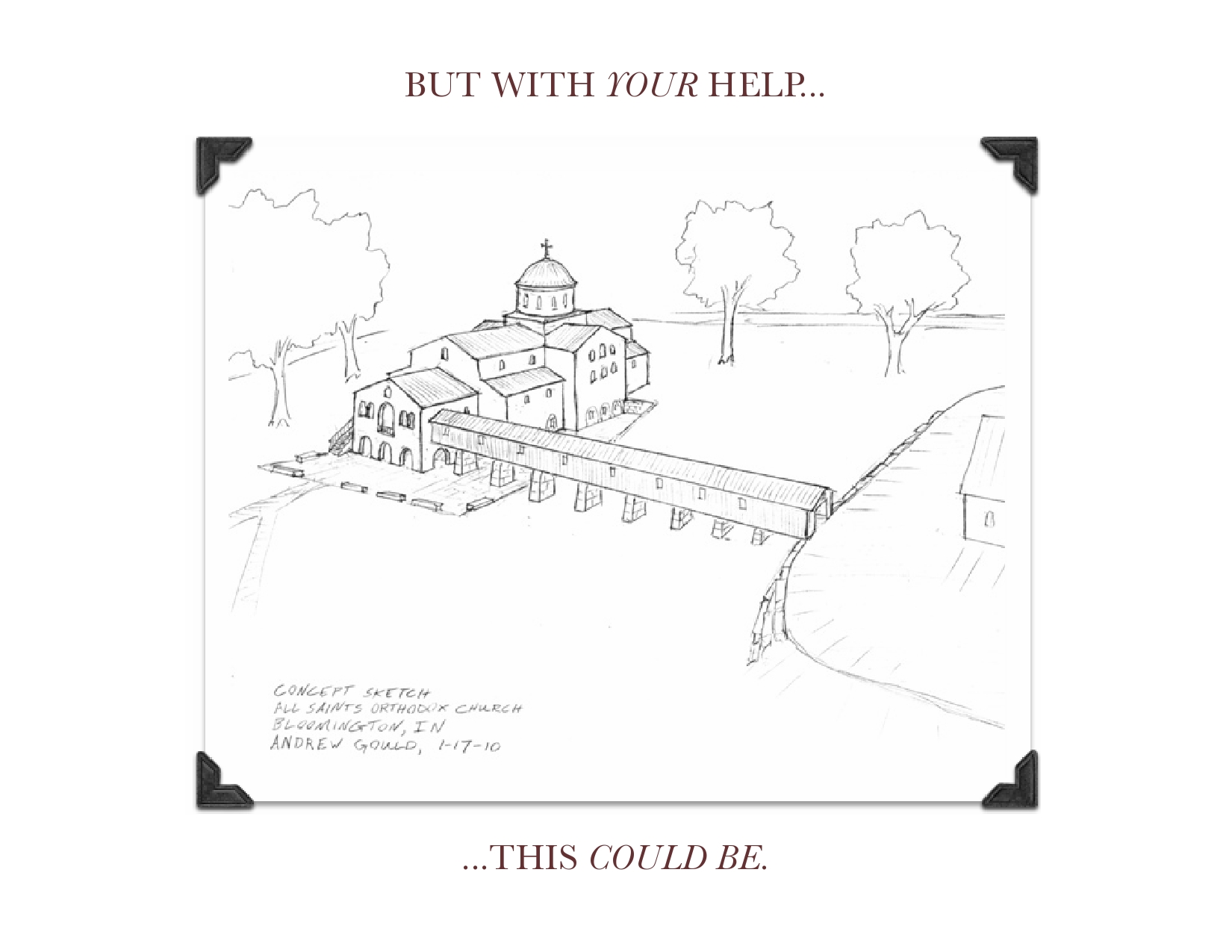 The last week before the workshop, the event planning was approaching a fulltime job; I had to make sure food got ordered and picked up, I had to track down CD shipments so we could have things to sell over the course of the weekend, I had to bug overworked Cappella Romana executive directors for scores (sorry to have been a nag, Mark, truly), I had to get registration materials printed and assembled, and I had to field phone calls from people who wanted to come but lived a couple of hours away and wanted to make sure it would really be worth their time. The last couple of days I wasn’t quite a one-man army; Megan, God bless her, helped with a lot of the last-minute errands and the putting together of the registration binders. I put together a couple of displays of Andrew’s concept sketch (pictured) so that workshop attendees could see it, at least trying to give a nod to the non-singer-friendliness of our space and indicating that we intend to do something about it.
On the other hand, once John actually got here, my job was significantly easier — I pretty much just got to sit back and enjoy the proceedings.
I must say it was worth it; all in all, throughout the course of the weekend, about 65 different people came. Not bad for an event centered around this obscure, gaudy Eastern repertoire that supposedly we Westerners can’t stand without the edges sanded down.
I picked John up at the airport last Thursday evening; his flight arrived at 10:30, and then between his checked luggage taking forever and my very smooth wrong turn leaving the airport, we didn’t get back to Bloomington until about midnight. Luckily, Megan had a wonderful meal and a good bottle of wine waiting for us when we got home (a Saveur recipe that turns lentils and sausages into a bowl of gold), and we three were up talking until around 2 in the morning.
In what would prove to be a pattern for the weekend, four hours later, it was necessary to be up and about. It was, as I told John, the “showpony” day; he was doing a radio interview for Harmonia in the morning (watch this space for details), a mini-lecture for WEST in the afternoon (no thanks to me; I had both the time and the place wrong, forcing us to rearrange our afternoon a bit), a coaching with Lucas, Megan and me on epistle cantillation, and then the first formal session of the workshop in the evening.
One thing that putting on such an event at All Saints did was push us to the absolute limits of what we’re able to do in our current space. John had a PowerPoint slide deck as part of his lecture; well, we’re a pretty low-tech parish on the whole, so I had to go out and hunt down a projector and a screen. WEST loaned us the projector by way of the Russian and East European Studies Institute; my old employers, the Archives of Traditional Music, were good enough to loan us the screen. Even so, it was difficult to figure out how to set up the presentation in our nave to maximize the size of the slides, minimize keystoning, and be within reach of our power outlets (even with extension cords). We managed, but I’d want to figure out how to do better next time.
We had made the decision to install a comprehensive sound system in the nave as the only real cost-effective solution to our acoustic woes for the time being; we gave the thumbs up to the order on 11 January, and the guys at Stansifer Radio turned it around as quickly as the possibly could, knowing that we hoped to be using it by 22 January, and they got it installed by Vespers on Wednesday, 20 January. John had also wanted to be able to plug his laptop into the sound system; I told Greg at Stansifer what I needed to do, and he told me, “Give me an hour to make you a cable.” An hour and twenty dollars later, I had exactly what I needed, and it worked beautifully.
In the end, where we needed to set up John’s presentation was nowhere near the condenser microphone installed for the homilist, so we still had to give him a handheld mic hooked up to Fr. Peter’s old amplifier so he wouldn’t kill his voice. (Why, you might ask, did we not plug the handheld into the nice sound system? Well, the mixer is back in a closet in the sanctuary, roughly 30 feet away from where John was standing. We had a long enough cable, but plugging it into the mixer produced no result. “Oh, right,” Fr. Peter said, stroking his chin. “I forgot — the long cable is dead.” Like I said — we’re kind of a low-tech community. Note to self: replace long cable before next such event.)
Nonetheless, John was a hit, a big one, and something that I heard from more than one person at the end of the session was, “You know, I was only going to come for tonight, but I need to rearrange my day tomorrow so I can come here.”
Following the lecture session, in lieu of a formal reception (which I’ll have to remember to set up for next time), a number of us tried to go to Finch’s for dinner, it being one of the nicer places in Bloomington. Alas, we got there just as the kitchen was closing, and so we relocated to Nick’s. It was a bit louder than we we might have liked otherwise, and they didn’t quite know how to make a Manhattan properly, but perhaps not an inappropriate venue, given that it was founded by a certain Νικόλαος Χρυσόμαλλος (Nick Hrisomalos).
It was a full house at Chez Barrett; besides John, our friend Max Murphy, my counterpart at Ss. Constantine and Elena in Indianapolis, was staying on our other futon for the night so that he wouldn’t have to commute. Once again, we found ourselves up until about two in the morning chatting, and needing to be up by about 6:30 to make sure our houseguests would be sufficiently plied with coffee and eggs, pick up the food for Saturday’s lunch (shout out to Eastland Plaza Jimmy John’s; three 30-piece party platters was a perfect amount of food for a very reasonable price, and they were gracious enough to have somebody there at 8:30am so I could pick it up, since All Saints is waaaaay far out of their delivery area), and get everything at the church set so that the 9am session could start on time.
Well, it didn’t quite. We might say that everybody was inspired enough by the previous evening to recalibrate their clocks to “Greek time,” and we didn’t get started until about 9:30am. Έτσι είναι η ζωή (that’s Greek for c’est la vie, which is itself French for “Life sucks, get a helmet”).
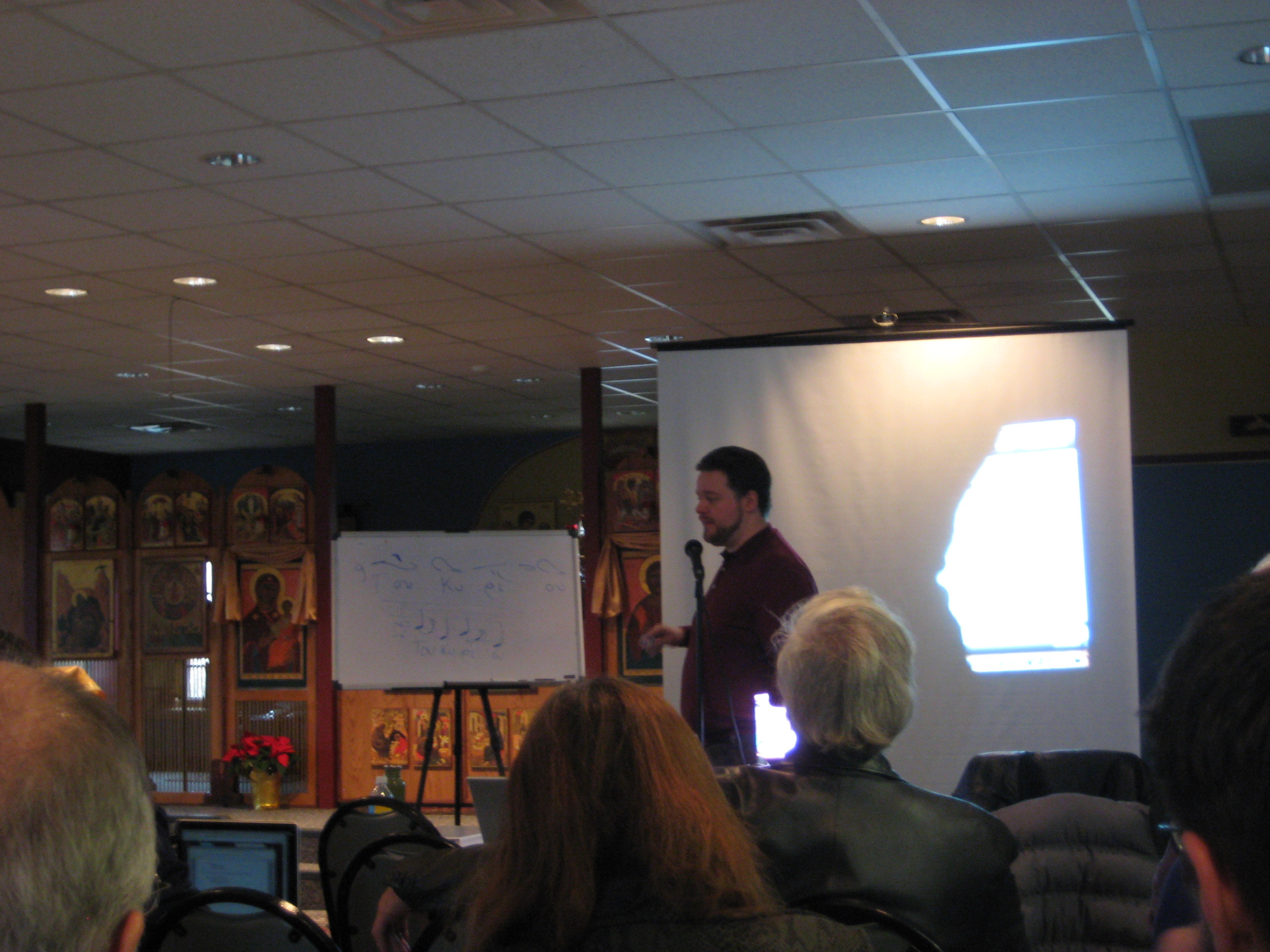 Without giving a blow-by-blow of the whole day, I’ll say that much of the day was dedicated to rehearsing the Divine Liturgy music, but there were a couple of theoretical points made that I’ll note. First, there was the issue of time, which John got at a few different ways. He has a principle, stated many times over the course of the weekend, that “If you think you’re not going fast enough, slow down.” Too often, he says, we just zip through the text like it doesn’t mean anything, which makes it not mean anything. This can be in chanting a hymn, reading the epistle, whatever. We treat hymns and readings like they’re just the next thing to get through so we can be that much closer to getting out the door, rather than adorning them with the beauty that a) they deserve and b) will make us want to be there and take part in the services as though they are gifts from God rather than as burdens to bear. So, again — if you think you’re not going fast enough, slow down.
Another way he stated this was to discuss the difference between χρόνος (chronos) and καιρός (kairos). The former is the world’s time; the latter is the Church’s time. This came up when he was talking about why some hymns are slow and melismatic, and even sometimes will revert to nonsense syllables — in the case of the latter, when this happens, the text has been stated thoroughly in a slow and melismatic fashion, and the hymn is now using “terirem” or some such to provide the opportunity to meditate on the text. Not only that, however; the whole point of the slow, melismatic style has a practical component — to cover a liturgical action, for example — but it also emphasizes the reality that in the liturgy, we are no longer in the world’s time (chronos) but on God’s time (kairos). I was reminded of what Met. Kallistos Ware says about the first time he was in an Orthodox church:
…I had no idea how long I had been inside. It might have been only twenty minutes, it might have been two hours; I could not say. I had been existing on a level at which clock-time was unimportant” (“Strange Yet Familiar: My Journey to the Orthodox Church” in The Inner Kingdom, St. Vladimir’s Seminary Press, 2000, p. 2).
As he acknowledges in the same essay, this itself was a trope (albeit realized after the fact) of what the Kievan emissaries are reported to have said after their visit to Hagia Sophia: “We knew not whether we were in heaven or on earth…”
Another thought came to mind during this discussion — what do we sing in the Cherubic Hymn? “Let us now lay aside all earthly cares.” What do most of us do with the Cherubic Hymn in our parishes? Sing a setting short and fast enough so that we repeat it three times, because we worry that people will get bored otherwise. Isn’t that rather missing the point?
The other theoretical point John made was that there are three textures of singing in our liturgical practice: soloist (priest or deacon or cantor, depending on what’s happening), choir, and congregation. “We need all three,” he said repeatedly. “It’s very much a dance of who sings what when, and if you limit yourself to only one of those textures, you lose something important and beautiful.” As you may recall, the week before, somebody told Andrew Gould that they didn’t come to church for the beauty but for the participation; one wonders how such a perspective would understand what John had to say on this point. My thought is that he’s right, but dances have to be both taught and learned or they become mass confusion.
The services themselves were an adventure, but a good one; at the kliros, the weekend suddenly turned into Byz Chant Boot Camp (or Parents’ Weekend of same, as our friend Laura Willms suggested), and John was the drill sergeant. This Was A Good Thing; he was able to do get away with making certain points in a way I simply can’t, partially because a) he won’t have to see these people next weekend b) we paid him to be here specifically to do that c) he’s Greek. He was not shy about being emphatic in terms of instructing people during services; if you were on the isokratima, for example, and were sleeping on the job and missed his cue for the move, you got an elbow in the ribs. (As John said later, and I absolutely agree with him, “Please tell me a better way to communicate with people who aren’t watching me while I am singing.”) The thing is, coming from him, people ate it up; after the service, a lot of the folks who got the business end of his drill sergeant-ness said only, “Wow — what an amazing teacher.” For me, how this manifested was him pointing to the Byzantine scores he was following and saying, “You’re reading with me, got it?” Up to that point, I hadn’t dared putting enough confidence into what I had learned over the summer to actually use it during services, but much to my own surprise, I managed to keep up. I wasn’t perfect (and when it was just me on my own I fell down and went boom a couple of times), but I kept up.
After Vespers, we were all tired and hungry enough that it seemed best to simply call off the 7-9 session — we had reached enough of a logical stopping point that anything further that evening would be a matter of diminishing returns. It was early enough that Megan, Laura and I were able to take John to Finch’s for dinner after all, and once again we all found ourselves up until 1am or so talking.
Matins and Divine Liturgy the next morning were not without their speed bumps — everybody was just enough out of their element to make sure of that — but everything went quite well regardless. (We even made it successfully through the Cherubic Hymn, which had been a cause of some lack of sleep on my part.) A lot of non-Orthodox workshop attendees came, so we had a very full church. That said, I’m not entirely certain that everybody in the parish knew what was going on or why we were doing what we were doing (despite my plugs for the weekend along the way), and some of the reactions I got from parishioners were worded accordingly (“That was beautiful, Richard, but I will be very happy when we go back to normal” was one example). On the other hand, there was the chorister who told me, “I felt like my musical soul had been fed for the first time in a long time.”
Here’s a comment made by a workshop attendee to which I keep returning — the commenter in question is part of the local UUC congregation and retired English faculty here at IU:
Excellent workshop on Byzantine chant this weekend at All Saints Orthodox church in Bloomington, with John Michael Boyer, cantor and teacher… The whole attitude of the Orthodox faith tradition is very flexible, welcoming, inclusive, and constantly changing–such a welcome change from most of the Western Christian churches… As it happens, I’m not a theist of any variety, but if I were monotheistically inclined, I’d give this church a serious thought. Good people all around… This was my third visit to your church and in every case, I was much welcomed.
Seems to me that’s successful outreach right there.
John’s flight out was scheduled for 4pm on Sunday. However, as we left All Saints around 12:30pm, he looked at me with deeply exhausted eyes and said, “Would you mind horribly if I changed my ticket and stayed an extra day?”
Well, I told him, I didn’t know for certain where he’d stay, but I’d see what I could do.
Megan and Laura made biscuits and gravy, which I think may have cemented John’s friendship with Bloomington (to say nothing of his arteries). He got a nap, and made a wonderful dinner for us that night — a recipe of his own devising, incorporating pasta, kielbasa, kalamata olives, mushrooms, and green peppers.
(Tellin’ ya — how do we rate all of these friends who ask, “Hey, can I cook in your kitchen while I’m here?”)
And, once again, we looked at the clock while talking, found that the hours had slipped away and it was three in the morning.
On the way out of town the next morning, we had lunch with Vicki Pappas, the chair of the National Forum of Greek Orthodox Church Musicians — also a Bloomington resident and founding member of All Saints (alas, in absentia for years, since she commutes to Holy Trinity in Indy). It was a very interesting conversation for which to be a fly on the wall; the musical situation in GOArch has its own intricacies, complications, and vicissitudes, to say the least.
The drive to the airport (no wrong turns this time, thank God) mostly consisted of us discussing how to get John back here, and soon. Watch this space.
Just to make sure I’ve said it: as with Andrew, I wholeheartedly recommend John if you’re looking for somebody to bring out as a speaker or as a guest instructor with respect to Byzantine chant. He’s knows his stuff inside and out, both in terms of chant and in terms of liturgics in general, he’s a great teacher, and of course he’s a wonderful cantor. He is a very effective speaker and teacher for an academic audience, an Orthodox audience, and a general audience — not something everybody can claim.
All in all, the weekend was a huge success in terms of being outreach, being educational, being of musical interest, and, more personally, building friendships. It’s very true that there’s very little in the way of specifics you can cover in a weekend; notation wasn’t discussed beyond some theoretical ideas, and there was only so much he had time to do with respect to the tuning systems, but I think what it did was threefold: it established that there is in fact interest in this material here in Bloomington, for the School of Music, the greater community, and the parish, it proved that you could talk about this subject from an explicitly confessional standpoint and have it be more informative for non-Orthodox participants than it would have been otherwise, and it stimulated interest in doing more. The School of Music faculty who came were very clear about wanting to participate more directly the next time John is here; people from the parishes of surrounding areas said, “Hey, how can we help with the next one?” and it’s also been expressed to me that there is a desire to figure out what portions of what we did last weekend we can keep as our normal practice. That will likely be a complicated conversation with a complicated outcome, but it’s a better response from the people in question than “That was nice, now let’s never do it again”.
What I will say is this: by virtue of the fact that we were open to the public and not charging admission, our own success made it quite a bit more expensive than we had originally planned. If you participated and would like to help, or would like to help regardless, please contact me (rrbarret [AT] indiana.edu). Our original donor has been very generous, but we had hoped to come away from this event with perhaps some seed money for the next one as well. Looking ahead, I am contemplating starting something which we might call “Friends of Music at All Saints” or some such, specifically to exist as some kind of a booster organization for such things; again, I am pretty much a one-man army here, so if you’re interested in participating, please let me know.
So, we had two visitors two weekends in a row. One told us about beautiful churches, another told us about what we do in those beautiful churches. Now what?
I think, if we want a useful synthesis of Andrew’s and John’s respective messages, it boils down to John’s point about kairos and chronos, and how that relates to the church building being an icon of the Kingdom. As Lucas pointed out to me, the word kairos kicks off the whole Divine Liturgy: Καιρός τοῦ ποιῆσαι τῷ Κυρίῳ — it is the time/moment/opportunity of acting for the Lord. Even better, if we want to read τῷ Κυρίῳ as a dative of the possessor, it is the Lord’s time of action. And what is the priest’s first blessing? Blessed is the Kingdom… The Liturgy is the Lord’s action in His own house on His own time. (I will note that this does not go well with the populist misunderstanding of “liturgy” as “the work of the people”, but it goes much better with the more accurate rendering of it as “public service”. It is the Lord’s public service being offered to His people, in other words.)
So, you have to liturgize in a way that emphasizes the fact that it’s God’s time, and you have to have a worship environment that emphasize’s that it’s God’s house. As Lucas also put it, you have to get across the idea that, no, actually, you don’t have anyplace better to be.
Schmemann, of course, talked about the idea that we should liturgize in a way that takes the Liturgy back out into the world. What I wonder is if we have a problem with the valve running the wrong way — that we bring our busy lives, our distractions, that is to say the world into the Liturgy with us and then expect the Liturgy to be run in a way that accommodates us. As I said with the Cherubic Hymn — we say that we are now laying aside all earthly cares, but do we really approach that text in a way that indicates we believe that that’s what we’re doing?
And when you’ve got a building that, no matter how you cut it, looks like an office building with icons and which traps our psalmody rather than lifting it up to heaven, is it any wonder that that’s our approach? Andrew was absolutely right — we’ve got the saints and the angels, but no City.
We’ve got our work cut out for us. On the other hand, here’s the good news — Fr. Peter told me a couple of days ago, “You know, a comment I got from a few people was that things seemed too slow. But you know what? In a lot of places, by having the choir sing it so slowly, I found that it matched better with the liturgical action, and it made a heck of a lot more sense.” We talked about a lot of this stuff, and it seemed to click with him that we need to figure out, and make a concerted effort reinforcing, the difference between kairos and chronos. It’s not going to be easy, but we’re at a point where it’s what we have to do.
The project that All Saints has ahead of it is not a building project or a musical project. Those are components, yes, but what it really is is a spiritual project. We’ve got to be the City on the Hill, the Heavenly City, the New Jerusalem, the Light that is not hid under a bushel. It is desperately needed in this town, in this area, in this world, and we’ve got to convince ourselves that we want to be that, that we want to be an icon of the Kingdom, more than we want to be what we’ve been pretty good at being up until now, which is a little, struggling church in a little, struggling Midwestern town.
If we can do that, then we will have the hard part out of the way. If we can convince ourselves that we believe that and that we can walk in faith, then the temple will just about build itself, $2.5 million or no, and people will stop worrying about whether or not the music is too Byzantine or too slow or not congregational enough or not “American” enough or whatever. (By the way, I found over the course of the weekend that just joining a good English translation with a melody written for the English made things pretty well more “American” on their own. Others may disagree with me, but that was my perception.) If there’s a point that both Andrew and John made, it is that the ethos of the received tradition is not a buffet, not a “meat and three”, not a list of things from which you pick and choose. There are things that we can adapt for local circumstances, but you do that after you’ve received the tradition, and then only in a way that doesn’t obscure what you’ve received. You don’t filter out the parts of the received tradition you don’t like pre-emptively. You may well come to church for participation rather than beauty, but that doesn’t mean that beauty isn’t part of the organic whole.
The church building and the liturgy have to reflect the fact that we worship a God who is bigger than we are. God already “met us where we’re at” in the Incarnation; it is up to us to respond to that in faith.
Now, having said all of that, I’m at the head of the line of people who need to figure out chronos and kairos. With these two weekends out of the way, I have a ton of reading to do on Ancient Greek democracy and a couple of weeks’ worth of working out on which I need to catch up. I’m going to be juggling things for a bit yet before I’m really into the rhythm of the semester. Along similar lines, last Wednesday, John texted me at about 8pm my time: “I’ve turned nocturnal. Just woke up. I’m not sure, but I think it’s Bloomington’s fault. :-)” I guess the gap between chronos and kairos gets us all in the end. Pray for us.
More importantly, however, pray for All Saints. We’ve got a lot of hard work ahead of us. With God’s help and by your prayers, we can do it. If you want to be involved more substantially, I’ve suggested a couple of ways you might be able to do so; contact me if you want more information.
Okay — back to being a student.
On the difference between καιρός and χρόνος and building a church that makes the difference clear (Part I)
Published 29 January 2010 Academia , General , Media , music , The Orthodox Faith 6 CommentsTags: all saints bloomington, all saints orthodox church, american church architecture, american orthodox architecture, andrew gould, christ kamages, church architecture, holy ascension church charleston, IU alumni, χρόνος, καιρός, john michael boyer, modern byzantine architecture, orthodox architecture, orthodox architecture is bloody expensive, orthodox hoosiers, the city on the hill, the difference between χρόνος and καιρός, things for the choir director to think about in a new church building
It’s really hard for me to believe that January of 2010 has just about gotten away from me entirely. Classes started on 11 January, then there were two Somethings Big at All Saints the next two weekends that pretty much ate my life, and now this last week, the third of the semester, has felt like the real first week of classes.
Oh yeah, and Great Lent starts up in two weeks.
My class schedule feels a bit more focused on my interests this semester than it did last semester; this is good, but it also feels like I’ve got more work to do. I’m sitting in on a class looking at the medieval city as well as an ethnomusicology seminar on music and sacred experience, I’m taking a seminar on Ancient Greek democracy (easily the class where I feel most outside of my area), a colloquium titled “Essential Readings in Early Medieval History,” third year Modern Greek, and then I’m supposed to do some Latin reading with one of my professors. I’m also reading St. Athanasius’ Greek life of St. Anthony.
It’s not really any more work than last semester was, to be truthful, but I’m just getting into the rhythm of it this week, so I’m feeling a little more behind than I’d like. I’ll live, and not every eye will weep for me.
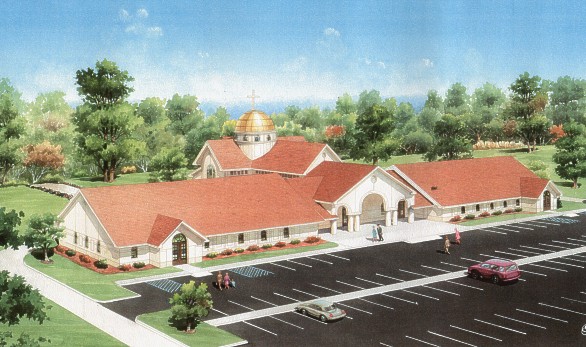 So, Andrew Gould visited All Saints the weekend of 15-17 January. All Saints’ building effort has effectively been dead in the water for ten years; the “temporary” building in which we presently worship is a shoebox (the left wing of the pictured concept painting), and it was deemed reasonable to build an ultra-utilitarian, multipurpose space first based on the logic that “people come for church but stay for the other things a church does” — plus, at the time (2001) they figured they’d be in there for less than five years. Well, when I arrived in 2003, Fr. Athanasius pointed at that painting and said, “That’s ten years away.” In 2005, it was still ten years away, and the parish council started toying with the idea of hiring a different designer, since it just seemed like there was no motivation on anybody’s part to build the original idea. We talked to Christ Kamages in 2006, but Fr. Athanasius announced his retirement shortly thereafter, and a number of people felt it would be unwise to jump into a capital campaign and building project under such circumstances. Ironically, Fr. Athanasius explicitly warned us against delaying, telling us at his last parish council meeting, “We walk by faith and not by sight, and I want you to go ahead with this,” but any conviction he intended to leave us with vanished as soon we had to start paying a fulltime priest with a family for whom this was how they put food on their table, as opposed to a retiree who didn’t need the money.
In 2007, Fr. Peter tried to figure out what we might be able to do to expand our facilities in small steps, and in returning to the original concept, he tried to push the idea of building the narthex and southernmost wing of the complex. The extension could be built to be an intentional worship space with provision for acoustics and so on, and would allow us more room to grow — we’d be facing south rather than east, but we would make do. The estimate came in at a half million dollars, which seemed to constitute a reasonable step in the right direction.
We raised, I think, all of $35,000. Maybe. “Pretty good for a church full of working people,” our treasurer told us, but it was clear that nobody in the community felt inspired to try to make sure it happened. Certain people who had originally said, “Let us know when you’re ready for us to write checks,” now were making excuses as to why they couldn’t — excuses like “Well, Dad’s old Episcopal church is building a new wing and we had to give to that…” I wish I were kidding. Worse, at least two large parishes outside of Bloomington were running capital campaigns and got to some of these people before we were ready. We were back to square one.
The situation didn’t improve any; we got to a point where the choir had to be relocated so that we took up half of the space we used to have, and eventually we were trying to figure out how we could configure the building so that the partition wall separating the virtual nave from the virtual fellowship hall could just be left open. We were (and are, make no mistake) in that horrible catch-22 where you need to build in order to grow, but you have to grow in order to build (and it is not an economic option to relieve the pressure by planting a mission). You will either figure out a way to build, or the problem will be self-correcting because you will die.
Enter Andrew.
Andrew’s work on Holy Ascension first came to my attention around Pascha of 2008, and I talked about him a bit here. I contacted him last spring in order to find out what it would take to get him out here when we started talking about how to get rid of the partition wall, and a number of us then made a concerted effort to convince the parish council that we should bring him to Bloomington to see what he would have to say. Long story short (too late!), we finally went ahead and booked Andrew in September, and the weekend of 15-17 January was the first time we could get the church’s calendar to sync with his.
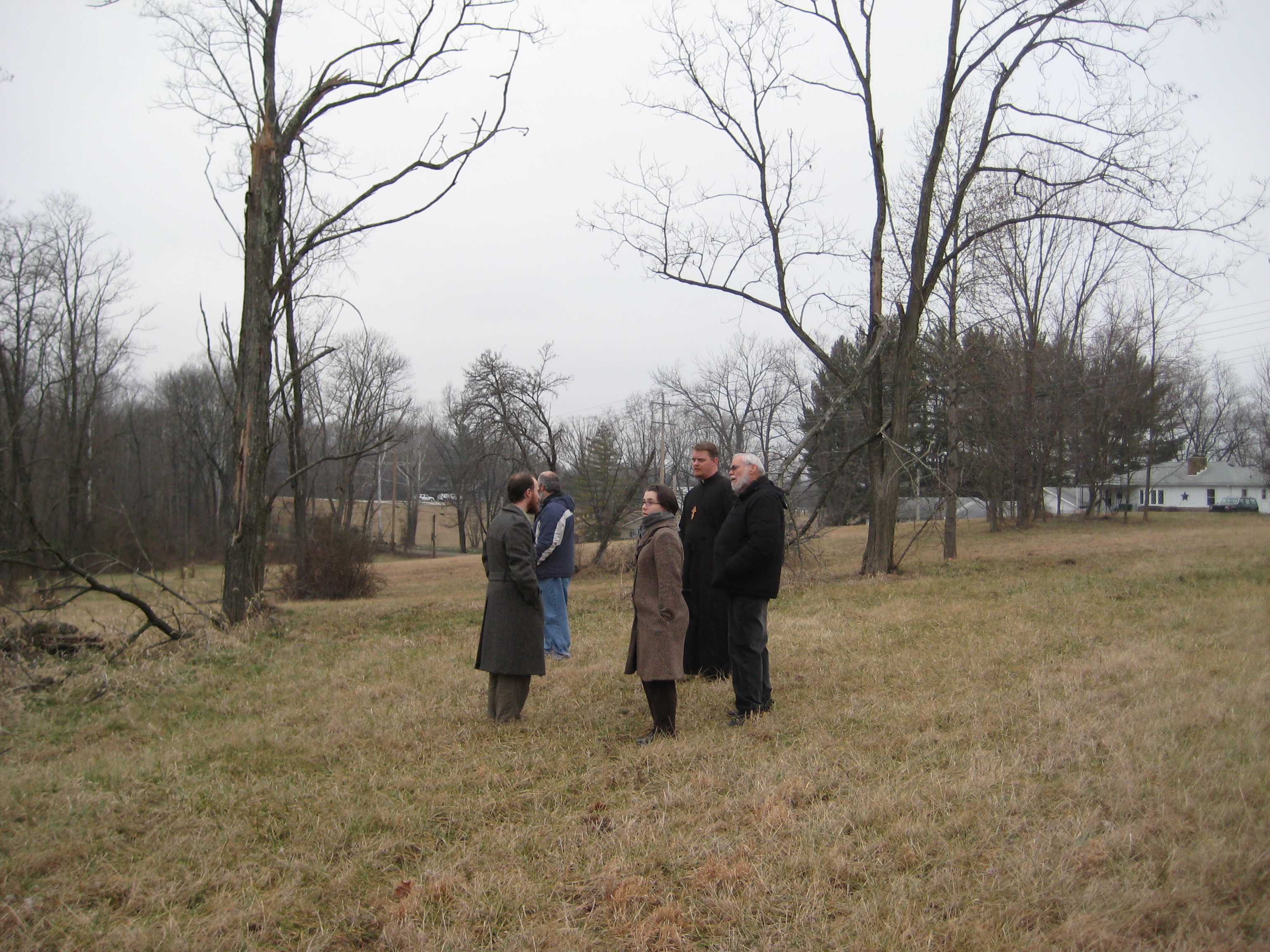 When Andrew arrived a couple of Fridays ago, the first thing we did when we got him to the church was walk him around the property. He got to see a very representative sample of our 24 acres, and when we finally finished the tour, he asked a question which changed the game as we had known it up to this point.
“Why don’t we build on the hill by the corner?”
Keep in mind this is a question that has been asked before. The hill in question is the highest and most visible spot on our property from the road, and it’s a no-brainer to wonder why that wasn’t the plan from the get-go.
The answer has always been, and thus was dutifully trotted out on this occasion, “Because that’s where the septic field is.” This has effectively always ended that line of inquiry.
Except that Andrew didn’t go down without a fight. “Show me,” he said. “Where is your septic field exactly?”
We showed him. We showed him exactly where it was marked off as being. And his answer was, “This is a non-issue. We can build right up to this point, and this is exactly where and how the church you want can fit here.” He paced it out for us. “You’ve already got a boxy utilitarian building over there,” he told us. “On the 24 beautiful acres you have, why do you want to surround your temple with cars and asphalt when you can put it someplace where people can really use it to transition into a different world and engage your land?”
We spent the next couple of days talking about it. Miraculously, we didn’t spent two days arguing about it. The conversation wasn’t, “Well, why don’t we see what might be less expensive?” Rather, the conversation was, “How do we make this happen?”
Andrew talked about a lot of things. He talked, for example, about how you have to build for the liturgy. I had asked John Boyer if there was anything I should be prepared to talk about from the choir’s perspective in the design process; acoustics, of course, were the concern at the top of John’s list. Besides that, however, he also a big narthex, an apse that functioned as a resonating chamber, and the choirs placed in transepts. Andrew, as it happened, brought up virtually all of those things unprompted as practical “must-haves” that aren’t negotiable. (And the one thing he didn’t present as such, transepts, once I told him what we’re trying to do, he said, “Yes, of course, you’ll want transepts.”) Acoustics, in fact, were the very first thing that he mentioned to me as one of the design features he won’t not do.
Andrew talked about money. To build what he would design for the number of people we’re talking about (200 on Sundays, 300 on feast days), we’re looking at ~$2 million. His fees will be 6-8% of that, including construction documents. Plus, we have ~$220,000 on our existing mortgage that we have to retire. So, at the end of the day, $2.5 million is what we’re looking at, soup to nuts. (This prompted the question — what was the estimate on the original concept? $2 million for the temple and the south wing, was the answer, and that was in 1999 dollars. So, we’re not out of our original range by any stretch of the imagination.)
One of the ideas that came up while talking about money was trying to establish an alumni network for Orthodox Christians who have come through Indiana University. Surely there have to be hundreds out there who were in Bloomington when there was no church at all — hence Orthodox Hoosiers; I am slowly but surely getting this running, but I’m a one-man army on this front. If you’d like to help in any way, administratively or financially, please get in touch with me (rrbarret [AT] indiana.edu); there is no support from All Saints behind this effort except for the moral kind, and if perhaps there were 20-30 interested parties willing to pool ~$1,000 of startup costs for charter membership benefits to be determined later, that’d be immensely helpful.
Most importantly, however, Andrew told us why we need to build a beautiful church. This alone was a game-changer, and how. To have somebody who knew what he was talking about, and who is clearly a faithful Orthodox Christian, tell us with humility yet authority that in our current building we appear to be God’s people in exile — well, the terms of the conversation are permanently different now, because everybody who heard Andrew’s answer understands that the point is not to build four walls and a roof, but rather to write an icon of the heavenly city. A gentleman who had just been through a $1.7 million building campaign at his own parish to build something, well, not quite as nice, shook his head and said, “If only we’d heard that before.”
Andrew was kind enough to leave us with a concept sketch:
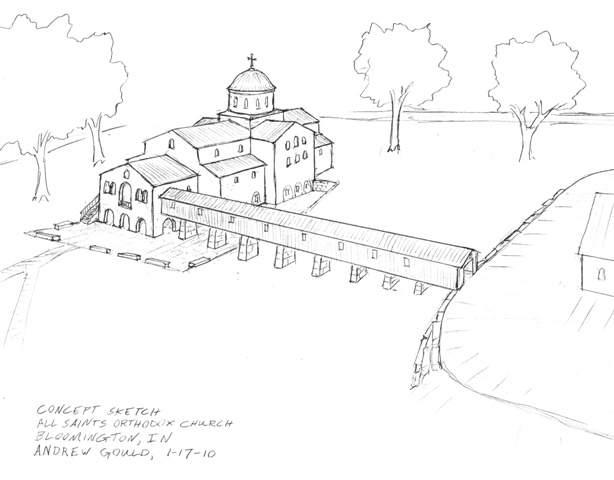
What you see is the view of the building from the southwest, somewhat in the air. The corner of building on the right is our existing building, surrounded by the parking lot. The church has a basement level which would function as the parish hall once finished; the temple itself would be level with the existing parking lot, and the covered bridge (a clever nod to famous Indiana landmarks) would extend from the parking lot to the narthex, over the valley that runs between the parking lot and the hill (plus you can also see the stairs leading up to the entryway on the north side of the narthex,). There would, of course, be whatever handicapped parking spaces are necessary, plus an elevator from the basement level to the narthex, but Andrew’s idea is that for the 99% of the parish that is able-bodied, the 200 feet from the parking lot to the church, however you choose to walk it, will function as a transition from the busy world into the Kingdom. “The temple will be 100 feet long to begin with,” he said, “so you’re walking 200 feet to and from Communion anyway. We walk that in the Target parking lot without even thinking about it. The church building shouldn’t be the place where we emphasize suburban ideas of convenience.”
Andrew’s other idea was to use a slab of limestone from our property (it used to be a working quarry) as our permanent altar. As I’ve told a couple of people, then we could tell C. S. Lewis fans that we have the real Stone Table.
Will we build it? It sure seems possible. Nothing has been decided formally (and I should emphasize that, lest I come across like I’m speaking out of school), and it will still be another week or so before the parish council can meet about how to move forward, but Andrew definitely got a lot of people excited. I think we should challenge ourselves to break ground within two years. I think we can build the city on the hill if we make it a priority to do so as a community.
The thing is, Fr. Peter is reasonably certain that we’re not going to be able to get a mortgage for more than half a million dollars. This means we’re going to have to come up with $2 million in cash, somehow. In the short term, we’re going to have to raise around $250k — ~$220,000 to retire the existing mortage, and somewhere around $21,000 to engage Andrew to formally get the design to the level of detail where he can produce the pretty watercolors that get people to write checks. That’s nothing when you’re talking about building a permanent church, but when you’re telling that to a lot of working-class Hoosiers, you realize just how much of an asset the imperial treasury actually was back in the day.
(Did I mention that I’m working on an Orthodox IU Alumni Network?)
By the way, I would absolutely, unhesitatingly, and without qualification recommend Andrew Gould to any church going through this process. He has a terrific eye, a wonderful sense of how architecture interacts with the landscape, and a frightening amount of knowledge when it comes to talking about the tradition of Orthodox Christian church buildings. Andrew is also very affable and easygoing, there isn’t a hint of arrogance about him, and he’s a great guy with whom to have a beer as well. All of us had a great time getting to know him, and we really hope to see him again soon.
What Andrew is not, just so we’re clear, is cheap and obedient — and I rank these negatives in the “plus” column, no question about it. Now, he doesn’t cost an arm and a leg, but neither does he say, “You’re a church, so I’ll charge you next to nothing.” He’s very up front about saying that he charges market price for what he does, and that this is his living, not how he fulfills charitable obligations. It cost $2,000 plus his travel to bring him out for the weekend to do this kind of consultation; as noted, the next stage will be $18-21k. The construction documents will be another chunk of change. This is not unreasonable; it’s just that that’s actually what these things cost. Our old design was done for “the discount” — and, well, as my father likes to say, the most cost effective way of doing anything is to do it right the first time, and sometimes free is too expensive. So, as far as I’m concerned, This is a Good Thing.
(By the way, because I’m clumsy, I accidentally spilled coffee all over the original watercolor of the old design during the course of this weekend, utterly ruining it. I swear to God it was absolutely an accident, but I was asked by somebody later, “Was that a Freudian spill?”)
As far as “obedience” goes — what I mean by that is, Andrew is not going to design whatever you want no matter what. He wants to design things that look like they belong where they are, but what he puts his name on has to be rooted somehow in Orthodox architectural tradition; if that isn’t what you want, call somebody else. Somebody challenged him on some points related to that over the course of the weekend; “I don’t come to church for the beauty, I come for the participation,” this person told him, more or less telling him that they felt like certain structural insistences on his part seemed unnecessary and foreign (at best) to what they were used to in churches. Andrew didn’t back down, and simply continued to explain with patience, humility, and his encyclopedic knowledge. This person was eventually won over — but the point is, don’t expect him to chuck centuries of tradition because you don’t like it. His churches are bigger than you, and bigger than him. Again, as I see it, This is a Good Thing.
This is already over 2,700 words, so I think I’m going to split this post in two. Thus endeth part the first; part the second, in which All Saints goes to Parents’ Weekend of Byz Chant Boot Camp, will be coming soon.
My opening remarks for John Michael Boyer in Bloomington: “…it is my fondest hope that this is not just the completion of one thing, but perhaps the beginning of a number of other things”
Published 29 January 2010 Academia , General , Media , music , The Orthodox Faith Leave a CommentTags: all saints bloomington, all saints orthodox church, American Society of Byzantine Music & Hymnology, annunciation church sacramento, archives of traditional music, axion estin foundation, byzantine chant, cantores in ecclesia, cappella romana, carmen-hellen tellez, daniel reed, early music institute, franklin hess, harmonia, IU dept of folklore and ethnomusicology, iu medieval studies institute, iu west european studies, john michael boyer, john tavener, koukouzelis institute, lamentations and praises, liturgica.com, liturgical music, luann johnson, mark powell, orthodox outreach, robin freeman, sacred music, stansifer radio, the byzantine chant narrative of continuity, the divine liturgy in english
I’m still writing the applicable blog post, but this seemed long enough to justify breaking out separately. More to come.
Good evening, everybody. I am very keenly aware that none of you came to hear me speak, so I will do my absolute best to keep my opening remarks as short as possible.
A few informal orders of business before I launch into my introduction – first of all, let me welcome you to All Saints Orthodox Church. Just to get it out of the way, let me emphasize that we are in a church, and we ask that you be respectful of the space. If you are unsure about what that means, by all means please ask me or Fr. Peter.
[…]
A word about the card and the envelope [in your packets]: this weekend represents, in virtually every respect, an experiment for All Saints. We have never done anything like this before, and there has been a lot of figuring things out as we go. We would really like to be able to do it or something like it again, maybe even on a somewhat regular basis if it works out. So, with respect to the card, we’d like to hear from you all what you thought. Whatever you have to say – this worked, that didn’t, maybe this could be covered next time, you need a jacket with elbow pads – we’re all ears so that we can do better next time.
Now, as for the envelope – as I said, this has been an experiment, and it’s the kind of thing of which we’d love to be able to do more. We’ve been very fortunate to be able to put this together with some very generous help from the Indiana University Center for West European Studies and a private donor. That said, there are always costs one wasn’t anticipating, but more importantly, it would be terrific to have some seed money for the next event like this. All of that is to say, the envelope is there not because this weekend isn’t paid for; it is there because the next one isn’t… yet. If you decide you want to do something in that regard, please make checks out to All Saints Orthodox Church, and put in the notes “chant workshop” or something like that. The point is, if you come away from this weekend having felt it was of value to you, both the card and the envelope represent a couple of formal ways you can express that. By all means talk to me if you have any questions; you can leave cards and envelopes on your chair or give them to me, or to Fr. Peter.
There is also a retail means by which you may support these kinds of events at All Saints. There is a table in the parish hall where you can buy recordings of the kind of music we’re here talking about tonight; a lot of these can be reasonably difficult to get in the States, and we encourage browsing – and buying! – at the breaks. All of these are recordings John told me to have around for this weekend, so perhaps he’ll be able to say more about them.
All right, enough of the administrative chatter.
Ladies and gentlemen, thank you all very much for coming tonight. The road to this weekend has been a long one; if I wanted to, I could trace it back to approximately 1996 or 1997 when I first met and became friendly with Mark Powell, the executive director of Cappella Romana and then a colleague of mine in its sister ensemble, the Tudor Choir. It is the network of relationships that seems to hover around Mark that in the end brought this weekend about, after all. That, however, would be far too long of a story for our purposes, so I will fast forward to the fall of 2006. Having traveled reasonably significant distances three summers in a row to various workshops and conferences for Orthodox Christian liturgical music, and subsequently lamenting the impossibility of being able to bring my entire choir to such an event, I began to consider how an effort might be launched to bring the event to my choir. Initial ideas were floated about trying to stage something in Indianapolis, but these conversations didn’t go anywhere, and to be truthful, it ultimately seemed worthwhile, particularly if I wanted to maximize the participation of the All Saints choristers, to try to put something together right here. If I played my cards right, it might even get some people in Indianapolis to come down to Bloomington – imagine that!
A number of objectives intersected in the planning for this weekend. First of all, it was very important for the All Saints choir to have the opportunity to work with an expert with a strong link to the received tradition, to experience an intensive kind of master class situation with the kind of person we hadn’t had the opportunity to work with before, somebody who could give us water from the well rather than artificially synthesized hydrogen and oxygen. As mentioned, it would also be nice to have an event that would make All Saints in Bloomington the destination for interested parties.
An additional goal was to find a way of reaching out to and engaging the local community through music. In the last few years we have looked for opportunities to do this; we have hosted a youth music festival on the grounds here two summers in a row, and a couple of years ago we contributed a concert of Holy Week music to a Middle Eastern arts festival put on by IU’s Program for Middle Eastern and Islamic Studies. A person who would be of interest to the Orthodox Christians who worship here, of musical interest to the local community, and of academic interest to the university community, would represent a huge step forward in that effort.
The first goal has this entire weekend to be accomplished. With respect to the second goal, however, as I look around the room, as well as glance at my list of registrants, I see my choir, I see All Saints parishioners, I see people from Bloomington, I see faculty and students from IU’s Early Music Institute, the Department of Choral Conducting, the Department of Folklore and Ethnomusicology, and the Center for West European Studies. I see people who have come from Indianapolis, Greenwood, Evansville, and Louisville. I see faculty from, besides IU, Wabash College and Butler University. It is a very real blessing to have you all here, I can truly say that the interest in John’s visit has exceeded my wildest expectations, and it is my fondest hope that this is not just the completion of one thing, but perhaps the beginning of a number of other things.
I will tell you that the planning of John’s visit originally moved ahead with private money. In the course of events, however, Dr. Lois Wise, the Director of the Indiana University Center for West European Studies approached me out of the blue one day and said, “Richard, are there any music events coming up at All Saints that we can help support?” Through WEST’s support and partnership, much more has been possible than would have been otherwise, and I am truly grateful for their sponsorship. WEST is represented this evening by Dr. Franklin Hess, the instructor of Modern Greek at IU – also my own Greek teacher, and a good friend. Frank, please accept on behalf of WEST this token of our appreciation.
There are a number of other people to thank as well for helping to make tonight possible, either through promotion, logistics, or other support; the Archives of Traditional Music, the Medieval Studies Institute, the Department of Folklore and Ethnomusicology, Robin Freeman, Dr. Carmen-Hellena Tellez, Dr. Daniel Reed, WFIU, the program Harmonia and their staff, especially LuAnn Johnson, the Bloomington Herald-Times, the Indiana Daily Student, Stansifer Radio for installing this wonderful sound system on Wednesday, Liturgica.com, all of my choir for their support, and of course Fr. Peter and the people and parish council of All Saints for taking me seriously when I said, “This may sound crazy, but what if we could make something like this work?” Above all, a special thank you to my wife Megan for all of her last-minute help with errands, assembly of materials, and being just all around some of whom I am undeserving.
Finally, this brings me to our honored guest himself. John Michael Boyer, it has been said, sang before he spoke. At the age of 7 John was singing as the then-youngest member ever of the Portland Opera Association. Over the years he has gone from singing for a papal audience as a boy as part of the liturgical choir Cantores in Ecclesia, to being the Protopsaltis, or first cantor, of the Greek Orthodox Metropolis of San Francisco and one of the principal singers of the professional vocal ensemble Cappella Romana. He is also the Protopsaltis and director of liturgy at the Greek Orthodox Church of the Annunciation in Sacramento. He has studied for a number of years with Greek master cantors Lycourgos Angelopoulos and Ioannis Arvanitis. In addition, he coached the vocal ensemble Chanticleer in their Grammy-winning recording of John Tavener’s Byzantine-influenced Lamentations and Praises. He is very active as a composer and adapter of traditional Byzantine liturgical music in the English language, and many of his efforts in this area culminated in Cappella Romana’s recent release, The Divine Liturgy in English – which, I am told, has just gone into a second pressing. He is one of the main movers and shakers in the United States in the movement to reincorporate traditional music in American Orthodox churches, and to this end he lectures and conducts workshops in Eastern Orthodox liturgical music at churches across the country. John has spoken at the conferences of the American Society for Byzantine Music and Hymnology as well as the Axion Estin Foundation, and he is also the director of the Koukouzelis Institute for Liturgical Arts, an outgrowth of the educational aims of his role as Protopsaltis of San Francisco.
It truly is a pleasure and a blessing to have him here – please join me in welcoming John Michael Boyer.
Orthodox Hoosiers
Published 16 January 2010 Academia , College , General , Media , The Orthodox Faith 1 CommentTags: all saints bloomington, bloomington, Indiana University, IU alumni, IU students, Orthodox Christian IU students, orthodox hoosiers, Orthodoxy at IU past present and future
A brief note of interest — if you are an Orthodox Christian and an IU alumnus, current student, or are otherwise an interested party, AND you are on Facebook, please take a second to join the Orthodox Hoosiers Facebook group. This is an effort that just started today (like, twenty minutes ago), so this just the beginning, and there’s much, much more coming, but let’s start here.
Update, 19 January 2010, 9:45pm: www.orthodoxhoosiers.org has been registered; there’s nothing there yet, but the site exists. The long-term goal here is to create a formal Orthodox IU Alumni Network; watch this space for details.


 Leitourgeia kai Qurbana: Contra den Zeitgeist