Read this and read the comments.
I think the exchange speaks for itself. To echo Fr. Andrew’s comment: Sheesh.
The adventures of a developing academic who got a late start
Read this and read the comments.
I think the exchange speaks for itself. To echo Fr. Andrew’s comment: Sheesh.
 That centermost white dot is Tom Hanks.
I’ll get back to that.
Obviously, much has happened in the three weeks or so since I was last able to post a chronicle of my time here. It’s also enough time that certain chapters are closing, or have in fact already closed; I have less than two weeks left here in Greece, my second class at the Athens Centre comes to an end tomorrow, Flesh of My Flesh arrives Monday afternoon, at which point my residence will shift for a few days, my IU colleagues have headed back to the States, and Ioannis Arvanitis has gone on vacation until the end of next week, meaning that last Friday’s Byzantine chant lesson was probably my last.
When last I was able to post, my first 3-week class at the Athens Centre was over and the new one had not yet started. This has been a good class, and it has certainly been more of an immersive language learning environment than the first managed to be. There are only two others in the class — Jim, a schoolteacher from Vancouver, B. C. who married a Greek woman and who is hoping to raise bilingual kids (if not just move here altogether), and Jan, the ambassador to Greece from Slovakia. We’ve jelled well. The good thing is that we all have our strengths and weaknesses, but they tend to complement each other. Jan is an experienced language learner, but speaks Greek with a thick Slovak accent. Jim has never learned a foreign language before, and as a result grammatical concepts take him some time, but he absorbs vocabulary very quickly, and his listening comprehension is vastly aided by having had Greek in-laws for the last decade. For me, grammar and reading comprehension are things which come quickly, but vocabulary takes me a bit longer than I’d like, and while my listening comprehension is vastly improved from where it was, I’m still sometimes painfully aware of how slow my ear is. With our forces combined, we’ve nonetheless been able to speak predominantly Greek in the class — let’s say between 80-90% on average, but often getting closer to 95%.
 A couple of weeks ago, I went with Frank (my Greek teacher at IU), his wife, and my fellow student Stefanos to see Phaedra with Helen Mirren at the ancient theatre of Epidauros. It was a really wonderful day all around; we first went swimming at a beach in Loutraki, a seaside town on the Peleponnesian peninsula — and let me say, swimming in the Gulf of Corinth ain’t bad. I think that’s the first time in probably eight years I’ve been in a body of water of any size, or salt water for that. Following the swim, we drove to the port town, and former Greek capital, of Nafplion. We ate a late lunch at a taverna called Vasillis (hey! That’s “Richard” translated into Greek! Perfect!), walked around the square, and also drove up to Palamidi, the Byzantine/Venetian/Ottoman mountaintop fortress which overlooks the city (“Real cities have medieval castles”).
By that point, it was time to head up to the theatre. After being seated (by the way, bring something soft to sit on — the stone risers are pretty much exactly as they were carved 2500 years ago), I heard an American couple talking behind me — “Seen Tom Hanks yet?” I wasn’t sure if they were joking, but I kept an eye on the entrances, just in case.
Sure enough, he and his wife showed up and were seated in the center of the front row. That picture at the top of this post was the best I could do, with distance, light, and camera all combined.
 The play was good; it was a bit weird, seeing a French Baroque playwright’s adaptation of Euripides, translated into English by a modern author, with Modern Greek supertitles, but there we are. It was very nearly a bare stage, with only a few chairs, some sort of small circular platform in the center, and a shell around the back of the stage with ramps leading off and on. Dress was modern, with Hippolytus pacing around the stage in a wifebeater in the first scene. Stanley Townsend was a larger-than-life, aged Theseus; for all of you IU kids reading along at home, think Tim Noble. Helen Mirren, naturally, owned the stage every second she was on it, and was downright creepy for much of the evening. I tend to think that her death scene didn’t have a ton of impact, but that seemed to be a bit of awkward staging more than anything.
I will also note that the acoustics at Epidauros are everything people claim them to be; it takes the ear a second to adjust, but once it does, you hear every word without any difficulty whatsoever.
 The very next day, Giorgos took me for a drive along the coastline to Sounio — in myth, the place where Aegeus threw himself into the sea, and where there is a temple to Poseidon which is said to form an equilateral triangle with the Parthenon and the Temple of Aphaia on the island of Aegina. The point where Aegeus is said to jumped is very rocky and uneven with a lot of loose stones; to be honest, if there was an Aegeus, I find it more likely that he just tripped and
 fell, black sails or no black sails. I was wearing Birkenstocks instead of my Merrells — bad idea.
On Sunday, at Divine Liturgy at St. Irene, I saw somebody else in the Communion line who looked remarkably like St. Vladimir Seminary faculty member Dr. Peter Bouteneff. As it turns out, it was, in fact, Dr. Bouteneff, explaining why it looked so much like him.

 The following Monday, I went to an event called the Athens Grand Prix Tsiklitiria, a big international track and field competition. It was a chance to see the 2004 Olympic Stadium in action; I got to see the men’s steeplechase, some of the men’s javelin, men’s high jump, and some of the women’s sprinting events. One very interesting thing is the pit of razor wir
 e between the seats and the field; they are evidently are various serious about not wanting fans to rush the pitch — not surprising, since it’s also used for soccer.
Throughout the week, I did some gift shopping; I discovered that there are a couple of city blocks right off of Annunciation Cathedral where there is nothing but ecclesiastical supply shops. I spent some time browsing through these establishments; as with Apostoliki Diakonia, the answer to just about any question beginning with “Do you have…” is “Yes, what kind are you looking for?” It’s quite something to see such places with your own eyes when you’re accustomed to there being only one or two places in the United States which carry these things at all, and then they usually have to import them. I will be going back for a few gifts; there is a bookstore (which I decline to name) which will not be among the places to which I return, however. Wh en I walked in to browse, somebody was immediately following me, asked if they could help me, and when I said I was just looking, they didn’t leave me alone. It was clear they didn’t want me in there (and I’m not altogether certain why), so I won’t burden them again.
By the way: a useful phrase in Greek is, “Μήπως μπορείτε να μου κάνετε μία καλύτερα τιμή;” (Mipos boreite na mou kanete mia kalitera timi?), which means, “Maybe you can give me a better price?” People will haggle, so don’t be afraid to ask.
Also — engraving is quite inexpensive here. I had bought a brass cigarette lighter as a gift, and I wanted to have the person’s name on it. There is an engraver at 9 Havriou Street who does beautiful work; it took less than an hour and cost all of 5 Euros.
This last Saturday I went to the island of Aegina — this will be its own post.
Sunday, I met Joshua Robinson, the Byzantine Greek student I was supposed to go to Petraki with a couple of nights ago. We had e-mailed a bit the week previous, and he met me at St. Irene. He joined Arvanitis and me for what has become our customary coffee after Liturgy, after which we went to Thanassis for lunch and traded stories. Very sharp and nice guy, and it’s good to know that he’s only a short drive north once I’m home — I hope to get to know him better on the other side of the ocean.
Monday of this week, Stefanos (Anna’s brother, not my IU colleague) and Liana took me to a play at the public theatre here in Halandri called Babylonia, by the 19th century Greek playwright Demetrios Byzantinou. The key conceit of the play is that each character is speaking a different dialect of Greek and they have trouble understanding each other; I actually understood more than I thought I would, and perhaps what I understood would be different from what everyday Greeks might understand. Of the two characters I understood most, one speaks katharevousa or the “purifying” speech, which is an elevated dialect quite close to Ancient Greek, and another speaks a dialect with a good amount of Italian mixed in. Even if I didn’t understand everything, I found it fascinating and highly entertaining, and had some unexpected laughs at moments when nobody else was laughing. For example, the scholar who speaks katharevousa has a speech where he walks a verb from the Attic form through the sound changes to what it looks like in “the Italian dialect”. I understood exactly what was going on, and I thought it was hysterical. There’s also an exchange where the Anatolian is dictating a letter to the katharevousa speaker, and in asking what the letter should say, the scholar uses a verbal adjective form, something rare which I’ve only ever seen a handful of times and would have trouble constructing if somebody held a gun to my head, but to my own surprise I got it, and immediately thought to myself, “Hey! That was a gerundive and I understood!” Shortly thereafter, the Anatolian, after hearing what the scholar has written, tells him, “You’ve written a troparion.”
Anyway, I was inspired enough to seek out a copy of the play, and I found one easily enough. It seems a worthy exercise for the person taking old and new Greek seriously to try to read some of it — we’ll see how it goes.
My chant lessons have been extraordinarily valuable; Arvanitis told me this last Sunday that we’ve worked through in a month and a half what he usually takes a year to teach. I am going back to the States with a decent grasp of the basics, close to twenty hours of lesson recordings for reference, and some books of repertoire that are difficult to get on that side of the water. We’ll see what I’m able to do with all of it once I’m home — I definitely have some ideas.
Okay — on the whole, this catches us up in terms of the travel narrative, save for Aegina, which will come later. Other thoughts and reflections to come.
Less than two weeks. Sheesh. Where does the time go?
I’ve been trying to post this since Thursday, but I’ve been subject to a very finicky Internet connection. Oh well.
Yesterday was the last day of my first class at the Athens Centre. It’s a bit hard to believe that this particular chapter has closed, but I suppose all those people who told me that the time would go by quickly are right.
The Athens Centre does six different levels in the Immersion category; I started out at level three, which is basically intermediate. We’ve finished the class not having hit quite all of the things which were covered by the fourth semester of the sequence at IU, but since I skipped over the middle two semesters, I’ve been content to have the chance to let things settle a bit. I’ve been very appreciative of Anna, the teacher, who has a grounding in Ancient Greek and Latin and is able to answer a lot of the kinds of questions I have; with her help, I was able to find the textbooks used in the secondary schools here to teach Ancient Greek. (They’re dirt cheap, too — three Euros or so a pop, and in the States books like these would cost around $25 apiece. I asked Anna if Greek linguistic pride was state subsidized; she smiled and said, “Φυσικά!” — “Of course!”) She uses the communicative approach while being able to talk about grammatical and linguistic issues, which is very helpful for me. As I found out yesterday, she’s also teaching Level IV, and I’m happy about that.
(Incidentally, for the last day, she had me make good on an earlier agreement to sing something for the class at some point. I broke out the ending section of “Cielo e mar” from La Gioconda — “Vieni, o donna, qui t’attendo…” — since it’s a reasonably useful party trick with the two sustained Bs flat at the end.)
I’m something of an oddball in the class; as I said earlier, I’m the only one who doesn’t have any Greek heritage, which also means I’m the only one who didn’t grow up hearing the language spoken, I’m the only one who has traveled specifically to take the class, I’m the only one who wasn’t in the previous class as well, and I’m also the only academic besides the teacher. What this all means from a practical standpoint is that grammatical issues aren’t really where I struggle, and I feel reasonably comfortable at least trying to express myself (perhaps a bit more than some of my classmates would prefer — hey, if we’re not at least attempting real conversations, how are we ever going to learn?), but my listening comprehension lags behind that of my fellow students. It’s gotten better; my ear is gradually waking up, but there’s still a good amount that flies past me. From that standpoint alone, I’m glad I still have another five weeks. By the end, we finally had reached the point in class where I had hoped we would start — that is, with Greek being the vast majority of what’s spoken in class — and I hope that means that I’ll feel pushed by Level IV. Alas, I’m the only one in this class going on to IV, so it’ll be a whole new group of people on Monday.
It’s really interesting trying to function in Greek; one very telling experiment was to go into a bunch of different shops starting off in Greek and seeing how long it took before either the shopkeeper switched to English or I had to switch to English to be able to tell them what I wanted. Some people replied in English immediately; one or two spoke English to me before I said anything at all but then looked taken aback, if not downright confused, when I replied in Greek. Cab drivers are great people to try to talk to; I usually take a taxi to and from my chant lesson, and the ones who talk seem to have a lot to say. I’ve gotten the same response from several when I’ve answered their questions about where I’m from and what I’m doing here — “Why? Since when do Americans care about what happens here?” One cabbie, when I assured him that I care very much about what happens here, told me, “Well, maybe you can get other Americans to care, too, then. You guys have all the power, not us.”
I also had to make an interesting mental shift during one cab ride when, after explaining that I was here specifically to learn Modern Greek, the driver asked, “What do you that you’re able to do that?” I started to say, “Well, I’m hoping eventually to be able to…” and then I realized, “Wait. I actually am.” (With apologies to my godson Lucas — for all of my fellow grammar Nazis out there, we might call this the power of the indicative mood.)
(Travel tip regarding hailing cabs here: if at first you don’t succeed, try, try, again. Keep trying, and eventually one will stop. Of the ones that stop, eventually one will agree to take you where you want to go. Just be patient and give yourself some extra time.)
My time with Arvanitis is extremely well-spent; I’ve had roughly ten hours or so worth of lessons with him, and we’ve been able to work through learning most, if not all, of the signs used in Byzantine notation; and with tonight’s lesson we started looking at actual chants. I’m still getting the hang of the intervals, but since he sings all of the exercises with me, my ear is gradually getting it. I feel awfully slow and dumb, but he assures me I’m not, telling me that we’ve covered in five lessons what he usually takes a semester to teach in class. He’s been a good person to get to know otherwise; he’s an adept scholar as well as a performer, and is able to speak with authority about why you’re reading those particular squiggles on the page, not just explain how. It’s also clear that what he does is informed by genuine faith; “When I sing, it’s to glorify God, not me,” he told me the other day, and it was refreshing beyond words to hear somebody like him say such a thing totally un-self-consciously. Last night’s lesson was rather unconventional; he met me at Kifissia Station and said, “Problem — I forgot the keys!” So, we had a lesson outside in the park sitting on a bench. I’ll be very interested to hear how the recording comes out.
By the way, my days of using cabs as my default mode of transportation from Halandri to Kifissia are, I think, over. I found a way to do it via public transportation that is far more reliable, to say nothing of faster by at least fifteen minutes and potentially half an hour depending on how things go. There are a lot more moving parts, but they go quickly, and they don’t involve me waiting for half an hour for a bus that may or may not come, since all of the buses involved are on major thoroughfares. Basically, I take one bus from home to Halandri Station, an express bus to Doukissis Plakentias Station, pick up the suburban railway there to Neratziotissa Station, and then the train to Kifissia Station. I’m not on any one leg of the trip more than five to ten minutes or so, and I don’t have to wait more than 10-15 minutes for any individual segment, either. (Richard public transportation WIN.)
So, one thing that it is pretty hard to get around when it comes to being in this part of the world:
It’s hot.
Now, it’s nowhere near as humid as Indiana is this time of year, so I’m on the whole more comfortable here than I would be at home, but back home I’d be in an air-conditioned building most of the day. That’s not the case here, generally. Greeks are built for the heat and tend to manage without A/C. Maybe they have it, and maybe they even tell you “Turn it on if you need it,” but there’s something unspoken, something behind the eyes, that says, “Only if it’s life or death, please.” I told Arvanitis that to me, it’s always hot here; he chuckled and said, “To me, when I’m in America, it’s always cold.”
To lay all cards on the table: my heritage is English and Danish. My ancestors, as I’ve noted before, were slaying each other in the ice and snow of northernmost Europe wearing only loinclothes and horned helmets. Some of my classmates have talked about finding their family villages while they’re here in Greece; I think mine is called Rydbjerg and it’s in Denmark. I tell them, only half-joking, that my kinsmen were ice fishing while theirs were raising goats.
In other words, I’m calibrated for about fifty degrees cooler than it is here right now, no getting around it. Trust me, I’m wearing all the linen and breathable fabrics I can; I wear a hat to keep off the sun, I carry water with me everywhere I go (and I even drink it without it being boiled in coffee grounds first), I’ve only worn sandals since I’ve been here. I wear undershirts; there are tradeoffs either way there, because the extra layer definitely heats me more, but it keeps me from sweating directly onto my outer shirt too much.
I still have sweat pouring off of me like I’m a miniature Niagara Falls. All. The. Time. I can be on a bus surrounded by people who are barely glowing, and I leave a puddle where I was standing. I have to carry water with me because I’m losing it faster than I’m able to take it in. Even though it’s light straw, my nice Panama hat still contains heat around my head, and I’ve actually sweated through it, with the band showing a telltale white trail from the salt, and I have to clean it out with rubbing alcohol more or less daily lest the hat be, shall we say, far more trouble than it’s worth. Since my feet sweat like the dickens too, essentially what I have to do when I get home is to take off my sandals, put them outside, and then go wash my feet. The sandals then stay outside until I need to wear them again. I also seem to have developed some heat rash on my legs, meaning I’m not wearing shorts again until it clears up.
I’m not sure that we in the constantly climate-controlled parts of the United States fully appreciate how much the weather has an impact on how people behave, to say nothing of the general rhythm of life, in this part of the world. There’s an extent to which dressing comfortably means something very different here than it usually does in the States, for example; mid-afternoon naps make more sense than working during the hottest part of the day; days tend to extend into the nights because it’s still warm but not too hot, and so on. Knowing that this is what the Mediterranean is like adds an extra dimension to St. Photini drawing her water from the well during the noon hour, and it certainly lends a very concrete, gritty reality to Christ washing the feet of the Disciples.
Anyway, for the heat sensitive traveler, I will say, at the risk of passing on too much information but nonetheless wanting to suggest something practical that might not be obvious, that the single best thing I’ve done (besides all of the above) is be smart about my undergarments. As much walking as I do here, there was a strong possibility of a wrong choice in that department making me miserable for the duration of the trip. Lest I really go down the TMI road, I’ll further add only that the closest you can get to something like Nike Dri-Fit shorts will be well worth it.
Oh, one other possibly useful travel tip: evidently, even with transformers and plug adapters, things like hair clippers and other tonsorial electronics from the States have a tendency to not like the power outlets here. I found this out the hard way at 11pm last night, when two things happened simultaneously: 1) the shield on my clippers slipped, taking a large chunk out of my hair, and 2) the batteries in my clippers died, and I was unable to recharge it at all. I wasn’t left with a lot of options beyond the disposable razor that Air France had given me when it turned out my luggage was still in Newark. As Anna the Greek teacher said to me this morning, “Why??? Your head looks like an egg!”

Can’t really say she’s wrong.
(I actually was thinking about donating my head after I die. To bowling.)
I close with a totally unrelated observation: memorials are big deals over here. Public notices are posted, and people travel to them. Here’s an example of such a notice posted near St. George here in Halandri:

 There are a couple of housekeeping things I would like to bring to your attention.
First of all, I would like to congratulate my godchildren Subdn. Lucas and Stacey Christensen on the 20 June 2009 arrival of Theodore Lucas Christensen. He was born the day before Father’s Day, so Lucas’ first Father’s Day as a father was in fact within the first 24 hours of his tenure as a father. Life’s not terrible, huh? Many years to Theodore Lucas and parents!
Secondly, I would like to help spread the word about the Society for Orthodox Christian History in the Americas. This effort appears to being spearheaded by Fr. Oliver Herbel, Matthew Namee, and others, and so far as I can tell, it’s a good, honest, scholarly approach to questions that seem to be largely dominated thus far by ideological wishful thinking. I for one am looking forward to reading Fr. Oliver’s dissertation when it is published; I hope that it will serve to balance works that are out there such as The American Orthodox Church: A History of its Beginnings.
Thirdly, I’d ask your prayers for my stepfather, Joe. He is undergoing some pretty major surgery on 1 July, and as my mom put it, he’s tightly wrapped around the axle about it. So, please, if you think about it, that’d be appreciated.
Okay. Where to begin?
I’ve been gone about three weeks. My previous longest trip abroad (of the three) was something like two and a half weeks. I’ve got five weeks to go.
I’d like to tell you that everything is great, that it’s been a really smooth ride so far, and that pretty much all is going as expected.
This would be a lie.
Now, to clarify, what would also be a lie is to say that things are terrible, I’m having a horrible time, I’m getting nothing out of this trip, I want my mommy, etc. I’m saying only that reality, as is often the case, is a bit more complicated under the best and easiest of circumstances, and that adjusting to a more-or-less totally unfamiliar environment where virtually all of one’s instincts about how things work, what to say, to whom to say it, and so on, are wrong, does not exactly represent the easiest of circumstances. This is, of course, part of the education of this kind of trip, and this means that one way or the other, I will be returning to the United States having learned a tremendous amount. Whether or not it is exactly what I thought I would learn is a different question, but never mind that now. The point is, I haven’t just been thrown into the deep end of the pool; rather, it’s at the very least one of the Great Lakes. (Or maybe the Aegean Sea.) Perhaps ironically, perhaps not, the most familiar thing I encounter here is the Divine Liturgy (even given ecclesiastical Greek as the liturgical language), which is perhaps the least familiar thing for many Americans who travel here.
To put it one way, I will see foreigners in the States for extended periods with different eyes from here on out.
All that having been said, that photo of the Acropolis at the top of this entry is exactly what I see every day on my way to school, as is the Olympic stadium from the 1896 Summer Games. That’s saying something, isn’t it?

 I left off last time just before a trip to a nearby beach for Anna’s goodbye party (this would be two Sundays ago, 21 June). At the beach, I had the, er, amusing experience of trying to explain to the bartender, in Greek, how to make a Manhattan. I did so; they didn’t believe me and looked on some recipe card that told them to add orange juice of all things, and I got to pay 7 Euros for the privilege of drinking what I didn’t order (and with Jack Daniels as the whiskey, no less). It wasn’t horrible; it was actually kind of interesting and potentially worth playing with further. It just wasn’t a Manhattan.
 The next night, for the after-party of Anna’s goodbye party, I more than happily paid 8 Euros for drinks that I knew were made the way I wanted them. (By the way, I have become a fan of the Pomegranate Splash for fruity drinks that don’t just taste like juice with attitude. There’s a bar here in Halandri that makes a very nice one, but I am blanking on the name. I’ll get back to you on that.)
I decided to change up my route to school; rather than walking 15 minutes to catch a bus all the way into Athens and it taking 45 minutes, I now catch a bus from a block away from the house, take it a short way to a metro station, take the metro into downtown Athens, and then a streetcar (“tram”, and you have to say it with a flipped r) to the bottom of the hill where the Athens Centre is located. It can still take a little over an hour, but there’s also the possibility of it taking closer to 40-45 minutes depending on when the bus comes. The tricky thing is that the bus route goes through two different metro stations; the second is theoretically is closer to the destination, but the traffic bottleneck just before that station is horrible in the morning. The first day I went this way I rode the bus all the way to the second station (Katehaki), and got to school about twenty minutes late thanks to the traffic. The second day, I got off the bus at the stop right before Katehaki, and beat the bus there by about fifteen minutes. From the skybridge going to Katahaki Station:

The third day, I just got off at the first metro station (Ethniki Amina), which has turned out to be the best option all around. I regularly get to school now between 9:00-9:15 instead of 9:20-9:40 — and while, as my teacher told me on the first day, “This is Greece, not Germany,” I still prefer being on the early side.
While I will be very curious to see what the system is like once the three metro stations presently under construction are open and everything is running everywhere, I have to say that it’s not bad. For the international traveler, it’s a heck of a deal; you can buy a weeklong pass for 10 Euros that gets you everywhere, or you can buy a monthlong pass for 35 Euros. Couple of things to note about the monthlong pass: you have to provide a photo (four passport photos typically cost 7 Euros at a photography shop), you have to buy it at the beginning of the calendar month, and if you show a student ID, you’ll get it for 18 Euros. The passes are not like the London Underground where there’s a card you keep and top off and use with a card reading system; these are disposable tickets, and to some extent, the system is “on your honor.” You should be able to produce a validated ticket at any time, but I’ve never actually seen anybody checking.
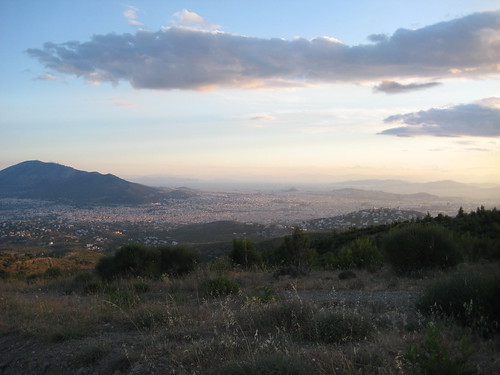
Thursday evening, Giorgos (Anna’s dad) said to me, “Go get your camera. I’m going to take you someplace you’ll like.” He took me to some spots overlooking Athens, as well as Penteli Monastery in, appropriately enough, New Penteli. From the vantage points above the city with the landscape spread out in front of us, Giorgos talked a lot about how really, even twenty to thirty years ago, almost none of the sprawl was here. What are now the suburbs were really separate villages, and the end result of the buildup of Athens into something they want to be a major European city is that people have emptied out the real villages and small towns of Greece. “We Greeks are eating each other, and the reason why is because people are getting rich off of it,” he said.
 The monastery is really lovely; I can’t say I’ve ever seen any place quite like it in the States. While we were there, Giorgos pointed out a priest and identified him as a “left-wing monk” named Fr. Timotheos, saying that he’s quite the publicity hound. He didn’t go into a lot of detail, but what I was able to dig up later suggested that he’s more of a nationalist figure than anything. Not quite certain what the deal there is.
A disquieting moment was when we were standing in front of the gates of the monastery, and Giorgos pointed out the bullet holes in the doors from attacks in decades past. He also showed me the following:

“What do you suppose that slit in the wall next to the mosaic is all about?” he asked me. I had to confess I didn’t know.
“That was where they pointed the guns against intruders,” he said.
 (Oh, and paging Rod Dreher: the monastery has chickens.)
One thing that would be really difficult to overstate is how there are churches everywhere. Big churches, little churches, medium-sized churches, tiny village chapels. You’ll turn a corner and just see something like this:

Or this:

As I said the other day, when I walked to one church and found they weren’t having Vespers, I was able to walk ten minutes to another church and see what they were doing. Had I been inclined, another 5-10 minute walk would have gotten me to another church. Coming from a country where I have to drive 15 minutes to get to church, and then my next nearest option is an hour and twenty minutes away, it’s remarkable.
 Friday morning, I attended a session of the second annual “Greece in the World” conference, with this year’s theme being Byzantine Studies. This particular session was titled “Byzantine Studies and the Orthodox Tradition”; Metropolitan John (Zizioulas) of Pergamon was the moderator, and the speakers were Dimitrios Balageorgos of the National and Kapodistrian University of Athens, who gave a talk on Byzantine music in today’s educational system, Giorgos Filias of the University of Athens, who spoke on liturgy and the Byzantine tradition, and Archimandrite Nicholas Ioannides of the University of Athens, who spoke on theology and Byzantine tradition.
Now, I can’t tell you what these gentlemen said in their papers, exactly. There were headsets that allowed English speakers to listen to the talks being translated, but let’s just say that the level of translation wasn’t exactly that of the United Nations. I will acknowledge freely that I would not want to be a translator who had to deal with such a particular and specific vocabulary, so I’m not casting aspersions on anybody — that’s just the way it was. Still, there were three big takeaways for me from attending this session:
(Unofficial #4: a native English speaker who knew the terminology well enough to do simultaneous translation of these kinds of talks could potentially do very well for themselves.)
In the evening, Giorgos introduced me to his childhood friend, Giorgos. (“And that’s Nicky, Nicholas, Nick, Nick, Nicky, and Nick.”) Giorgos Secundus (or perhaps I should say Dhefteros) is well-read in history and very adept at ancient Greek; we had a lot to talk about, even if my Greek and his English are about on the same level. I told Giorgos Prime (or Protos, I suppose) later that I very much enjoyed meeting him; he got a bit of a smile on his face and said, “Yes, George always has something to say.” I’m not certain what that meant.
 Saturday I spent some time exploring Athens and points south. I found Apostoliki Diakonia, the bookstore of the Church of Greece; well, to be more precise, I had found it the previous Monday, but the hours of operation for smaller shops are governed by rules I’m still not sure I understand, and Saturday was the first day I could get over there when they were open.
I can best describe this store by saying that they carry everything that is virtually impossible to get in the States without mammoth effort and economic expenditure. You want an Ieratikon? Check. A Typikon? No problem. The services, the Menaion, Triodion, and Pentecostarion in Byzantine chant bound into real books? You betcha — how many and which edition? A complete Synaxarion? Right this way, sir.
This poses its own set of problems, however, as a moment’s thought should make clear.
In other words — where the heck do you begin????
I mean, okay, you could just buy one of everything. Things are reasonably inexpensive, and it would be a lot less to just buy them here rather than have them shipped.
Except… oh, wait. There’s a 50 pound limit on items of luggage before overweight charges are incurred. And you can only check two items of luggage before you start paying per item. And I have other stuff to get home. And… and… and…
Suddenly you realize there’s only so much you can take back with you before you’re not really making it any more cost-effective and just giving yourself a heck of a lot more to carry — because make no mistake, these books are heavy.
I found myself thinking, I could easily spend hundreds of Euros here, and then have to spend hundreds of more Euros toting it all back home… Ultimately, I just bought a couple of small prayerbooks for now. I will go back later and buy some other things, gifts for a few people and then one or two chant books for my own reference. Other stuff… well, this won’t be my last trip here.
Ack. So many books, so little room in the suitcases.
 I had lots of time before Vespers at St. Irene, so I took the train down to Piraeus Harbor. This is where one catches the boats to the various islands; for example, I’ll be going to Aegina from here on 18 July, where I’ll get to pay my respects to St. Nectarios.
There wasn’t a tremendous amount to do down here for somebody who was still a few weeks away from embarking, but I walked around for a bit before heading back. Here’s St. Dionysios Church, right next to the harbor:

And from the front:

Gotta love the Constantinopolitan flag, still flying after all these years… (By the way, in case anybody was wondering, yes, you can find an AEK onesie here.)
I returned to Athens and enjoyed a frappé at Singles, the café behind St. Irene Church, jotting down some notes for later before going into the church at 6:30 for 7pm Vespers.
 (Did I mention there are a lot of cats and dogs in Athens? Here’s one at a table near where I was sitting at Singles.)
As I entered the church, I clearly heard Lycourgos Angelopoulos intoning the apichima for Tone 2 (or Second Authentic mode, as I think Arvanitis would prefer I say) and then proceeding to sing the Doxastikhon for “O Lord I have cried”. I guess Vespers actually started at 6 this week. Oops. As it worked out, in the morning for Liturgy I didn’t arrive until the very last doxology before the Trisagion. I’ll live.
 Monday I was walking home through Halandri after my chant lesson, and as I passed St. George Church, I was aware of a large reception on the lawn with music, a sit-down dinner, and so on. Is this a wedding reception? I wondered. Then it occurred to me that it was a celebration of Ss. Peter and Paul (29 June), which seems to be a big deal over here. Anna told me that she didn’t know what the Apostles’ Fast was before she started going to All Saints in Bloomington, but the Greeks definitely know what 29 June is. I had seen other signs and posters elsewhere indicating festal services for Ss. Peter and Paul, as well.
This brings me pretty much up to today. I still have a lot to say, but since I’m already nearing 3,000 words for this entry, let’s call this the narrative and the next post will be the analysis and reflection. I need your paper topics by tomorrow, the quiz will be Monday, and the final is scheduled for — wait, where are you going?
More for my own organizational needs than anything else, let’s say that the next post will cover the following:
Frank, my Greek teacher at IU, invited me to the baptism of his nephew, Panagiotis. (Well, Panagiotis Phillipos, but I’ll get to that.) As usual, the complication was me getting from point A to point B, since Frank’s in-laws live in Kifisia; originally the plan (as I understood it) had been to pick me up, then to pick me up at Kifisia Station, and then I wound up taking a taxi all the way to their house.
 The baptism was at St. George, a small chapel in Kifisia. Frank explained that for a family that doesn’t really go to church much, it can be difficult to get one of the nicer churches for a baptism or a wedding; you have to plan about a year in advance. Thus, it seems that infants tend to get baptized at around one or two years old rather than at a few weeks or months old.
The service in most of the particulars were very much the same as what I’ve seen in the States, with a few interesting differences. The biggest difference is that the social circle that has the most say in determining the context of the baptism is the family, not the parish. As such, this baptism in particular did not occur in the context of an already scheduled service (at All Saints we often do them during Orthros, for example), but was a more-or-less private family affair.
 As an event with familial significance beyond just the practice of the faith, it is a big, rowdy occurrence, with people moving around everywhere and talking and often not paying much attention to the service itself. This is not necessarily a bad thing, and need not be indicative of much more than the practice of baptism being very tightly woven into the culture. That said, clergy here seem to have less compunction here about telling the congregation that they need to be quiet when it is necessary to do so. Here, part of what contributed to the tenor of the crowd was that it was outside, and when the liturgical action moved into the chapel for First Communion, really only the parents and godparents could go in.
 There were a few liturgical differences I saw; for example, as opposed to Antiochian practice where oil is pretty much just dotted in the necessary spots, this kid was absolutely slathered everywhere, like a plucked turkey getting basted. The chrismation portion is done, but no particular emphasis is put on it; in other words, the crowd pretty much stops paying attention at that point. This helps to explain why, sometimes, when cradle Orthodox find out converts get received by chrismation in some circles, they get a quizzical look on their face and ask what that is. It goes by really fast, and can just seem like the last step of the baptism before First Communion. I’d be curious to see a baptism in a country like Lebanon to see if it’s the same way. Finally, since the baptism doesn’t occur in the context of a service, First Communion is part of the baptism. One small difference was that, instead of the hair from the tonsuring being burned, it was thrown into the baptismal font (pictured).
Panagiotis Phillipos is the child’s baptismal name; there was some confusion that made certain people unhappy because the priest only said “Panagiotis” at the actual baptism (“Phillipos” being a family name of significance), but the baptismal certificate will be correct. Panagiotis is the masculine form of “Panagia,” one of the terms for the Virgin Mary (Anna, my Greek teacher at the Athens Centre, is always saying “Panaghia mou!” which is roughly the equivalent of “My God” as an outburst, except referring to the Theotokos).
The reception following the baptism was much like a wedding reception in the States; it was a sit-down meal with wine and a catered buffet lunch, and everything was absolutely delicious. I got to meet many of Frank’s in-laws, although mostly I stuck with him and Vasiliki. He mentioned that down the road, I should think about applying for a Fulbright to come here; as a Byzantinist with facility in Modern Greek, particularly with the American School of Classical Studies here, he thinks it would be very a worthwhile possibility. He himself spent a year here on a Fulbright about thirteen years ago, so he knows something about the process. We’ll see.
After going home, I eventually wandered out to try to go to Vespers. I initially went to St. George nearby; as I walked in, I realized there was a baptism going on rather than Vespers. It was towards the end and the priest was giving a homily in English; I stuck around, thinking that perhaps Vespers might be going on after the baptism. However, as this family left, another family came in for another baptism. So, I struck out for St. Nicholas a few blocks down the road (gotta love being someplace where you can just walk about five minutes to get to another Orthodox parish, as opposed to driving at least an hour). Entering the church, there was — you guessed it — another baptism. It was evidently Baptism Day in Athens; that said, I don’t believe in coincidences, so I’m also musing on what I was supposed to see and what was intended to have been underscored for me by showing it to me three times in one day.
This morning, Anna and I went to St. Irene for Divine Liturgy. Arvanitis is also at St. Irene, and we had agreed to set up another lesson time there. What I might say about Divine Liturgy at St. Irene is that if you have heard the Lycourgos Angelopoulos recording The Divine Liturgy of St. John Chrysostom, then you have an idea of what they do at St. Irene. They follow the Typikon very strictly, according to Arvanitis, and there are certain variations that, while being common practice in many parishes, technically depend on the presence of multiple clergy. For example, this is why “O gladsome light” was not sung at Great Vespers last Saturday — according to the Typikon, it is sung by the clergy, not by the choir, and then only when there are multiple clergy. Along similar lines, the dynamis of the Trisagion is only done when there are multiple priests, according to a strict reading of the Typikon. Besides those differences, they did the Typika instead of the stational antiphons, much like the recording, and in general did most of the same settings as found on that CD. They apparently sing the Trisagion and other hymns in the mode of the day rather than just singing one setting, so we heard a first mode Trisagion instead of the second mode version on the CD — I’d expect to hear that next Sunday. I’ll also note that they have an ambo (along one of the pillars, however, rather than being in the middle of the church), and they use it for the Epistle reading. Anyway, to put it bluntly, the Liturgy was gorgeous, prayerful, contemplative, and was so much of exactly what I wish we Americans were more comfortable with when it comes to liturgical practice, and was so much of exactly what I think many Americans fear when it comes to liturgical practice. It placed itself firmly within the received tradition without feeling the need to add its own tweaks. Say the black, do the red, and do all of both.
Receiving Holy Communion, I’m happy to say, has been more of a non-issue here in Greece than I’ve found it to be in Greek churches outside of Greece. I’ve written about this elsewhere, but in Krefeld, Germany, for example, Fr. Irodion was happy to receive us at the chalice, but he was very specific about taking the letters we had brought from Fr. Peter, and there were, um, interesting looks on people’s faces when we actually communed. At St. Nicholas last week and St. Irene today, there was no issue (and I remembered to hold the cloth this time! Yay!). I gave my name as “Rihardhos,” and all was well.
 Following Liturgy, Anna and I had coffee with Arvanitis at a café right behind St. Irene. I was tickled to find that the brand of coffee they were serving was “Café Barretti,” which along with the “Rihardhos Mousikos Oikos” makes Athens a city that just has my name all over it.
Arvanitis made a comment about Middle Byzantine notation that caused my ears to perk up — that at least some of the signs appear come from Palestine. Palestine? This is a possible avenue for linking this stuff to what my formal research interests are — we will see.
I am writing this while procrastinating from doing my Greek homework and ironing some shirts for the coming week, but here are a few general thoughts and observations:
I have never seen so many people roll their own cigarettes as I see here in Greece. I am told that it is because it is cheaper, but since when do smokers care about what cigarettes cost? The more compelling explanation that Frank gave me is that everything has to be done with some amount of ritual here in Greece, and rolling one’s own cigarettes lends itself to that very well. As well, there is distrust by many Greeks of American conglomerates, and with cigarettes in particular they don’t trust the additives and whatnot that go into the mass-produced smokes. I smoked one as a gesture of accepting hospitality a few days ago; this had the twofold benefit of a) reminding me that I don’t like cigarettes, handrolled or otherwise, and b) relieving me of the responsibility of having to smoke another one.
A question that has come up a few times — what is Greece? Is it Western Europe? Eastern Europe? The Middle East? In terms of the culture, religion, and geography, it seems to be the center of a Venn diagram where all of those overlap. Technically it is considered Western Europe, but then I’ve been told that “Greece is the end of the West and the beginning of the East.” Still, I could see just the opposite being argued, too.
Travel tip for people with laptops, particularly Macs: you will want a chill pad for your notebook traveling in this part of the world. My MacBook crashed twice before I realized what was wrong. Luckily, they are very readily available in virtually every electronics store here, and a decent one can be had for around 23 Euros. I have the Akasa Gemini, which is USB-powered and also has an additional USB port to replace the one it uses on the notebook itself.
Okay — homework beckons. More later.
(That’s pronounced “Ya sas” for those of you who can’t read Greek letters.)
 I checked in online on Tuesday; I was flying Indianapolis to Newark, with a nonstop from Newark to Athens. I had a window seat, and the plane was empty enough that I had two empty seats between me and the aisle. I thought I’d probably only need to check one bag, but I indicated two just to be on the safe side — I had packed an empty carry-on suitcase in my big suitcase, both to keep myself from overpacking as well as to have a carry-on for side trips, and to give myself room to pack gifts on the way back. I had an empty duffel bag in which to pack overflow if it actually turned out the suitcase was over.
Wednesday morning, when I actually checked in at the airport, I was told that they were a bit concerned about me not having enough time in Newark to make my connection, but not to worry — they would reroute me through Charles de Gaulle Airport in Paris if there was a problem. Still, everything looked good for the Indianapolis flight to be on time, so looked like everything would be all right. I wound up having to move a few things into the duffel bag after weighing the suitcase, and I checked both bags.
Saying goodbye to Flesh of My Flesh at the airport with me being the one taking off for the summer was very strange feeling. She’s gone away four summers in a row; now it was my turn to go off and have an international adventure and for her to stay home. How would this time be different, with our roles reversed? Ask me again in two months.
The plane boarded, we pushed off from the gate only slightly late, taxied off… and parked on the tarmac for an hour and fifteen minutes. Air Traffic Control had issued a new wheels-up time just as we closed up the plane for an hour and a half later, so there we sat. It was a tiny aircraft, and even with nobody in the seat next to me it was cramped. Air travel FAIL.
My flight to Athens was at 5:30pm; perhaps it would be delayed as well and it would be no big deal. Arriving in Newark at 5:26pm, the gate agent looked up my flight — “It’s still listed as on time,” she told me. “But who knows — you might still make it.” Of course, the gate for the Athens flight was all the way on the other side of the airport. Even with a shuttle bus, it took twenty minutes to get over there, by which time the flight was long gone. Air travel FAIL.
I was rebooked for the Paris connection; that meant waiting in Newark for another four hours, and it would also mean arriving in Athens at 4:30pm rather than 10:30am. Air travel FAIL.
Turned out I wasn’t alone; I met an IU undergrad named Alex Edwards who was on her way to participate in an archaeological dig on the island of Aevia, and for whom this was her first major international trip. “Well,” I said as we stood in line to get our flights rebooked, “the good news about this kind of rough start is that there’s someplace for the rest of the trip to go.”
The good people at the Archives of Traditional Music had gotten me a rather hefty iTunes gift card as a parting gift, so I decided to buy a pair of video glasses for my iPod and download some movies to watch on the flight to Paris. I bought Burn After Reading, Star Trek the Motion Picture, and Star Trek II: The Wrath of Khan. Unfortunately, it turned out that, at the speed of the Boingo hotspot at Newark, it would take about three hours to download the movies, and by this point I had less than an hour. I’d have to finish downloading them once I got to Greece. Also, the goggles themselves would require charging overnight before I could use them. Finally, I discovered in horror that my iPod power/sync cable had managed to be left at home, so I had to buy one of those too. Wi-Fi FAIL; Inflight entertainment options FAIL; Richard packing FAIL.
The flight to Paris boarded late; it was also jam packed. I still had my window, but boy oh boy was I crammed right up against it for the duration of the trip. Flying Northwest I’ve become accustomed to international flights being noticeably better and more comfortable than domestic flights; this is not the case with Continental Airlines, it would seem — word to the wise. Rather than any additional legroom, with the couple sitting next to me I had exactly one inch short of enough room to extend my leg at all comfortably; as a result I had a bad cramp in my knee two hours into the flight about which I could do exactly nothing. A good number of people on that flight seemed to be there because they had missed another plane, and were all in the resulting absolutely sunny mood. Even when I went to the bathroom, within two minutes there were angry pounds on the door. Needless to say, I didn’t sleep. Air travel FAIL.
Flying in over Paris really is lovely, I will say that; the countryside is green and open and seems like a place I’d be very interested to explore. On the other hand, Charles de Gaulle Airport is nothing I really needed to see under the circumstances. The best thing I can say is that between getting a coffee and croissant and navigating through the barely-organized chaos that was boarding the flight to Athens, I got to use un petit peu of my French. I will also say that I got to see the humorous sight of a group of nuns going through security and having to take out laptops.
The Paris-to-Athens leg of the trip had me, once again, packed in with the rest of the sardines, meaning I didn’t sleep — or rather, I did sleep for a bit until the flight attendant dropped a can of tomato juice into my lap. Air travel FAIL. (That said, we did get real food on the Air France flight.)
Landing at Athens International Airport, I noticed with some amusement that I could see a very large IKEA from the air, with an Orthodox church at the end of the parking lot. Yep, I thought, this is Greece.
My big suitcase was the first bag off the conveyor belt; after twenty minutes, though, it became clear that the duffel bag hadn’t made it (and neither had any of Alex’s luggage). After another twenty minutes in line at customer service, I found out the bag was still in Newark (Air travel FAIL FAIL FAIL) and would be delivered to me the next day.
So it was that at long last, my friend Anna Pougas and her dad Giorgos found me, a bedraggled, sweaty, tired Anglo in a Panama hat, ultimately about seven hours later than originally planned. Nonetheless, when Giorgos asked if I wanted to see anything before we went home, I said yes, absolutely.
We walked around Porto-Rafti, a lovely bay with beaches and swimming, as well as old trenches from World War II. We also drove by the temple of Artemis where Iphigenia is said to have been buried, and then had very decent seafood in a restaurant by the harbor. Interestingly enough, there’s a music store in the area called “Ριχάρδος Μουσικός Οίκος” (Ριχάρδος being a Hellenicization of Richard — “Rihardhos”). If I had been sharp enough at the time, I would have taken a picture. Perhaps later.
By the way — if you ever plan on coming to Greece, be aware that the culture of driving is much different from what it is in the States. Chalk Athens up as another European city in which I would never want to drive (so far, that’s just about all of them in which I’ve travelled), and here it’s because drivers here are simply much more aggressive by custom. I suppose we could say that here the rules of the road really are guidelines at best. The other side of this is that, when you’re talking about people who have driven this way all their lives, it’s not really a problem — they know what they’re doing. For me, however, I think my inexperience with that kind of driving would just make me a hazard on the road.
When we got to the Pougas’ house in Halandri, I immediately jumped in the shower and subsequently collapsed in bed. Jet lag? What jet lag?
 The next day I woke up around noon. After my bag was delivered, around 3pm, Anna and I walked into the downtown part of Halandri to see if I we could get my cell phone situation straightened out. (Side note: there are pomegranate and orange trees just growing in people’s yards and on the sidewalks.) I’m an AT&T customer so my phone — a Samsung SGH-A437 — is quad-band, and they had given me an unlock code so I could replace the SIM card overseas. We went into a Vodafone store, I unlocked the phone, put in the card they gave me, and… “Wrong card,” the phone’s display told me, even after entering the PIN for the card. I tried again. “Wrong card,” the phone’s display stubbornly repeated. “It’s difficult with Samsung phones,” they told me. Cell phone FAIL. Anna said that they had an old unused phone at home that I could use for the time being; ironically, it turned out to be the same Nokia phone that Megan has loathed for the last two years.
 One thing I discovered really quickly: much like London, where Anglican churches are virtually around every corner, so it is here with Orthodox churches. You can’t swing a dead cat without hitting a church. It’s also clear that, in most instances, the churches were here first, and people built around them (with one case in particular being a remarkable demonstration of this, but I’ll get to that later). The central church in Halandri is St. Nicholas Church, and we attended Vespers there. There’s a lot of restoration of the frescoes going on inside; on the north wall are very bright icons which have clearly been cleaned up, and scaffolds are around indicating that work is being done. From the darkness hanging over a lot of the iconography, it’s apparent that a lot of work is needed — I don’t know if it’s particulate from incense or just what happens to egg tempera after a century or so.
 It was a Friday evening, and much like the States, weekday services are clearly expected to have, er, light attendance — the priest did it entirely as a reader’s service, and I mean as a reader’s service. Nothing was sung at all except for the apolytikion for Pentecost — everything else was simply read, and quickly. We were out in less than half an hour.
 We walked around afterwards — Anna showed me the new church which is being built in Halandri, St. George, which she said has been under construction all of her life (her brother was baptized in the basement, where they’ve held services up until a few years ago when the nave was finally ready) and for which Giorgos later said he remembered helping to dig the foundations as a boy. Only (“only,” I say as an American who worships presently in a church that’s just trying to figure out how to not look like an office building) the apse and dome are frescoed at this point, and the bell tower is still being finished; “That’s still a lot farther ahead than many churches in America,” I said.
After our little walking tour of Halandri, we headed back to the house to find Giorgos. We were meeting Anna’s brother, Stephen, and his girlfriend Liana to go out to a movie — and I mean out. As in outdoors. Drive-in without the cars. The movie? Well, it was Angels and Demons (Dan Brown FAIL), but never mind that now. Beyond the novelty of watching it in the open air with a concession stand where I could have ordered a martini if I had wanted one, it was also a useful exercise to listen to the English soundtrack while trying to follow along with the Greek subtitles.
 Saturday, Anna and I decided to head into downtown Athens and attend Vespers at St. Irene, which is Lycourgos Angelopoulos’ church. (Gavin Shearer, this paragraph is for you.) Athens’ gradually expanding metro system is really nice; on the whole, I have to give a big thumbs-up to the public transportation system here, which seems to be very useful and quite economical. I’m paying 35 Euros for a monthly pass that gives me access to everything — buses, the metro, streetcars, even some of the regional rail I think — as opposed to the 30 pounds we paid apiece for the weekly Tube pass in London. As I said, the system is new (I think it opened in 2001) and thus is still expanding, so there is no metro station near where I’m staying (but there will be one a five minute walk away in a year or so!), but the buses also aren’t too bad. (And hey, the Athens metro even has its own version of “Mind the gap”.) As it is, we made it to Syndagma Station, in central Athens right by the National Gardens, without a whole heck of a lot of muss or fuss. Real cities have trains.
Here’s some useful advice about walking around downtown Athens: there is no such thing as a soft sell there. If you’re walking around the tourist-heavy areas, everybody will be trying to get you to come into their shop or sit down at one of their tables; if you go into a shop, they will do everything they can to get you to leave some of your money there. I was more-or-less prepared for this and only went into a shop because there was something specific I wanted (a little triptych in this case), and only discussed with the saleslady the exact item I was buying, no matter what else she tried putting in front of me. Interestingly enough, she assumed I was Russian; this is not the first time Greeks have jumped to this particular conclusion about me (such as when I visited the Greek cathedral in London a couple of years ago). I’m not sure what that’s all about, but never mind. “Ευχαριστώ, όχι” (Efharisto, ohi “Thank you, no”) coming from the lips of an Anglo raised more than a few eyebrows, and not all of them with respect; I got more than one snarky “Μιλάς καλά Ελληνικά!” (Milas kala Ellinika “You speak Greek well!”) After a couple of those I wanted to reply, “Όχι, δεν μιλώ καλά και το ξέρω!” (Ohi, dhen milo kala ke to xero “No, I don’t speak well and I know it!”)
 We got much-needed coffee from Χατζή (“Chatzi’s”), and soon found a rather stark example of a church being there first and people building around it. Here is the chapel of the Holy Power of the Virgin, a chapel of the monastery of the Dormition at Pendeli. In the United States, obviously developers would do everything they could to buy and demolish the property; that they don’t do that here may lead to what look like awkward solutions, but they are definitely conversation starters.
 Just a little further down is the Cathedral of the Annunciation, the cathedral of Athens. Services are not being held right now while renovations are happening, but it is still open to the public. Among other things, they have the relics of Patriarch St. Grigorios V (the icon over his reliquary even depicts him hanging in front of the Phanar) and Athenian St. Philothei.
By the way — even the phone booths here are with LEMON!

 And how much do you have to love being able to stand on one street corner and see a centuries-old church (foreground), a centuries-old mosque (right), and the Acropolis (hill in background)?
After walking around a bit, we ate a late lunch at Thanasis, a souvlaki place a few blocks from the Cathedral. There I developed a new love: tirokaftiri. ‘Nuff said.
As might be expected, Vespers at St. Irene Church with Lycourgos Angelopoulos as the protopsaltis was a much different experience from the Friday night Vespers at St. Nicholas, to say the least. All I can say is that was the fullest Great Vespers I have ever experienced, in every sense of the word. The church is beautiful, it was celebrated reverently without a single thing cut (although, curiously, “Gladsome light” was read, not sung — as was the Nunc dimittis, for that matter, but I already knew that to be read in Byzantine practice), and it was sung by left and right Byzantine choirs. All told, it was about an hour and a half.
 Observations about churches in Greece: all but one I’ve been in so far have a left/right choir setup in front of the iconostasis in the part of the church which would actually have the architectural term of “choir” — that is, between the altar (the iconostasis in this case) and the nave, with a rail in front of the nave. This has the positive effect, particularly when one sees how the two choirs interact with each other, the clergy, and the congregation during a service, of making the two choirs integral parts of the church architecture in a way that reflects the basic cruciform structure of the building. This also strongly emphasizes that the clergy, left choir, right choir, and congregation all have distinct roles in a given service, very much unlike how in many American churches the two choirs have been collapsed into one, which is then for all intents and purposes collapsed into the congregation.
This also has a couple of effects which no doubt many Americans would immediately find distasteful: it means that the altar is farther away from the congregation than it would be without the choir, and it also means that the congregation’s role, generally, does not involve singing — at least nowhere near as much as one finds in many American parishes. While acknowledging that I say this as a church musician who has the role of singing during services one way or the other, I would like to stress that, in context, these are not the Very Bad Things that some might already be thinking they are. When it is working, there is not only no confusion, but there is really no particular reason for the congregation to sing along. The choirs are leading the worship in a different way, and to a very real extent it would seem arrogant in this context for a member of the congregation to try to sing along — the piety of the congregation is largely silent and inwardly-focused, and these are people who would be scandalized by it going any other way. Seen thus in action, I would be hard-pressed to describe the members of the congregation as not participating — it is only that participation means something else than what we often mean as Westerners. It will perhaps be no surprise to find out that I think there’s something there we Americans learning to be Orthodox can draw from this manner of piety — certainly something more than we’ve convinced ourselves is worth taking from it.
The churches also all have galleries (i.e., upper levels in which to stand in the nave), there is a tendency (but by no means a rule) to have the women standing on the left and the men on the right, they all use amplification, they all have rows of chairs, and there’s a good bit of Western-style iconography in most of the older churches. I asked Anna about the chairs; she said that as long as she can remember, churches have had rows of chairs in Greece. (Notice I didn’t say “pews”.) I am curious to find out if this a recent, urban development, or if the simple truth is that, quite frankly, the churches I’ve been in so far have been populated mostly by people over sixty. Yes, it’s true; Orthodox Christianity in Greece seems to be pretty much the faith of the elderly. God bless their steadfastness, but somewhere along the way the faith didn’t get passed on to their children or grandchildren except in a handful of instances.
The poor also tend to congregate outside of churches here. This makes sense; the churches are in population centers, and there is reason to believe that people going into the churches might be willing to be instruments of charity. This is convicting to me, accustomed as I am to the local church being well away from the rest of the world and inaccessible to the poor and being culturally accustomed to ignoring the people we deem “panhandlers”. Can I go into a church and in good conscience worship the God-man who told me to clothe the naked and feed the hungry while ignoring those very people at the door? How do I know that they are truly in need? Do I have the right to judge? What do I do? I do what I can at any given moment, I suppose, whatever that is, make the Sign of the Cross, and pray I’ve done the right thing, whatever that is.
Sunday morning, we attended Divine Liturgy at a little church in downtown Athens, St. Nicholas (there are just a few of those in the area). It was quite different from St. Irene; it was very small — perhaps seventy or eighty people would fit in there total — small enough so that they didn’t have sufficient space for left and right choirs, nor the extended choir area in front of the iconostasis. There was a very different character of service here than I found at St. Irene; there were liberal cuts all over the place (during Orthros they jumped from the Gospel reading to “More honorable than the cherubim…”, the Great Doxology was trimmed down significantly, there were only two iterations of the Trisagion instead of three, only the Resurrectional apolytikion was sung followed by the kontakion and all the festal apolytikia were omitted, etc.), and while the choir was all men, they sang almost entirely four-part music. It was somewhat disconcerting; the sound approximated that of a barbershop ensemble singing Russian music in Greek. That said, they sang with as much gusto and enthusiasm as they could muster, and it was beautiful even if it left me scratching my head a bit. The priest did not question my coming up to the chalice at all, although I did not realize unil after I had received that, with no servers, it was up to me to hold the napkin to my chin. Richard taking Holy Communion FAIL (although, thankfully, knowing the ins and outs of local parish practice are not a general requirement for partaking so far as I know).
Following Liturgy, we went across the street to the Byzantine Museum. Reading their brochure, it said that students of non-EU universities who were doing Classical Studies or Fine Arts could get in for free with a student ID; I showed my ID at the door and was told I would have to pay because I was a non-EU student. Right, I explained, having anticipated the misunderstanding; your brochure says that’s fine, given my area of study (which I didn’t think was too much of a stretch of the truth). The woman’s brow furrowed and she picked up a Greek version of the brochure. Finally she nodded, but still had a confused look on her face. “I guess that’s what it says,” she told me, and waved me in. Glad I read the fine print more closely than she did.
 The exhibit there is decidedly more modest than that at the Royal Academy of Arts back in February, but it had the advantage of not presenting it as “Look at how these crazy, backwards, superstitious Byzantines did things”. It is far more matter-of-fact with less editorializing. The exhibit guide was going at far more leisurely a pace at each section than I had patience for, however, so I worked my way through it on my own. Definitely worth the visit for the iconography portion; it’s also fun to see prosphora seals from Late Antiquity.
Lunch was in an Athenian suburb a little bit north of Halandri called Kifisia; for those of you with a point of reference in the Pacific Northwest, this would be the Attiki Bellevue. We went to a souvlaki place (“Dear Lord, thank you for our daily souvlaki,” Giorgos said) called Gourounakia Kifisias (“The Little Pigs of Kifisia”), and I once again swooned over my latest crush, tirokafteri. (Food here will be an entirely separate posting, as will, I think, travel tips for the heat sensitive.)
Back at home, I called Ioannis Arvanitis and set up a meeting for Monday; shortly thereafter, I started to fall asleep while e-mailing somebody, and I decided retreat was the wiser part of valor, particularly since the next day would be my first day of school.
More to come.
 This is only tangentially related to my usual topics, but I find my friend and Archives of Traditional Music colleague Patrick Feaster’s work on what he calls paleospectrophony to be fascinating, even if I am utterly unqualified to say much about it beyond “Wow, cool.” For obvious reasons, the section on how his technique can be used on neumatic musical notation is of great interest to me (although he has said that Byzantine notation would not work with what he does). Give it a look.
This week is my last week at work. Friday I will sit at this desk for the last time and have a few days before I venture off into a totally different world. (By the way, remind me to never again quit a job right before fiscal year end.)
Next week I get on a plane and go to a foreign country for eight weeks. I’ve never been to this place before, I’ve never been away from home that long, and I’ve never taken that long of a flight before. When I get back, I will have a week to ten days or so to recover from jetlag before my wife and I will be drawn into the hustle and bustle of a wedding. Once the wedding is over, it will be time to dive headfirst into being a full-time grad student.
In other words, this week is the last paragraph in a particular chapter of my life, a chapter which started three years ago today when I had my first day as the Undergraduate Programs Coordinator in the College of Arts and Sciences. It seems like a lifetime ago.
I am somewhat conflicted; I am more than happy to have this chapter be over with and to have the new one I’m starting — there were moments where it seemed that the chapter was going to close without me having another one to start. On the other hand, as happy as I am to finally have these opportunities, the last year has been wonderfully refreshing, particularly compared to the previous five, and I’m leaving something where I could be safe and reasonably content indefinitely. I’ve been chasing this ball, in one form or another, for the last six years; now that I’ve got it, what do I do with it? There’s part of me that says, “What do you think you’re doing, trying to play this game at thirty-two when you have a more-than-decent deal where you are? Who do you think you are?” There are parts of me that would be more at ease about this were I ten years younger — I would have far less to lose.
Nice as that would be, however, that isn’t how things worked out, and the opportunities are presenting themselves now, not then.
Meanwhile… I have to figure out what all I’m taking with me, and even more importantly, what I’m not — i.e., the temptation to not bring half of my library with me needs to be resisted.
Today, as I mentioned might be happening a couple of weeks ago, I did a phone interview for one of the bigger Orthodox media presences regarding my choir schools piece in AGAIN. I still don’t want to give a ton of details until I know for sure exactly what’s happening, but what I can say is that it was fun, the people involved were really nice, and we had a lovely chat. I look forward to hearing how the whole thing gets edited together; I’ll say right up front that for all I know, I could sound like a complete, raving idiot, or I could sound like somebody with an interesting notion worth discussing further. One way or the other, I’m happy to have had two excellent opportunities, in print and in broadcast media, to talk about an idea that I’ve been trying to interest other people in for four or five years now. If the conversation dies here, it won’t be because I didn’t have an audience.
One thing I want to get out of the way now, however: I was initially referred to as “Dr. Barrett” (before we were recording, thank God), and somehow somebody seemed to have the idea that I’m an instructor of music at Indiana University. Neither is the case, I have never represented myself as either one, and I’d really hate for somebody to think I’m claiming to be something I’m not. I quickly made sure the interviewer understood that was incorrect, but for purposes of clarification:
I work at Indiana University, and I am doing graduate work here, but not in the School of Music, and at this time I only have a Bachelor’s degree in Music from IU, with Voice Performance as my concentration. I am not presently, and never have been, an instructor of any kind at Indiana University. I have had some private voice students, and I am the choir director and cantor at All Saints, but that is the extent of my activity as a music teacher at this time. At the moment I work for a unit on campus called the Archives of Traditional Music, but it is not in an academic capacity. I will be leaving this position at the end of next week anyway to be a full-time student again. At some point in the future it will be possible to call me “Dr. Barrett,” but not for awhile yet, and it won’t be in music.
Just so we’re clear. Like I said, I’d really hate for somebody to get the idea that I’m claiming some status that is not in fact mine to claim. I have too much respect for the people who do have terminal degrees!
Anyway — I will post more details as I have them.
 As I’ve more or less said before, I’m not an ethnomusicologist, but my interests do tend to at least touch things ethnomusicologists care about and vice versa. Thus, I at least keep my eyes open, and also as I’ve noted before, I’m in a good place to to do so (at least for the next two weeks).
The current issue (Winter 2009, Vol. 53, No. 1) of Ethnomusicology: The Journal of the Society for Ethnomusicology has an article titled, “Right Singing in Estonian Orthodox Christianity: A Study of Music, Theology, and Religious Ideology,” by Amherst College faculty member Jeffers Engelhardt. It is “an intimate musical ethnography of how Estonian Orthodox Christians at a small parish in Tallinn are making their liturgical singing ‘right'” (p.32), and seeks to examine the questions,
What do musical change and religious renewal reveal about the dynamic interrelationship of theologies and musical styles? How are orthodoxy and orthopraxy established musically? How do local histories condition the possibility of current and future practices? (p.32)
These are great, practical questions, and Prof. Engelhardt has been able to base his exploration of them on practical experience — between 2002 and 2007, he spent a lot of time conducting field research at Cathedral of Saint Simeon and the Prophetess Hanna in Tallinn, including singing in the choir (although, as he notes, he is not an Orthodox Christian himself).
Prof. Engelhardt makes several excellent points and observations; he places his work in the context of religious renewal for Christians in general in Estonia, which is “a process of investing their lives in the post-Soviet order with a particular morality and soteriology.” Estonian religious renewal is significant because
[it] both recognize[s] and resist[s] conventional aspects of the modernity mythologized in post-Soviet and postsocialist transition and ostensibly figured in the European Union: democracy, liberal pluralism, secularism, free markets, cosmopolitanism, universal human rights, consumerism, individualism, “normalcy,” and benign nationalism. (p.36)
For the Orthodox Christians in particular, “right singing” is an ideal which exists in this context;
it is a musico-religious poetics whereby Orthodox Christians are transforming understandings of personhood, human ecology, and secularism in Estonian society through sonic ideals that have decided moral and ideological dimensions. […] Thus, the musical and liturgical practices, congregational life, and institutional affiliations of local Orthodox communities in Estonia bring together a host of aesthetic, theological, social, and ideological concerns. All of these concerns coalesce in the idea lof right singing… [which] is a conduit of illumination and transforms invidiual and corporate bodies into Orthodox bodies of Christ. Right singing creates the correct unity of doxa (belief) and praxis (practice) that is the conservative essence of Orthodox Christianity. (Ibid.)
Prof. Engelhardt follows up on this point by suggesting that “[i]f the singing is right, then the belief expressed in that singing is right; if the belief is right, then the musical practices grounded in that belief are right” (p.37).
In other words, religious renewal in Estonia is not just about reclaiming something repressed during the Soviet era but about fundamentally trying to reshape the world around them into something consonant with their Christian faith; furthermore, “right singing” is not just an expression of these aims for the Orthodox Christian in Estonia, but one of the instruments through which the aims will be completed.
Given this, one of the really interesting points of Prof. Engelhardt’s analysis of the Cathedral’s practice is when he speaks of using Byzantine music for special Liturgies, such as a specific example where a parishioner was to be ordained to the diaconate.
There are a number of reasons why [the Cathedral] would use [Byzantine music] to make this liturgy special. Singers, priests, and parishioners at the Cathedral…invest Byzantine chant and styles of singing perceived as temporally or geographically distant with special significance. These ways of singing are right because they sound the right religious ideology and create the right religious imaginary [sociological term referring to a set of values, institutions, laws, and symbols common to a particular social group and the corresponding society]; they distinguish Estonian Orthodox musical practices from Russian Orthodox Obikhod-inspired practices. For [the Cathedral], Byzantine sounds are “right” because they are “more archaic” and “more monastic” than the Estonian Orthodox traditions with marked Russian Orthodox and Protestant Lutheran influences; Byzantine sounds bring worshipers to the “right level”… [and] Byzantine ways of singing are “more ascetic” and evoke the “feeling” that is such an important part of Orthodox Christian experience… [and] Byzantine ways of singing bring [the congregation] “to the source” of the Christian tradition[.] (p.39-40)
This interlocks with earlier point of how “right singing” (orthopsalmody?) is an ideal which exists in the context of religious renewal in Estonia: “[F]or Orthodox Estonians, the trajectories, geopolitics, ideologies, and moral norms of this kind of transition do not correspond entirely with the Orthodox lives they imagine leading” (p. 41), therefore
[r]ight singing is…how Orthodox Christians situation themselves within a global religious imaginary… [which] has enabled religious renewal and, in the process, established alternative, Orthodox perspectives on the modernity being fashioned through post-Soviet transition, reframing its liberal ideologies and doctrine of secularism. The Byzantine aspects of right singing, in other words, create a form of “morally inflected cosmopolitanism”…that is given voice through liturgical practice[.] (p.44)
He reaffirms and restates this point a little later:
In general, then, what is sung at the Cathedral…and, just as important, how it is sung, localizes temporally and geographically distant Orthodox sounds in order to make singing right… Byzantine is a chronotope (a temporal and spatial field of action) incorporating aspects of musical style, theology, and religious imagination that captures what singers sense as the archaic, originary, and more authentic qualities of their way of singing. Negotiating this kind of proximity…within a global Byzantine imaginary as part of the ongoing renewal of Estonian Orthodoxy and amidst ongoing social, economic, and ideological transformation, then, is a process of making singing right. (p.46)
Prof. Engelhardt concludes with some startlingly sympathetic observations:
The ideal of right singing gives voice to eternal religious truths that empower Orthodox Estonians to live faithfully and in relation to God, one another, and a global religious community. The soteriological, ethical, and affective dimensions of right singing are profound, and by singing the right way, Orthodox Estonians realize their full humanity through the unity of beauty and truth, aesthetics and veracity. […] By endeavoring to sing the right way… Orthodox Estonians work at incrementally transforming themselves, their Church, and their world into this likeness [of God]. Musical practice, in other words, is an agentive means of religious transformation as it shapes individual and communal disciplines, sensibilities, and moral actions. (p. 50)
Prof. Engelhardt’s ethnography is very thought-provoking, and it is remarkable how applicable the picture he paints of the situation in Tallinn is to the Orthodox church choirs in the United States I’ve seen or with whom I’ve sung. While not using the specific technical language of ethnomusicology and sociology, I’ve participated in many conversations about Orthodox liturgical music that wind up in largely the same place as this article. One question that comes to mind is, just as much as the “Byzantine imaginary” allows Orthodox Estonians a means to frame their responses to modernity, I wonder to what extent we might hypothesize that some Orthodox Americans, or even Orthodox Christians elsewhere, wish instead to synthesize modernity with the Byzantine imaginary? What does that look like? How does the synthesis differ from the response?
Now, a questionable point, at least for me, is methodology. A large portion of Prof. Engelhardt’s fieldwork depends on his perspective as a participant in the choir, and he acknowledges that while he is participating with the faithful, he is not participating as one of the faithful. Without getting into the question of whether or not one should sing in the choir if one is not Orthodox, I’ll just say that it begs the question of how his observations were colored by the perspective of a non-believing participant. I don’t doubt that it likely helped to make his observations as sympathetic as they are, but it seems to me that there are lines being crossed with this methodology. Again, I am not an ethnomusicologist, so I acknowledge I raise this question from a standpoint of ignorance, and I would be curious as to how an ethnomusicologist might answer this concern. One way or the other, this is a methodological approach that strikes me as at least requiring full disclosure — that is, it not being enough for the researcher to state that they are a non-adherent; rather, a statement of of what the researcher’s religious beliefs actually are is needed to clear up any ambiguities. I could very well be totally wrong on this point, and if I am, that’s fine, but that is my initial reaction.
In all fairness, Prof. Engelhardt acknowledges the problem to some extent, noting that not being an Orthodox Christian presents certain challenges to this kind of work:
The ideal of right singing gets at things that are hard for ethnomusicologists to get at: belief, faith, the numinous, and apophatic ways of knowing through negation rather than through the positive statements of modern scholarly practice. The challenge for non-Orthodox ethnographers like myself, then, is to apprehend at all the correct unity that makes singing right. (p. 37)
Another shortcoming is the bibliography; of 125 total references listed, literature which specifically treats Orthodox Christianity only gets six entries. Of those six works, four deal with Orthodox sacred music, three of which focus on Russian practice. Given the prominence of Byzantine chant in the ethnography, it is odd to me that the references would not reflect more substantial reading and understanding in that area. Some citations talking about theology of icons or liturgical aesthetics in general would also seem appropriate, given how Prof. Engelhardt synthesizes his points in the conclusion.
There are also some curious imprecisions here and there; there is a quotation on pp. 35-6 from the “Canon for Sunday Orthros,” which hardly narrows down exactly which Canon it might be (and his translation from Estonian isn’t a lot of help, either). He refers to the diaconate being the first step in becoming a priest; while it can be, yes, it is not the prescriptive matter that he implies. In another instance, he speaks of “an authentic Orthodox theology of sound” (p. 49) without clearly stating what that might be or providing a citation.
Having noted these points, however, I think there is much to appreciate about Prof. Engelhardt’s work, and whatever I may wonder about his methodological approach, I applaud his willingness as a non-Orthodox Christian to treat the musical practices of Estonian Orthodox Christians on their own terms. If you are interested in reading the entire article, it is not available online, but if you’re near a university library, they should have the journal on their shelves.
I’ll close with Prof. Engelhardt’s final paragraph, which is perhaps the part every scholar who works in areas related to religion should read:
Beyond these conclusions about why the right singing of Orthodox Estonians is right (conclusions based on a musical ethnography of orthopraxy), one verges on matters of belief and faith (the inwardness and veracity of doxa) that reveal the limits of how modern, secular scholarship produces knowledge… Suggesting how musical style, religious ideology, and sociohistorical circumstance affect the rightness of sound is only part of the story. The other part of the story is about the epistemology given voice through the outward expressions of orthopraxy; it is about the ineffability of some religious experiences, the unverifiable efficacy of some rituals, the possibility of divine revelation, and the corporeal sensibility of the authentic, all of which are no less real or true than musical style, religious ideology, and sociohistorical circumstance. Regarding these profoundly significant aspects of right sounds, one must, I believe, defer to those for whom they are right, stopping short of any complete representation in order to recognize and reflect on their ultimate meaning and power in the lives of the faithful. (p. 52)


 Leitourgeia kai Qurbana: Contra den Zeitgeist