Archive for October, 2008


Various points of interest (or not)

George List was an emeritus faculty member for the Department of Folklore and Ethnomusicology here at IU. He retired in 1976, the year I was born, but still had an office and an assistant here. I first spoke to him over the phone in April, when I started working here at the Archives of Traditional Music; I met him for the first of three times in August. He was ninety-seven years old, he was frail, he was blind, he had been a widower for “seven long years” as he put it, and he had even outlived his son. Despite all of that, he was sharp as a tack, very active mentally, perfectly articulate. He was also clearly very lonely. He made a big impression on me the three times I got to meet him, perhaps more than I realize even now.

He passed away on Sunday, 28 September. It’s affected me this week a lot more than I thought it would — I even had a dream about him a couple of nights ago, although I don’t really remember much about it, beyond wanting to say goodbye in person and trying go back in time a couple of days by crossing the international date line. Aionia mneme.

Sometimes there are these fortuitous moments of synchronicity that tell you you were supposed to do something. Megan has been toying with the idea of getting an iPod for a little while, and I finally decided it was time to take the plunge and call it a late birthday present (my regular readers, both of them, may recall that I was in New York and she had just arrived in Germany on her birthday; I was so discombobulated that I didn’t remember to say “Happy birthday”, and she was so discombobulated that she didn’t notice). So we bought one of the new 120gb iPod Classics yesterday (it was $250; for reference, my 80gb Classic was $350 a year and a half ago), and after paying for it, the guy behind us in line, noticing we had bought a different pair of earbuds, asked us, “Hey, do you want the earbuds that come with that?”

We shrugged and said, “No, not really.”

“Can I buy them from you for $10?” He was about to spend $30 or some such on a replacement pair — seemed fair to us, and appeared to be one of those moments where the timing just worked out the way it was supposed to.

Of course, once we got home, we realized that we had also given him the USB cable. Oh well — keeps us humble.

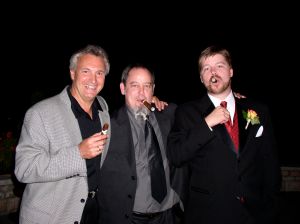
Me, Bryn, and some guy at Jeff Fletcher's wedding, 12 September 2005A year ago today my friend Bryn Patrick Martin passed away from a bad reaction to painkillers. It was a stupid way to go and entirely preventable; I’m still mad at him. He was a constant, and I mean a constant, in my life between 1993 and 2003; this picture of him and me smoking cigars (can’t remember who the guy on the far left was) was taken the last time I saw him, 12 September 2003. His devilish smile (and overall countenance), obscene sense of humor, and most of all his fierce loyalty to the people about whom he cared remain very much missed. Aionia mneme.

I note among the stats for the last few days that for the first time ever I’ve received a hit off of a Google search for “Richard Barrett.” Exactly how this works I’m not sure, since last time I checked, I think it was the 15th page of results before this blog popped up, so the searcher in question must have been very persistent. Not that I care about my Google rank, exactly, but I do hope that people don’t see all of the matches on the first several pages for the white supremacist Richard Barrett and think that’s me. (If he had any idea who I was, he’d probably hope people didn’t get us confused, too.) If people want to think I’m the English composer or the motivational speaker, that’s probably okay. (Maybe not the R&B pioneer or the minor-league Depression-era Seattle baseball player, since they’re both dead.)

Josef Pieper on the Palin/Biden debate

What, then, is flattery? Flattery here does not mean saying what the other likes to hear, telling him something nice, something to tickle his vanity. And what is thus said is not necessarily a lie, either. […] In what lies the distinction? What makes the difference? The decisive element is this: having an ulterior motive. I address the other not simply to please him or to tell him something that is true. Rather, what I say to him is designed to get something from him! This underlying design makes the message a flattery, even in the popular meaning of the word. The other, whom I try to influence with what he likes to hear, ceases to be my partner; he is no longer a fellow subject. Rather, he has become an object to be manipulated, possibly to be dominated, to be handled and controlled. Thus the situation is just about the opposite of what it appears to be. It appears, especially to the one so flattered, as if a special respect would be paid, while in fact this is precisely not the case. His dignity is ignored; I concentrate on his weakness and on those areas that may appeal to him — all in order to manipulate him, to use him for my purposes. And insofar as words are employed, they cease to communicate anything. Basically, what happens here is speech without a partner (since there is no true other); such speech, in contradiction to the nature of language, intends not to communicate but to manipulate. The word is perverted and debased to become a catalyst, a drug, as it were, and is as such administered. Instrument of power may still seem a somewhat strong term for this; still, it does not seem so farfetched any longer. […]

“The world wants to be deceived”, the saying goes… This is indeed true, yet at the same time too narrow. What the world really wants is flattery, and it does not matter how much of it is a lie; but the world at the same time also wants the right to disguise, so that the fact of being lied to can be easily ignored. As I enjoy being affirmed in my whims and praised for my foibles, I also expect credibility to make it easy for me to believe, in good conscience or at least without a bad conscience, that everything I hear, read, absorb, and watch is indeed true, important, worthwhile, and authentic!

Such, then, is the demand. To such a demand the supply has to respond if there is going to be a profitable business. […] [W]e are faced, in short, with the threat that communication as such decays, that public discourse becomes detached from the notions of truth and reality. […]

[T]his much remains true: wherever the main purpose of speech is flattery, there the word becomes corrupted, and necessarily so. And instead of genuine communication, there will exist something for which domination is too benign a term; more appropriately we should speak of tyranny, of despotism. On one side there will be a sham authority, unsupported by any intellectual superiority, and on the other a state of dependency, which is again too benign a term. Bondage would be more correct. Yes, indeed: there are on the one side a pseudoauthority, not legitimized by any form of superiority, and on the other a state of mental bondage.

Josef Pieper, Abuse of Language — Abuse of Power, pp.21-30


adventures in writing alexander lingas all saints bloomington all saints orthodox church american orthodox architecture american orthodox music american orthodoxy Antiochian Archdiocese Antiochian Orthodox Christian Archdiocese of North America Antiochians books byzantine chant cappella romana chant church architecture ecclesiastical chant ethnomusicologists ethnomusicology fellowship of ss. alban and sergius Greece Greek greek food greekness hazards of church music international travel tips ioannis arvanitis joe mckamey john michael boyer kurt sander Latin liturgical adventures liturgical architecture liturgical music liturgical texts and translation liturgy liturgy and life lycourgos angelopoulos medieval byzantine chant Metropolitan PHILIP militant americanist orthodoxy modern byzantine architecture modern greek music music as iconography my kids will latin and greek when they're newborns my kids will learn latin and greek when they're newborns orthodox architecture orthodox architecture is bloody expensive Orthodox choir schools Orthodox Ecclesiology orthodox outreach orthodox travel pascha at the singing school Patriarchate of Antioch Patriarch IGNATIUS IV Patriarch of Antioch publishing random acts of chant richard barrett in greece richard toensing rod dreher sacred music st. vlads st john of damascus society Syriac the Bishop MARK fan club the convert dilemma the dark knight The Episcopacy The Episcopate the only good language is a dead language this american church life travel we need more american saints why do we need beautiful music in churches?

Blog Stats

  • 263,845 hits

Flickr Photos