(That’s pronounced “Ya sas” for those of you who can’t read Greek letters.)
 I checked in online on Tuesday; I was flying Indianapolis to Newark, with a nonstop from Newark to Athens. I had a window seat, and the plane was empty enough that I had two empty seats between me and the aisle. I thought I’d probably only need to check one bag, but I indicated two just to be on the safe side — I had packed an empty carry-on suitcase in my big suitcase, both to keep myself from overpacking as well as to have a carry-on for side trips, and to give myself room to pack gifts on the way back. I had an empty duffel bag in which to pack overflow if it actually turned out the suitcase was over.
Wednesday morning, when I actually checked in at the airport, I was told that they were a bit concerned about me not having enough time in Newark to make my connection, but not to worry — they would reroute me through Charles de Gaulle Airport in Paris if there was a problem. Still, everything looked good for the Indianapolis flight to be on time, so looked like everything would be all right. I wound up having to move a few things into the duffel bag after weighing the suitcase, and I checked both bags.
Saying goodbye to Flesh of My Flesh at the airport with me being the one taking off for the summer was very strange feeling. She’s gone away four summers in a row; now it was my turn to go off and have an international adventure and for her to stay home. How would this time be different, with our roles reversed? Ask me again in two months.
The plane boarded, we pushed off from the gate only slightly late, taxied off… and parked on the tarmac for an hour and fifteen minutes. Air Traffic Control had issued a new wheels-up time just as we closed up the plane for an hour and a half later, so there we sat. It was a tiny aircraft, and even with nobody in the seat next to me it was cramped. Air travel FAIL.
My flight to Athens was at 5:30pm; perhaps it would be delayed as well and it would be no big deal. Arriving in Newark at 5:26pm, the gate agent looked up my flight — “It’s still listed as on time,” she told me. “But who knows — you might still make it.” Of course, the gate for the Athens flight was all the way on the other side of the airport. Even with a shuttle bus, it took twenty minutes to get over there, by which time the flight was long gone. Air travel FAIL.
I was rebooked for the Paris connection; that meant waiting in Newark for another four hours, and it would also mean arriving in Athens at 4:30pm rather than 10:30am. Air travel FAIL.
Turned out I wasn’t alone; I met an IU undergrad named Alex Edwards who was on her way to participate in an archaeological dig on the island of Aevia, and for whom this was her first major international trip. “Well,” I said as we stood in line to get our flights rebooked, “the good news about this kind of rough start is that there’s someplace for the rest of the trip to go.”
The good people at the Archives of Traditional Music had gotten me a rather hefty iTunes gift card as a parting gift, so I decided to buy a pair of video glasses for my iPod and download some movies to watch on the flight to Paris. I bought Burn After Reading, Star Trek the Motion Picture, and Star Trek II: The Wrath of Khan. Unfortunately, it turned out that, at the speed of the Boingo hotspot at Newark, it would take about three hours to download the movies, and by this point I had less than an hour. I’d have to finish downloading them once I got to Greece. Also, the goggles themselves would require charging overnight before I could use them. Finally, I discovered in horror that my iPod power/sync cable had managed to be left at home, so I had to buy one of those too. Wi-Fi FAIL; Inflight entertainment options FAIL; Richard packing FAIL.
The flight to Paris boarded late; it was also jam packed. I still had my window, but boy oh boy was I crammed right up against it for the duration of the trip. Flying Northwest I’ve become accustomed to international flights being noticeably better and more comfortable than domestic flights; this is not the case with Continental Airlines, it would seem — word to the wise. Rather than any additional legroom, with the couple sitting next to me I had exactly one inch short of enough room to extend my leg at all comfortably; as a result I had a bad cramp in my knee two hours into the flight about which I could do exactly nothing. A good number of people on that flight seemed to be there because they had missed another plane, and were all in the resulting absolutely sunny mood. Even when I went to the bathroom, within two minutes there were angry pounds on the door. Needless to say, I didn’t sleep. Air travel FAIL.
Flying in over Paris really is lovely, I will say that; the countryside is green and open and seems like a place I’d be very interested to explore. On the other hand, Charles de Gaulle Airport is nothing I really needed to see under the circumstances. The best thing I can say is that between getting a coffee and croissant and navigating through the barely-organized chaos that was boarding the flight to Athens, I got to use un petit peu of my French. I will also say that I got to see the humorous sight of a group of nuns going through security and having to take out laptops.
The Paris-to-Athens leg of the trip had me, once again, packed in with the rest of the sardines, meaning I didn’t sleep — or rather, I did sleep for a bit until the flight attendant dropped a can of tomato juice into my lap. Air travel FAIL. (That said, we did get real food on the Air France flight.)
Landing at Athens International Airport, I noticed with some amusement that I could see a very large IKEA from the air, with an Orthodox church at the end of the parking lot. Yep, I thought, this is Greece.
My big suitcase was the first bag off the conveyor belt; after twenty minutes, though, it became clear that the duffel bag hadn’t made it (and neither had any of Alex’s luggage). After another twenty minutes in line at customer service, I found out the bag was still in Newark (Air travel FAIL FAIL FAIL) and would be delivered to me the next day.
So it was that at long last, my friend Anna Pougas and her dad Giorgos found me, a bedraggled, sweaty, tired Anglo in a Panama hat, ultimately about seven hours later than originally planned. Nonetheless, when Giorgos asked if I wanted to see anything before we went home, I said yes, absolutely.
We walked around Porto-Rafti, a lovely bay with beaches and swimming, as well as old trenches from World War II. We also drove by the temple of Artemis where Iphigenia is said to have been buried, and then had very decent seafood in a restaurant by the harbor. Interestingly enough, there’s a music store in the area called “Ριχάρδος Μουσικός Οίκος” (Ριχάρδος being a Hellenicization of Richard — “Rihardhos”). If I had been sharp enough at the time, I would have taken a picture. Perhaps later.
By the way — if you ever plan on coming to Greece, be aware that the culture of driving is much different from what it is in the States. Chalk Athens up as another European city in which I would never want to drive (so far, that’s just about all of them in which I’ve travelled), and here it’s because drivers here are simply much more aggressive by custom. I suppose we could say that here the rules of the road really are guidelines at best. The other side of this is that, when you’re talking about people who have driven this way all their lives, it’s not really a problem — they know what they’re doing. For me, however, I think my inexperience with that kind of driving would just make me a hazard on the road.
When we got to the Pougas’ house in Halandri, I immediately jumped in the shower and subsequently collapsed in bed. Jet lag? What jet lag?
 The next day I woke up around noon. After my bag was delivered, around 3pm, Anna and I walked into the downtown part of Halandri to see if I we could get my cell phone situation straightened out. (Side note: there are pomegranate and orange trees just growing in people’s yards and on the sidewalks.) I’m an AT&T customer so my phone — a Samsung SGH-A437 — is quad-band, and they had given me an unlock code so I could replace the SIM card overseas. We went into a Vodafone store, I unlocked the phone, put in the card they gave me, and… “Wrong card,” the phone’s display told me, even after entering the PIN for the card. I tried again. “Wrong card,” the phone’s display stubbornly repeated. “It’s difficult with Samsung phones,” they told me. Cell phone FAIL. Anna said that they had an old unused phone at home that I could use for the time being; ironically, it turned out to be the same Nokia phone that Megan has loathed for the last two years.
 One thing I discovered really quickly: much like London, where Anglican churches are virtually around every corner, so it is here with Orthodox churches. You can’t swing a dead cat without hitting a church. It’s also clear that, in most instances, the churches were here first, and people built around them (with one case in particular being a remarkable demonstration of this, but I’ll get to that later). The central church in Halandri is St. Nicholas Church, and we attended Vespers there. There’s a lot of restoration of the frescoes going on inside; on the north wall are very bright icons which have clearly been cleaned up, and scaffolds are around indicating that work is being done. From the darkness hanging over a lot of the iconography, it’s apparent that a lot of work is needed — I don’t know if it’s particulate from incense or just what happens to egg tempera after a century or so.
 It was a Friday evening, and much like the States, weekday services are clearly expected to have, er, light attendance — the priest did it entirely as a reader’s service, and I mean as a reader’s service. Nothing was sung at all except for the apolytikion for Pentecost — everything else was simply read, and quickly. We were out in less than half an hour.
 We walked around afterwards — Anna showed me the new church which is being built in Halandri, St. George, which she said has been under construction all of her life (her brother was baptized in the basement, where they’ve held services up until a few years ago when the nave was finally ready) and for which Giorgos later said he remembered helping to dig the foundations as a boy. Only (“only,” I say as an American who worships presently in a church that’s just trying to figure out how to not look like an office building) the apse and dome are frescoed at this point, and the bell tower is still being finished; “That’s still a lot farther ahead than many churches in America,” I said.
After our little walking tour of Halandri, we headed back to the house to find Giorgos. We were meeting Anna’s brother, Stephen, and his girlfriend Liana to go out to a movie — and I mean out. As in outdoors. Drive-in without the cars. The movie? Well, it was Angels and Demons (Dan Brown FAIL), but never mind that now. Beyond the novelty of watching it in the open air with a concession stand where I could have ordered a martini if I had wanted one, it was also a useful exercise to listen to the English soundtrack while trying to follow along with the Greek subtitles.
 Saturday, Anna and I decided to head into downtown Athens and attend Vespers at St. Irene, which is Lycourgos Angelopoulos’ church. (Gavin Shearer, this paragraph is for you.) Athens’ gradually expanding metro system is really nice; on the whole, I have to give a big thumbs-up to the public transportation system here, which seems to be very useful and quite economical. I’m paying 35 Euros for a monthly pass that gives me access to everything — buses, the metro, streetcars, even some of the regional rail I think — as opposed to the 30 pounds we paid apiece for the weekly Tube pass in London. As I said, the system is new (I think it opened in 2001) and thus is still expanding, so there is no metro station near where I’m staying (but there will be one a five minute walk away in a year or so!), but the buses also aren’t too bad. (And hey, the Athens metro even has its own version of “Mind the gap”.) As it is, we made it to Syndagma Station, in central Athens right by the National Gardens, without a whole heck of a lot of muss or fuss. Real cities have trains.
Here’s some useful advice about walking around downtown Athens: there is no such thing as a soft sell there. If you’re walking around the tourist-heavy areas, everybody will be trying to get you to come into their shop or sit down at one of their tables; if you go into a shop, they will do everything they can to get you to leave some of your money there. I was more-or-less prepared for this and only went into a shop because there was something specific I wanted (a little triptych in this case), and only discussed with the saleslady the exact item I was buying, no matter what else she tried putting in front of me. Interestingly enough, she assumed I was Russian; this is not the first time Greeks have jumped to this particular conclusion about me (such as when I visited the Greek cathedral in London a couple of years ago). I’m not sure what that’s all about, but never mind. “Ευχαριστώ, όχι” (Efharisto, ohi “Thank you, no”) coming from the lips of an Anglo raised more than a few eyebrows, and not all of them with respect; I got more than one snarky “Μιλάς καλά Ελληνικά!” (Milas kala Ellinika “You speak Greek well!”) After a couple of those I wanted to reply, “Όχι, δεν μιλώ καλά και το ξέρω!” (Ohi, dhen milo kala ke to xero “No, I don’t speak well and I know it!”)
 We got much-needed coffee from Χατζή (“Chatzi’s”), and soon found a rather stark example of a church being there first and people building around it. Here is the chapel of the Holy Power of the Virgin, a chapel of the monastery of the Dormition at Pendeli. In the United States, obviously developers would do everything they could to buy and demolish the property; that they don’t do that here may lead to what look like awkward solutions, but they are definitely conversation starters.
 Just a little further down is the Cathedral of the Annunciation, the cathedral of Athens. Services are not being held right now while renovations are happening, but it is still open to the public. Among other things, they have the relics of Patriarch St. Grigorios V (the icon over his reliquary even depicts him hanging in front of the Phanar) and Athenian St. Philothei.
By the way — even the phone booths here are with LEMON!

 And how much do you have to love being able to stand on one street corner and see a centuries-old church (foreground), a centuries-old mosque (right), and the Acropolis (hill in background)?
After walking around a bit, we ate a late lunch at Thanasis, a souvlaki place a few blocks from the Cathedral. There I developed a new love: tirokaftiri. ‘Nuff said.
As might be expected, Vespers at St. Irene Church with Lycourgos Angelopoulos as the protopsaltis was a much different experience from the Friday night Vespers at St. Nicholas, to say the least. All I can say is that was the fullest Great Vespers I have ever experienced, in every sense of the word. The church is beautiful, it was celebrated reverently without a single thing cut (although, curiously, “Gladsome light” was read, not sung — as was the Nunc dimittis, for that matter, but I already knew that to be read in Byzantine practice), and it was sung by left and right Byzantine choirs. All told, it was about an hour and a half.
 Observations about churches in Greece: all but one I’ve been in so far have a left/right choir setup in front of the iconostasis in the part of the church which would actually have the architectural term of “choir” — that is, between the altar (the iconostasis in this case) and the nave, with a rail in front of the nave. This has the positive effect, particularly when one sees how the two choirs interact with each other, the clergy, and the congregation during a service, of making the two choirs integral parts of the church architecture in a way that reflects the basic cruciform structure of the building. This also strongly emphasizes that the clergy, left choir, right choir, and congregation all have distinct roles in a given service, very much unlike how in many American churches the two choirs have been collapsed into one, which is then for all intents and purposes collapsed into the congregation.
This also has a couple of effects which no doubt many Americans would immediately find distasteful: it means that the altar is farther away from the congregation than it would be without the choir, and it also means that the congregation’s role, generally, does not involve singing — at least nowhere near as much as one finds in many American parishes. While acknowledging that I say this as a church musician who has the role of singing during services one way or the other, I would like to stress that, in context, these are not the Very Bad Things that some might already be thinking they are. When it is working, there is not only no confusion, but there is really no particular reason for the congregation to sing along. The choirs are leading the worship in a different way, and to a very real extent it would seem arrogant in this context for a member of the congregation to try to sing along — the piety of the congregation is largely silent and inwardly-focused, and these are people who would be scandalized by it going any other way. Seen thus in action, I would be hard-pressed to describe the members of the congregation as not participating — it is only that participation means something else than what we often mean as Westerners. It will perhaps be no surprise to find out that I think there’s something there we Americans learning to be Orthodox can draw from this manner of piety — certainly something more than we’ve convinced ourselves is worth taking from it.
The churches also all have galleries (i.e., upper levels in which to stand in the nave), there is a tendency (but by no means a rule) to have the women standing on the left and the men on the right, they all use amplification, they all have rows of chairs, and there’s a good bit of Western-style iconography in most of the older churches. I asked Anna about the chairs; she said that as long as she can remember, churches have had rows of chairs in Greece. (Notice I didn’t say “pews”.) I am curious to find out if this a recent, urban development, or if the simple truth is that, quite frankly, the churches I’ve been in so far have been populated mostly by people over sixty. Yes, it’s true; Orthodox Christianity in Greece seems to be pretty much the faith of the elderly. God bless their steadfastness, but somewhere along the way the faith didn’t get passed on to their children or grandchildren except in a handful of instances.
The poor also tend to congregate outside of churches here. This makes sense; the churches are in population centers, and there is reason to believe that people going into the churches might be willing to be instruments of charity. This is convicting to me, accustomed as I am to the local church being well away from the rest of the world and inaccessible to the poor and being culturally accustomed to ignoring the people we deem “panhandlers”. Can I go into a church and in good conscience worship the God-man who told me to clothe the naked and feed the hungry while ignoring those very people at the door? How do I know that they are truly in need? Do I have the right to judge? What do I do? I do what I can at any given moment, I suppose, whatever that is, make the Sign of the Cross, and pray I’ve done the right thing, whatever that is.
Sunday morning, we attended Divine Liturgy at a little church in downtown Athens, St. Nicholas (there are just a few of those in the area). It was quite different from St. Irene; it was very small — perhaps seventy or eighty people would fit in there total — small enough so that they didn’t have sufficient space for left and right choirs, nor the extended choir area in front of the iconostasis. There was a very different character of service here than I found at St. Irene; there were liberal cuts all over the place (during Orthros they jumped from the Gospel reading to “More honorable than the cherubim…”, the Great Doxology was trimmed down significantly, there were only two iterations of the Trisagion instead of three, only the Resurrectional apolytikion was sung followed by the kontakion and all the festal apolytikia were omitted, etc.), and while the choir was all men, they sang almost entirely four-part music. It was somewhat disconcerting; the sound approximated that of a barbershop ensemble singing Russian music in Greek. That said, they sang with as much gusto and enthusiasm as they could muster, and it was beautiful even if it left me scratching my head a bit. The priest did not question my coming up to the chalice at all, although I did not realize unil after I had received that, with no servers, it was up to me to hold the napkin to my chin. Richard taking Holy Communion FAIL (although, thankfully, knowing the ins and outs of local parish practice are not a general requirement for partaking so far as I know).
Following Liturgy, we went across the street to the Byzantine Museum. Reading their brochure, it said that students of non-EU universities who were doing Classical Studies or Fine Arts could get in for free with a student ID; I showed my ID at the door and was told I would have to pay because I was a non-EU student. Right, I explained, having anticipated the misunderstanding; your brochure says that’s fine, given my area of study (which I didn’t think was too much of a stretch of the truth). The woman’s brow furrowed and she picked up a Greek version of the brochure. Finally she nodded, but still had a confused look on her face. “I guess that’s what it says,” she told me, and waved me in. Glad I read the fine print more closely than she did.
 The exhibit there is decidedly more modest than that at the Royal Academy of Arts back in February, but it had the advantage of not presenting it as “Look at how these crazy, backwards, superstitious Byzantines did things”. It is far more matter-of-fact with less editorializing. The exhibit guide was going at far more leisurely a pace at each section than I had patience for, however, so I worked my way through it on my own. Definitely worth the visit for the iconography portion; it’s also fun to see prosphora seals from Late Antiquity.
Lunch was in an Athenian suburb a little bit north of Halandri called Kifisia; for those of you with a point of reference in the Pacific Northwest, this would be the Attiki Bellevue. We went to a souvlaki place (“Dear Lord, thank you for our daily souvlaki,” Giorgos said) called Gourounakia Kifisias (“The Little Pigs of Kifisia”), and I once again swooned over my latest crush, tirokafteri. (Food here will be an entirely separate posting, as will, I think, travel tips for the heat sensitive.)
Back at home, I called Ioannis Arvanitis and set up a meeting for Monday; shortly thereafter, I started to fall asleep while e-mailing somebody, and I decided retreat was the wiser part of valor, particularly since the next day would be my first day of school.
More to come.


 There are a couple of housekeeping things I would like to bring to your attention.
 I left off last time just before a trip to a nearby beach for Anna’s goodbye party (this would be two Sundays ago, 21 June). At the beach, I had the, er, amusing experience of trying to explain to the bartender, in Greek, how to make a Manhattan. I did so; they didn’t believe me and looked on some recipe card that told them to add orange juice of all things, and I got to pay 7 Euros for the privilege of drinking what I didn’t order (and with Jack Daniels as the whiskey, no less). It wasn’t horrible; it was actually kind of interesting and potentially worth playing with further. It just wasn’t a Manhattan.
 The next night, for the after-party of Anna’s goodbye party, I more than happily paid 8 Euros for drinks that I knew were made the way I wanted them. (By the way, I have become a fan of the
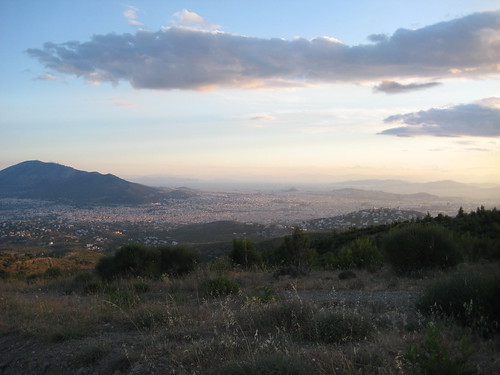
 The monastery is really lovely; I can’t say I’ve ever seen any place quite like it in the States. While we were there, Giorgos pointed out a priest and identified him as a “left-wing monk” named Fr. Timotheos, saying that he’s quite the publicity hound. He didn’t go into a lot of detail, but what I was able to dig up later suggested that he’s more of a nationalist figure than anything. Not quite certain what the deal there is.
 (Oh, and paging

 Friday morning, I attended a session of the second annual “Greece in the World” conference, with this year’s theme being Byzantine Studies. This particular session was titled “Byzantine Studies and the Orthodox Tradition”; Metropolitan John (Zizioulas) of Pergamon was the moderator, and the speakers were Dimitrios Balageorgos of the National and Kapodistrian University of Athens, who gave a talk on Byzantine music in today’s educational system, Giorgos Filias of the University of Athens, who spoke on liturgy and the Byzantine tradition, and Archimandrite Nicholas Ioannides of the University of Athens, who spoke on theology and Byzantine tradition.
 Saturday I spent some time exploring Athens and points south. I found
  I had lots of time before Vespers at St. Irene, so I took the train down to Piraeus Harbor. This is where one catches the boats to the various islands; for example, I’ll be going to

 (Did I mention there are a lot of cats and dogs in Athens? Here’s one at a table near where I was sitting at Singles.)
 Monday I was walking home through Halandri after my chant lesson, and as I passed St. George Church, I was aware of a large reception on the lawn with music, a sit-down dinner, and so on. Is this a wedding reception? I wondered. Then it occurred to me that it was a celebration of Ss. Peter and Paul (29 June), which seems to be a big deal over here. Anna told me that she didn’t know what the Apostles’ Fast was before she started going to All Saints in Bloomington, but the Greeks definitely know what 29 June is. I had seen other signs and posters elsewhere indicating festal services for Ss. Peter and Paul, as well.
 The baptism was at St. George, a small chapel in Kifisia. Frank explained that for a family that doesn’t really go to church much, it can be difficult to get one of the nicer churches for a baptism or a wedding; you have to plan about a year in advance. Thus, it seems that infants tend to get baptized at around one or two years old rather than at a few weeks or months old.
 As an event with familial significance beyond just the practice of the faith, it is a big, rowdy occurrence, with people moving around everywhere and talking and often not paying much attention to the service itself. This is not necessarily a bad thing, and need not be indicative of much more than the practice of baptism being very tightly woven into the culture. That said, clergy here seem to have less compunction here about telling the congregation that they need to be quiet when it is necessary to do so. Here, part of what contributed to the tenor of the crowd was that it was outside, and when the liturgical action moved into the chapel for First Communion, really only the parents and godparents could go in.
 There were a few liturgical differences I saw; for example, as opposed to Antiochian practice where oil is pretty much just dotted in the necessary spots, this kid was absolutely slathered everywhere, like a plucked turkey getting basted. The chrismation portion is done, but no particular emphasis is put on it; in other words, the crowd pretty much stops paying attention at that point. This helps to explain why, sometimes, when cradle Orthodox find out converts get received by chrismation in some circles, they get a quizzical look on their face and ask what that is. It goes by really fast, and can just seem like the last step of the baptism before First Communion. I’d be curious to see a baptism in a country like Lebanon to see if it’s the same way. Finally, since the baptism doesn’t occur in the context of a service, First Communion is part of the baptism. One small difference was that, instead of the hair from the tonsuring being burned, it was thrown into the baptismal font (pictured).
 Following Liturgy, Anna and I had coffee with Arvanitis at a café right behind St. Irene. I was tickled to find that the brand of coffee they were serving was “Café Barretti,” which along with the “Rihardhos Mousikos Oikos” makes Athens a city that just has my name all over it.
 My class is small; four people including myself, and then the teacher. From left to right in the picture is Alexander, who is from Switzerland, with a Greek mother and a Swiss father; Aspasia, a Texan woman with a Greek father; Anna, the teacher, who is as native Greek as the day is long; and Maro, a woman from Wisconsin who lives here now and also is of Greek heritage.
 In the early evening, Stefanos Fafulas, the other IU student who’s here on the FLAS, met me at Syntagma, and Anna also joined us. We met up with Frank Hess, Stefanos’ and my Modern Greek teacher at IU, and his wife Vasiliki, whom I had never met before. We went to a café near the Acropolis for a frappé and caught up some. It was odd seeing all these people whom I know from school suddenly in the context of the Parthenon being visible over Frank’s right shoulder, but there you go.
 Tuesday I discovered this view from the roof of the Athens Centre. That’s the Acropolis on the left. You know how in movies set in Seattle, the Space Needle is visible from every point of view in the city, even though it isn’t in real life? Well, in real life, the Acropolis is pretty much visible from any point in Athens. It’s a city that hasn’t really discovered ultra-tall skyscrapers, and while there are a number of smaller buildings that crowd together and make it difficult to see a lot of the surrounding hills, you can catch a glimpse of the former cathedral of Athens virtually everywhere you go.
 Wednesday, I went with Anna, Stefanos, and Liana to a concert at
  d she doesn’t quite yet know how to end a song all the time, but there’s a lot there to like. The only place I have found where somebody in the United States might buy her music is
  Also, Coraline (subtitled “The house in the fog” in Greek) was a lot better with Greek subtitles than Angels and Demons was. (Not, mind you, that we should be surprised by this.)


 Sutton Hoo exhibit
 Following the British Museum, we went to the Royal Academy of Arts for their Byzantium exhibit with a stop at a place called Rendezvous in Leicester Square for gelato. It was good and hit the spot, but it was definitely expensive. I’ll also point out that the sign they had posted to let people know they can’t sleep in doorways is a bit odd. It looks like the caption should be, “No sensual reclining in doorways.”
 The Byzantium exhibit is stunning; the examples of iconography are really breathtaking and leave you wanting to venerate them, even though there are ropes that quite handily keep you from doing so. There was also a 13th-century Syriac Gospel lectionary on display; that was pretty darn cool. Something that rankled a bit was the caption on the wall about church life that talked about how the iconostasis was to keep the unholy masses from even being able to see the altar and how the chanting was done by all-male voices, words that seemed specifically chosen to play up how backwards these Byzantines with their alien form of Christianity were, but I suppose the real question is, what should I have expected?
 A leisurely walk from RAA to Westminster Cathedral for Sung Mass took us through Green Park and past Buckingham Palace. We bought some tea and some other gifts from one of the many Buckingham Palace gift shops; Megan hoped to find a tea cozy, but those turned out to be as hard to find as black pudding, for some reason. Finally we had coffee at the Costa across the street from the Cathedral, and then it was time for Mass.

 We walked back to the hotel afterwards, with me pausing to be amused by a sign from the Considerate Builders Scheme, and started packing things up. We decided to go to the Sherlock Holmes Pub and Restaurant for dinner; please let me caution you against making the same mistake. It is a tourist trap with a capital T, capital TR. The food is expensive and not good enough to merit the price (although now I know what “Toad in the Hole” is, and it would be curious to try it again someplace better), and overall it is just not worth it at all.
 Back to happier things.
 This was the first time I had seen the interior of the Oxford church; while humble in a lot of respects — it is a very simple brick building — they have done a lot with what they have. Also, while somewhat smaller than All Saints, I’d say they packed in about 30-40 more people than we typically do — it was filled to the gills. On the other hand, it was 2 February on the Old Calendar (the Meeting of the Lord, or Candlemas as doubtless some of the English converts might call it), so it being a major feast might well have accounted for the attendance.
 The rest of the day was spent strolling around the town and the campus, and it was a gorgeous, if chilly, day for it. In some respects, it was good we were there on a Sunday — most places where we might have been tempted to spend lots of money were closed. That said,
  Finally, it was time to go back into the city. We got good sausage rolls from a bakery called La Croissanterie, and boarded the train.
 Yeah, Oxford is still my favorite place in the universe. What can I say?
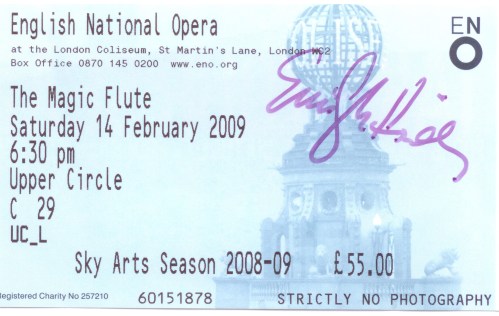 Word to the wise: programs are £4 apiece at ENO, and cash only.
 Following the show, Megan, I, Frank, Emily, and Ayla, an old schoolfriend of hers, and her boyfriend went to a bar called


 Leitourgeia kai Qurbana: Contra den Zeitgeist