A couple of months ago, I wrote about getting to see St. Nicholas Orthodox Church in Oxford and the beautiful job they did renovating an old Anglican building. I also briefly mentioned St. Raphel of Brooklyn Orthodox Church in Iowa City as an example of similar work in America.
I have a number of personal ties to the Iowa City parish; Lori Branch, one of my predecessors as All Saints’ choir director, is there, as is Matthew Arndt, an old friend of mine going back to the seventh grade, and my good friend Paul Bauer spent some time there about eight or nine years ago when they were still in a storefront. I’ve been fortunate enough to have reason to visit there three times over the last year; once just to go and see my friends, another time to participate in fundraising concert they were putting on, and then just a couple of weeks ago to do something of an extended Byzantine chant advocacy session. (I’ve also gone a different way each trip; I drove the first time, flew the second, and this last go-round I went by train. Next time I think I’ll probably ride a horse.)
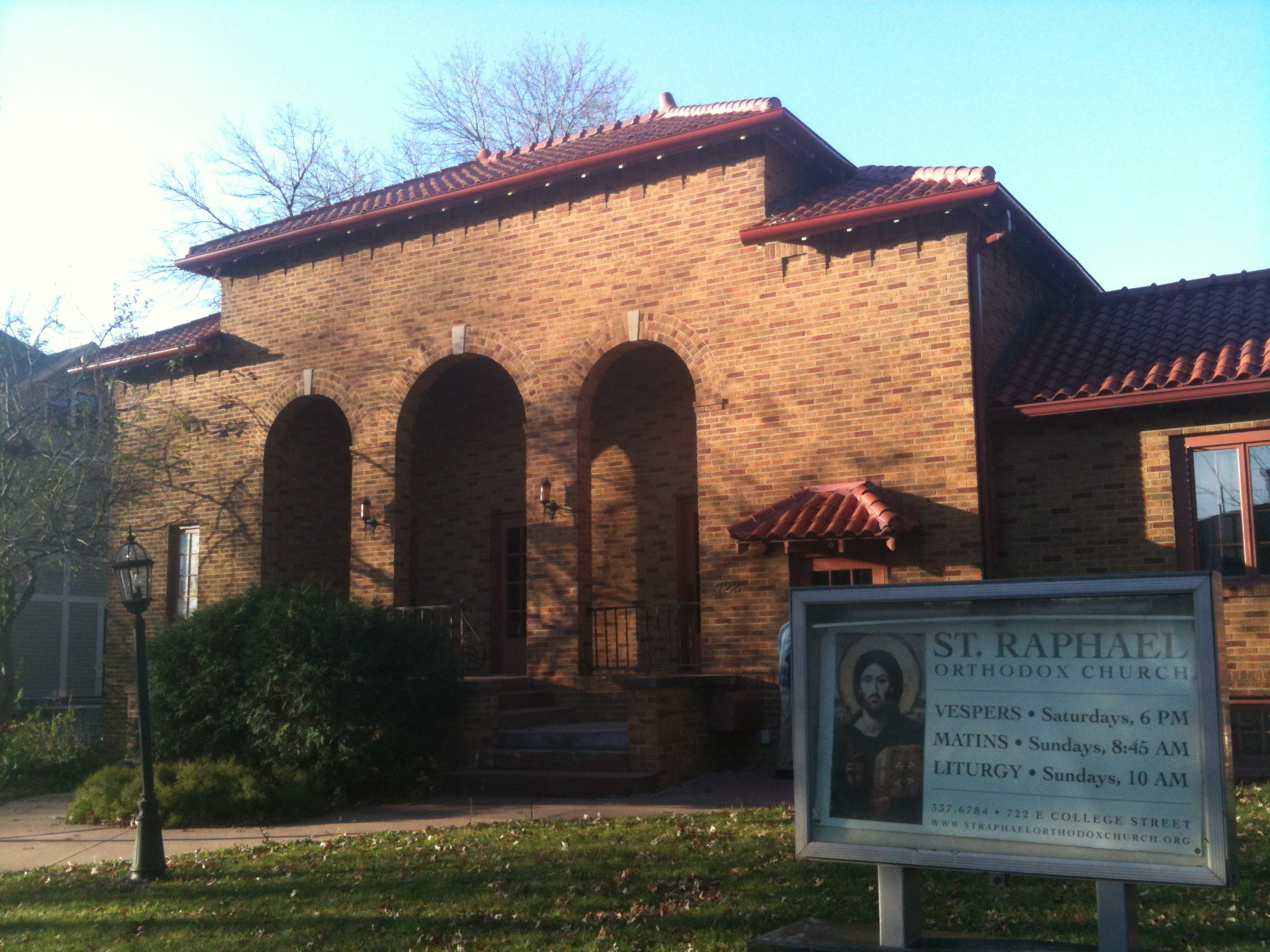 Anyway, in 2009, the parish was able to acquire a building that used to house a Christian Science congregation. It’s right in the center of downtown, maybe a five minute walk from the University of Iowa campus, so it’s very accessible to the people who actually live there. The shell of the structure on its own provides a number of great advantages; the nave is open and spacious, and the acoustics are wonderful. There’s an undercroft that’s perfect as a fellowship hall. What more or less functioned as the chancel with the original configuration has translated very nicely into the sanctuary. They’ve also done a pretty substantial remodeling of the interior, and they’ve done a number of things beautifully. The iconostasis and sanctuary are lovely, they’ve left a lot of space on the walls for frescoing when the time comes, they’ve put down hardwood with strategically located area rugs rather than covering every square inch of the floor with carpet (I mean, c’mon, who would do that anyway, right? Ahem…), and they’ve left the floor open, with benches around the perimeter and a handful of chairs. They probably won’t be able to put a dome on it in the long run, for both structural and municipal reasons, and the one thing they don’t have is a full kitchen, but they’re very well set otherwise. I have to say it was a real joy to be able to both sing and prattle on in their nave for the weekend — I was able to do something with them that I can’t do at my own parish, which was split them up into antiphonal choirs. There was more than enough room to set it up, and the acoustics are perfect for people to be able to hear each other (and themselves). (At All Saints, on the southeast side of the nave right next to the bishop’s throne, there’s a door leading out into the hallway that’s typically used as the main entrance into the church, for better or for worse. A right choir would block the door, which would tick some people off AND probably violate fire code. Hopefully we plan better for the permanent building.)
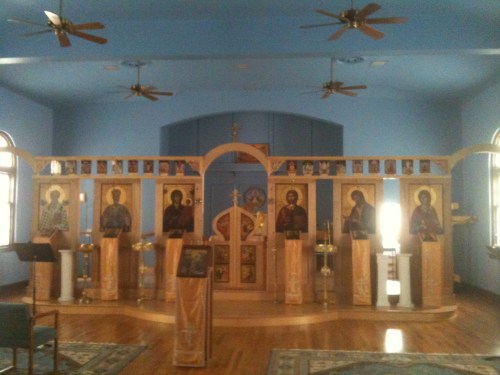
At the parish website, you can see much of the work that they had to go through to transform the building; as with the St. Nicholas situation, I think there’s a lot there to learn for parishes that wind up acquiring pre-existing structures (first off, start with something that was designed for a use not entirely dissimilar to Orthodox liturgy — i.e., not a bank if you can at all manage it). It’s not easy to do it right, but it seems to me to be very much worth doing well regardless!
Also as with the St. Nicholas situation, the parish very much had to take a leap of faith or five to take advantage of this opportunity; if you feel so inclined, I’d encourage you to make a contribution to their capital campaign as a show of support. Such things tend to come around when they go around, if you know what I mean. There doesn’t seem to be an electronic PayPal option, at least at this time, but I’m double-checking on that point.
 As I announced back in May
 I will also note that they’ve made it a point to first and foremost treat the building as a place of worship, and they have prioritized their efforts accordingly. I am familiar with phased church building projects where the approach is, “Well, people come to church for services, but they stay for everything else a church does, so best to build something that one can get by in for worship and that maximizes the ability to do all of the ancillary things. Then you’ll grow faster and can build the temple down the road.” I humbly submit that this approach doesn’t really work, at least not from what I’ve seen. The Church is first and foremost a worshipping body, not a coffee-drinking body, and when you put what is supposed to be our first priority in second place so that the men’s group has somewhere to meet, I think people sense that. Worse, from what I’ve seen, the ways you have to rethink your liturgical practice in a setting you’ve built only for the bare minimum of accommodation have a nasty tendency to become permanent. This means that if the day ever comes where you get to build the permanent temple, you’re already wondering, “Well, why do we need [X component of ecclesiastical architecture] anyway, when it adds another $250k to the price and we’ve learned how to get along just fine without it in our existing space?” By contrast, St. Nicholas has prioritized the liturgical function of the building over secondary activities, and it shows with the care they’ve put into their furnishings. They’ve clearly been able to do a lot with what resources they have, and they’ve also shown a lot of forethought in leaving the walls white so that they can be frescoed later.


 Leitourgeia kai Qurbana: Contra den Zeitgeist